The UK government proudly affirms that the country has some of the strongest equalities legislation in the world, particularly the Equality Act 2010. For it to be true, however, the government should implement the legislation in its entirety, including the socio-economic duty, proclaimed in Section 1 of the Act.
The socio-economic duty would require public authorities to actively consider how their decisions and policies of the highest strategic importance can increase or decrease inequalities of outcome. Regrettably, successive governments have failed to commence the duty, and therefore it is not technically binding on public authorities. It is encouraging that the duty was brought to life in Scotland in 2018 and the Welsh Government has announced they will follow suit in 2020.
The socio-economic duty can be a useful lever to understand and address the structural causes of material inequalities and their negative effects on human rights and well-being.
This article presents and draws conclusions from the strategic choices made by the people running a national campaign to bring the socio-economic duty to life. The article introduces four key factors that contributed to making progress between 2017 and 2019, despite the limited resources available: a) the added value of merging advocacy and epistemic communities working on equality and on human rights; b) the engagement with political actors at key stages of the process; c) the combination of ‘naming and shaming’ and best practice; and d) the celebration of smaller victories along the way.
The socio-economic duty, and this article in particular, are cited in an Amicus in front of the Supreme Court of Mexico on the State’s duty to include informal settlements in the census and other appropriate data collection. The Amicus is presented by Dr Koldo Casla and nine national and international organisations that are part of the International Network of NGOs for Economic, Social and Cultural Rights (ESCR-Net).
You can also read ‘Time to listen to people with lived experience of poverty and bring the socio-economic duty to life’, a chapter written by Koldo Casla together with colleagues from Just Fair, Joseph Rowntree Foundation, the University of York and Thrive Teesside, in UNISON’s recent publication (pp. 83-90) on the commemoration of the pledge made two decades ago to end child poverty in the UK this year. (Spoiler alert: It didn’t happen, and in fact, the country moved in the opposite direction in recent years).
The Israel Supreme Court recently cited a paper written by Haim Abraham, Lecturer in Law at the University of Essex.
The paper titled ‘Parenting, Surrogacy, and the State’ demonstrates that Israel’s legislation, and regulation of assisted reproduction treatments, systematically discriminates individuals and same-sex couples based on sexual orientation, family status, or gender.
By surveying the legislative and social developments in Israel in relation to surrogacy and the conceptualisation of the family unit, Haim shows that the right to parenthood is a fundamental negative constitutional right which extends to the use of surrogacy treatments. Furthermore, Haim establishes that the prohibition on same-sex couples and single individuals to engage in surrogacy arrangements fails to adhere to the principle of proportionality, as other less discriminatory practices are available and the harm to same-sex couples and single individuals in the current legislation outweighs its benefits.
On 27 February 2020, the Supreme Court reached the same conclusion. It held that the current Surrogacy Act of 1996 discriminates against same-sex couples and single men, and that the infringement on the rights to equality and parenthood is disproportionate.
Haim Abraham’s full paper in Hebrew is available here.
Dr Niall O’Connor, Lecturer in Law at the University of Essex, has authored an article exploring the significance, in the employment context, of freedom of contract as a fundamental right in article 16 of the EU Charter of Fundamental Rights (the Charter).
For the first half of its existence, few could have foreseen that article 16 would soon be at the centre of debates surrounding the precise place of business freedoms within EU employment law. This has changed following a number of controversial decisions in which the Court of Justice of the EU (CJEU) relied on article 16 to undermine the effectiveness of employee-protective legislation.
This article examines the nature of freedom of contract as both a fundamental right and a general principle of EU law and its effects in the employment context. Critical Legal Studies (CLS) is relied on to show that existing arguments as to the use of Article 16 as a radical tool in the employment context have been both exaggerated and underplayed.
Finally, the article explores potential counterweights to freedom of contract as a fundamental right, notably the right to work found in article 15 of the Charter.
The article was published as an Advance Article on 6 November 2019 in the Industrial Law Journal and is currently free to access here.
Dr Johanna Hoekstra, Lecturer in Law at the University of Essex, published an article with Professor Olga Martin-Ortega, Director of the Business, Human Rights and Environment Research Group at the University of Greenwich, entitled Reporting as a Means to Protect and Promote Human Rights? The EU Non- Financial Reporting Directive. The article was published in November 2019 in Vol 44 of the European Law Review.
The paper analyses the adoption and content of the EU Non-Financial Reporting Directive 2014/95 (NFR Directive) in the context of current developments to protect and respect human rights through corporate human rights due diligence and transparency legislation and considers the potential role of the reporting obligations of the Directive in the wider debate regarding human rights reporting. The analysis presented in this article makes clear that the NFR Directive is not designed to protect and promote human rights.
The NFR-Directive entered into force in 2014 and was transposed by all Member States in December 2016. Non-financial reporting builds on corporate financial reporting and requires corporations that meet certain criteria with regards to income and size to publish a statement on policies and procedures regarding environmental protection, social responsibility and employee protection, anti-corruption and bribery, diversity on boards, and human rights protection. The Directive leaves it to the company to decide on the format of the report, the extent of the information that is disclosed, and the specific issues that are included in the report. The flexible criteria on what should be reported will make it more difficult to understand the company’s impact on society in an objective manner.
The Directive includes the possibility for Member States to require integrated reporting (the financial information is published alongside non-financial information) which creates a more holistic understanding of corporate activities and for Member States to require the information in the report to be independently verified by a designed institution. Most Member States choose not to transpose this second option because of worry that the additional costs would damage the competitiveness of their companies. The NFR Directive can be placed in the developing mandatory legal framework on corporate human rights responsibilities which include reporting laws such as the UK Modern Slavery Act and human rights due diligence laws such as the French Duty of Vigilance Law.
While reporting is advocated as a measure to further corporate accountability with regards to human rights, the NFR-Directive is primarily framed as an accounting measure that is intended to stimulate economic investment through furthering transparency. The requirements in the NFR-Directive are framed in a way that they reduce the potential effectiveness of the reporting because of the flexible and general criteria and the lack of verification by an overseeing body in most Member States. This is aggravated by the divergence between the requirements of the NFR-Directive and the UN Guiding Principles of Business and Human Rights (UNGP). The 2011 UNGP are the main reference in the definition of corporate responsibilities regarding human rights and propose a three-pillar framework to address the actual and potential impact of companies on human rights: (1) the state’s duty to protect; (2) the corporate responsibility to respect; and (3) the victims’ access to remedies. As the NFR Directive was published later than the UNGP it is regrettable it did not take the reporting requirements of the UNGP as a starting point to further develop the law.
The NFR Directive differentiates between who should report and who should not report, based on the type of company and the number of employees whilst the UNGP acknowledge that all companies have a reporting obligation, although this obligation can differ depending on the sector in which the company operates. It adds that this process should draw on human rights expertise and involve meaningful consultation with stakeholders which is not part of the NFR Directive. The NFR Directive contains specific requirements as to environmental and social factors that the company should report on but uses the word “could” in relation to human rights reporting and only suggests this could include: “information on the prevention of human rights abuses.” The limited requirements mean that it is up to the company to decide on how they approach the issue. There is therefore a risk that reporting will be a mere box ticking exercise that does not involve any meaningful reporting, which to have a significant effect needs to be closely linked to due diligence.
Reporting cannot be equated with a meaningful due diligence process that identifies, prevents, mitigates and accounts for corporate impact on human rights. Reporting as the main legislative tool leaves in the hands of civil society organisations, shareholders, and consumers the task of monitoring the veracity of the information. This does not sit well with the substantive, far reaching and right holder centred concept of due diligence proposed in the UNGPs. The Directive does not recognise the consolidated approach to human rights responsibilities of businesses and there is a concern that it may limit existing social expectations expressed in soft law, including the UNGPs. This has led to a call for European legislation on corporate human rights due diligence.
Dr. Tara Van Ho, Lecturer in Law at the University of Essex, spoke on the responsibility of corporations under international law at the 40th anniversary celebrations of the Urban Morgan Institute for Human Rights at the University of Cincinnati School of Law in the US.
Dr. Van Ho, a co-President of the Global Business and Human Rights Scholars Association, was asked to discuss the international legal standards relevant to addressing business impacts on human rights.
After outlining the expectations in the UN Guiding Principles on Business and Human Rights, currently the most authoritative statement on the issue, Dr. Van Ho focused on the difficulty victims face in securing remedies. These include, but are not exclusive to, states that are unwilling and unable to ensure victims can hold corporations accountable and complex corporate structures that limit the ability of victims to pursue people abroad.
When states like the US take administrative action to sanction businesses, the fines paid rarely go to support the victims but instead benefit the treasury of the enforcing state. There is room for hope, however. As Dr. Van Ho explained, businesses can embed respect by human rights by ensuring they speak about human rights responsibilities, empower employees and others to raise concerns through independent grievance and complaint mechanisms, and ensuring their incentive structures encourage managers and employees to take human rights seriously. This has been done successfully by some businesses.
The Urban Morgan Institute is the oldest endowed human rights centre at a law school in the world. There is a rich history of collaboration between Essex and Cincinnati.
The Urban Morgan Institute houses the Human Rights Quarterly, the world’s leading interdisciplinary journal on human rights, which has provided a venue for research works from several Essex faculty members.
The Essex Human Rights Centre‘s first director, Kevin Boyle, and the Urban Morgan Institute’s Director for its full 40-year history, Bert Lockwood, were long-term friends and colleagues. Professor Lockwood served as a visiting lecturer at Essex for a year when Professor Boyle was asked to serve at the UN.
A few years later, the late Sir Nigel Rodley, the long-term Chair of the Essex Centre, visiting Cincinnati to receive the Butler prize for his work on human rights and to deliver a speech on the prohibition of torture.
Dr. Van Ho is a graduate of the educational programmes at both centres.
Dr Onyeka Osuji, Reader in Law at the University of Essex, recently presented his research on mandatory modern slavery disclosure at two international conferences.
Disclosure
is an emergent regulatory strategy for corporate social responsibility (CSR) in
certain jurisdictions despite its original conception as a voluntary management
tool. As exemplified by recent anti-modern slavery legislations in some
jurisdiction, disclosure is growing in significance and reach. In extending
social responsibility to global supply chains, disclosure regulation implicitly
references ideas of gatekeeper responsibility and glocalisation and overcomes
the extraterritorial limitations of substantive regulation.
Anti-modern slavery legislations by California in 2010, the UK in 2015 and Australia in 2018 reflect the regulation by information approach based on a universal revenue threshold. The goal of the regulatory strategy appears to be two-fold. On the one hand, disclosure requirements may promote the awareness of modern slavery and encourage businesses to eliminate or reduce its existence in their operations, supply and purchasing chains. On the other hand, information generated through reporting requirements will be used by stakeholders like consumers and investors factor in purchasing and investment decisions. This market-based approach indirectly relies on stakeholder pressure to compel businesses to address modern slavery.
This research examines the underlying assumptions for disclosure-oriented modern slavery legislations. These assumptions include leverage and political CSR, adequacy of a revenue threshold test for the capacity to confront modern slavery in operations, supply and purchasing chains, business case justifications for CSR, and an activist and vibrant stakeholder group of investors, consumers and civil society.
The paper demonstrates the various limitations of the disclosure regulatory strategy of the modern slavery legislations and argues that it is at the lowest end of a hierarchy of effective legislated CSR. Alternative thresholds, including sector-based and regional approaches, may reflect the degree of risk and need for awareness and therefore approximate to the contextual understanding of CSR and its priorities. The reliance on the market-based reputation and stakeholder information regulation excludes direct positive and negative incentives for compliance. It may encourage symbolic statements of corporate policies and processes rather than substantive compliance and quality reporting of steps undertaken to reduce risks. The lack of provisions for monitoring, verification and enforcement and for responsibility, liability and accountability creates the potential for a “promise-performance gap” exemplified by deceptive and misleading statements.
This research was presented at the 18th International Conference on Corporate Social Responsibility (CSR) and 9th Organisational Governance Conference ‘CSR: Public and Private Perspectives’, Barcelos, Portugal (10-13 September 2019) and at the one-day conference ‘Critical Perspectives on “Modern Slavery”: Law, Policy and Society’, organised by the Wilberforce Institute for the Study of Slavery and Emancipation, University of Hull (30 October 2019).
Where do individuals who suffer harm as a result of the negligence or malfeasance of the UN go to seek redress? Sadly, there is nowhere for them to go. Maybe I shock easily, or maybe I hold the UN up on a pedestal and expect it to react in a way in which it is clearly not capable of reacting. Regardless, the UN’s handling of mass torts claims, arising largely in the context of peacekeeping, is shocking.
The victims can’t go to a domestic court where they live or work, or where the harm happened, because the UN is largely immune. They can’t go to a regional or international Court because the UN will also be immune from such proceedings. The UN’s internal complaints processes are not independent, equipped or given jurisdiction to handle mass claims. At the same time, victims have not usually been able to rely on their own countries to pursue claims on their behalf. These are countries emerging from conflict, with weak legal systems and infrastructure. The last thing on their minds or within their capacity is to bring an international dispute against a country or organization that has come to help them keep the peace.
The UN has sometimes seen fit to set up trust funds or similar frameworks to rehabilitate victims, but this approach has only been taken after widescale media attention, and then, purely on a humanitarian basis – so without accepting any liability. This is simply about charity. So, victims have no ability to demand restitution or compensation that corresponds to the harms they suffered – they just have to wait and see what’s on offer and be thankful for what they’re given.
This is what happened with cholera victims in Haiti. In 2016 the UN issued a qualified apology and outlined a two-track strategy: Track 1 focuses on intensified efforts to treat, control and eradicate cholera, and Track 2 promises to deliver “a package of material assistance and support to those Haitians most directly affected by cholera” to be developed in a victim-centered manner, including through consultations with victims. A Trust Fund was established to generate and manage its resources. As of July 2019, it was reported that only 4% of the funding target had been met.
It is also what happened to Roma, Ashkali and Egyptian displaced persons in Kosovo who were forced to live in camps where they were subjected to lead poisoning resulting in serious illnesses and deaths. A UN Human Rights Advisory Panel determined that the UN was responsible for an array of violations and recommended reparations including public acknowledgment, payment of adequate compensation to the victims for material and moral damages suffered, reimbursement of fees and expenses and a series of measures to guarantee non-repetition. However, in May 2017 it was announced that the UN would establish (only) a trust fund for projects to help the affected communities. In February 2019, it was reported that the trust fund had received no contributions.
This bit of charity has become like a business expense, without any real sense of accountability or recognition of victim’s rights. This is shocking for an institution that has been a key promoter of standards on victims’ rights. And, because there is no one to hold the institution to account (because victims have no access to an independent court to adjudicate the claims), there is no incentive to strengthen the system to avoid recurrence – there is no learning from mistakes despite all the lip-service about victim-centred processes.
This use of the lex specialis principle is misguided for three reasons.
First, the principle is only capable of displacing general law when there are more precise or ‘special’ rules that apply in a given situation. The UN hasn’t put in place special rules; it has simply exempted itself from dealing with parts of the situation – which is not the same thing.
Mass claims are often resolved in expedited or abridged fashions. But when this happens there is usually some independent adjudicative body which is capable of addressing the claims which fall outside the mold or where the claimants prefer or the circumstances require a more judicial process because of the particularity of the claim. Victims should have the possibility to opt out of a limited administrative process that does not take into account the full spectrum of their needs or rights. Some transitional justice or administrative claims commissions as well as mass claim settlement procedures afford this two-tiered possibility. The General Assembly resolution on third-party claims provides no scope for a more individualized and independent adjudication process, even if it were to allow for a wider understanding of ‘private’ claims.
The cynics among the readers will be wondering why I am shocked; why I expect more from this global multilateral institution in an era when multilateral approaches have fallen out of favour with the most powerful states. But some things are just worth fighting for.
This piece originally appeared on Opinio Juris as a part of the recent symposium on International Organizations Accountability and is reproduced here with permission and thanks. Read the original piece here.
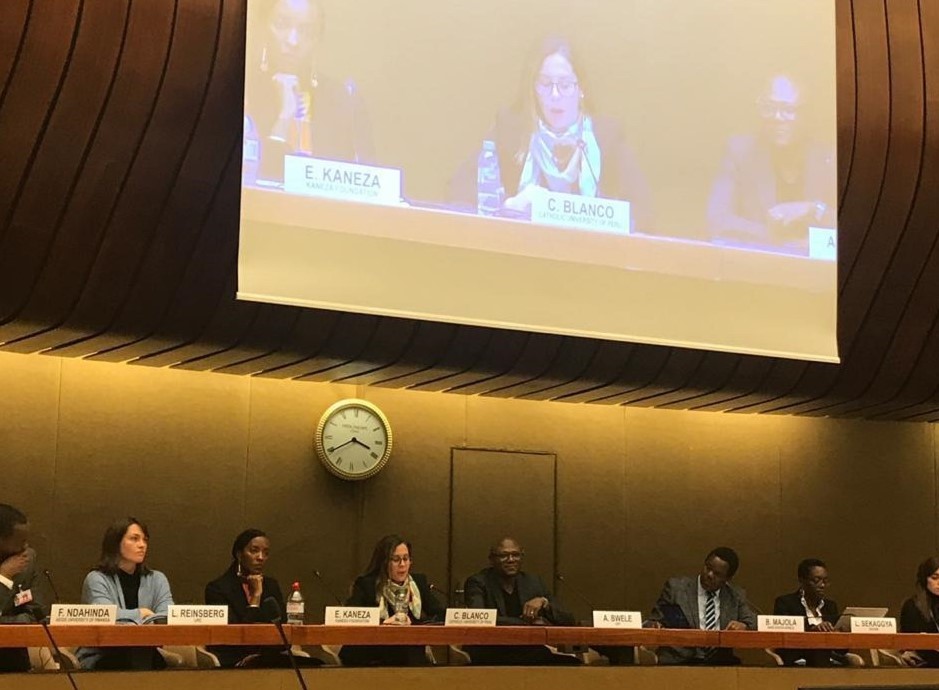
Cristina Blanco, PhD researcher in international human rights law, presented at a workshop organised by the Office of the High Commissioner for Human Rights.
The workshop aimed to develop proposals for enhancing cooperation between international and regional human rights mechanisms in combating racism, racial discrimination, xenophobia and related intolerance.
Cristina’s presentation focused on the relationship between the Inter-American Human Rights System and other international human rights systems, in regards to discrimination against indigenous peoples in the American region, with a particular emphasis on their economic and social rights.
Christina Blanco presenting at the international workshop on enhancing cooperation between United Nations and regional human rights mechanisms (Geneva, Palais des Nations)
Although human rights systems have made valuable contributions to this regard, there are also some areas that can be strengthened. This includes the greater reference and cross-fertilisation among systems, especially in matters of collective property; more standards and recommendations – both in numbers and specificity – on discrimination against indigenous peoples in the economic and social spheres; greater harmonisation in key standards such as the right to prior consultation and consent in contexts of extractive activities; and a broad look at the different forms of racism including a preventive approach to institutional discrimination based on an intercultural approach and attention to discrimination in interpersonal relationships.
Noam Lubell, Professor of International Law at the University of Essex and Swiss Chair of International Humanitarian Law (IHL) at the Geneva Academy, has co-authored new Guidelines for States on how to investigate allegations in armed conflict.
The new Guidelines are set to become the international benchmark for effective investigations into violations of international humanitarian law in all conflicts around the world. Being sensitive to the differences that characterise domestic legal and investigative systems, they identify several practical and legal issues that may arise in such investigations or should be considered beforehand. Their overarching aim is “to provide practical assistance by setting out a general framework for investigations in armed conflict and, where relevant, the corresponding international principles and standards”.
Professor Lubell addressing the New York Diplomatic Community. Image: Geneva Academy
Professor Lubell’s co-authors were Jelena Pejic, Senior Legal Adviser at the ICRC, and Claire Simmons, a Researcher at Essex Human Rights Centre and PhD candidate in the School of Law. Their findings were presented in October 2019 in New York before delegates from the UN General Assembly First and Sixth Commissions, UN agencies and other experts in an event co-organized with the Permanent Mission of Switzerland to the UN.
On 29-30 July 2019, the authors organised an expert workshop at the School of Law, in association with the Essex Armed Conflict and Crisis Hub. The meeting brought together academics (working on international law, feminist legal theory, international relations, terrorism and security studies) and practitioners (working on gender, peace and security in the countries and regions of focus).
The meeting provided an opportunity to discuss the challenges associated with the women, peace and security and counter-terrorism frameworks, from a feminist perspective. It also provided an opportunity to consider the ways in which the international and regional frameworks represent diverse perspectives and views and how they can better do so. The meeting provided an opportunity to share experiences and practices, to develop common understandings and to map out how global feminist scholarly and activist communities can helpfully engage with these debates.
We were delighted to host such a dynamic group of experts for two days of what proved to be powerful, intensive and important discussions. We are excited about the prospects for building the next phases of the work, and the possibilities this will have for research collaborations and related policy work. These issues are multi-disciplinary and complex and it is so important to work collaboratively. We are hopeful that the next phases of our work will extend and deepen these collaborations.
From left to right: Josephine Roele, Gender Action for Peace and Security network (GAPS) and Dr. Emily Jones, School of Law and Human Rights Centre, University of Essex
The Global Context
In 2015, United Nations Security Council Resolution 2242 was adopted as
part of the wider Women, Peace and Security (WPS) agenda. This resolution
brought together the WPS agenda and counter-terrorism for the first time, and
urged States
and the United Nations to ensure the participation and leadership of women’s
organizations in devising strategies to counter terrorism and violent
extremism. It also encouraged the Plan of Action to Prevent Violent
Extremism to integrate women’s participation, leadership and empowerment as
core to United Nations strategy and responses and requested the
Counter-Terrorism Committee and its Executive Directorate to integrate gender
as a cross-cutting issue within their respective mandates.
Resolution 2242 is key in noting the need to situate women’s voices at the centre of the counter-terrorism agenda. The resolution has helped foster debates between the UN Counter-Terrorism Committee, UN Women and WPS. However, there has been debate amongst scholars and practitioners about bringing the feminist project together with the by now well-established post 9/11 international security regimes. Furthermore, references to women in the Resolution are arguably too superficial to engender a meaningful intersection between these very different agendas. Some of these concerns were highlighted by the UN Special Rapporteur on the promotion and protection of human rights and fundamental freedoms while countering terrorism. In her February 2018 report on counter terrorism and emergency legal responses, she highlighted the harmful impacts of gender-blind counterterrorism regulations. Also, there is clearly a great need to better include activist and practitioner voices.
From left to right: Jeannine Ella A. Abatan, Institute for Security Studies (ISS) Regional office for West Africa, the Sahel and the Lake Chad Basin; Dr Sara M.T. Polo, Department of Government, University of Essex; Valentine Hambyem, School of Law, University of Essex
The Regional Context
Multiple terrorist groups operate
within the Sahel region and North Africa, including Boko Haram, Al-Shabaab,
AQIM and other Al Qaeda affiliates. Such terrorist threats pose a great threat
the security of states and the human security for those who live there, impacting
on human development, good governance and rule of law. Killings by terror
groups have led to mass displacement and encampment where malnutrition, disease
and gender-based violence are prevalent. The increased use of sexual violence and abduction
from schools as tactics of systematic terror is a demonstration that terrorism
and extremism target and affect women, men, girls and boys in different ways. Disappearances
of male detainees impact female family members, who bear the burden of anxiety,
harassment, social exclusion and economic hardship. Similar effects ensue from
the prolonged detention without trial of male family members, extraordinary
rendition and forced deportations. However, while women are victims of
terrorism and counter-terrorism measures, they can also be volitional actors in
both terrorist entities and counter-terrorism measures. Terrorism has also ravaged
state infrastructure and undermined economic growth, fuelled by diminished
investor confidence and struggling tourist sectors.
The fight against terrorism has increased security spending, which has diverted resources from development initiatives. Also, some governments have used anti-terrorism policies to prey on minority, marginalised, religious or ethnic groups. In addition, some governments use vague terrorism definitions to punish people, particularly political dissenters, and to suppress social movements, including those that seek gender equality.
The particular security challenges in the Sahel region and North Africa have led to strategic partnerships between the UN and the African Union such as the United Nations-African Union Joint Task Force on Peace and Security. Similarly, the “G5 Sahel” – an institutional framework for coordination and monitoring of cooperation on security and development policies between Burkina Faso, the Republic of Mali, the Republic of Mauritania, the Republic of Niger and the Republic of Chad, launched a new Women’s Platform in Niger in October 2018. The goal of the platform is to increase women’s involvement in areas of peace, justice and security in the region by bringing together country leaders and civil society organizations. Additionally, there has been increased attention to such challenges within the AU, such as by the AU Office of the Special Envoy on Women, Peace and Security.
Our Next Steps
We will be releasing a report of the workshop which will summarise the main issues that arose and provide some analysis of next steps.
Workshop participants in our Human Rights Seminar Room












 Essex Law Research Blog