The time has come for the Essex Law Research editorial team to swap our legal tomes for some sun hats and lemonade! We’re taking a summer break to recharge our intellectual batteries and embrace the season of relaxation.
Fear not, for our commitment to delivering insightful legal scholarship remains steadfast, so the ELR blog will transition to an intermittent posting schedule.
We will return to our regular scheduling with the next academic year, refreshed and with thought-provoking content. Until then, enjoy the summer, stay curious, and keep an eye out for our sporadic updates!
On 22 May 2024, the University of Essex showcased its top-tier research achievements at the Celebrating Excellence in Research and Impact Awards ceremony on our Colchester campus. The event honoured individuals and projects that have significantly enhanced lives worldwide through Essex’s ground-breaking work.
In a spectacular ceremony, several prestigious awards were bestowed upon research pioneers, transformative projects, and innovative technical teams. Notably, the Essex Law School secured an impressive four awards across distinct categories, underscoring our commitment to excellence in diverse fields:
Professor Lorna Woods won the award for Best Research Impact in the Faculty of Arts and Humanities for her work on online safety.
The award for Outstanding Mid-Career Researcher went to Dr Matthew Gillett for his research on the use of international criminal law to protect vulnerable groups as well as the environment from grave harms.
Dr Nikhil Gokani, who influenced the approach WHO and civil society have taken on effective laws for food and alcohol labelling, won the award for Best Research Impact by an Early Career Researcher.
Professor Yseult Marique won an award for her piece in The Conversation titled: One in five councils at risk of ‘bankruptcy’ – what happens after local authorities run out of money.
The Essex Law School has previously scooped The Conversation award thrice, in 2020, 2021 and 2023!
Essex Law School colleagues celebrating excellence at the 2024 Research & Impact Awards Ceremony
While not all of our colleagues secured awards, their brilliance shone through nominations in key categories.
Dr Nikos Vogiatzis was nominated in the Outstanding Mid-Career Researcher category (Faculty of Arts and Humanities) for his exceptional work on European law and the award of a Senior Humboldt Fellowship at the University of Cologne.
Dr Elena Sherstoboeva was also a runner-up for the Research Visibility Champion award for her diligence in running research visibility training for our School.
And, last but not least, Melissa King, from our professional services team, was nominated for the Outstanding Research Support award.
Professor Stavroula Karapapa, Faculty Dean Research (Arts & Humanities), at the 2024 Awards Ceremony
“There is so much dynamism and creativity coming from our research community at ELS who are pursuing impactful research that is making a real difference in the world. Congratulations to Lorna Woods and Nikhil Gokani on this important recognition of their work and to our fabulous runners-up: Koldo, Erin, Matthew and Sabina – for highlighting the incredibly impactful work of the Human Rights Clinic.”
Snapping success at the 2024 Excellence in Research and Impact Awards
A full list of this year’s winners will be available here.
The awards are open to all academics, researchers, and doctoral students each year and signal the University’s commitment to world-class research that makes a difference.
If you are an aspiring legal scholar seeking advanced training in law within a dynamic research environment that encourages innovation and interdisciplinary exploration, the SENSS Doctoral Training Partnership at Essex Law School could be your gateway to an exciting academic journey.
What is SENSS?
The South and East Network for Social Sciences (SENSS), an ESRC-funded Doctoral Training Partnership (DTP), is dedicated to fostering innovative and inclusive social science research training and collaboration. Among the eight distinguished institutions comprising SENSS, the University of Essex plays a pivotal role as the coordinating institution.
SENSS provides fully-funded doctoral studentships, mentorship from global experts, personalised research methods training, and diverse placements as part of its Doctoral Training Partnership. These opportunities empower researchers to extend their social scientific skills beyond academia.
Here at the Essex Law School and Human Rights Centre, aspiring PhD students can apply for SENSS studentships, unlocking comprehensive support and collaborative excellence in their academic journey.
Why choose the Essex Law School?
Choosing where to pursue your doctoral training is a significant decision. At the Essex Law School, we have meticulously crafted an environment that champions excellence and fuels innovation. Here is why you should join us:
We are a research powerhouse. Our Law School has been ranked 3rd in the UK for research power in law according to the Times Higher Education research power measure (REF2021). Law at Essex is also ranked 47th in the THE World University Rankings, which show the strongest universities across the globe for key subjects (and 9th for UK Universities). This speaks volumes about the calibre of research conducted within our School. Our academic staff collaborates globally, working with the United Nations, the European Union, governments, and non-governmental organisations.
We believe in the power of interdisciplinary research. Our dynamic research clusters foster collaboration across diverse backgrounds, creating a vibrant intellectual space for innovative and stimulating legal exploration.
With expertise spanning diverse legal disciplines, our academics are the driving force behind the Law School’s excellence. Our faculty boasts exceptional scholars, providing intellectual leadership in key areas, including Human Rights Law, led by Dr. Andrew Fagan who is Director of the Human Rights Centre; International & Comparative Law led by Professor Yseult Marique, an associate member of the International Academy of Comparative Law; Private and Business Law, led by Professor Christopher Willett who also spearheads the Law, Business and Technology Interdisciplinary Hub; as well as Public Law & Sociolegal Studies, led by Professor Theodore Konstadinides, who is also a founder member of the Constitutional and Administrative Justice Initiative (CAJI).
Our academic leads are ready to guide you and link you with the ideal academic mentors.
Our research student community is central to our success. These talented individuals explore a broad range of exciting topics under expert supervision, forming a vibrant tapestry of ideas.
Image via Shutterstock
Our Essex Law Research Blog features Vanessa Topp, a SENSS-funded doctoral candidate at the Essex Law School & Human Rights Centre, who offers below her insights into the application process and provides valuable advice for prospective candidates.
Can you share your experience with the application process for the SENSS Doctoral Training Partnership and highlight how the partnership’s collaborative approach influenced your decision to apply?
“I applied for the student-led studentship with SENSS, and throughout the application process, I received invaluable support from my supervisors and my department which allowed me to refine and greatly improve my proposal.”
“While the multiple rounds of review and steps involved in the application process initially felt somewhat intimidating and fast-paced, the ability to receive and implement feedback from several different perspectives was ultimately crucial to building a successful application.”
“There are several reasons why I was particularly drawn to SENSS. I am particularly excited to be a part of the SENSS network because it allows me to collaborate with academics from other institutions that are part of the DTP working on research relevant to my own and I look forward to participating in cross-institutional knowledge sharing.”
“I also appreciate the opportunities provided through SENSS to conduct fieldwork in collaboration with external partner organisations or to potentially participate in an overseas institutional visit at another university which I feel will lead to more meaningful and impactful research.”
Reflecting on your successful application, what tips or insights would you offer to prospective candidates aiming to secure SENSS funding and maximise the opportunities offered by this collaborative platform of universities?
“Start the process as early as possible so you can revise your application several times and be open to taking on board feedback, while also remembering that ultimately it is your project, and you have to be happy with the proposal you design.”
“The SENSS application contains a lot of different elements – not just the proposal – so make sure to take your time with these as well. The space to write your proposal in the application form is quite compact, so these other parts of the application form can provide an important opportunity to provide more information that you could not include in the proposal for space limitations; about your project, who you are as a candidate, and how you are the best fit to your project.”
“SENSS is a collaborative network, so it is also important to look into what this means and to highlight what aspects you would like to participate in and what your contributions will be.”
Where can you find out more?
Explore the opportunities offered by the SENSS scholarships at the Essex Law School on our informative webpages. Discover eligibility criteria, application processes, and the outstanding benefits that await you by accessing the downloadable documents provided below.
For inquiries about legal research and the SENSS scheme, please contact Dr. Anil Yilmaz Vastardis, our Postgraduate Research Director.
Specific questions about academic disciplines? Reach out directly to our dedicated Academic Leads (mentioned above) who can put you in touch with suitable supervisors.
Embark on your journey to become a world-leading scholar in law. Do not miss the chance to join SENSS at the Essex Law School, where innovation, excellence, and transformation define the doctoral experience.
On 27-28 March 2023, we organized a “Dragon’s Den” themed event to highlight the incredibly impactful work being done at Essex Law School and to solicit feedback, encouragement, and ideas about how to take colleagues’ work to the next level.
Our “Dragons” included leading external experts from different policy domains relevant to colleagues’ research, including David Ciliberti (EU Commission, DG Just – Consumer Policy), Ben Hayes (AWO agency), Fiona Rutherford (JUSTICE), Nick Wortley (Competition and Markets Authority); and Steven Malby (Foreign, Commonwealth and Development Office) and Mark Fuller (Showrunner Comms).
They, as well as members of Essex’s Research Impact team, were tasked with reviewing colleagues’ impact pitches and providing strategic, constructive advice about new angles, synergies, and other tactics to enhance ongoing impact and the potential for future impact.
Our “Dragons” included leading external experts from different policy domains.
The “Dragon’s Den” event coincides with the growing recognition of the importance of impactful research outside of academia, which is now fully incorporated into the Research Excellence Framework. The Research Excellence Framework (REF) has defined impact as ‘an effect on, change or benefit to the economy, society, culture, public policy or services, health, the environment or quality of life, beyond academia’. The Essex Law School had a very strong result on impact at the last REF assessment exercise in 2021, with 71.4% of its impact case studies achieving a 4* (top) ranking. We are looking forward to an even stronger result for 2028.
A snapshot of the brilliant minds that converged at Essex Law School’s “Dragon’s Den” event: impactful research, insightful advice, and future collaborations in one frame.
Twenty-seven colleagues with research already generating impact, or with strong impact plans, presenting their work to the “Dragons” and fellow colleagues during the two-day event. These colleagues, some with many decades’ experience and others much mewer in their research careers, “pitched” research in a vast array of subject areas including, food and alcohol labeling, legal aid cuts, business and human rights, consumer law, corporate social responsibility, migration, refugees and trafficking in persons, environmental law, the law of armed conflict, anti-racist approaches to end-of-life, cyber law and cybersecurity, transitional justice, detention and hostage-taking, abortion rights, adoption and family law, social rights and more.
The “Dragons” selected two case studies, one from each day, as showing the most promise: Dr Francis Rees’ work on Exploitative Practices of Child Digital Labour on Social Media Platforms and Professor Noam Lubell’s work on Cumulative Civilian Harm in War. Well done to both!
Connections were forged, knowledge was shared, and ideas ignited during our “Dragon’s Den” event. Together, we shape the future of impactful research.
We are excited to see how all colleagues take their work forward and continue to innovate both in the United Kingdom, regionally, and globally. Watch this space!
Are you an aspiring legal scholar with a hunger for advanced training in law and a thirst for a vibrant research environment that fosters innovation and interdisciplinary exploration?
If the answer is a resounding ‘yes,’ then the CHASE Doctoral Training Partnership at Essex Law School could be your ticket to an exciting and transformative journey in the world of academia.
What is CHASE?
The Consortium for Humanities and the Arts South-East England (CHASE) is not just any doctoral training partnership; it is an AHRC-funded initiative that is carving out a path for the next generation of world-leading arts and humanities scholars.
Comprising nine prestigious institutions engaged in collaborative research activities, including an AHRC doctoral training partnership, CHASE is a gateway to an intellectually stimulating and supportive academic community. And we are proud to announce that the University of Essex is one of the esteemed members of this exceptional consortium.
Here at the Essex Law School and Human Rights Centre, our students and applicants to our PhD programme are eligible to apply for CHASE studentships and take advantage of the unparalleled training opportunities offered by this partnership.
CHASE is dedicated to supporting discipline-based projects, but what sets it apart is its specialisation in interdisciplinary research and emerging fields of study and creative practice. If you are looking to pioneer new methodologies, CHASE provides a great platform for your academic aspirations.
Moreover, CHASE does not just stop at academic prowess; it extends its reach to powerful partnerships with leading organizations in the creative and public sectors. This collaboration is a goldmine of opportunities for future CHASE scholars, providing a network of connections that few other programmes can match.
Why choose the Essex Law School?
The choice of where to embark on your doctoral training is not one to be taken lightly. At the Essex Law School, we have worked hard to create an environment that nurtures excellence, fosters innovation, and empowers our students to become leaders in their chosen fields.
Here is why you should consider joining us:
We are a research powerhouse. Our Law School has been ranked 3rd in the UK for research power in law according to the Times Higher Education research power measure (REF2021). This speaks volumes about the calibre of research conducted within our institution. Our academic staff collaborates with the United Nations, governments, human rights organizations, and corporations worldwide.
We believe that the best research happens at the intersection of various disciplines. This is why we encourage innovative and interdisciplinary approaches to legal research. Our research clusters bring together colleagues from different backgrounds to work on collaborative projects, creating a stimulating and diverse intellectual environment.
Our academics are the heart and soul of the Essex Law School. They bring a wealth of expertise across a wide range of legal disciplines. We are proud to have some remarkable scholars in the field, with particular strengths in areas of intellectual leadership, including Human Rights Law, led by Dr. Andrew Fagan who is Director of the Human Rights Centre; International & Comparative Law led by Professor Yseult Marique, an associate member of the International Academy of Comparative Law; Private and Business Law, led by Professor Christopher Willett who also spearheads the Law, Business and Technology Interdisciplinary Hub; as well as Public Law & Sociolegal Studies, led by Professor Theodore Konstadinides, who is also a founder member of the Constitutional and Administrative Justice Initiative (CAJI).
Our academic leads are more than willing to provide guidance and connect you with the right members of our academic staff.
Our thriving community of research students is at the heart of our success. These talented individuals investigate a broad range of exciting topics under the supervision of our academics, creating a rich tapestry of ideas and insights.
Image via Shutterstock
Where can you find out more?
Are you intrigued to explore what the CHASE Doctoral Training Partnership at the Essex Law School can offer you? Join us for an information session on the CHASE student-led studentship scheme on 18 October 2023, from 12:30-1:30 pm (UK Time), via Zoom. This is the perfect opportunity to learn more about eligibility, application processes, and the incredible benefits that await you.
For further details, eligibility criteria, and application procedures, please visit our web pages here. For questions relating to legal research and the CHASE scheme, please contact our Postgraduate Research Director, Dr. Anil Yilmaz Vastardis. If you have other specific questions about academic disciplines, do not hesitate to reach out to our academic leads (mentioned above) who are here to guide and inspire you on your academic journey.
Your journey to becoming a world-leading scholar in the field of law begins here. Do not miss this chance to be part of the CHASE Doctoral Training Partnership at Essex Law School, where innovation, excellence, and transformation are the name of the game. Your future awaits – seize it with both hands!
Get ready to embark on an exciting journey with the Essex Law School, as we proudly introduce the new Business Law Clinic (BLC) that opened its doors in the 2023-24 academic year.
The BLC provides an opportunity for our undergraduate and postgraduate students to gain new knowledge in various specialised areas of Business Law that are not covered in the standard teaching curriculum and/or are observed from a new angle in a practical setting.
It also creates new opportunities to enhance the practice-readiness and employability of our Business Law-oriented students by providing them with transferrable skills such as teamwork, business communication, empathy, and many more highly sought-after skills by employers.
The BLC proudly stands as a vital cornerstone for both the local and University communities, dedicated to offering expert guidance, enriching education, and cutting-edge research across different areas of Business Law.
Our unwavering commitment echoes the esteemed tradition of social justice upheld by the Essex Law School and the Essex Law Clinic, as we passionately champion social justice through the lens of Business Law.
Social justice is understood as equality, and activities aim to alleviate inequality in various settings by:
(a) providing access to justice to those individuals who are disadvantaged in society, e.g., because they cannot afford legal advice and/or do not know how to access it themselves;
(b) enabling those groups of individuals without strong social networks to gain essential skills, including money management, and provide the knowledge and expertise needed to boost their employability for a brighter future;
(c) supporting organisations that serve the public good, such as local authorities, not-for-profit organisations serving the community, or for-profit organisations that are either means-tested or pledge to fund the work of the BLC.
Supervised research-based projects
In 2023-24, the BLC starts with supervised research-based work in four projects:
Tackling Corporate Plastics Waste (offered to UG students only): this project covers corporate and environmental law aiming to find ways to encourage businesses to reduce their use of single-use plastic in Colchester and beyond and thus benefit the local community.
Tax Project (offered to UG students only): this provides a unique opportunity for students to engage with tax law and create the first edition of the BLC’s Student Tax Guide.
LawTech Journal Lab (offered to UG students only): this focuses on how technology enhances legal services and the administration of justice and aims to benefit the Essex Law School’s student community via newsletters on recent developments in this area.
Trade Marks and Branding (offered to PGT students only): this project is designed to immerse students in the realm of trade mark protection, instilling them with the strategic acumen essential for sculpting the brand identities of fledgling startups and thriving enterprises. Their mission: to disseminate this newfound expertise far and wide, empowering the public with the keys to branding success.
The BLC now accepts applications.
If you would like to become part of the BLC family, apply now by completing the form via this link.
Applications close on 23 October 2023 at 9am.
If you require more information, please get in touch with the BLC Director, Dr. Andrea Fejős at this email address: afejos@essex.ac.uk.
Image via Shutterstock: The entrance to The Supreme Court, Parliament Square, London
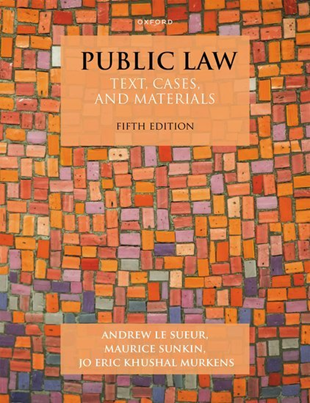
Public Law: Text, Cases, and Materials, the definitive guide to understanding the practical workings of UK Public Law, has just released its eagerly awaited 5th edition. Authored by renowned legal scholars Prof. Andrew Le Sueur, Prof. Maurice Sunkin KC (Hon), and Prof. Jo Eric Khushal Murkens, this latest edition brings to life the key institutions, legal principles, and conventions that underpin Public Law in the UK.
Recognising the need for an accessible and comprehensive resource, the authors have meticulously curated extracts from key sources, providing clear explanations and insightful critiques to facilitate a deeper understanding of this legal field. By examining case law and its political context, this book encourages students to explore the core issues in public law with a critical mindset.
The 5th edition of Public Law: Text, Cases and Materials is now available by OUP
One of the standout features of Public Law: Text, Cases, and Materials is the inclusion of clear commentary and analysis, expertly complemented by a diverse range of extracts from various sources. By incorporating academic writing, reports from parliamentary committees, and key judicial decisions, students are provided with an enriching array of information. This enables them to develop vital analytical skills, essential for success in the field.
This latest edition offers important additions and updates to enhance the learning experience. Notable highlights include reorganisation of the book’s structure, incorporating a new chapter on devolution. Additionally, the coverage of judicial review has been significantly expanded to reflect the growing political and constitutional significance of this area.
Readers will also benefit from the inclusion of the latest developments, such as the withdrawn Bill of Rights Bill (2022), the Independent Review Human Rights Act Review (2021), the United Kingdom Internal Market Act (2020), the Scottish Continuity Bill Reference and the Protocol on Northern Ireland/Ireland and more.
Public Law: Text, Cases, and Materials aims to bridge the gap between theory and practice, providing an indispensable resource for law students, practitioners, and anyone interested in understanding the complex landscape of public law. With its clear commentary, engaging analysis, and thought-provoking learning features, this edition empowers readers to explore and interpret legal concepts with confidence.
The authors’ collective expertise and experience bring unparalleled value to the latest edition of Public Law: Text, Cases, and Materials. The research visibility team had the chance to speak with Professor Sunkin, who delves deeper into the latest updates and insights featured in this highly anticipated publication:
In light of recent legal developments in the UK, could you identify one or two key updates you have made to the new edition of the book? How do these changes reflect the evolving landscape of public law?
“This has been a fast-moving area of law especially in the post-Brexit era. But, Brexit has been only part of the picture. Since the previous edition debates around devolution, and around the place of judicial review and human rights in our system have intensified. In this edition, we have been able to consider the importance of these and other developments to provide an updated account of UK public law.”
Can you identify one or two seminal cases or legislative developments that have had a significant impact on our understanding and interpretation of public law since the previous edition of your textbook? How have these cases shaped the field?
“We have always sought to use case studies to help readers understand the interplay between law and government. In this edition we have, for example, included a case study on the Windrush scandal that highlights some of the worst elements of administrative injustice within the UK system. Important cases on the power of government, including to seek to prorogue Parliament, also give valuable insights into how judges seek to ensure that the executive respects the rule of law.“
Public law is deeply intertwined with democratic governance and the exercise of state power. Could you elaborate on any new chapters or expanded sections in the latest edition that explore the relationship between public law and democratic institutions? How do these additions enhance the readers’ understanding of the complex interplay between law and democratic processes?
“We hope that the additional space devoted to judicial review, along with the revised and updated chapters on administrative justice and human rights will help readers understand how law and democratic governance are deeply intertwined.”
To learn more about the contents of the latest edition of Public Law: Text, Cases, and Materials, please visit the publisher’s website here.
Author Dr Jaime Lindsey from Essex Law School, researched mental capacity law in practice by observing Court of Protection hearings, reviewing court files, and conducting interviews with social workers, mediators and lawyers, in addition to theoretical and doctrinal analysis.
The Court of Protection can make decisions about a person’s mental capacity and make best interests rulings on financial, health, or welfare matters for people who may lack the capacity to make their own decisions.
This can include a range of decisions across a person’s life, including decisions about medical treatment, where to live, whether a person can have a sexual relationship or whether they can manage their finances.
Analysing the court through a procedural justice lens, she concludes that procedural justice is not always secured for the person at the heart of Court of Protection cases, as they often do not participate, their experiential evidence is discounted and the court is not designed with the person at the centre of its practice.
This impacts upon their ability to secure access to justice.
Dr Lindsey’s book, Reimagining the Court of Protection: Access to Justice in Mental Capacity Law, outlines her main findings and goes on to make a case for reimagining the Court of Protection as an institution that better secures access to justice for its subjects, with specific recommendations for reform.
The book has been shortlisted by the Socio-Legal Studies Association for the Hart SLSA prize for early career academics, and the Hart SLSA book prize 2023.
Dr Lindsey said: “I am delighted and honoured to have been shortlisted for two prestigious SLSA prizes for my book, Reimagining the Court of Protection.
This is an area which impacts so many people daily and this book, looking at the realities of mental capacity law in practice drawing on empirical socio-legal research, shines a light on the work of this important jurisdiction.”
The winning book in each category will be announced at the annual SLSA conference in April.
This story was first published on the University of Essex’s news webpages and is reproduced on the ELR Blog with permission and thanks.
Upon the nomination of the United Nations High Commissioner for Refugees (UNHCR), Professor Geoff Gilbert has been accorded the title of Sérgio Vieira de Mello Professor of International Human Rights & Humanitarian Law in the Essex Law School & Human Rights Centre at the University of Essex!
Sérgio Vieira de Mello worked most of his life for the UNHCR, retired and was then asked to serve as Special Representative of the Secretary-General to Iraq. He was killed in the Baghdad bombing of 2003. He was Brazilian and the government immediately created Sérgio Vieira de Mello Chairs that were meant to be available across the whole of South and Central America to promote education on and for, research regarding, and solidarity with forcibly displaced persons.
The expansion beyond Brazil did not happen until Goeff took on the role of inaugural Chair of the Secretariat of the Global Academic Interdisciplinary Network and there are now SVdM Chairs in Dominican Republic, Costa Rica, Mexico, and Ethiopia, with plans for Mozambique and Thailand. Geoff’s initial plan was for the chairs to be established in low- and middle-income countries that host the vast majority of the 103 million people within UNHCR’s mandate, but UNHCR wants to expand these globally akin to United Nations Educational, Scientific and Cultural Organization (UNESCO) Chairs.
Geoff is the first Sérgio Vieira de Mello Professor in the global North, reflecting his education, research and solidarity regarding forcibly displaced persons for the past thirty (30) years.















 Essex Law Research Blog