‘Milk-shaking’ political figures and irresponsible advertising

Dr. Alexandros Antoniou, Lecturer in Media Law, University of Essex

On 2 October 2019, the Advertising Standards Authority (ASA), the UK’s advertising watchdog, banned a promotional tweet on Burger King’s Twitter page on the grounds that it condoned anti-social behaviour.

Background

In May 2019, a 32-year-old man launched a milkshake at Nigel Farage, the Brexit Party leader, as he campaigned in Newcastle ahead of the European elections. The man pleaded guilty to common assault and criminal damage at North Tyneside Magistrates’ Court and was ordered to pay compensation and carry out unpaid work. District Judge Bernard Begley was unimpressed by the claim that his act was a “right of protest” and called instead the incident an “act of crass stupidity”.

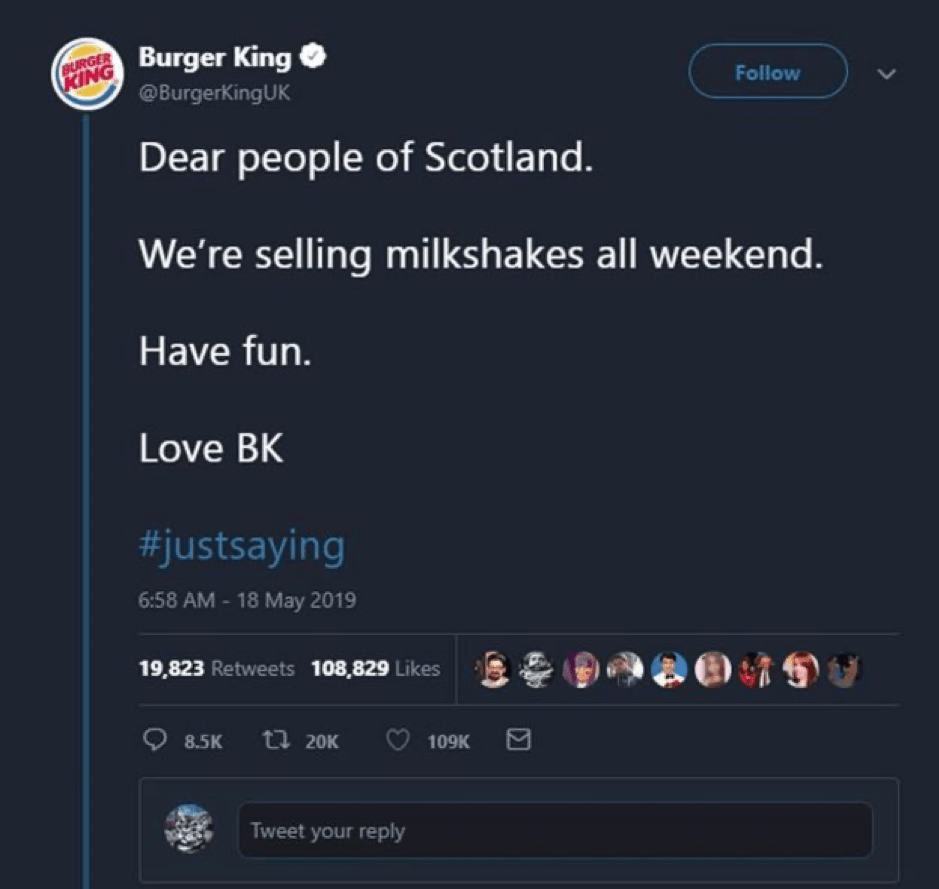
In response to this incident, an Edinburgh-based McDonald’s branch announced in May that it chose not to sell milkshakes while a Brexit political rally, addressed by Farage, was held nearby. However, Burger King’s approach was different. Shortly after the McDonald’s announcement, they tweeted:
Is ‘milkshaking’ becoming a habit?

The tweet, which was retweeted more than 19,000 times, attracted 24 complaints because it was believed to encourage violence. A follow-up tweet by Burger King made clear that this was not the intention behind it, stating that they would never endorse violence.

But ‘milkshaking’ appears to be emerging as a growing tactic in protest against right-wing political figures. ‘Milkshaking’ causes people to look profoundly embarrassed in front of the press, without however inflicting any substantial harm. In addition to suit cleaning costs, Farage was awarded compensation for inappropriate “distress and inconvenience”. He tweeted that normal campaigning was becoming impossible because some ‘remainers’ (i.e. individuals in favour of the UK remaining in the EU) had been “radicalised”.

The English Defence League (EDL) leader Tommy Robinson and the failed UKIP candidate Carl Benjamin also had food and milkshakes repeatedly thrown at them during their European election campaigns. ‘Milkshaking’ seems to be taking off on the other side of the Atlantic too. It was reported in June 2019 that a woman threw an unspecified drink over Matt Gaetz, a pro-Trump Republican Congressman, as he was leaving a coffee shop in Florida. She was later charged with battery and released on bail.

The ASA ruling

Because of the wide media coverage of a spate of incidents of ‘milkshaking’ political figures, the ASA (whose remit includes claims made by companies on their own websites and in social media spaces under their control) considered that people who read the tweet were likely to understand it as a reference to those incidents.

Although the regulator recognised that the tweet may have been intended as “a tongue in cheek reaction” to the suspension of milkshake sales by the fast food giant’s competitor, it held that:

“in the context in which it appeared […] it would be understood as suggesting that Burger King milkshakes could be used instead by people to ‘milkshake’ Nigel Farage.”

The ASA held that the ad condoned such anti-social behaviour and irresponsibly encouraged further instances in breach of the regulator’s harm and offence rules, which require advertisers to avoid including in their marketing communications material “likely to condone or encourage behaviour that prejudices health or safety” (CAP Code, Rule 4.4). The ASA ruled that the ad must not appear again in its current form.

As speculation over the prospect of an early general election after MPs returned to Parliament is mounting, and campaign events possibly nearing, the ASA’s adjudication usefully reminds us to drink milkshakes responsibly.

Cross-Border Mergers in the EU: Shareholders’ Derivative Suits Against Corporate Directors

Dr Georgios Zouridakis, Lecturer in Law at the University of Essex, has published a new chapter in the edited collection Cross-Border Mergers: EU Perspectives and National Experiences (Springer 2019).

Dr Zouridakis’ study shows that shareholders championing corporate interests may face several obstacles following cross-border mergers within the EU, depending on whether the suit is temporally prior to the merger or vice versa. The fact that, post-merger, the company ceases to exist (and is succeeded by another entity in another jurisdiction), gives rise to issues regarding the application of rules intrinsic to the mechanics of derivative suits and particularly those on: continuous ownership; contemporaneous ownership; costs; and on the requirement for shareholders to first demand the board to take action.    

Given that the derivative suit, in all its variations, is a form of shareholder-led representative action, provided by most European countries – and often the only such available – this chapter argues in favour of a policy facilitating such shareholders’ enforcement of corporate claims in the cross-border merger context. 

Dr Zouridakis’ chapter is included in the collection Cross-Border Mergers, which was edited by Dr. Thomas Papadopoulos and published by Springer in October 2019.

This edited volume focuses on specific, crucially important structural measures that foster corporate change, namely cross-border mergers. Such cross-border transactions play a key role in business reality, economic theory and corporate, financial and capital markets law. Since the adoption of the Cross-border Mergers Directive, these mergers have been regulated by specific legal provisions in EU member states.

This book analyses various aspects of the directive, closely examining this harmonised area of EU company law and critically evaluating cross-border mergers as a method of corporate restructuring in order to gain insights into their fundamental mechanisms. It comprehensively discusses the practicalities of EU harmonisation of cross-border mergers, linking it to corporate restructuring in general, while also taking the transposition of the directive into account.

Exploring specific angles of the Cross-border Mergers Directive in the light of European and national company law, the book is divided into three sections: the first section focuses on EU and comparative aspects of the Cross-border Mergers Directive, while the second examines the interaction of the directive with other areas of law (capital markets law, competition law, employment law, tax law, civil procedure). Lastly, the third section describes the various member states’ experiences of implementing the Cross-border Mergers Directive.

Essays for sale? ‘Misleading’ essay writing ad banned by the ASA

Dr. Alexandros Antoniou, Lecturer in Media Law, University of Essex

On 11 September 2019, the Advertising Standards Authority (ASA), the UK’s advertising regulator, found that claims on the website of an essay writing service lacked adequate substantiation and breached the Authority’s rules on misleading advertising.

What was the ad about?

The ASA’s remit includes, since 2011, claims made by companies on their own websites and in social media spaces under their control. The contested advertisement appeared on the website http://www.proacademichelp.co.uk, which included on its home page the following text:

EXCELLENCE BEGINS HERE… There [sic] no better place than Proacademichelp.co.uk to get the best academic help. Professionals [sic] Assistance by highly qualified experts… FIRST ORDER DONE FOR FREE*

Services listed on the website included assignments and dissertations for several subjects including law, engineering and marketing. Further text read:

Quality Essays We don’t offer plagiarized or duplicate essay content. Our content is 100% original. Quality is what comes first for us.

Under the page titled ‘Essays’, additional text included the following statements:

Best Essays by Oxford and Cambridge Experts… We provide accurate and possibly best essays that are of highest standards. Our expert essayists make sure that they deliver you a first-rate quality of essay…

A disclaimer available on the website read in smaller text:

Proacademichelp.co.uk is offering services pertaining to editing, proofreading, formatting and consultation through its website while ensuring to comply with the laws and ethical norms of the industry. We do NOT [emphasis in the original] own any work given to us by clients. We do not offer any sort of writing services.

What were the regulatory issues raised?

One complainant challenged whether the statement ‘FIRST ORDER DONE FOR FREE*’ could be substantiated. Additionally, the ASA felt there were reasons for further investigation and queried whether the claim ‘best essays by Oxford and Cambridge experts’ could also be adequately substantiated and whether the website misleadingly implied that students could submit an essay they had bought as their own.

What was the ASA’s decision?

First of all, advertisers are required under the ASA’s Non-Broadcast Advertising Code (CAP Code) to address the regulator’s enquiries without delay. In an apparent disregard for the Code, Proacademichelp.co.uk provided no response. This resulted in a finding of breach of Rule 1.7 of the CAP Code (unreasonable delay).

Second, the ASA upheld the single complaint against the ad because it found no evidence that the claim ‘first order done for free*’ was a genuine offer. The statement on the website did not include any information about how to obtain the ‘free’ order, nor did it identify any further limitations or qualifications attached to it. As such, it failed to clarify the extent of the commitment the consumer must make to benefit from a free offer in breach of Rule 3.23 of the CAP Code.

Third, the ASA challenged the statement ‘Best Essays by Oxford and Cambridge Experts’. This was sensibly taken to imply that students who selected this essay writing service would receive high-quality essays from individuals who had attended prestigious Oxbridge institutions. Although this claim was likely to be regarded by consumers as objective, no evidence was provided whatsoever by Proacademichelp.co.uk to substantiate it. As a result, the ASA found that it violated its general principle under Rule 3.1 of the CAP Code, which requires advertisers to avoid including materially misleading statements in their commercial messages.

Last but not least, the regulator took issue with Proacademichelp.co.uk’s claims that the essays would be plagiarism-free. It considered that students likely to read them would understand that they could purchase and submit essays as their own without any consequences. The website did not, however, make clear that this was not the case and as such, it was found to have mislead consumers by omitting material information in breach of Rule 3.3 of the Code. The ASA also noted that the disclaimer provided was ‘insufficient’ to neutralise the unsubstantiated claims about non-plagiarised professionally written essays. The regulator concluded:

We told [Proacademichelp.co.uk] not to use the claim ‘best essays by Oxford and Cambridge experts’ and not to imply that students could submit an essay that they bought as their own without risks.

This is not the first time the ASA has grappled with claims made by essay writing companies. In 2013, the Authority ruled that Oxbridgeessays.com had breached its CAP code by offering a money-back guarantee that customers would receive ‘at least the grade they ordered’. Commissioning custom essays is a rapidly growing problem, which the higher education sector and legislation has been slow to address. Also known as ‘contract cheating’, this practice compromises the fairness of the assessment process and presents a real threat to academic integrity. A study conducted by Swansea University found that one in seven students globally is believed to have paid for someone to produce their assignment, ‘potentially representing 31 million students around the world’.

Offering a product which (the presence of disclaimers notwithstanding) can be used for the purposes of cheating in a programme of study is not compliant with the ASA’s core principle, which requires marketing communications to be ‘legal, decent, honest and truthful.’ The UK Advertising Code will not, however, apply to non-UK based websites offering custom essay writing services. This approach may have limited impact considering that many of these websites are based overseas (and are thus beyond the ASA’s jurisdiction). Nevertheless, the ASA’s ruling is a useful reminder that providers’ unsupported claims that their essays are ‘100% original’ or ‘100% plagiarism free’ are misleading and far from honest. Although such an advertised essay may not include any plagiarised text per se, submitting it and representing it as the student’s own work can amount to an act of plagiarism, which is a serious academic offence.

To Prorogue or Not?

Theodore Konstadinides, Professor of Law, University of Essex and Charilaos Nikolaidis, Lecturer in Law, University of Essex have published a new piece on the Blog of the International Journal of Constitutional Law.

The authors consider what the UK constitution permits in circumstances where Parliament is in effect prevented from carrying out its duties in holding the government into account prior to Brexit day. You can read their full post entitled ‘To Prorogue or Not: An Implied Constitutional Convention to End a “Constitutional Outrage”’ here.

Suggested citation: Theodore Konstadinides & Charilaos Nikolaidis, To Prorogue or Not: An Implied Constitutional Convention to End a ‘Constitutional Outrage’, Int’l J. Const. L. Blog, Sept. 1, 2019’.

Advertising regulation: an insight into recent developments

On 14 June 2019, the Advertising Standards Authority, the UK’s advertising watchdog, introduced new rules which target ads featuring gender stereotypes likely to cause harm, or serious or widespread offence. The ban was imposed because the regulator found some portrayals could contribute to “limiting people’s potential”.

Dr. Alexandros Antoniou, Lecturer in Media Law, takes a look at the first ever ads to have been formally investigated by the Authority under its new rules. His piece on The International Forum for Responsible Media, can be accessed here.

Gendered Perspectives on Terrorism and Counter-Terrorism Responses

A Dialogue on the Sahel Region and North Africa

Dr. Carla Ferstman, Senior Lecturer in Law, Dr. Emily Jones, Lecturer in Law, Floriane Borel, Agnieszka Szafranowska

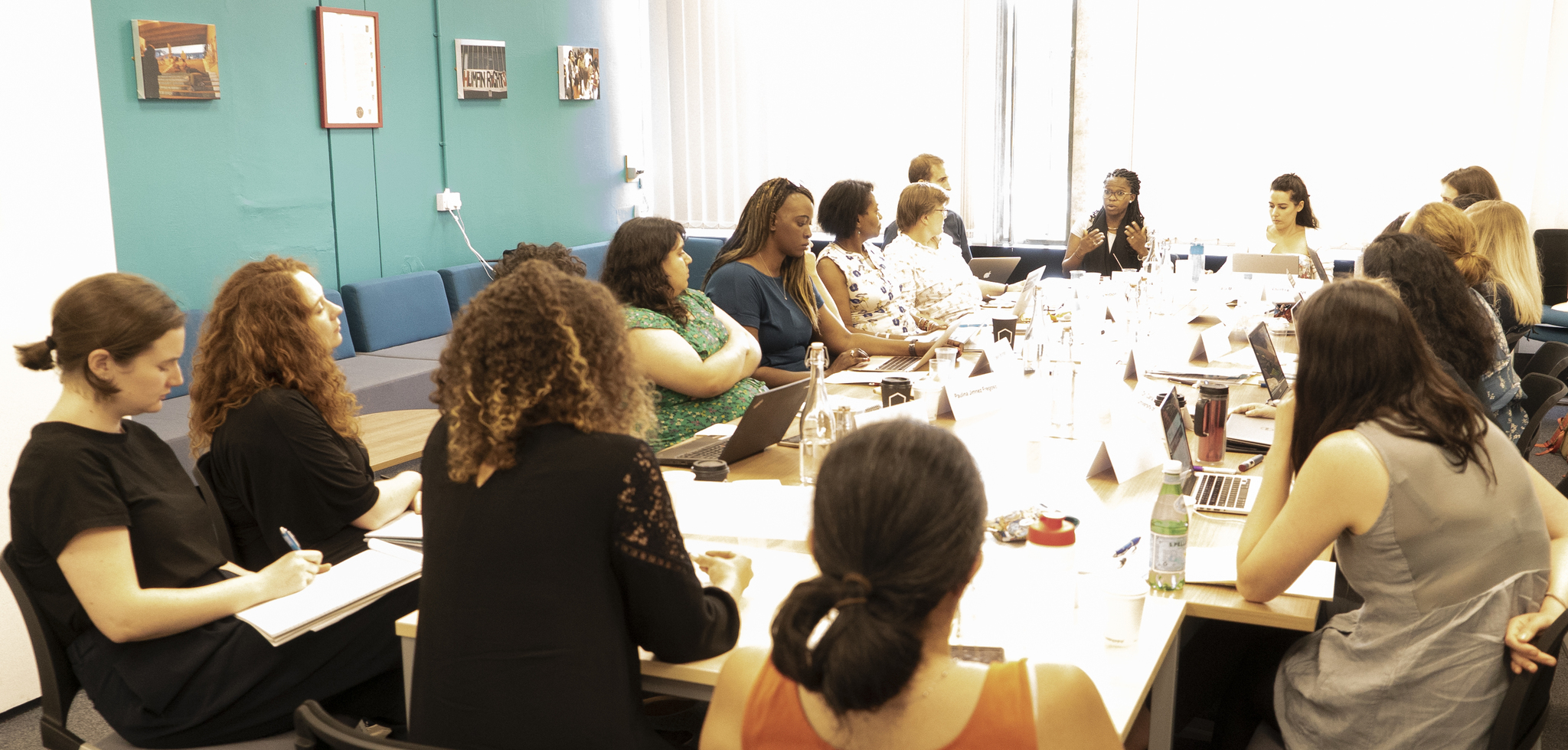
On 29-30 July 2019, the authors  organised an expert workshop at the School of Law, in association with the Essex Armed Conflict and Crisis Hub. The meeting brought together academics (working on international law, feminist legal theory, international relations, terrorism and security studies) and practitioners (working on gender, peace and security in the countries and regions of focus).

The meeting provided an opportunity to discuss the challenges associated with the women, peace and security and counter-terrorism frameworks, from a feminist perspective. It also provided an opportunity to consider the ways in which the international and regional frameworks represent diverse perspectives and views and how they can better do so. The meeting provided an opportunity to share experiences and practices, to develop common understandings and to map out how global feminist scholarly and activist communities can helpfully engage with these debates.

We were delighted to host such a dynamic group of experts for two days of what proved to be powerful, intensive and important discussions.  We are excited about the prospects for building the next phases of the work, and the possibilities this will have for research collaborations and related policy work. These issues are multi-disciplinary and complex and it is so important to work collaboratively. We are hopeful that the next phases of our work will extend and deepen these collaborations.

From left to right: Josephine Roele, Gender Action for Peace and Security network (GAPS) and Dr. Emily Jones, School of Law and Human Rights Centre, University of Essex 

The Global Context

In 2015, United Nations Security Council Resolution 2242 was adopted as part of the wider Women, Peace and Security (WPS) agenda. This resolution brought together the WPS agenda and counter-terrorism for the first time, and urged States and the United Nations to ensure the participation and leadership of women’s organizations in devising strategies to counter terrorism and violent extremism. It also encouraged the Plan of Action to Prevent Violent Extremism to integrate women’s participation, leadership and empowerment as core to United Nations strategy and responses and requested the Counter-Terrorism Committee and its Executive Directorate to integrate gender as a cross-cutting issue within their respective mandates.

Resolution 2242 is key in noting the need to situate women’s voices at the centre of the counter-terrorism agenda. The resolution has helped foster debates between the UN Counter-Terrorism Committee, UN Women and WPS. However, there has been debate amongst scholars and practitioners about bringing the feminist project together with the by now well-established post 9/11 international security regimes. Furthermore, references to women in the Resolution are arguably too superficial to engender a meaningful intersection between these very different agendas. Some of these concerns were highlighted by the UN Special Rapporteur on the promotion and protection of human rights and fundamental freedoms while countering terrorism. In her February 2018 report on counter terrorism and emergency legal responses, she highlighted the harmful impacts of gender-blind counterterrorism regulations. Also, there is clearly a great need to better include activist and practitioner voices.

From left to right: Jeannine Ella A. Abatan, Institute for Security Studies (ISS) Regional office for West Africa, the Sahel and the Lake Chad Basin; Dr Sara M.T. Polo, Department of Government, University of Essex; Valentine Hambyem, School of Law, University of Essex

The Regional Context

Multiple terrorist groups operate within the Sahel region and North Africa, including Boko Haram, Al-Shabaab, AQIM and other Al Qaeda affiliates. Such terrorist threats pose a great threat the security of states and the human security for those who live there, impacting on human development, good governance and rule of law. Killings by terror groups have led to mass displacement and encampment where malnutrition, disease and gender-based violence are prevalent. The increased use of sexual violence and abduction from schools as tactics of systematic terror is a demonstration that terrorism and extremism target and affect women, men, girls and boys in different ways. Disappearances of male detainees impact female family members, who bear the burden of anxiety, harassment, social exclusion and economic hardship. Similar effects ensue from the prolonged detention without trial of male family members, extraordinary rendition and forced deportations. However, while women are victims of terrorism and counter-terrorism measures, they can also be volitional actors in both terrorist entities and counter-terrorism measures. Terrorism has also ravaged state infrastructure and undermined economic growth, fuelled by diminished investor confidence and struggling tourist sectors.

The fight against terrorism has increased security spending, which has diverted resources from development initiatives. Also, some governments have used anti-terrorism policies to prey on minority, marginalised, religious or ethnic groups. In addition, some governments use vague terrorism definitions to punish people, particularly political dissenters, and to suppress social movements, including those that seek gender equality.

The particular security challenges in the Sahel region and North Africa have led to strategic partnerships between the UN and the African Union such as the United Nations-African Union Joint Task Force on Peace and Security.  Similarly, the “G5 Sahel” – an institutional framework for coordination and monitoring of cooperation on security and development policies between Burkina Faso, the Republic of Mali, the Republic of Mauritania, the Republic of Niger and the Republic of Chad, launched a new Women’s Platform in Niger in October 2018. The goal of the platform is to increase women’s involvement in areas of peace, justice and security in the region by bringing together country leaders and civil society organizations. Additionally, there has been increased attention to such challenges within the AU, such as by the AU Office of the Special Envoy on Women, Peace and Security.

Our Next Steps

We will be releasing a report of the workshop which will summarise the main issues that arose and provide some analysis of next steps.

Workshop participants in our Human Rights Seminar Room