On 18 May 2020, the UK communications regulator Ofcom ruled that Loveworld Limited, which broadcasts the religious television service Loveworld, breached its Broadcasting Code after a news programme and a live sermon featured potentially harmful claims about the causes of and treatments for COVID-19.
The Ofcom investigation found that a report on Loveworld News, a programme featuring news from studios around the world, included a number of uncorroborated claims that the source of the risk to health was the effect of 5G Wi-Fi networks rather than the viral transmission of COVID-19. The report also contained several assertions that there was a “global cover-up” about the cause of the pandemic. Another report during the programme “repeatedly and unequivocally” presented the anti-malarial drug hydroxychloroquine as a “cure” for the virus without clearly recognising that this was a clinically unproven claim about the effectiveness of the drug for coronavirus treatment and without acknowledging the drug’s potentially serious side effects.
In relation to both reports, the regulator found that Loveworld Limited had not preserved “due accuracy” (in breach of Rule 5.1 of the Code) and had failed to adequately protect viewers from potential harm (in breach of Rule 2.1) by presenting content of this nature as unequivocal facts rather than views placed in an appropriate context. Ofcom underlined that it did not seek to curb the broadcaster’s ability to present programmes covering current affairs from a religious perspective, but it did not consider that the religious nature of the channel justified a departure from the established application of these rules.
In addition, a sermon broadcast on Your Loveworld was also found to have included “unchallenged and unevidenced” claims casting doubt on the necessity and effectiveness of the social distancing policies adopted by governments (including the United Kingdom) as well as assertions questioning the motives behind official health advice in relation to the coronavirus and 5G technology. In particular, Pastor Chris Oyakhilome (the founder and president of the megachurch Christian denomination known as Christ Embassy) preached that the lockdown measures, the roll-out of 5G and potential future vaccines were part of a plan to reach “the final union between man and machines” because “Satan wants to create a new man”. Ofcom considered that these statements risked “undermining viewers’ confidence in the motives of public authorities and leading them to disregard current and future advice (including on any future vaccine) intended to protect public health.” An exacerbating factor in this case was that these views were set out – without challenge – by a person who was portrayed to viewers as a figure of knowledge and particular authority.
The regulator held that the sermon broadcast provided “a platform for uncontextualized views” that had the potential to cause significant harm to viewers (in breach of Rule 2.1) and that Loveworld Limited had not taken any measures to provide its audience with adequate protection from such material, for example, by challenging the conspiracy theory or including the views of others and making it clear that other explanations could exist.
Ofcom recognised the Licensee’s right to hold and broadcast controversial views which diverge from, or challenge, official authorities on public health information. However, the inclusion of unsubstantiated assertions in both programmes had not been sufficiently contextualised and risked undermining viewers’ trust in official public health advice, with potentially serious consequences for their own and others’ health. In light of the serious failings in these cases, Ofcom directed Loveworld Limited to broadcast summaries of its decisions and will consider imposing further sanctions.
Equality requires us to treat like cases alike. But who are the like cases? Does equality require similarity in the factual situation of those compared? Treating like cases alike is not necessarily as restrictive a formula as is often understood to be; neither does the comparator requirement have to be one of the problematic aspects of applying that formula. Much depends on how we choose to interpret the notion of likeness. This paper aims to propose an interpretation that is based not on the similarity of the situations, but on the similarity of the claims at hand. It does so with reference to the relevant case-law of the European Court of Human Rights. The basic goal is to show that such an alternative understanding of what likeness entails can prove particularly helpful both in terms of comprehending previous instances of the case-law of the Court as well as in terms of allowing for a more principled approach to prevail in the future.
The analysis unfolds in four main steps. The first step argues that the classic formulation of formal equality does not really require, as a matter of necessity, the tracking down of an “analogously situated” comparator and then it proposes a different normative framework for understanding “likeness”. The second step demonstrates how the proposed framework allows us to navigate through the (very close) interaction between the comparability and the justification stages without conflating the two. The third step deals with the way in which the approach advanced in this paper helps us bring the formal conception of equality closer to what is known as substantive equality, simply by enabling us to look at the requirement for “likeness” from a different angle. Finally, the fourth step explains how the perception of likeness as similarity in the weight of the legitimate interests involved can help provide clearer answers when the court faces difficult questions.
This post is based on: Charilaos Nikolaidis, ‘Rethinking Likeness and Comparability in Equality Claims Brought Before the European Court of Human Rights’, Public Law, Issue 3, July 2020, pp. 448-467. The full text is available for download below.
This material was first published by Thomson Reuters, trading as Sweet & Maxwell, 5 Canada Square, Canary Wharf, London, E14 5AQ, in Public Law as ‘Rethinking Likeness and Comparability in Equality Claims Brought Before the European Court of Human Rights’, Public Law, Issue 3, July 2020, pp. 448-467 and is reproduced by agreement with the publishers.
This could be the most significant test of Spain’s fairness as a society.
Starting last month, Spain has a minimum income scheme in place. Considering some of the international coverage, you would be forgiven for thinking it is some sort of universal basic income. It is not so. It is rather a social assistance programme for the poorest families, similar to the ones existing in other European countries. Households will be allowed to claim between 462 and 1,015 Euro depending on their size and composition. The benefit will be compatible with other sources of income, in which case the amount of the benefit would be lowered accordingly.
It is a very last resort, which, believe it or not, the fourth largest economy in the Euro-area did not have until now, not at least for the whole country, and not one that deserved that name.
If it works well, this initiative has the potential for alleviating the most severe forms of social exclusion. Spain has the dishonour of having one the highest rates of child poverty in the EU: one in four children live below relative poverty in households that get less than 60% of the median income. After a long decade of austerity policies, this is a victory for the left, possibly the most significant one since equal marriage (2005), the social care law (2006) and the historical memory law (2007).
But, as well as a victory, it is also the expression of a huge policy and political failure. Spain’s regions and nationalities have had the power and the responsibility to protect the most vulnerable for more than three decades. However, by and large they have failed to do so, in a systematic breach of the human rights to social security and to an adequate standard of living.
The 1978 Constitution established that social security should be maintained “for all citizens (to) guarantee adequate social assistance and benefits in situations of hardship” (Article 41). Spain does have social security with public pensions, including non-contributory pensions, unemployment protection and other economic benefits for those temporarily unable to work for different reasons. But a lot of people suffer long-term unemployment, work in extremely precarious jobs, or are simply left behind by the system. The Constitution also bestowed on regions and nationalities the power to set up complementary social assistance schemes (Article 148.1.20), and all 17 of them accepted this responsibility in their respective statutes of self-government.
Starting with the Basque Country in 1989 and Andalusia in 1990, each region has created its own system. But there is huge variation between them in terms of coverage, adequacy and conditionality.
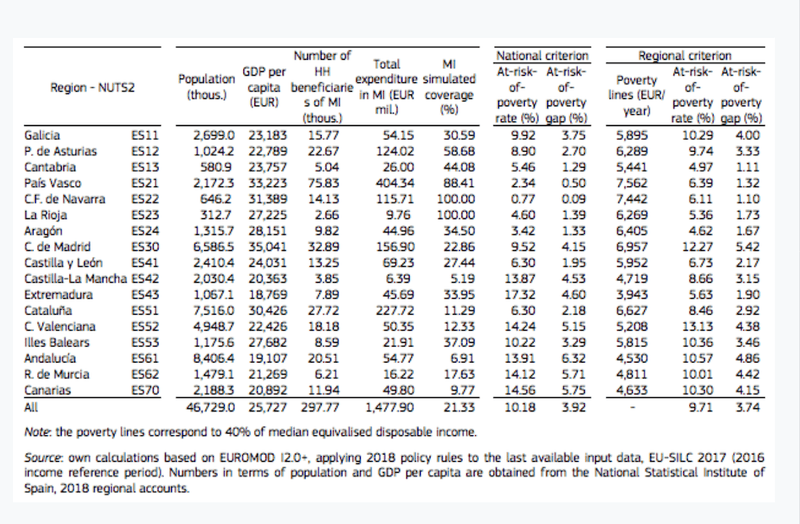
As seen in the table below (based on data from 2018), Madrid and the Basque Country are two of the richest regions, with similar levels of GDP per capita. Yet, despite having one third of Madrid’s population, and half the poverty level (6.4 for 12.3%), the Basque scheme reaches 2.3 times more people and public expenditure is 2.6 times greater. The Basque programme covers 88% of those in greatest need, compared to 23% in the case of Madrid.
With the exception of Navarre, La Rioja and the Basque Country, the vast majority of regions leave out half of the population that meet the economic criteria. The general average is just 21.33%, which means that almost eight in 10 people are unable to get the economic support they need. With just over 8% of the country’s population, nearly 38% of all recipients, living in the Basque Country, Navarra or Asturias, the three regions accumulate 43% of all of Spain’s public spending on minimum income.
Source: Adrián Hernández, Fidel Picos and Sara Riscado, “Moving towards fairer regional minimum income schemes in Spain”, JRC Working Papers on Taxation and Structural Reforms, European Commission, April 2020, p. 12
The austerity of the 2010s created an ever-greater need for a people’s quantitative easing. However, because of limited resources in some cases, and ideological blindness and lack of interest in others, for three decades the regional public authorities failed to fulfil the right to social assistance recognised in Article 13 of the European Social Charter, leaving millions of people behind.
Looking at the small print
Let us hope Spain’s new minimum income scheme will mark a turning point. For now, it is too early to tell if it will match up to the expectations. A number of issues remain unclear and are concerning.
For example, the coverage is arbitrarily limited to people between 23 and 65 years of age. Public authorities at the central, regional and local levels should urgently develop truly accessible and non-bureaucratic procedures. Considering the digital divide, it is essential to establish a system by which individuals can request this benefit from social services face-to-face. In light of the concerning experiences in other countries, observers must watch out for the possible misuse of sanctions and conditionalities. Just as crucial, existing regional schemes should be retained and developed to complement the new central benefit.
The real test will come when the flashlights focus on something else. If the practical questions get answered, and if conservatives do not get rid of it when they return to power whenever they do, then we will be able to celebrate this as one of the most important victories of the left.
This could be the most substantial policy for the people at greater risk of harm, disadvantage and poverty. This could be the most significant test of Spain’s fairness as a society.
The elephant in the room is that none of this would have happened without Covid-19. But this cannot be a passing whim, nor a PR stunt for the left-leaning coalition government. The right-wing Popular Party and the extreme-right Vox seem very confused. Some of their leaders have spoken against this initiative with hyperbolic references to the nanny-State. However, they did not dare to vote against it when the debate came to Parliament in mid-June.
The real test will come when the flashlights focus on something else. If the practical questions get answered, and if conservatives do not get rid of it when they return to power whenever they do, then we will be able to celebrate this as one of the most important victories of the left.
This could be the most substantial policy for the people at greater risk of harm, disadvantage and poverty. This could be the most significant test of Spain’s fairness as a society.
This post first appeared on Open Democracy and is reproduced here with permission and thanks.
England is no stranger to strategic or – at times – abusive use of insolvency provisions.
In the early 2000s, a mechanism frequently used by debtors to retain the control of distressed companies at the expense of their creditors was pre-packaged administration. Following some empirical studies and a public consultation, the Coalition Government introduced some changes to the insolvency system to address the concerns from the industry and practitioners. Yet, it seems that Parliament will have to turn again its attention to similar issues in the not-so-distant future.
In fact, the recent case of Virgin Atlantic, which filed for Chapter 15 protection in the USA to shield itself from the claims of its creditors, as well as other trends in the rescue practice, bring back to the fore the ongoing issue of strategic or abusive use of insolvency provisions.
This blog post briefly discusses whether, and the extent to which, we should be worried by these growing trends in the rescue “industry”.
Pre-Packaged Administrations
Pre-packaged administrations are a hybrid form of corporate rescue. These procedures combine the benefits of informal workouts with the properties of formal procedures.
In a pre-packaged administration, the sale of the distressed business is negotiated before the debtor files for insolvency. Usually, the buyer is a person connected to the debtor’s existing shareholders, sometimes even the existing shareholders or directors. The sale is effected shortly after the debtor files for insolvency, leaving the creditors with no remedies and abysmally low returns for the money they lent to the debtor.
In a paper published at the beginning of this year,[1] Dr. Vaccari identified the characteristics that make a pre-packaged administration abusive. This happens when the sale is determined by a close group of players, who collusively act solely to sidestep or subvert insolvency rules and extract value from the company. To be abusive, such actions should cause undue financial harm to the creditors and fail the “next best alternative” valuation standard.
Conscious of the risks associated with pre-packaged administrations, the Coalition Government launched a study into these proceedings which resulted in the Graham Review (2014) as well as in minor regulatory changes. Some of the industry-led measures introduced following the Graham Report are currently under review. The recently enacted Corporate Insolvency and Governance Act 2020 introduced an extension[2] to end of June 2021 to the power to legislate on sales to connected persons, which was granted by the Small Business, Enterprise and Employment Act 2015 (‘SBEEA 2015’) but expired in May 2020.
It seems accurate to claim that the risks of abusive use of pre-packaged administrations, especially in sales to connected parties, have been significantly curtailed since the regulatory and industry-led changes introduced in 2015. Nevertheless, shareholders and directors have not embraced overnight a new, more inclusive and stakeholder-oriented approach to the management of corporate crises. As a result, the rescue industry has developed new mechanisms to sidestep and at times subvert insolvency rules, for the purpose of promoting the interests of out-of-money players (such as shareholders and directors) at the expense of the residual claimants in insolvency (i.e. secured and unsecured creditors).
Recent Trends
Some recent, high profile cases show the emergence of new trends in corporate rescue practice, designed to sidestep or subvert insolvency rules. These trends are light-touch administrations (LTAs), temporary stays on creditors’ claims – sometimes effected internationally – and reverse mergers.
In LTAs, administrators rely on paragraph 64(1), Schedule B1 of the Insolvency Act 1986 to allow the existing directors of an insolvent company to continue exercising certain board powers during an administration procedure. This practice, however, undermines one of the pillars of the English corporate insolvency framework, i.e. that those responsible for the debtor’s failure are not allowed to run the company in insolvency. The idea behind this choice is that independent insolvency practitioners are better placed than existing directors to protect and promote the interests of creditors as a whole, without necessarily affecting the chances of the debtor to be rescued or sold on a going concern basis.
In LTAs, the existing directors are not free to do whatever they want. Directors usually sign with the administrator a consent protocol, prepared by the Insolvency Lawyers Association and the City of London Law Society. Such a protocol introduces restrictions to the use of directors’ powers in order to safeguard the interests of other creditors and stakeholders. However, in a recent article yet to be published,[3] Dr. Vaccari conducted a doctrinal analysis of the guidance provided by the courts in running LTAs and concluded that the interests of unsecured creditors are unduly affected by these procedures.
The recent events in Debenhams’ restructuring support the early findings in Dr. Vaccari’s article. Debenhams became the first high street business in the UK to enter a LTA process in April 2020, after sales plummeted under the nationwide lockdown. To date, Debenhams’ lenders and owners are “highly supportive” of the LTA process and are funding the administration fees. The process is likely to result in a sale of the profitable assets of the business by the end of September 2020.
So, all good? Not really. In the meanwhile, Debenhams is not paying its landlords and suppliers, with the exception of essential ones. Many workers are paid by the Government (and the taxpayers) through the Job Retention Scheme. Also, this LTA represented the third time the retailer underwent some form of insolvency procedure in less than a year. Earlier attempts included a pre-packaged administration after rejecting financial support from Sports Direct’s owner Mike Ashley and a company voluntary arrangement.
In other words, Debenhams is a “zombie” business, something out of The Walking Dead. It has already been killed several times by the market; it is a failed business, yet it is still operating for the benefit of existing shareholders and directors.
Debenhams is not the only recent case of strategic use of insolvency provisions. After the rejection of a bailout request by the UK Government, Virgin Atlantic worked on a £1.2 bln rescue deal with some of its shareholders and private investors to stave off collapse. It is likely that the negotiations will go ahead – despite the shaky financial situation of the company – thanks to a moratorium or stay on executory actions by the creditors. This moratorium is one of the innovations introduced by the Corporate Insolvency and Governance Act 2020[4] and it has been used as part of a restructuring plan procedure under the newly introduced part 26A of the Companies Act 2006.
However, Virgin Atlantic has assets all over the world. In order to protect them from executory actions, the company sought recognition of the English stay under Chapter 15 of the U.S. Bankruptcy Code. Chapter 15 is a part of the U.S. Bankruptcy Code designed to facilitate cooperation between U.S. and foreign courts. It was added to the code in 2005 by the Bankruptcy Abuse Prevention and Consumer Protection Act, and it allows foreign individuals or companies to file for bankruptcy protection in the U.S. in cases where assets in more than one country are involved. When the order is granted, it is usually recognised all over the world, thus protecting the debtor’s assets against creditors’ predatory actions.
Often, Chapter 15 is filed in conjunction with a primary proceeding brought in another country, typically the debtor’s home country. However, no such proceeding has been opened with reference to Virgin Atlantic. The restructuring plan mentioned above is a company, rather than an insolvency procedure, which means that creditors are less protected than in insolvency. The effect of the Chapter 15 filing is, therefore, to give world-wide recognition to a private agreement negotiated by the company’s directors and key creditors with the support of existing shareholders. A vote on the plan from the wide range of creditors who have legitimate claims against the company will not take place until late August, with a confirmation hearing scheduled for the beginning of September. As a result, the outcome of the Virgin Atlantic case is not dissimilar from Debenhams’ one: the claims of out-of-money shareholders and directors are prioritised against the legitimate interests, rights and claims of other, less sophisticated creditors.
Finally, a practice that it is emerging with renewed preponderance is the use of “reverse mergers” or “reverse takeovers”. A reverse merger is a merger in which a private company becomes public by acquiring and merging with another public company. If the public company files for insolvency first, sells all its assets but keeps its legal standing, the private buyer can go public by merging with the public, insolvent company. In this way, the private buyer avoids the complicated and expensive compliance process of becoming a public company by merging with the insolvent, public debtor. Additionally, all licences, permits, quotas, clearances, registration, concessions etc. conferred on the insolvent debtor will continue with the buyer despite the changing of hands of the controlling interest.
This may, in theory, seem a good idea to maximise the value of the insolvent debtor. Ultimately, the debtor’s listing in the stock exchange (and its public nature) is an asset. What’s wrong in selling it?
First and foremost, the fact is that compliance regulations are sidestepped. Unlike a traditional Initial Public Offering (IPO), reverse merger disclosure documents are generally not reviewed by securities commissions; only by the exchange on which the two companies propose to list. Although this reduces the regulatory burden on issuers, it also dispenses with an important element of investor protection.
These regulations are not simply procedures designed to make life difficult to companies that want to go public. These are procedures designed to protect investors and, ultimately, creditors.
Additionally, another reason to opt for a merger rather than a purchase is if the target company has significant net operating losses that the buyer might be able to use to reduce its tax liabilities. Finally, reverse mergers do not necessarily require concurrent or any kind of financing, as they can take place with a share exchange.
In the U.S. the process has been used by several companies, particularly by start-ups in the automotive sector. These include Nikola Motors, Lordstown, Fisker Automotive, Velodyne Lidar and bus-maker Proterra. At the time of writing, Nikola Motors has a stock exchange value exceeding US$2 bln, while Lordstown has a stock market value of US$1.6 bln. If you haven’t heard these names before, you’re not the only one. Both Nikola and Lordstown have yet to produce their first (electric) vehicle!
It is not surprising that all these companies relied on reverse mergers to go public. Reverse mergers involve less regulatory scrutiny, are cheaper in terms of professional and other expenses, faster than a traditional IPO and able to avoid or minimize market and execution risk on their going-public transactions. Which, ultimately, brings us to the question: are reverse mergers of an insolvent public company a trick or a threat for the debtor’s stakeholders?!?
What’s Next
The Government should respond promptly to these new trends emerging from practice. The commitment to promoting a rescue culture and – more generally – the rescue of distressed yet viable businesses cannot come at the expense of “everything else”. Cases like Debenhams, Virgin Atlantic and the U.S. listing of automotive start-ups suggest that the market is unable at the moment to self-regulate.
The Covid-19 pandemic accelerated a trend towards the strategic or abusive use of insolvency provisions. If unchecked, this trend can only result in more insolvencies and higher taxes.
If suppliers are not paid, the above-mentioned insolvencies will create a domino effect in the industry and they will result in further filings. As for taxes, Dr. Vaccari mentioned in a previous blog post that the re-introduction of the Crown preference is expected to increase the returns to the HMRC. However, higher numbers of insolvency procedures and a downturn of the economy are likely to affect the capacity of companies to generate revenue and – as a result – to pay taxes. If companies pay less taxes and the Government is forced to spend more in subsidies to companies and employees, this is likely to result in cuts to public services and higher rates of taxes for people and companies alike.
The publications mentioned in this article are available on Westlaw, Researchgate.net and Academia.edu. Dr. Vaccari regularly discusses insolvency matters on Twitter and LinkedIn.
[1] E Vaccari, ‘English pre-packaged Corporate Rescue Procedures: Is There a Case for Propping Industry Self-Regulation and Industry-Led Measures such as the Pre-Pack Pool?’ (2020) 31(3) I.C.C.L.R. 170, 184-185.
[3] E Vaccari, ‘Corporate Insolvency Reforms in England: Rescuing a “Broken Bench”? A Critical Analysis of Light Touch Administrations and New Restructuring Plans’ (2020) I.C.C.L.R. (forthcoming).
In corporate insolvency procedures, not all creditors are alike. This is despite the pari passu principle.
The pari passu principle is often said to be a fundamental rule of any corporate insolvency law system. It holds that, when the proceeds generated by the sale of debtor’s assets are distributed to creditors as part of an insolvency procedure, they have to be shared rateably. In other words, each creditor is entitled to a share of these proceeds that corresponds to the percentage of debt owed by the company to its creditors.
Imagine that a company has creditors for £100,000. Creditor A has a claim for £1,000, creditor B for £5,000. The company is insolvent and it is liquidated. The sale generates £50,000 of proceeds available to be distributed to the creditors. While it would have been possible to say that, for instance, older creditors or creditors with larger claims are paid first, the pari passsu principle states that all creditors are treated alike. As a result, creditor A will receive 1% of these proceeds (£500), while creditor B will receive 5% of them (£2,500).
There are, of course, exceptions to the pari passu principle.
First, the pari passu principle applies only to assets that are available for distribution. For instance, a bank may have granted a mortgage to the debtor to buy a property, and the debtor may have given that property as a collateral to the bank. If the debtor becomes insolvent, the proceeds generated by the sale of that property are distributed first to the bank and then, if anything is left, to the other creditors.
Secondly, the law might introduce exceptions to this principle in order to prioritise the payment to creditors that are deemed particularly worthy of additional protection.
The Law
Until the Enterprise Act 2002, the Inland Revenue and HM Customs & Excise (now HMRC) were granted a status as preferential creditors for certain debts listed in Schedule 6 of the Insolvency Act 1986. As a result, debts owed to the them had to be fully paid before any distribution to floating charge holders, pension schemes and unsecured creditors (among others) was made.
This preferential status granted these agencies a stream of £60-90 million each year in insolvencies. Section 251 of the Enterprise Act 2002, however, abolished the Crown’s status as preferential creditor and introduced a new regime (the ‘prescribed part’) wherein a portion of the distributions in liquidation was ring-fenced specifically for unsecured creditors.
Back in the 2018 Budget, mixed in with many other tweaks, the Government announced a seemingly innocuous change to the way in which business insolvencies will be handled from 6 April 2020 (later postponed to insolvencies commencing on or after 1 December 2020, irrespective of the date that the tax debts were incurred or the date of the qualifying floating charge).
Without attracting much publicity, the announced move was codified in sections 98 and 99 of the Finance Act 2020, which received Royal Assent on 22nd of July 2020. As a result, HMRC gained secondary preferential treatment over non-preferential and floating charge holders – often banks that have loaned money to firms – for uncapped amounts of VAT, Pay As You Earn (‘PAYE’) income tax, student loan repayments, employee National Insurance Contributions (‘NICs’) or construction industry scheme deductions.
In a related development, Parliament also approved the Insolvency Act 1986 (Prescribed Part) (Amendment) Order 2020. The effect of this Act is to increase the prescribed part from £600,000 to £800,000. However, this change does not apply to floating charges created before 6 April 2020.
So What?
The Government argues that giving HMRC priority for collecting taxes paid by employees and customers to companies is appropriate. These represent taxes that are paid by citizens with the full expectation that they are used to fund public services. Absent any form of priority, this money actually gets distributed to creditors instead. As a result, the Exchequer should move ahead of others in the pecking order and give HMRC a better chance of reclaiming the £185m per year they lose.
These explanations do not appear totally sound. The creation of the prescribed part and the increase of its cap to £800,000 served the purpose of ensuring that at least some of this money is paid back to the HMRC and used to fund public services. What has not been properly considered is the impact the Crown preference and the increased prescribed part will have on: (i) the wider lending market and access to finance; as well as (ii) corporate rescue practices.
With reference to lending practices, the new system disproportionately affects floating charge holders and unsecured creditors. The abolition of administrative receivership – a procedure controlled by lenders – by the Enterprise Act 2002 was compensated by the loss of preferential status for the HMRC. The re-introduction of such preference means that lenders in general and floating charge holders in particular will be pushed to lend money at higher interest rates, as lenders have no idea as to the tax arrears of any borrower on a day to day basis.
Lenders now face a double blow (increased prescribed part and Crown preference) in relation to realisations from the floating charge. They are, therefore, likely to reduce the amounts that they lend to businesses, to take account of the dilution in the realisations that they would receive in insolvency. This is a particularly unwelcome outcome in the current marketplace.
Lenders are even more likely to seek fixed charge (where possible) and to introduce covenants for reviewing the debtor’s tax liabilities. Such liabilities are likely to increase significantly in the next few months, as VAT payments due by businesses between March and June 2020 have been deferred until the end of the 2020/21 tax year. Lenders may also insist that a borrower holds tax reserves to deal with liabilities to HMRC and, in large operations, on group structures which minimise the dilution from Crown preference.
Finally, unsecured creditors may choose to protect themselves by keeping their payment terms as tight as possible and limiting the number of days that credit is offered for.
Additionally, and perhaps more importantly, such move may hamper the willingness to support an enterprise and rescue culture, which was the main justification for the abolition of the Crown’s preference. This is because HMRC’s gain is the other creditors’ loss, especially considering that the taxes classified under the preferential claim are ‘uncapped’ (while before the enactment of the Enterprise Act 2002 they were capped to amounts due to up to 1 year before the commencement of the procedure).
Despite assurances to the contrary, the existence of a preferential treatment may push the HMRC to exercise increased control over the insolvency process and promote early petitions for liquidation in the hope of higher return.
Also, the HMRC has never historically been particularly supportive of reorganisation efforts. This means that distressed companies may have to file for a new restructuring plan under part 26A of the Companies Act 2006 and seek a court-approved cross-class cram-down to overcome the HMRC’s negative vote. Such an approach would increase cost, litigation and time needed for the reorganisation effort, thus potentially pushing viable debtors out of business.
There are other elements that militate against the re-introduction of such preferential status. HMRC currently have the ability to robustly manage their debt. HMRC have powers not available to other unsecured creditors, including the ability to take enforcement action without a court order to seize assets and to deduct amounts directly from bank accounts.
HMRC have the power to issue Personal Liability Notices to corporate officers for a failure to pay National Insurance Contributions (NICs) or future unpaid payroll taxes. HMRC also have the power to insist on upfront security deposits where there is a genuine risk of non-payment of PAYE, NICs or Value Added Tax (VAT). Similarly, HMRC may issue Accelerated Payment Notices for disputed tax debts.
One of the key features of the English corporate insolvency framework is its focus on promoting business rescue and, more in general, a rescue culture, as evidenced in previous papers[1] by the author of this post. The recent long-term changes introduced by the Corporate Insolvency and Governance Act 2020 seemed to go in the direction of strengthening the rescue attitude. It makes, therefore, little sense to introduce policies designed to help businesses survive the Covid-19 pandemic and, at the same time, reduce their ability to borrow cheaply. The re-introduction of the preferential status for certain unpaid taxes spins the clock back to 2003 and is likely to hurt the existing, fragile business recovery.
The publications mentioned in this article are available on Westlaw, Researchgate.net and Academia.edu. Dr. Vaccari regularly discusses insolvency matters on Twitter and LinkedIn.
[1] E Vaccari ‘English Pre-Packaged Corporate Rescue Procedures: Is there a Case for Propping Industry Self-Regulation and Industry-Led Measures such as the Pre-Pack Pool?’ (2020) 31(3) I.C.C.L.R. 169; E Vaccari, ‘Corporate Insolvency Reforms in England: Rescuing a “Broken Bench”? A Critical Analysis of Light Touch Administrations and New Restructuring Plans’ (2020) I.C.C.L.R. (accepted for publication); E Vaccari, ‘The New ‘Alert Procedure’ in Italy: Regarder au-delà du modèle français?’ (2020) I.I.R. (accepted for publication).
The allegations of sexual misconduct against an unnamed Conservative MP have received significant media coverage lately. The Sunday Timesreported that the ex-minister was taken into custody on Saturday 1 August 2020 after a former parliamentary employee accused them of rape, sexual assault and coercive control. The MP has not been named publicly so far. But what stops the media from naming rape suspects? There are several aspects of media law which are relevant to this case.
To start with, the Tory MP remains anonymous partly because of recent developments in the law of privacy. Cliff Richard’s legal action against the BBC in 2018 established that suspects of law enforcement investigations enjoy ‘a reasonable expectation of privacy’ up to the point of charge. This general principle was endorsed by the Court of Appeal in the subsequent case of ZXC v Bloomberg LP in May 2020. Giving lead judgment in this case, Lord Justice Simon stated:
[…] those who have simply come under suspicion by an organ of the state have, in general, a reasonable and objectively founded expectation of privacy in relation to that fact and an expressed basis for that suspicion. The suspicion may ultimately be shown to be well-founded or ill-founded, but until that point the law should recognise the human characteristic to assume the worst (that there is no smoke without fire); and to overlook the fundamental legal principle that those who are accused of an offence are deemed to be innocent until they are proven guilty.
[para. 82]
This does not necessarily mean that the media cannot report on criminal investigations. Such investigations can only lawfully be reported where there are countervailing public interest grounds to outweigh the suspect’s privacy interests and justify disclosure of their name (e.g. where the individual under investigation is a political figure). Different media organisations’ approach to this balancing exercise may, however, vary; hence, some media outlets may decide to name the suspect more quickly than others.
Furthermore, an alleged victim of a sexual offence enjoys an automatic right to lifelong anonymity under section 1 of the Sexual Offences (Amendment) Act 1992 and should not be identified in a written publication available to the public or a relevant programme for reception in England and Wales. The anonymity applies from the time an allegation is made by the alleged victim or anyone else. Section 5 of the 1992 Act makes it an offence to breach these provisions. The individual concerned may waive their right to anonymity if specific requirements are fulfilled and a court can lift the anonymity in certain circumstances, but this happens only rarely. One practical implication of these statutory provisions is that the media must be mindful of the potential for ‘jigsaw’ identification, i.e. piecing together different bits of information that create a more complete picture of an individual whose identity should be concealed. This means that the media must limit the publication of any matter ‘likely to lead’ to the complainant’s identification and as a result, care is needed with detail.
There could also be libel risks if, prior to any charge, a suggestion is published that an identified suspect may be guilty of a crime. A media report which includes the suspect’s name may allow that individual to successfully sue the publisher for defamation if the investigation does not lead to a prosecution. The media can safely publish the name of a person under investigation if the name is officially supplied by a spokesperson for a governmental agency, e.g. the police. This is because the report will be protected by the defence of qualified privilege in defamation law. It is anticipated that most media outlets will wait until the individual concerned has been named by the police. Finally, the publication of details which turn out to be incorrect could result in a conviction for contempt of court if a judge thinks that the material published created ‘a substantial risk of serious prejudice or impediment’ to the legal proceedings.
Dr. Jaime Lindsey recently published an article in Child and Family Law Quarterly (Volume 32, Issue 2, pp. 157-176), titled ‘Protecting vulnerable adults from abuse: under-protection and over-protection in adult safeguarding and mental capacity law’.
The article concerns the intersection between adult safeguarding and mental capacity law; an area which raises a number of difficult issues for lawyers, policy makers and health and social care professionals when thinking about the extent to which the civil law ought to be used to respond to abuse of adults with impaired mental capacity.
The article draws on original empirical data to show that adults vulnerable to abuse are left under-protected in some cases and over-protected in others. In particular, it argues that the Mental Capacity Act 2005 has become a tool for protecting vulnerable adults from abuse. Moreover, this is done in ways that restrict and control the vulnerable victim, rather than targeting the perpetrator.
Learning from developments in the domestic abuse sphere, including the Domestic Abuse Bill currently going through Parliament, Dr. Lindsey argues that safeguarding adults law should instead focus on perpetrators of abuse by developing a Safeguarding Adults Protection Order (SAPO), instead of resorting to mental capacity law in these challenging cases.
The article is available on LexisLibrary and a copy can be requested via the University’s Research Repository here.
Prof. Theodore Konstadinides and Dr. Anastasia Karatzia acted as the UK national rapporteurs for theFédération Internationale Pour Le Droit Européen (FIDE) Congress 2020, one of the most significant conferences on EU law which brings together academics, advocates, judges and representatives from the EU institutions.
The Congress is an occasion to exchange views and expertise on EU law. Prof. Konstadinides and Dr. Karatzia were selected as the national rapporteurs for one of the three topics of the conference: National Courts and the Enforcement of EU Law: The Pivotal Role of National Courts in the EU Legal Order.
In their report, the authors explore pertinent questions about the interaction between UK national courts and the Court of Justice of the European Union concerning issues such as the preliminary reference procedure, the principle of supremacy, presumption of mutual trust, and the judicial independence of national courts and tribunals.
The Congress Publications, which include Prof. Konstadinides’ and Dr. Karatzia’s report, were published in July 2020 and are available digitally as Open Access resource here.
A year after the introduction of the UK Advertising Standards Authority’s (ASA) new rule on gender stereotyping, a new study evaluates the regulator’s approach to depictions of harmful gender stereotypes in advertisements.
Dr Alexandros Antoniou and Dr Dimitris Akrivos from the School of Law are the authors of ‘Gender portrayals in advertising: stereotypes, inclusive marketing and regulation’. Their study, which was recently published in the Journal of Media Law, a leading journal in the field, offers an in-depth socio-legal analysis of the ASA’s modern practice which systematises for the first time the regulator’s rulings in the field of gender stereotyping.
For a long time, academic research has highlighted the impact gender stereotypical advertising images can have on people’s aspirations, professional performance and mental well-being. In response to long-standing concerns around the matter, the ASA introduced in June 2019 a new advertising rule and guidance into its harm and offensiveness framework. The new rule, which came into effect on 14 June 2019, states: ‘Advertisements must not include gender stereotypes that are likely to cause harm, or serious or widespread offence’. Academic discussion has not until now queried whether the actions taken by the ASA constitute a satisfactory response to the problem.
Their new article brings a new perspective in the ASA’s approach by paying close attention to the complex structure of gender stereotypes and the interaction between their multiple components. More specifically, Dr Antoniou and Dr Akrivos’ research looks at how the ASA has dealt with different forms of gender stereotyping, including sexualisation and objectification; body image; gender roles, behaviours and characteristics; and the ridiculing of those who do not conform to gender norms.
The authors argue that, although the ASA’s new rule and guidelines constitute a step in the right direction, they represent a missed opportunity to take bolder action against ads that objectify or inappropriately sexualise individuals. Dr Antoniou and Dr Akrivos stated: “the new ASA guiding principles need to be revisited in order to go beyond the traditional male/female binary”. They recommend that the new guidance on gender representation in marketing communications needs to reflect the multi-faceted nature and fluidity of modern gender identities. “We propose the introduction of a new concept requiring advertisers to give ‘due weight and consideration’ to the diversity of modern masculinities and femininities”.
The University of Essex’s press release on the study can be found here. The research also featured in an article on the global marketing magazine Campaign and a piece on the LGBTQ magazine GScene.
Dr Samantha Davey has recently published a book with Hart, entitled ‘A Failure of Proportion: Non-Consensual Adoption in England and Wales’. This book is the result of PhD research which was funded by the Arts and Humanities Research Council. It explored the topic of adoption – specifically the issue of adoption without parental consent.
The central question Samantha sets out to address in her book, is as follows: in what circumstances is it proportionate to remove children from their parents into care and place them for adoption?
In England and Wales, and most other jurisdictions, adoptions are final and irrevocable. Adoption, in these circumstances, is non-consensual, signals not only the end of the legal relationship between children and parents but the end of familial relationships. Once an adoption is finalised, it is very rare for it to be revoked and unusual for direct contact to take place between children and their parents.
Dr Davey’s book explores an area of law which has sparked considerable debate amongst academics, practitioners and the judiciary nationally and internationally. The emphasis of her book is on the circumstances in which non-consensual adoption may be regarded as a proportionate measure and when less severe forms of intervention, such as long-term foster care or kinship care, may also meet children’s needs while providing protection to children’s rights under the European Convention on Human Rights.
The book builds on existing literature on adoption law but takes the discussion in new directions, placing an emphasis on the need to closely scrutinise children’s and parents’ rights at all stages of the adoption process. A unique feature of this book is its emphasis on routinely incorporating key provisions from the United Nations Convention on the Rights of the Child into analysis when determining whether an adoption order is a proportionate measure.










 Essex Law Research Blog