The Online Safety Bill presents an opportunity to address violence against women and girls in its digital dimensions and hold accountable the tech platforms that profit from this abuse.
But if the new law passes in its current format, it will leave women and girls facing violence and the threat of harm in their everyday online interactions.
In an event, co-hosted by Maria Miller MP and Baroness Nicky Morgan, experts, and leading organisations will discuss how the Online Safety Bill provides an essential vehicle to hold tech companies accountable for preventing and tackling VAWG and why a VAWG Code of Practice must accompany the Bill, to ensure tech companies take proactive steps to prevent VAWG in a comprehensive and systematic way.
The CoP sets out how the regulator will recommend tech meets their legal obligations to identify, respond to and prevent VAWG on their platforms. A copy of the CoP can be downloaded here:
This would create safer online spaces for women and girls – spaces where action is taken to prevent abuse, perpetrators and the platforms that ignore this abuse face consequences, and our self-expression is not restricted by the threat of violence.
In the 1990s, Bruce Ackerman defined ‘constitutional moments’ as historic milestones of intense deliberation and change in a country’s politics, change that reflects in the country’s constitutional settlement.
Since October 2019, Chile is going through its own constitutional moment, a moment that began with popular resistance against rising public transport fees in the capital Santiago.
Social Rights and the Constitutional Moment seizes the opportunity of this unique moment to unpack the context, difficulties, opportunities, and merits to enhance the status of environmental and social rights (health, housing, education, and social security) in a country’s constitution.
Social Rights and the Constitutional Moment (Hart 2022): please see below contents and links to chapter summaries
In 2020-2021, this partnership brought together practitioners and academics from Chile and other countries (Argentina, Brazil, Canada, Colombia, Ireland, Mexico, South Africa, Spain, the United Kingdom and the United States) to share and learn from international and comparative practice with the goal of informing the ongoing process of constitutional reform in Chile.
More than thirty contributions were compiled and submitted to members of the constitutional convention and other public authorities in the country in September 2021. This new book presents an extended version of a selection of those essays.
Still today, with laudable exceptions (such as this, this, this, this and this), the majority of comparative constitutional studies in the English language tend to focus on the United States and Europe, and the analysis of peripheral legal systems, when it exists, can only be found on the sidelines as a more or less blatant afterthought. Unlike common practice in comparative constitutional law, this book is anchored in Latin America, building from Chile.
Drawing on the analysis of both academics and practitioners, the book provides rigorous answers to the fundamental questions raised by the construction of a new constitutional bill of rights that embraces climate and social justice.
With an international and comparative perspective, chapters look at political economy, the judicial enforceability of social rights, implications of the privatisation of public services, and the importance of active participation of most vulnerable groups in a constitutional drafting process.
Ahead of the referendum on a new constitution for Chile in the second half of 2022, this collection is timely and relevant and will have a direct impact on how best to legislate effectively for social rights in Chile and beyond.
By Louise Millescamps, University of Essex, School of Law
L’ auteur tient à remercier Dr Laure Sauve, Eugénie Duval et Dr Xavier Aurey pour leurs précieux commentaires sur les versions précédentes de cet article.
Le 16 octobre 2021, David Peace, un malade en phase terminale affirme que «la législation anglaise l’a abandonné». Diagnostiqué en 2019 d’une maladie affectant sa motricité, ce Londonien a voyagé en Suisse afin de pouvoir bénéficier d’une fin de vie digne et sans crainte de douleurs «intolérables». La législation anglaise refuse, en effet, aux personnes en fin de vie de recourir au suicide assisté. En France, la mort assistée est aussi illégale. Le 5 février 2022, un homme français de 55 ans a été arrêté après avoir assisté sa mère de 94 ans dans sa mort. Il a expliqué souhaiter mettre fin à la «situation de plus en plus indigne de sa mère». Selon son avocat, ce fils a été le «témoin d’un processus de déshumanisation» et n’a fait qu’agir à la demande de son parent.
Il est intéressant de comparer ces deux pays qui refusent la légalisation de la mort assistée afin de mieux comprendre les arguments des législateurs. En effet, en France comme en Angleterre, la mort assistée (qui englobe le suicide assisté et l’euthanasie) est réprimée pénalement. Le suicide assisté est une pratique par laquelle le patient met fin à sa vie grâce à des moyens ou grâce à un environnement particulier qui lui ont été fournis par une tierce personne. En France, il est associé à la non-assistance à personne en danger puisque l’on considère que la personne tierce n’a pas porté secours à une personne en détresse. Cette personne tierce peut être condamnée à 5 ans d’emprisonnement et 75 000 € d’amende. En Angleterre, cette pratique est condamnée par le Suicide Act 1961 qui par sa section 2 condamne toute action encourageant ou assistant au suicide. La peine, beaucoup plus sévère, peut aller jusqu’à 14 ans d’emprisonnement.
L’euthanasie est quant à elle une pratique par laquelle une personne tierce met elle-même fin à la vie du patient avec son consentement par l’injection d’un médicament pas exemple. En France, elle est associée à l’homicide volontaire qui est puni de 30 ans de réclusion criminelle (Article 221-1 du code pénal), tandis qu’en Angleterre, l’euthanasie est associée à un meurtre ou un homicide involontaire, passable d’un emprisonnement à vie. De ce fait, les personnes euthanasiant un patient en fin de vie risquent, en Angleterre, l’emprisonnement à vie.
L’objectif de cet article est donc de présenter l’évolution du droit français et anglais sur la fin de vie (I) ainsi que les arguments mis en avant par les législateurs pour refuser de légaliser la mort assistée (II).
I. L’évolution limitée de la loi anglaise et française
L’évolution de la législation française et anglaise est partagée entre un refus de légaliser la mort assistée et une volonté d’améliorer la prise en charge de la fin de vie. En France (1), comme en Angleterre (2), des affaires ont permis de grands changements dans la loi: la reconnaissance des directives anticipées et la possibilité de refuser l’hydratation et l’alimentation artificielle. De plus, la France est le premier pays à légaliser la sédation longue et continue, permettant une reconnaissance implicite de l’euthanasie passive.
1. Vers une tolérance de l’euthanasie passive en France
En France, la première affaire qui a influencé la législation fut l’affaire Vincent Humbert en 2003. Vincent Humbert a été victime en 2000 d’un accident de la route le rendant tétraplégique, muet et aveugle. En 2003, sa mère, aidée par un médecin, provoqua la mort de son fils. Ceci a poussé le législateur à adopter la loi Leonetti le 22 avril 2005 relative aux droits des malades et à la fin de la vie. Cette loi a parachevé les soins palliatifs grâce aux directives anticipées, c’est-à-dire la possibilité pour une personne d’exprimer dans un document écrit ses vœux quant aux décisions médicales à prendre en fin de vie, document qui doit être renouvelé tous les trois ans. Cette loi a également interdit l’obstination déraisonnable ou «acharnement thérapeutique». Il s’agit de soins inutiles, disproportionnés ou ayant pour seul but le maintien artificiel de la vie (Article 2 de la Loi n° 2016-87 du 2 février 2016 créant de nouveaux droits en faveur des malades et des personnes en fin de vie). Cette interdiction permet d’introduire un droit au «laisser mourir» permettant au patient qui refuse tout traitement médical de voir sa volonté respectée par le corps médical même si ce choix met sa vie en danger. Cela signifie par exemple qu’un patient souhaitant arrêter ses traitements médicaux, comme un médicament permettant de soulager les douleurs, peut le demander afin de précipiter la fin de sa vie.
Une deuxième affaire qui a permis une évolution de la loi française est l’affaire Vincent Lambert. Après un accident de la route, cet homme s’est retrouvé dans un coma végétatif. En 2013, c’est-à-dire six ans après l’accident, le médecin chargé de s’occuper de Vincent Lambert conclut à un acharnement déraisonnable et décide d’arrêter l’alimentation artificielle de Vincent Lambert. Cependant, les parents de Monsieur Lambert s’opposent à cette décision du médecin et il s’ensuit une longue procédure judiciaire. En 2019, les traitements de Vincent Lambert sont arrêtés et il décède quelques semaines plus tard. C’est à la suite de cette affaire très médiatisée que le législateur adopte la loi Claeys Leonetti du 2 février 2016 créant de nouveaux droits en faveur des malades et des personnes en fin de vie. Selon cette loi, le médecin droit respecter la volonté du patient exprimée dans des directives anticipées et, la nutrition et l’hydratation artificielles constituent des traitements médicaux qui peuvent être arrêtés (article L. 1110-5-1 alinéa 2 du code de la santé publique). Enfin, cette loi a aussi introduit la possibilité pour le patient de demander la sédation profonde et continue jusqu’à son décès, renforçant le droit « au laisser mourir » du patient. Avec ce dernier élément, le législateur semble tolérer l’euthanasie passive même s’il estime que l’intention de la sédation profonde et continue n’est pas de donner la mort mais de soulager la douleur alors qu’une mort est imminente et inévitable. Ainsi hâtée, la mort est justifiée par le soulagement de douleurs insupportables.
Ainsi, le législateur français a essayé d’étendre le plus possible la notion de soins palliatifs dans la loi afin d’assurer une mort digne aux patients en fin de vie sans pour autant légaliser l’euthanasie et le suicide assisté.
2.En Angleterre, le refus du législateur de légaliser tout type de mort assistée
En Angleterre, le Mental Capacity Act de 2005 permet aux patients de recourir aux directives anticipées ainsi que de demander la cessation des traitements médicaux qui comprennent l’hydratation et l’alimentation.
Les mesures sur les directives anticipées ont été introduites à la suite de l’affaire Re C [1]. Dans cette affaire, s’est posée la question de la capacité du patient atteint de schizophrénie paranoïaque à donner ou retirer son consentement pour un traitement médical. Cette capacité à refuser un traitement médical a donc fait écho aux situations des personnes en fin de vie qui deviennent incapables d’exprimer leur consentement à cause d’une maladie. La Law Commission a donc décidé d’introduire la possibilité pour le patient de recourir aux directives anticipées.
De plus, le législateur a rejeté trois projets de loi qui auraient permis un pas vers la légalisation de la mort assistée. Ces projets de loi sont intervenus notamment après l’affaire Tony Nicklinson. En 2008, Tony Nicklinson a subi un accident vasculaire cérébral qui l’a laissé paralysé et muet. Il vivait un cauchemar et souhaitait mettre fin à sa vie. Cependant, il ne pouvait pas le faire sans aide. Il a donc demandé en 2012 à la Supreme Court de l’autoriser à mettre fin à sa vie avec l’aide d’un médecin ainsi que de reconnaître l’incompatibilité de cette loi avec ses droits fondamentaux. Suite au rejet de ses demandes, Tony Nicklinson a refusé de s’alimenter et est décédé peu après. Si l’un des projets de loi évoqués ci-dessus avait été adopté, des personnes dans la même situation que M. Nicklinson aurait pu bénéficier d’une assistance dans la mort. En 2012, une ancienne députée du Parlement écossais a présenté un projet intitulé «the Assisted Suicide (Scotland) Bill (2013)». S’il avait été adopté, ce projet aurait permis à une personne atteinte d’une maladie en phase terminale de mettre fin à ses jours grâce à un médicament prescrit par le médecin. Le projet a été rejeté dès la première étape du débat. Deux autres projets de loi similaires ont été examinés et rejetés en 2014 et 2015.
En France, comme en Angleterre, les lois ont été fortement influencées par différentes affaires très médiatisées. Cependant, les législateurs anglais et français refusent toujours de légaliser l’euthanasie et le suicide assisté. Ils justifient notamment leur refus en arguant que les soins palliatifs et la mort assistée poursuivent des objectifs différents: les premiers ont pour but de soulager la douleur du patient tandis que la seconde vise à provoquer le décès du malade en fin de vie.
Photo by the National Cancer Institute on Unsplash
Les arguments des législateurs anglais et français pour justifier leur refus de légaliser la mort assistée
Les arguments du législateur anglais sont similaires à ceux du législateur français et sont repris dans les différents débats parlementaires lorsqu’un nouveau projet de loi tendant à la légalisation de la mort assistée est en discussion. Il existe trois arguments principaux pour appuyer le refus de la légalisation de cette pratique. Les législateurs font d’abord valoir un manque de clarté problématique pour les personnes qui seraient concernées par la mort assistée (1). Ils estiment ensuite qu’il faudrait réformer la prise en charge du patient en fin de vie plutôt que de légaliser la mort (2). Enfin, est mis en avant l’argument selon lequel le choix du patient sur sa fin de vie comprend également la possibilité de changer d’avis, ce que l’acte irréversible qu’est la mort ne permet pas (3).
1. Un manque de clarté des propositions de loi dangereux pour les patients en fin de vie
Les législateurs français et anglais ont avancé que les propositions de loi étaient trop vagues. Par exemple, la proposition de loi de 2012 présentée en Ecosse ne possédait pas de définition permettant de différencier l’euthanasie du suicide assisté. Les projets de loi étaient alors inadéquats pour le patient qui souhaite prendre contrôle de la fin de sa vie. En effet, le malade en fin de vie souhaitant mourir par sa main (suicide assisté) mais qui décède par une le fait d’un médecin (euthanasie), ne prend pas contrôle de sa fin de vie comme il le souhaiterait.
De plus, ce manque de clarté aurait pesé sur le corps médical qui se serait chargé de cette mort assistée incertaine. En effet, il est nécessaire que le médecin soit soumis à des règles très clairement établies, lesquelles garantiraient le consentement du patient de recourir à la mort assistée, et permettraient au médecin de ne pas être jugé pour un acte qu’il pensait être autorisé. Enfin, le manque de clarté des projets de loi aurait également eu des répercussions pour les juges et avocats qui auraient eu de nombreuses difficultés pour apprécier si une affaire concernant la mort assistée pouvait être jugée criminellement. Considérées comme étant trop peu précises par les législateurs anglais et français, ces derniers ont préféré ne pas adopter ces propositions.
2. Une meilleure prise en charge de la fin de vie du patient
Un autre argument avancé par les législateurs français et anglais est qu’il est nécessaire non pas de légaliser la mort assistée, mais de placer les malades en fin de vie dans une meilleure situation.
Pour eux, il s’agit de réformer la prise en charge du patient en fin de vie et d’alléger du mieux possible sa souffrance sans toutefois avoir recours à la mort. En effet, selon les législateurs, avec une fin de vie sans douleur et un meilleur accompagnement du malade dans son décès, la légalisation de la mort assistée deviendrait superflue.
Les législateurs français et anglais, dissuadés par le caractère irréversible de la mort, tentent alors de mettre en avant l’alternative d’une fin de vie préférable plutôt que la légalisation d’une mort plus douce.
Un des arguments essentiels en faveur de la légalisation de l’euthanasie est que le patient devrait pouvoir choisir et prendre le contrôle de sa fin de vie. Mais, la liberté de choisir comprend aussi la liberté de changer d’avis ; l’acte irréversible qu’est la mort assistée serait donc inadaptée pour les patients en fin de vie. Selon cette approche, le patient qui recherche la mort ne voudrait en fait qu’abréger ses souffrances et aux portes de la mort. De plus, les législateurs considèrent que parfois la mort est souhaitée par le patient non pas pour mettre fin à ses douleurs mais pour éviter de devenir un « fardeau » pour sa famille. Ainsi, les législateurs sont formels : à cause du caractère irréversible et définitif de la mort assistée, cette dernière ne peut être légalisée sans porter atteinte à la liberté des patients de choisir et de changer d’avis.
Pour conclure, les législations françaises et anglaises ont évolué afin de garantir aux patients une fin de vie plus sereine. Grâce à la volonté d’éviter l’acharnement thérapeutique ou la possibilité de la sédation profonde et continue, les souffrances sont soulagées. Cependant, les législateurs restent fermes dans leur refus de légaliser l’assistance dans la mort. Pourtant, la société évolue et souhaite de plus en plus la légalisation de la mort assistée, comme en témoignent les propositions en ce sens de plusieurs candidats lors des dernières élections présidentielles en France et les nombreux sondages [2]. C’est pourquoi, en complément de ce premier article, un second projet, une interview, se concentrera sur les arguments en faveur de l’euthanasie.
[1]C (Adult: Refusal of Medical Treatment), Re [1994] 1 WLR 290 (Fam).
[2] Selon l’IFOP, Le regard des Français sur la fin de vie, avril 2021, 93% des Français souhaitaient la légalisation de l’euthanasie pour les personnes souffrant de maladies insupportables et incurables. En Angleterre, Populus (maintenant appelé Yonder), Dignity in Dying Poll, 2019 a établi que 84% supporte la légalisation de la mort assistée chez les malades en fin de vie.
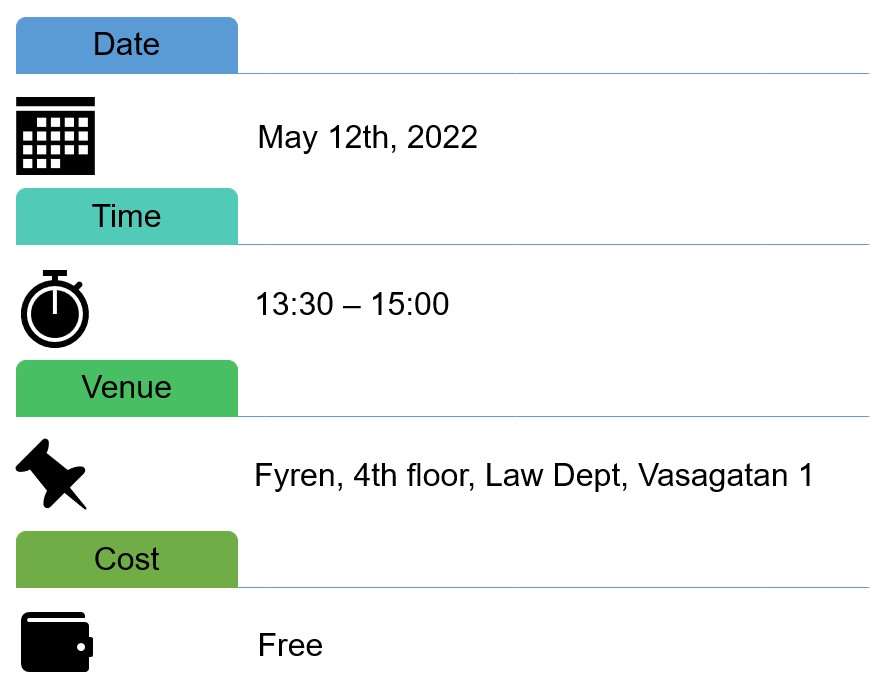
Dr. Emily Jones, Senior Lecturer in Law, University of Essex, will lead a seminar on the theme of ‘Posthuman International Law and the Rights of Nature’.
The rights of nature are beginning to be recognised in many countries but have yet to be recognised in international law.
Seeking to challenge and re-think the anthropocentrism that permeates International Environmental Law, this seminar will discuss the synergies between posthuman theory and the legal recognition of the rights of nature, reflecting on the application of both to international law.
The lecture will draw on multiple examples of contexts where nature’s rights have been recognised, including in New Zealand, India, Ecuador, the US, and beyond, to think through the similarities and differences between these contexts and the lessons to be learned.
Reflecting on the possibility of the recognition of the rights of nature in international law, the talk will conclude with an evaluation of the ways that posthuman theory can be applied to help inform the rights of nature project, seeking to ensure that the rights of nature live up to their transformative posthuman potential.
The seminar is organized by Dr. Matilda Arvidsson, as part of the project ‘AI, the social contract, and democracy’, financed by WASP-HS in collaboration with the international law and environmental law groups at the Department of Law of the University of Gothenburg.
The seminar is open to researchers, students at an advanced level, and the public.
On 3 February 2022, the UK’s regulator of advertising across all media, the Advertising Standards Authority (ASA), published its research in harmful racial and ethnic stereotyping in UK advertising. The survey highlighted a number of important issues that participant consumers raised about the depiction of people from different racial and ethnic backgrounds.
Ads that are likely to cause serious or widespread offence and/or harm owing to particular portrayals of race and ethnicity have long been regulated under the UK Code of Non-broadcast Advertising (CAP Code) and the Code of Broadcast Advertising (BCAP). Rule 4.1 of the CAP Code states that ‘Marketing communications must not contain anything that is likely to cause serious or widespread offence. Particular care must be taken to avoid causing offence on the grounds of age; disability; gender; gender reassignment; marriage and civil partnership; pregnancy and maternity; race; religion or belief; sex; and sexual orientation’. Equivalent provisions are found in Rule 4.2 of the BCAP Code. Marketers are urged to consider public sensitivities before using potentially offensive material and compliance is typically assessed with reference to several factors, including the context, medium, audience, type of product and generally accepted standards.
Advertising can play a role in legitimising stereotypes. Certain types of racial and ethnic stereotypes can, in particular, cause harm by creating a set of limiting beliefs about a person that might negatively affect how they perceive themselves, and how others see them. In the aftermath of the death of George Floyd (whose murder by a police officer in the US city of Minneapolis in 2020 sparked a global movement for racial justice and led to pressure for change across the world), the ASA has been reflecting on what further efforts could be made to address factors that contribute to Black, Asian and other minority racial or ethnic groups experiencing disproportionately adverse outcomes in different aspects of their lives.
As a first step, the regulator commissioned public opinion research in order to establish whether stereotypes associated with race and ethnicity can, when featured in ads, give rise to widespread or serious offence and/or contribute to real-world harm, such as unequal outcomes for different racial and ethnic groups. The research, which was conducted between March and June 2021, comprised two stages: a qualitative study that covered different interest groups, and a quantitative study that was designed to identify the extent to which attitudes and beliefs were held across individual communities and the UK as a whole. The research indicated that: ‘over half of Black, Asian and Minority Ethnic respondents felt that, when they were represented in ads, they are not accurately portrayed, and of those, just over a half felt people from their ethnic group are negatively stereotyped’.
Five categories of racial and ethnic stereotypes were identified by the research (some of which are interrelated):
Roles and characteristics: overt or subtle stereotypical portrayals pertaining to appearance, behaviour, employment status, mannerisms, accent and preferences. Such portrayals may contribute to the homogenisation of vastly diverse groups and can be seen to reinforce or promote outdated views of a particular race or ethnic group.
Culture: the exaggeration and mocking of accents, ‘lazy’ references to culture, cultural appropriation, and the use of imagery suggestive of colonialism.
Religious beliefs and practices: repeated depictions of Muslim or Asian women wearing the hijab were seen by participants as ‘an easy stereotype that lacked authenticity’. There was, however, support for portrayals that did not draw specific attention to a person’s racial or ethnic background.
Objectification and sexualisation: concerns were expressed about depictions of sexualised and/or objectified Black men and women as well as depictions that ‘fetishised and exoticised’ Asian women. However, positive portrayals of the diversity of body shapes and sizes were generally welcomed.
Use of humour at the expense of other ethnic groups: making fun of a group or their appearance, culture or tastes, e.g., the use of different accents can be seen as mocking or ‘othering’ by reinforcing the idea that people from racial or ethnic minorities who speak with an accent are different from White or Western people.
Moreover, the research highlighted three potential types of harm that could develop from adverse portrayals of race and ethnicity:
reinforcement of existing stereotypes through the repeated use of certain portrayals (often described as ‘always showing us the same way’, e.g., the casting of Asian men as shop keepers, waiters and taxi drivers or subtle reinforcements of a servile role). The perceived harm in relation to this was seen in making it easier for others to see people from racial or ethnic minorities as different to the mainstream (‘othering’);
the emergence of new tropes which continue creating a one-dimensional picture of Black, Asian and other minority racial or ethnic groups; and
perpetuating or implicitly reinforcing racist attitudes by depicting racist behaviour: such depictions were felt to pose a risk of evoking past trauma and reinforcing prejudice (even where it was understood that the advertiser’s intention was to challenge negative stereotypes within the messaging of the ad).
The research did not give the ASA reason to believe that its interpretation and application of the Codes’ rules were generally out of step with consumers’ and stakeholders’ opinions. The findings can, however, bring more clarity and valuable insights on the types of ads that pose a risk of causing harm and/or offence. At the end of 2022, the regulator will conduct a review of its rulings in this area to identify newly emerging areas of concern and ensure that it is ‘drawing the line in the right place’.
At this stage, it is not anticipated that a new targeted rule will be introduced into the Advertising Codes to ban the kinds of portrayals identified in the report. Nevertheless, the Committee of Advertising Practice (CAP) and the Broadcast Committee of Advertising Practice (BCAP), which are responsible for writing and updating the UK Advertising Codes, will consider whether specific guidance on racial and ethnic stereotypes is necessary to encourage creative treatments that challenge or reject problematic stereotypes and diminish issues arising from the repeated presentation of a specific race or ethnicity in a particular way. Finally, the research findings will be presented to industry stakeholders and training will be offered to support advertisers where necessary.
This article was first published on the IRIS Merlin legal database and is reproduced on the ELR Blog with permission and thanks. The original piece can be viewed here.
Photo of Richard Ratcliffe at the candlelit vigil outside the Foreign Office on Friday 05 Nov. 2021, eleven days into his hunger strike, via Flickr.
Professor Carla Ferstman is a lawyer and an activist. Before joining the School of Law in 2018, she directed REDRESS, an organization dedicated to helping torture survivors in all parts of the world to seek justice for all the harm they suffered. That is where she first met Richard Ratcliffe, the husband of Nazanin Zaghari Ratcliffe who was released earlier this week on 15 March 2022 after almost six years of being kept as a hostage in Iran.
Kate Clayton, Senior Communications Officer at the University of Essex, spoke to Carla to find out more about her perspective on Nazanin’s journey to freedom and to ask her what lessons we might be able to draw from her case.
Why has the plight of Nazanin and her family resonated with so many people in the UK and beyond?
On a human level, it is hard to fathom what it must feel like to have one’s family torn apart by such an arbitrary, brutal act and to feel so powerless over so many years. So this was about compassion first of all. But also, Richard’s advocacy, his unwillingness to be quieted in the face of the injustice he and Nazanin faced helped to bring and keep people on board.
Do you think there were any turning points in the campaign?
Yes, several, and I will focus on the positive ones.
First, is the recognition by the UN Working Group on Arbitrary Detention that Nazanin’s detention was arbitrary, that she was likely to have been arrested because of her status as a dual Iranian-British national, and that she should be immediately released. This 2016 decision made it clear that this was no ordinary criminal case where the UK should sit back and wait for justice to take its course. No, Nazanin was being targeted. Removing the veneer of a criminal justice justification for her detention was really important because it helped to move the UK Government towards a position where it understood that it had to act. Passivity was not an option.
Second, was the coming together of many of the families of detainees, mainly dual nationals and Iranian nationals with foreign links. This was crucial to change the narrative about what was happening. All the stories were so similar – this was a form of hostage-taking. It was also important to counter isolation and build a sense of common solidarity.
Third, was the 2019 decision by then Foreign Secretary Jeremy Hunt to grant Nazanin diplomatic protection, meaning that the UK Government had recognised formally that the harm caused to Nazanin was a harm to the UK Government and one for which it could intervene as a state to state claim. This was a landmark recognition.
Fourth, was the March 2022 repayment by the UK of a £400m debt that had been outstanding since the 1970s in relation to an outstanding order for military equipment.
You managed to involve Essex students in the campaign. How did this go?
Iran’s human rights record was being considered by the UN Human Rights Council in Geneva through its universal periodic review process. The students, under the auspices of the Human Rights Centre Clinic helped prepare a submission on behalf of seven families to highlight the injustice of their situation. This came at a really important time and was a start of much more robust joint advocacy by families of detainees. This was quite a unique opportunity for the students to work on such a concrete, live case involving real people undergoing serious human rights violations in real-time.
Have campaigns like this impacted your academic research?
Indeed, I just recently co-authored with my colleague Dr Marina Sharpe a journal article which considers whether the arbitrary detention of dual and foreign nationals in Iran violates the Convention on the Taking of Hostages and may constitute a crime against humanity. We hope this will be useful to ongoing scholarly debates and also assist the many organisations who are following these issues and governments whose citizens continue to be affected by the practice.
What do you think comes next for Nazanin and Richard?
One of the wonderful things about the freedom they now have is that it is absolutely for them to figure out their next steps. Something we may all take for granted, I imagine for them feels very luxurious.
What next for the other cases?
There are still so many people who remain arbitrarily detained in Iran in a hostage context, many for multiple years, under very difficult circumstances. And the practice is also happening in more and more countries. The advocacy must continue until the practice stops.
This piece was first published on the Blog of the University of Essex and is reproduced on the ELR Blog with permission and thanks.
UK retailers Marks and Spencer (M&S) and Aldi have finally called a truce to the trademark-based legal spat pitting their caterpillar cakes, Colin and Cuthbert, against each other. While details of the settlement have not been made public, Aldi’s Cuthbert will not reportedly return in quite the same form. As Aldi tweeted, upon announcing that an agreement had been reached:
Getting out early on good behaviour, keep an eye out for Cuthy B this Spring 👀👀 x #FreeCuthbert
Colin the Caterpillar, a roll sponge cake decorated with milk and white chocolate icing and sprinkles, has been an M&S stalwart for more than 30 years. The retailer claims to have sold more than 15 million to date. Since 2011, rival products with similarly alliterative names have appeared: Asda’s Clyde, Tesco’s Curly, Waitrose’s Cecil, Co-op’s Curious and Cuthbert.
In April 2021, presumably because it was thought that, of all the caterpillar cakes, Cuthbert most closely resembled Colin, M&S launched legal proceedings to protect its intellectual property and get Aldi to remove the product from its shelves. The retailer claimed that the similarity between the two cakes would lead consumers to think that they were of the same standard, thereby allowing Cuthbert to ride on Colin’s coattails.
Companies often seek to protect, as trademarks, certain signs that help them distinguish their products and services from those of their competitors, such as brand names, logos and slogans. Along with patents (which protect innovative technical solutions) and copyright (which protects creative or intellectual works such as books and music), they are a form of intellectual property.
The Colin v Cuthbert dispute hinges specifically on trademarks, because it related to the distinctive characteristics of commercial assets. M&S has held trademarks in the UK in relation to Colin’s name and green packaging since 2009 and 2020 respectively, but these have not been infringed.
The problem for M&S is that its trademark would probably not extend to the underlying idea of a chocolate roll with a smiley face on it. Securing protection for the shape of a product is actually quite difficult in trademark law – not to mention proving that a competitor has presented his goods as those of somebody else.
The four-finger-shaped KitKat chocolate bar and the shape of the London taxi are two examples of iconic shapes that have not succeeded. One key reason behind this is that the average consumer doesn’t usually make assumptions about the origin of products on the basis of their shape, or that of their packaging, when other graphic or word elements are absent.
Caterpillar cakes have seen decades of children grow up (image via Flickr)
Passing Off
There have been cases in the UK where shapes and packaging have attracted protection under what jurists refer to as the law of passing off. Passing off offers legal protection against harm to what is termed the “goodwill” of a business. And it can be used to protect unregistered trademarks.
Goodwill here is a legal concept, which refers to a business’s means of attracting people’s custom. It is harmed when a trader suggests – through misdescription on packaging or parasitic copying of a well-known product – that their product or service has some association or connection with another trader, when this is not the case.
In 2015, pop-star Rihanna famously won her battle to stop fashion brand Topshop using an unlicensed image of her on a T-shirt. She did so by convincing a judge that customers buying the top would think she had endorsed it. The Court of Appeal ruled that the unauthorised use of her photograph amounted to passing off.
Passing-off claims are notoriously difficult to establish. If someone promotes their bottled drinking water business as “the De Beers of still water”, they may be infringing the De Beers trademark but it is unlikely that a judge would find that they were passing themselves off as connected to De Beers in any commercial sense.
To win a passing-off claim against Aldi, M&S would have essentially had to prove that Colin had built up such a reputation as a signature product – in the same way that Rihanna had done as a music artist and style icon – that customers would be able to recognise it without difficulty. The retailer would also have had to prove that Cuthbert was so similar to Colin that consumers, after opening the packaging, would be misled into thinking that the two were somehow associated.
What is more, the fact that so many supermarket chains now have their own version of a caterpillar cake – coming in a variety of sizes and decorative features – would not have helped in establishing that Colin is unique. M&S would have had to prove that in the minds of cake buyers in the UK, the caterpillar has not become a generic shape for cakes.
Further, Aldi’s excellent Twitter campaign – and the widespread publicity the lawsuit has attracted – will have also contributed to dispersing any consumer confusion.
Lastly, it would have been difficult for M&S to argue that Aldi’s caterpillar cake had damaged or had the potential to damage the goodwill in Colin – that is, its power to attract and retain buyers of the cake. The market for caterpillar cakes is saturated: there are just so many to choose from.
The agreed settlement between the two parties means there was no court judgement on the facts. The terms of the settlement remain confidential. It is unknown whether liability – that is, blame – was admitted by Aldi for the wrong allegedly suffered by M&S.
Rarely does a party in a settlement walk away thinking, I have won. Typically, there is no winner and no loser in a negotiated resolution. This case will nonetheless have seen both M&S and Aldi benefit from the kind of marketing exposure that money cannot readily buy.
This article was first published on The Conversation and is reproduced on the ELR Blog under a Creative Commons Licence. View the original article here.
Artificial Intelligence (AI) could revolutionise the world-wide economy as well as the way we live, work and interact with each other. While this new technology certainly presents great potential, it also comes with important risks to human life, health and wellbeing – among other risks.
In an effort to prepare for this new environment, the European Commission has been at the forefront of several initiatives that aim to provide a harmonised regulatory framework for the safe deployment and use of AI systems across Member States [1]. Amongst its most recent initiatives is a public consultation on how to adapt civil liability rules to the digital age and artificial intelligence. This public consultation, which closed on 10 January 2022, aimed to collect views on:
how to improve the applicability of the Product Liability Directive (PLD) to the digital age, including AI, and
whether there is a need to further harmonise rules of liability for damage caused by AI systems beyond the PLD.
The consultation is an important first step towards building a robust liability framework fit to address the current and future challenges posed by AI and the digital age in Europe. The changes that could be implemented as a result of the consultation could be immense and produce far-reaching consequences. Understandably, this public consultation attracted a high level of interest from various stakeholders, including businesses (Google, Bosh, Siemens, Avast), consumer organisations (BEUC, France Assos Santé), insurers (AXA, Insurance Europe, France Assureurs), NGOs, interest groups, legal scholars as well as members of the general public. In total, the European Commission received around 300 responses.
Pr. Jonas Knetsch (University of Paris 1 Panthéon-Sorbonne) and Dr. Emmanuelle Lemaire (University of Essex), assembled a small ad hoc research group, comprised of Pr. Michel Cannarsa (The Catholic University of Lyon), Dr. Laurie Friant (University of Paris 1 Panthéon-Sorbonne) and Pr. Simon Taylor (Paris Nanterre University), to produce a report in response to the consultation.
Overall, the authors of this report were of the view that the PLD should be adapted to enhance consumer protection in the digital age and increase legal certainty for all stakeholders. The authors also recognised that AI technology posed specific challenges and recommended that complementary measures be adopted to ensure the safe deployment and use of AI systems across Member States.
Adapting the PLD rules to the digital age and AI
The Product Liability Directive, which came into force on 30 July 1985, was a response to the increasing demand for consumer protection in a hyper-industrialised environment where goods were mass-produced, and mass-consumed. In essence, the Directive aimed to offer a high level of protection to consumers while ensuring that producers did not bear an undue burden. It was thus designed to strike a careful balance between the interests of both consumers and producers.
Yet, we must remember that the Directive was implemented at a time when the Internet was still in its early days, the use of AI remained largely theoretical, marketplaces were positioned in the ‘physical world’, and concepts such as ‘circular economy’ and ‘the Internet of Things’ (IoT) were simply non-existent. To say that the PLD – which did not undergo any major changes since 1985 – is in need of reform is certainly an understatement.
In order to adequately adapt the PLD to the digital age and AI, the authors of the aforementioned report took the view that the scope of application of the PLD should be extended, and in particular that:
the concept of ‘product’ should be expressly extended to intangible goods,
the concept of ‘producer’ should be extended to include online marketplaces and remanufacturers,
the concept of ‘damage’ should be extended to include specific types of immaterial loss (i.e. privacy or data protection infringements not already covered under the General Data Protection Regulation, and damage to, or the destruction of, data).
The authors of the report also recommended the amendment of specific PLD rules in certain situations, and more specifically:
the suppression of the development risk defence for AI products only,
the suppression of the 10-year longstop period in case of death or personal injury,
a clarification of the conditions enabling the 3-year limitation period to start running,
an alleviation of the burden of proof of ‘defect’ and ‘causation’ for products classified as ‘technically complex’ (which would include AI products and The Internet of Things).
In addition to recommending that the PLD be adapted, the authors of the report were also in favour of the European Commission adopting complementary measures in the context of AI to account for the specific features presented by this technology (autonomy, complexity, opacity, vulnerability, and openness).
Adopting complementary measures in the context of AI
The regulation of AI is proving challenging across legal systems, not least because of the difficulty in defining what AI is and what can be classified as an AI system. The European Commission made a recent effort to try and offer a clear – but open – definition of the term ‘AI system’ to ensure legal certainty while providing the necessary flexibility to accommodate any future technological developments. As the definition currently stands, an AI system means software that is developed with some specific listed techniques and approaches ‘and can, for a given set of human-defined objectives, generate outputs such as content, predictions, recommendations, or decisions influencing the environments they interact with.’[2] The definition is quite broad, and in consequence, the range of products based on – or using – AI systems can be diverse and include voice assistants, image analysing software, search engines, speech and face recognition systems, as well as advanced robots, autonomous cars, drones or Internet of Things applications. Not all these products present the same type or level of risk, and some AI-based products are therefore more dangerous than others.
The authors of the report recommended that the European Commission consider:
the harmonisation of strict liability where AI-based products or services create a ‘serious risk of damage’ to consumers with an option to allow Member States to offer more protective liability rules to consumers,
the harmonisation of mandatory liability insurance for certain AI products,
the harmonisation of liability rules regarding the compensation of specific types of immaterial loss beyond the PLD (i.e. privacy or data protection infringements not already covered under the General Data Protection Regulation, and damage to, or the destruction of, data).
If you are interested in knowing more about the recommendations made by this university group to the European Commission, you can find a copy of their report (no. F2771740) – written in French – on the EC website or download it directly from our blog below:
[1] See e.g. European Commission, Communication from the Commission to the European Parliament, the European Council, the Council, the European Economic and Social Committee of the Regions – Artificial Intelligence for Europe (COM(2018) 237 final); European Commission, White Paper on Artificial Intelligence – A European approach to excellence and trust, (COM(2020) 65 final); European Commission, Communication Coordinated Plan on Artificial Intelligence (COM(2021) 205 final); European Commission, Proposal for a Regulation of the European Parliament and of the Council laying down harmonised rules on Artificial Intelligence (Artificial Intelligence Act) and amending certain Union legislative Acts (COM(2021) 206 final).
[2] European Commission, Proposal for a Regulation of the European Parliament and of the Council laying down harmonised rules on Artificial Intelligence (Artificial Intelligence Act) and amending certain Union legislative Acts (COM(2021) 206 final), Article 3(1).
Russia is no longer a member state of the Council of Europe. On 16 March, the Committee of Ministers (CM) of the Council of Europe decided, “in the context of the procedure launched under Article 8 of the Statute of the Council of Europe, that the Russian Federation ceases to be a member of the Council of Europe”. The decision was effective immediately. This came just a day after the Parliamentary Assembly of the Council of Europe (PACE) unanimously recommended that ‘the Committee of Ministers should request the Russian Federation to immediately withdraw from the Council of Europe’ and, if Russia does not comply, ‘that the Committee of Ministers determines the immediate possible date from which the Russian Federation would cease to be a member of the Council of Europe’. At the same time, shortly before PACE voted on this matter, the Russian Federation had submitted a formal notification to the Secretary-General indicating that it would withdraw from the Council of Europe under Article 7 of the Statute, and that it would denounce the European Convention on Human Rights. This post will revisit some of the key decisions of the last three weeks, demonstrating how these decisions could shed light on legal ambiguities surrounding withdrawal, suspension and expulsion from the Council of Europe.
Suspension and Expulsion
After its invasion of Ukraine, an obvious and fundamental violation of international law, the Council of Europe has clearly taken a firm stance against Russia. It was understood that, after more than two decades of a turbulent relationship, the war in Ukraine could not warrant anything less than an immediate and clear reaction. Thus, the Secretary-General, the Committee of Ministers, the President of the Venice Commission – among others – have all condemned on multiple occasions and in the strongest terms the invasion. For the first time, Article 8 of the Council of Europe Statute was relied upon on 25 February to suspend Russia’s rights of representation in the Council of Europe. The European Court of Human Rights also granted urgent interimmeasures, asking Russia to refrain from military attacks against civilians and civilian objects and abstain from blocking and terminating the activities of Novaya Gazeta. On 15 March and 16 March the PACE and CM adopted the aforementioned historic opinion and decision, respectively.
Questions surrounding the withdrawal, suspension and expulsion from the Council of Europe had not been the subject of extensive scholarly analysis, until the insightful study by Dzehtsiarou and Coffey of 2019. The key provisions are indeed Articles 7 and 8 of the Council of Europe’s Statute – but, as Milanovic observed, the wording of these provisions is not ideal. These provisions should be read alongside Article 3 of the Statute, which states the values of the Council of Europe. Thus, the clear political determination of the Council of Europe’s organs to request Russia to withdraw took place in the context of a number of legal ambiguities surrounding the relationship between Articles 8 and 7, in particular. After all, this is the first time that Article 8 is enforced against a member state. In that sense, the expulsion decision against Russia has shed light on the applicable legal framework in a number of ways, as will be shown below.
Key decisions since 24 February
The exposition of key decisions of the CM and PACE is selective and focused on the scope of the post; all decisions or further information is available here:
24 February: The CM decides to hold an extraordinary meeting on 25 February to examine measures to be taken under Article 8.
25 February: The CM decides, under Article 8, to suspend Russia’s rights of representation in the Council of Europe. Resolution CM/Res(2022)1 on 2 March clarifies that the suspension concerns the CM, PACE, the Congress of Local and Regional Authorities and committees set up under Articles 15.a, 16 and 17 of the Statute.
10 March: Russia announces (albeit not formally triggering Article 7) its intention of not participating in the Council of Europe.
10 March: On the same day, the CM decides to consult PACE with a view to deciding further measures against Russia under Article 8. PACE had already decided, on 25 February, to hold an extraordinary meeting on 14 and 15 March to discuss the consequences of the Russian Federation’s aggression against Ukraine.
14 March: PACE begins the extraordinary meeting; the members show clear support for the further use of Article 8. A draft report on the ‘Consequences of the Russian Federation’s aggression against Ukraine’ is circulated among members.
15 March: Shortly before the vote, the Russian Federation submits its letter under Article 7 and also notifies the Secretary-General of its intention to denounce the European Convention on Human Rights (ECHR) under Article 58 ECHR. The President of the Assembly (rightly, as will be shown below) informs the members that the Article 7 letter will in no way impact the discussions and the vote on the further use of Article 8.
15 March: PACE votes unanimously in favour of the CM requesting Russia to withdraw from the Council of Europe ‘immediately’.
15 March: After the vote, the Secretary-General, the Chair of the CM and PACE’s President make a joint statement on the ‘exclusion’ of Russia, indicating that it can no longer be a member of the organisation.
16 March: The CM decides to end Russia’s membership with immediate effect, namely from 16 March 2022.
A two-step process against Russia and the role of the Assembly
The first point to be noted is that, on this occasion, Article 8 was used as a two-step process. The first step was the suspension decision on 25 February. The second step was that of ‘expulsion’. Thus, the further use of Article 8 referred to in the decision of 10 March concerned the second step, which is that of ‘expulsion’. Nevertheless, Article 8 is not ideally worded as it refers to Article 7. This matter is returned to below. The question as to why the Parliamentary Assembly was not consulted more extensively (see below) prior to the suspension decision of 25 February could be answered with reference to Statutory Resolution (51) 30, Admission of new members (annexed to the Statute), which also refers to withdrawal:
The Committee of Ministers, before inviting a State to become a Member or Associate Member of the Council of Europe, in accordance with Articles 4 and 5 of the Statute, or inviting a Member of the Council of Europe to withdraw, in accordance with Article 8, shall first consult the Consultative (Parliamentary) Assembly in accordance with existing practice.
The above provision indicates that the Parliamentary Assembly should be consulted prior to the request to withdraw under Article 8 – but not necessarily in the case of suspension. It was possibly felt that it was of the utmost importance to activate immediately Article 8 and proceed with the suspension decision that it entailed on 25 February. However, the Decision of 25 February was adopted ‘[f]ollowing an exchange of views with the Parliamentary Assembly in the Joint Committee’, so clearly the Parliamentary Assembly was involved.
Simultaneously, it is worth noting that Article 8 of the Statute is not the only provision which could have been drafted in a clearer way. Indeed, the above provision in Statutory Resolution (51) 30 is not ideally worded, too. In particular, it refers to an ‘invitation to withdraw’, while Article 8 indicates that this is not an invitation but rather a request.
Russia’s expulsion and the full separation of Articles 7 and 8
When the Assembly prepared and circulated the draft report on the further use of Article 8, it was not known, it appears, that Russia would submit the Article 7 letter shortly afterwards. When that was announced, the Parliamentary Assembly rightly continued with the consideration of the use of Article 8 despite the activation of Article 7. As von Gall argued, even if Article 7 would be triggered by Russia, the organs of the Council of Europe would still need to proceed with the request to leave under Article 8. As she explained, ambiguities surrounding membership of the Council of Europe should not be used to undermine the mandate of the organization. Nothing in the text of the Statute appears to suggest that such a move is not legally permissible.
It is now known that Article 7 was triggered by Russia on 15 March. The above sequence of decisions indicates that the Council of Europe organs were determined to force Russia to withdraw – in effect, to expel it from the organization. The Article 7 letter was an attempt by Russia to avoid that. It is important to recall that, under the text of Article 7, the withdrawal takes effect at the end of the financial year. Simultaneously, one of the amendments that were adopted in the report of the Assembly concerned precisely the addition of the word ‘immediately’ – which brings to the fore the question of the timing of withdrawal and the possibility of immediate expulsion (which, as we know now, is exactly what has happened). Leaving aside the timing of withdrawal, and contrary to Article 8, Article 7 provides for a ‘voluntary withdrawal’ (p. 65) – which clearly is not the case here as we are before the most serious violation of Article 3 of the Statute.
As the draft, and then the adopted Opinion, confirm, the Assembly was of the view that no discretion should be left to the Committee, and it thought so even before the submission of the Article 7 letter. This is legally significant because Article 8 provides that if the state does not comply, the Committee ‘may decide’ that the state is not a member after a specific date. Of course, the Opinion of the Assembly is not binding as the Committee makes the decision – but, as already noted, it proved very influential.
In this context, the activation of Article 7 by the Russian Federation on 15 March (and the withdrawal at the end of the financial year that it implied) inevitably brought to the fore the interplay between Articles 8 and 7 of the Statute. Article 8 provides that the Committee of Ministers can request a state ‘to withdraw under Article 7’. Simultaneously, it has already been mentioned that Article 7 provides for a voluntary withdrawal and also that the use of Article 8 is autonomous from Article 7: a state cannot use Article 7 at will to evade the consequences of the use of Article 8 by the Council of Europe.
The decision to expel immediately was made by the Committee, taking into account the Opinion of the Assembly. After this sequence of decisions, Article 8 could have been interpreted by the CM in at least two ways. First, as implying a connection with Article 7 in the following way: that the request to withdraw if the state complies would take place under the terms of Article 7, namely by the end of the financial year. Differently put, that an ‘expulsion’ on a specific date (including with immediate effect) could only take place once it was established that the member state in question is unwilling to cooperate. This situation could be viewed as a de facto expulsion, even if legally Russia would remain a member state until the end of the financial year. By analogy, the example that Klein provides (p. 66) of the Greek military junta would be of relevance (Greece, having declared its withdrawal under Article 7, was de facto suspended from December 1969 until the end of the next financial year).
Second, Article 8 could be (and indeed was) interpreted as enshrining a right to terminate the state’s membership immediately, regardless of whether or not the state cooperates. This position strengthens the connection between Articles 3 and 8, thereby providing for the possibility of immediate expulsion regardless of the willingness of the state. As Dzehtsiarou observed, ‘Russia was suspended as a result of aggression and gross violations of the values and principles of the organisation’ and therefore ‘the termination of membership should be imminent’.
These considerations were certainly taken into account in the Opinion of the Assembly. Arguably, the Committee went even further than the Opinion by ceasing Russia’s membership with immediate effect (ie without a ‘request’). Thus, Article 8 was fully dissociated from Article 7 and provided for the immediate expulsion from the organization. In doing so, the Council of Europe organs and the CM in particular emphasised that (i) this was clearly not a voluntary withdrawal but an expulsion (ii) the terms and timeframe of expulsion would be determined by the Council of Europe and not Russia.
The clear separation of Article 8 from Article 7 could also have implications for the difficult question of whether Russia is bound by the ECHR for the next six months (see Article 58 ECHR). Plausible arguments have been provided in both directions, and clearly this matter will be the subject of much discussion. Until a decision is made, one would be inclined to think that precisely because Article 8 was interpreted and applied in this way (i.e. immediate expulsion), the starting point would be that the ECHR ceased to apply on 16 March as well.
Conclusion
Russia’s exit from the Council of Europe (and from the European Convention on Human Rights, on which more generally see here and here) was an inevitable and necessary decision which has of course consequences, especially because, as the Council of Europe leaders acknowledged, it deprives the Russian people of access to the European Court of Human Rights (for a broader discussion see the aforementioned article, p. 467 et seq). But ultimately, in every step of this process, and in light of the seriousness of the violations of Article 3, it was the Council of Europe suspending, requesting to leave, and eventually expelling Russia. In this context, the full separation of Articles 7 and 8 is legally and politically significant.
The author would like to thank (with the usual disclaimer) Kanstantsin Dzehtsiarou and Kushtrim Istrefi for very helpful comments on earlier versions.
This article was first published on 17 March 2022 on the ECHR Blog and is reproduced on the ELR Blog with permission and thanks. The original piece can be accessed here.
On 14 January 2022, a high-profile libel trial began before Mrs Justice Steyn at the Royal Courts of Justice in London. The British businessman Arron Banks sued investigative journalist Carole Cadwalladr for libel. Mr. Banks is an outspoken backer of Brexit. Ms Cadwalladr is an award-winning journalist who writes for the Guardian and Observer in the United Kingdom. She is particularly known for her work in uncovering the Cambridge Analytica scandal.
The case arose out of remarks in a Ted Technology Conference titled ‘Facebook’s role in Brexit – and the threat to democracy’ given by Ms Cadwalladr in April 2019, and a related Tweet. In the course of the Ted talk, which centred on the UK’s 2016 vote to leave the European Union, she said: “And I am not even going to go into the lies that Arron Banks has told about his covert relationship with the Russian Government”.
Arron Banks has always strongly denied any illegal Russian links, but he has admitted meeting Russian embassy officials on a number of occasions. Although his Leave.EU campaign was fined GBP 70,000 over multiple breaches of electoral law, the National Crime Agency’s investigation found no evidence of criminal activity.
Proceedings were issued on 12 July 2019. In a preliminary ruling on the meaning of Ms Cadwalladr’s words, Mr. Justice Saini held on 12 December 2019 that an average ordinary listener would have understood her words to mean: “On more than one occasion Mr. Banks told untruths about a secret relationship he had with the Russian Government in relation to acceptance of foreign funding of electoral campaigns in breach of the law on such funding.”
Mr. Banks maintained in his legal claim that the threshold of ‘serious harm’ under section 1 of the Defamation Act 2013 had been met in terms of damage to his reputation. Ms. Cadwalladr stated that this was not the meaning she had intended and that she had always taken care to say there was no evidence to suggest Banks had accepted any money. She originally pleaded the defence of ‘Truth’ under section 2 of the 2013 Act but, after Mr. Justice Saini handed out his ruling on the meaning her statement bore, Ms. Cadwalladr withdrew this defence in November 2020. She is now relying on the defence of ‘Publication on a matter of public interest’ under section 4 of the Act.
The defence under section 4 reflects principles established by previous case- law. It consists of two elements: Section 4(1)(a) requires that the words complained of were (or formed part of) a statement on a matter of public interest, and if the publication in question passes this test, then it also needs to meet the requirement of section 4(1)(b), which contains objective and subjective components.
The subjective component is that the defendant must believe the publication was in the public interest and the objective component is the question of whether it was reasonable for the defendant to hold that belief. Section 4(2) of the 2013 Act requires in particular that, in determining these matters, the court ‘must have regard to all the circumstances of the case’.
Thus, the central issue at this trial is likely to be whether it was reasonable for Ms. Cadwalladr to believe that the publication of her statements was in the public interest. The court will also look at the content and subject of the allegations, and the way the journalist acted in researching and reporting them. If Ms. Cadwalladr loses, she faces legal costs of up to GBP 1 million on top of damages.
In a piece published by Open Democracy, Ms. Cadwalladr stated: “Right now, we can’t police the money spent in our elections: this is a massive problem for our democracy. Facebook is unregulated and our electoral laws are still hopelessly unenforceable. There was (and still is) a huge public interest in journalists raising these issues – both as a warning for us here in Britain, and for countries everywhere”.
An interesting aspect of this case is that Arron Banks sued neither the Guardian Media Group which published Ms. Cadwalladr’s reporting for years nor TED which hosted her talk (or other large media outlets which made similar allegations). Instead, he chose to sue Cadwalladr personally. Press freedom groups have called for the case to be thrown out and described it as bearing many of the elements of a so-called SLAPP lawsuit – Strategic Litigation Against Public Participation. A key characteristic of such types of actions is the disparity of power between the claimant and the defendant.
The case has renewed calls for the UK Government to ensure that SLAPPs are not used to silence legitimate criticism and stifle any public interest reporting. Action to combat the emergence and growth of abusing litigation targeting journalists throughout the EU and ensure convergence in Member States’ approaches to SLAPPs is currently being considered at the EU level.
The Banks v Cadwalladr trial was heard over five days and judgment was reserved. The case has been followed closely by several investigative reporters. The Reporters Without Frontiers emphasised in particular that “the ruling will have serious implications for journalism not only in the UK, but internationally, given the popularity of London courts as a jurisdiction for such suits, and highlights the need for greater protections for journalists facing legal threats”.
This article was first published on the IRIS Merlin database of the European Audiovisual Observatory and is reproduced on the ELR Blog with permission and thanks.











 Essex Law Research Blog