On 10 June 2022, the House of Lords International Agreements Committee, chaired by Baroness Hayter, launched an inquiry into the Memorandum of Understanding (MoU) between the UK government and the government of the Republic of Rwanda for the provision of an Asylum Partnership Arrangement.
The UK-Rwanda MoU was published by the Government on 14 April 2022. It is a political agreement under which anyone who is deemed to have arrived illegally in the UK since 1 January 2022 may be relocated to Rwanda. Although their claim for asylum in the UK would not be considered, they would be able to claim asylum in Rwanda. However, concerns were raised by academics, legal practitioners, third-party stakeholders and activists in relation to the choice of an MoU as a tool for implementing the arrangement.
The UK-Rwanda MoU is an important agreement, which may have far-reaching consequences for individuals and their rights. Unlike formal international agreements (treaties) that are subject to formal parliamentary scrutiny arrangements under the Constitutional Reform and Governance Act 2010, an MoU is not a treaty. Rather, it is a political arrangement between the UK and Rwanda, which is not designed to be binding in international law.
Prof. Konstadinides and Dr. Karatzia questioned, in particular, whether an MoU is an appropriate vehicle for the relocation of asylum seekers deemed to have arrived illegally in the UK, “especially given: (a) the implications it has for individual rights, and (b) the assurances and safeguards included in the MoU, particularly those relating to inspection and monitoring, a relocated individuals’ access to legal assistance, and data protection which give rise to legitimate expectations as to the other party’s conduct.” They argue that such commitments would be better protected by a formal treaty.
In its final report, the Lords Select Committee criticised the UK government for having avoided any meaningful parliamentary scrutiny. It emphasised that, during the course of its inquiry, it “routinely heard” from witnesses that the UK-Rwanda MoU was inconsistent with the UK’s obligations under international law. However, the Committee refrained from offering any conclusions on the compatibility of the MoU with the UK’s international obligations, given the ongoing proceedings before the High Court concerning proposed deportations under the controversial agreement.
The Committee received 19 written submissions from academics, NGOs and lawyers, as well as a submission from the UNHCR, the United Nations Refugee Agency. The written evidence can be accessed here.
Young European Research Universities Network (YERUN) is a network of young research universities in Europe seeking to have a true impact on the role and nature of academic pursuit. The competitive Research Mobility awards support early career researchers to establish new research collaborations within the YERUN network while providing a platform to promote multidisciplinary research.
Dr Koldo Casla will work alongside Marion Sandner (PhD candidate at Antwerp University) on the meaning of solidarity and responsibility in global politics and in international law, and the relationship between these two ideas and social rights.
Solidarity is one of the unifying principles of a society. But does solidarity have a role in the international society? How is solidarity recognised in international human rights law? What are the implications of the recognition of solidarity within nations and between nations? In other words, if we are bound by solidarity, what do we owe each other, and what does this mean for human rights, and for social rights in particular? These are some of the key questions Koldo and Marion will be busy with in the next few months.
Dr Fikayo Taiwo will work with Martin Munu (PhD candidate at Maastricht University) on access to justice, regional economic integration and electronic commerce (e-commerce).
As access to justice is a sustainable development goal (SDG), the researchers will investigate the extent to which the nascent Agreement establishing the African Continental Free Trade Agreement (AfCFTA) dispute resolution mechanism advocates this SDG for e-commerce disputes. Given the increasing popularity and complexity of e-commerce and the societal peculiarities on its availability and use across the continent, as well as the inspiration drawn from the World Trade Organisation Dispute Settlement Understanding (WTO-DSU), the researchers will consider any gaps in WTO rules and case law covering e-commerce with the objective of drawing any possible lessons for promoting access to justice under the AfCFTA, and contributing towards sustainable, inclusive socio-economic development in Africa.
The collaborations will last until the end of 2023. We look forward to announcing their findings. Watch this space!
In the European Union (EU), the general concept of animal welfare is provided by the Treaty on the Functioning of the EU which considers animals as “sentient beings”. Briefly, animal welfare refers to the state of an animal that is healthy (both physically and emotionally) and has the ability to satisfy its behavioural needs. EU farm animal welfare legislation includes several acts laying down minimum standards for the protection of farm animals. However, these minimum standards fail to guarantee the welfare of farm animals. In contrast, the EU Organic Regulation 2018/848 and the Implementing Regulation 2020/464 provide detailed rules aiming to promote “high animal welfare standards”.
Adopted in 1991, the EU Organic Regulation was most recently revised in 2018, with the changes of this revision entering into force in 2022. One of the most significant updates is the expansion of the scope of the Organic Regulation (i.e., additional species and stages of production). Together with Benjamin Lecorps (Bristol Veterinary School), I have been invited by Alice Di Concetto (The European Institute for Animal Law & Policy) to contribute to a research note on the EU Organic regulations and their impact on animal welfare. This research note draws from my previous work on EU Organic regulations, where I first explored, together with two animal welfare scientists, how these regulations affect dairy cattle welfare[1] as well as other species farmed in the EU.[2]
Animal welfare standards in EU Organic regulations represent a significant improvement compared to the minimum standards. EU Organic regulations aim to provide animals with better protection from negative experiences, limiting pain or suffering induced by routing management practices.
For example, the use of cages and the practice of force-feeding (e.g., used for the production of foie gras) are prohibited in organic systems. Additional requirements aim to ensure animals’ needs are met, beyond the animals’ interest not to suffer. Organic farmers are required to provide their animals with the ability to express natural behaviours or access important resources (e.g., mandatory outdoor access; lower densities).
However, some challenges remain and animals in certified organic production still stand to benefit from further improvements yet to be implemented. On a number of aspects, EU Organic regulations provide exceptions (e.g., physical mutilations; tethering), use vague language or remain silent.
One of the main limitations relates to the lack of emphasis by EU Organic regulations on the welfare of animals during transport. Apart from minor provisions, animals in organic agriculture are subjected to the same rules in the Transport Regulation that apply to non-organically produced animals. However, these rules are limited and there is evidence that they do not guarantee a good level of animal welfare during transport and need to be improved.[3]
If you are interested in knowing more about this research note, you can download it directly from our blog below:
[2] Eugénie Duval, “Le droit de l’Union relatif à l’agriculture biologique : la promotion d’un meilleur bien-être des animaux d’élevage ?”, in Isabelle Michallet (dir.), Bien-être et normes environnementales, Mare et Martin, 2022
[3] I am currently writing a paper comparing live animal transportation regulations in several jurisdictions, highlighting animal welfare challenges and future directions.
I wanted to share some highlights of last week’s IUCN Third International Environmental Law Conference in Oslo. The title of the four-day conference was ‘The Transformative Power of Law: Addressing Global Environmental Challenges’.
The backdrop of the conference was not lost on the 400+ participants (with more joining online), with the ongoing destruction being inflicted on Ukraine, devastating hurricanes in central and northern America, recent unprecedented heatwaves in Europe and massive floods in Pakistan. Thus, we heard about the importance of the rule of environmental law in the face of such unprecedented and monumental threats to human and environmental security – including the triple threat of climate change, the fastest rate of biodiversity loss on record, and escalating global pollution levels.
Yet, there was also time to celebrate what is, indeed, a monumental anniversary year in environmental circles, with the recently celebrated 50th anniversary of the 1972 Stockholm Declaration on the Human Environment, and its successor landmark instruments (1982 World Charter for Nature, 1992 Rio Earth Summit, 2002 Johannesburg World Summit on Sustainable Development) plus anniversaries of the three 1992 treaties on Climate Change, Biological Diversity and Desertification; and the 1982 Law of the Sea Convention. Finally, in my own area, it is also 45 years since the adoption of the 1977 Additional Protocols to the Geneva Conventions which included provisions for the first time on the protection of the environment in armed conflict.
One of the best Plenary sessions in my opinion was that composed of the Supreme Court Justices from around the world. They were tasked with answering the conference’s themed question in relation to the ‘transformative power’ of the judiciary. We all know that members of the judiciary have a very difficult job to do at times, and their bravery in the face of Government repression often draws little attention or goes largely unnoticed. While several justices argued that their role on the bench was a rather restrained one, due to their own particular legal systems, others demonstrated a more creative, transformational approach to their role in interpreting the law. Often the need for such creativity stems from Government inaction on existing promises. Fewer are more legendary than WCEL’s former Chair, Dr. Parvez Hassan, who in 1994 argued the landmark public interest litigation case of Shehla Zia vs. WAPDA in the Pakistan Supreme Court, citing similar rulings in the Indian Supreme Court, to expand the human right to life to also include the right to a healthy environment.
Among the many excellent panellist contributions though were the words of Dr. Emmanuel Ugirashebuja, Minister of Justice and Attorney General of the Republic of Rwanda and former President of the East African Court of Justice. He spoke of the wider ripple effects that just initiating a legal case can create. While in some situations, he said, simply the commencement of a legal action might force the Government or other public actor to drop a planned environmentally-damaging project, or at least to mitigate its potential environmental impacts. Yet, Dr. Ugirashebuja also said that such litigation may also give the judges a vital opportunity they can then use to advance legal interpretations to better protect the environment in the future.
The final day also saw an interesting panel covering a wide range of new and emerging norms of international environmental law. Dr. Nick Bryner reminded us that since Covid, many states had rolled back on their environmental promises and reduced their mitigation efforts, arguing that other emergencies now needed to take precedence. Note the timely World Bank Report on just this topic in relation to escalating poverty levels. But, he said, under the norm of non-regression, removing environmental protections should only be done where the science has changed, thus where such measures are no longer scientifically necessary – not due to political expediency. Clearly, with the triple planetary threats facing the planet, now is also not the time to be regressing on environmental protection.
Professor Nicholas Robinson suggested a principle of resilience, notably of building resilience into environmental impact assessments to ensure that planned projects are resilient to such threats as climate change. And finally, Professor Michel Prieur’s words focused on the lack of legal indicators in relation to implementation and compliance. The Sustainable Development Goals, he said, contained only indicators of a scientific or economic nature, and thus legal indicators are much needed to ensure states fulfil their legal obligations.
Prof. Hulme, Chair of the WCEL Specialist Group on Environmental Security and Conflict Law, presenting at the IUCN 3rd International Environmental Law Conference in Oslo (Oct. 2022)
There were plenty more plenary sessions as well as some 34 parallel sessions to choose from covering plastic pollution, nature-based solutions, rights of nature, wildlife crimes, BBNJ and sea-bed mining developments, energy governance, reversing the biodiversity decline, the rights of future generations, and on armed conflict and ecocide. Consequently, the discussion was very rich and varied. There were many mentions of the need to achieve the goal to be nature positive by 2030, as well as for a circular economy, including in relation to UNEA’s plastics pollution treaty currently being drafted, and the need to change consumption and production patterns to meet the biodiversity post-2020 framework due to be discussed (and hopefully adopted) at December’s CBD COP 15.
IUCN WCEL 2022 Oslo International Environmental Law Conference
Prof. Karen Hulme has particular interests in environmental law, the laws of armed conflict and environmental rights. She is also the Chair of the WCEL Specialist Group on Environmental Security and Conflict Law.
In October 2021, Arne Vermeerbergen, Ayşe Uzun Demir, Charlotte Dickson and Parkhi Saxena took on this project. They came with varying degrees of prior knowledge, but for all of them, the scope and complexity of the project was a steep learning curve which they all took on with great enthusiasm. This was one of the six projects of the HRC Clinic of the University of Essex in 2021-22 (the annual report of the Clinic’s activities can be found here).
To give a brief overview of the scope of the project, there are 45 Thematic Mandate and 13 Country Mandate Holders, variously titled Special Rapporteurs, Independent Experts or members of a Working Group. They are supported by the Office of the High Commissioner for Human Rights (OHCHR). They are a Charter mechanism and so are not tied to any particular human rights treaty, but they all have their own separate mandates.
Clearly, the Country Mandate Holders focus on human rights in that country, but the thematic SPMHs focus on their mandate globally; they may issue thematic reports, communications, statements and undertake country visits on their mandate followed by a country report. SPMHs change regularly and a new one may have more or less knowledge of persons within the mandate of UNHCR.
Initially limited to refugees, UNHCR’s mandate has expanded over the past eight decades to include stateless persons and conflict-driven internally displaced persons (IDPs) within the Global Protection Cluster. And UNHCR staff move in and out of headquarters and between countries and regional offices in the field.
Maintaining links in such circumstances is not straightforward and the Clinic Project was about improving communication along with expanding interaction. The Team needed to learn all about the Mandates, but also about UNHCR’s mandate and its operations, as well as the interaction between different parts of the UN: UNHCR, OHCHR, and the independent Mandate Holders.
The desk-based research showed that there was a wide variation in engagement by SPMHs with persons in UNHCR’s mandate, and sometimes there was no carry-over when the SPMH changed. While there is an obvious link between the Special Rapporteurs on the human rights of internally displaced persons and on the human rights of migrants, nearly every thematic SPMH has some relevance to refugees, IDPs and stateless persons – violence and discrimination against women might spark flight and be a constant threat during protracted displacement, minorities are often persecuted and have to flee, the threat to freedom of religion and belief is often the reason for seeking refugee status abroad, transitional justice may be essential for refugees and IDPs to feel it is secure to return. To substantiate the desk-based research, the Team also interviewed SPMHs, their OHCHR support teams and relevant sections in UNHCR HQ and the regions.
Their report made clear the need for greater training for SPMHs regarding UNHCR’s protection mandate, but also for improving awareness of the usefulness of SPMHs to UNHCR’s field operations – UNHCR achieves most of its successes through quiet diplomacy from its in-country missions to 137 countries. Over 80% of the 100 million forcibly displaced persons within UNHCR’s mandate are living in low- or middle-income countries, many that are not party to any refugee convention or even international human rights law treaty. A lot of what UNHCR does has to remain confidential, in much the same ways as the ICRC. However, SPMHs can and should speak out about rights violations and while SPMHs are there for every victim, they are also there for refugees, IDPs and stateless persons.
What the Team also highlighted was UNHCR’s cross-border perspective compared to SPMHs that either are mandated for one country or are carrying out country visits. While the independence of all parties needs to be maintained, the potential for coherent and coordinated intervention cannot be doubted.
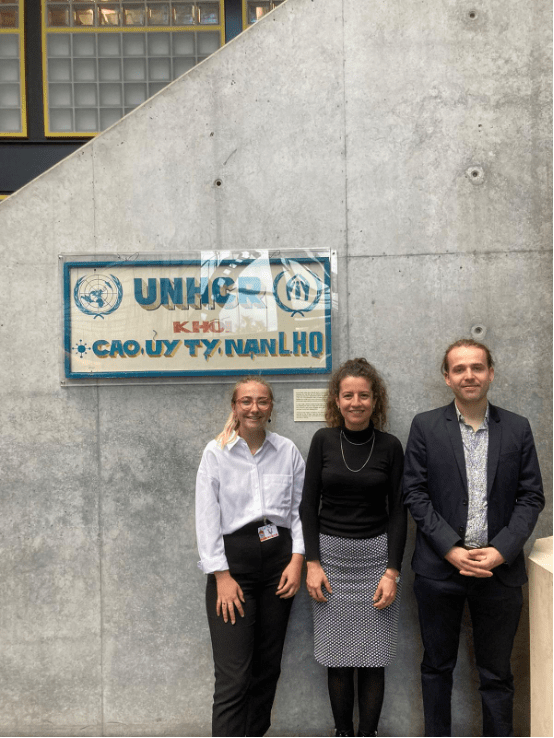
In recognition of their continued association with the project, the Team received the Essex Law School Bursary of the 2021-22 academic year. Furthermore, to promote their findings, the Team were invited by Peter Swiniarski of the HRLU, who hard worked with them all year, to speak at the UNHCR HQ in Geneva on 29 September 2022. They prepared over the Summer and then, with a little specific planning on the night before and in the morning, three of them in person, Arne, Ayşe, and Charlie, with Parkhi joining online from India as she prepared to take up her new position as Assistant Lecturer at Jindal Global Law School, presented in Lecture Room 4 in UNHCR to members of the HRLU and to about 40 field officers around the world.
A picture of the online presentation (inset: ongoing session in UNHCR HQ, Parkhi Saxena presenting online)
It was a fantastic success and the following day, a former Essex student, now based in Mogadishu for UNHCR, Sebastian Herwig, contacted Prof. Geoff Gilbert (who supervised the project) to congratulate them. This was insightful, beyond Masters-level, impactful research that will affect UNHCR, OHCHR and SPMHs as they all seek to enhance the human rights of persons within their mandates.
The Team summed up their year-long experience in a few words:
We were fortunate to work on a project that was incredibly interesting yet very challenging. We hope that the outcomes of our research can make a difference to UNHCR’s and SPMH’s work in building better lives for those forced from their homes.
Faith In Nature has become the world’s first company to officially appoint Nature to its Board of Directors. The precedent-setting move gives Nature a vote on key business decisions with Essex Law School academic and Co-Founder of Lawyers for Nature Brontie Ansell joining the Board as the first representative for Nature.
In a fundamental change to their corporate governance structure and in a first for the business world, the decision from the natural hair care and soap company gives the natural world a voice and a vote on the future of the business.
The company has formally amended its constitution, with the result that Nature is now represented on the Board by an individual who is legally bound to speak on behalf of the natural world. The nominated proxy will speak and vote on behalf of Nature, much as a guardian acts on behalf of a child in the courts of law.
This decision extends a growing legal precedent around environmental personhood – the attribution of legal rights to non-human entities – and presents a fresh opportunity for businesses wanting to reduce their environmental impact.
Simeon Rose, Faith In Nature’s Creative Director and driver of the initiative, said: “We’re delighted to be the first to do this but we don’t want to be the last. Our hope is that other businesses who take their responsibility to the natural world seriously will follow suit – and we’re really happy to share details of how and why we did this. We’ve always wanted Nature to be at the heart of what we do and this felt like this is the next serious step we could take to make that a reality. This is much more than spin: by changing our governance structure we are making sure we’re legally accountable and that what’s good for Nature informs our strategy.”
Rose’s vision has been realised by lawyers that helped pioneer the concept of environmental personhood, Paul Powlesland and Brontie from Lawyers for Nature, and Grant Wilson from Earth Law Centre. Earlier this year, the Earth Law Centre assisted with the high profile legal case to attribute legal rights to Nature in Panama. The legal process with Faith In Nature also received significant support and expertise from a pro bono team of corporate experts at international law firm Shearman & Sterling LLP.
In what will be a rotating position, Brontie will be the first board representative for Nature. Brontie is Director and Co-Founder of Lawyers for Nature and is also a Senior Lecturer in Essex Law School at the University of Essex.
Brontie said: “This will hopefully spark a big change in how the business world perceives and acts on its responsibility to the natural world. For too long Nature has been seen purely as an expendable resource: this kind of thinking has led us to the brink of ecological collapse. It can and must change.”
Grant Wilson at the Earth Law Centre, added: “The movement for the Rights of Nature is picking up momentum across the world, but businesses have been slow to recognise that they are a crucial part of this story. Making Nature a Director is a tangible step that businesses can take to ensure that their operations take into account the rights and needs of the natural world.”
The board representative will work in concert with a committee of environmental experts, to make Nature’s case on all major board decisions. Faith In Nature has decided to open-source the legal process to allow other companies to follow its lead.
This story was first published on the University of Essex’s news webpages and is reproduced on the ELR Blog with permission and thanks.
The adage ‘ignorance of the law is no excuse’ is significantly inaccurate. Ignorance and mistake of law do, under certain circumstances, exclude responsibility both in national and international criminal law.
Dr. Antonio Coco‘s recently published monograph The Defence of Mistake of Law in International Criminal Law updates the existing reviews of law and practice on the topic, aiming to go a step further: it takes the analysis of mistake of law as a starting point for systematic observations about international criminal law in general.
First, the book defines the contours of the defence of mistake of law in the general theory of criminal law, distinguishing it from cognate defences and highlighting, most notably, its connection with superior orders.
Secondly, it gives an overview of the possible approaches to the defence, offering examples from national law as terms of reference for the subsequent analysis of international criminal law.
Thirdly, it surveys the relevant law and practice of international criminal tribunals, with a focus on the International Criminal Court, and it contemplates offences for which a defence of mistake of law may potentially succeed.
Finally, the author tries to interpret what the rules on mistake of law applicable before international criminal tribunals imply about the purpose of punishing individuals and the legitimacy of such punishment.
Published by OUP
Whilst the discourse on international criminal law is more and more concerned with global politics, The Defence of Mistake of Law in International Criminal Law brings back the focus on the appropriateness of imposing a guilty verdict on the individual defendant, a human being constituting the basic unit of each society.
Building on her 15-year research on cybercrime, Dr. Audrey Guinchard, Senior Lecturer at the Essex Law School, gave a presentation on the criminalisation of cybercrime at the 2022 Society of Legal Scholars (SLS) Conference, held on 6-9 September at King’s College London.
In her paper, Dr. Guinchard explained that regulating crime is the traditional domain of nation states; cybercrime is no exception. The first legal instruments to tackle computer-focused crimes (e.g., unauthorised access or hacking) date back to the seventies and eighties. Yet, international institutions such as the OECD and the Council of Europe have quickly recognised the transborder nature of cybercrime, keen to push for the creation of a level-playing field and better cooperation among nation-states. In fact, we could even argue that international efforts of criminalisation are concomitant, if not anticipatory, of national legal instruments on cybercrime.
Dr. Guinchard pointed out that what is less known behind this push for harmonisation is the role of the computing community, a scientific community which has international dialogue at its heart and which has frequently engaged with legal professionals more than legal professionals have engaged with computer scientists. These key features of the criminalisation of cybercrime continue to shape modern legislation as the movement for reforming the UK Computer Misuse Act demonstrates.
Yet, Dr. Guinchard emphasised that blind spots remain: comparative law analyses can be superficial; the international outlook remained dominated by Western/European countries, ignoring the many voices of Asia, Africa and Latin America; the link between improving cybersecurity and decreasing cybercrime remains unappreciated; and criminalisation can carry hidden agendas which turn the fight against cybercrime into a battleground of values, as the recent push for the UN treaty on cybercrime illustrates.
So, if the transborder nature of cybercrime has long been a rallying cry for its worldwide criminalisation, the resulting legal frameworks continue to be subjected to various influences and forces, acknowledged and unacknowledged, leading to a paucity of information as to how effective the law is in tackling cybercrime. Dr. Guinchard argued that reflecting on those pathways to criminalisation may allow us to move away from these hypes and understatements which have marred the field since its inception.
A copy of Dr. Guinchard’s slides can be downloaded below. She can be contacted at this email address: abguin@essex.ac.uk.
Having laid out the horizontal dimensions of diversity in property in Part 1, I here offer a critique of the assumption in mainstream economics that all kinds of property institutions need to be or will be transformed into private property to promote economic development. I also reflect on my previous work that applies and develops Darwinian mechanisms of variation, inheritance, and selection—which have been extensively discussed in evolutionary biology and evolutionary economics—to study property regime transformation in China.
In On the Origin of Species (1859), Darwin specified three mechanisms of evolutionary change—variation, inheritance, and selection. It should be noted that Darwin never liked the word evolution due to ‘his denial of progress as a predictable outcome’ (Gould 1996/2011:137). Gould (1996/2011: 41) argued that ‘Darwin’s revolution should be epitomized as the substitution of variation for essence as the central category of natural reality.’ He further argued:
…in Plato’s world, variation is accidental, while essences record a higher reality; in Darwin’s reversal, we value variation as a defining (and concrete earthly) reality, while averages (our closest operational approach to “essences”) become mental abstractions.
Institutions are, in substance, prevalent habits of thought with respect to particular relations and particular functions of the individual and of the community […] The situation of today shapes the institutions of tomorrow through a selective, coercive process, by acting upon men’s habitual view of things, and so altering or fortifying a point of view or a mental attitude handed down from the past. […] The evolution of society is substantially a process of mental adaptation on the part of individuals under the stress of circumstances which will no longer tolerate habits of thought formed under and conforming to a different set of circumstances in the past.
Changing socio-economic contexts may shift and reframe ‘perceptions and dispositions within individuals’ and give rise to new ‘habits of thought and behaviour’ (Hodgson 2012: 287) and thus new forms of institution. Veblen (1899/2007) termed this phenomenon ‘selection’ as ‘selective adaptation’. Although Veblen ‘did not make the context, criteria or mechanisms of selection entirely clear’, he ‘generally saw institutions as units of selection in a process of economic evolution’ (Hodgson 2012: 291).
In terms of ‘co-evolution’, it is the ‘signature term’ of Richard Nelson. His 1982 book with Sidney Winter An Evolutionary Theory of Economic Change represented the start of the neo-Schumpeterian wave. Most evolutionary economists use the term ‘co-evolution’. Further, the Darwinian mechanisms have been extensively discussed by biologists, institutional and evolutionary economists, for example Parker 1980 (discussing creation, selection and variation) and Luksha 2008 (discussing variation, selection, and niche construction).
Bringing Darwinian ideas and Veblenian institutions to the analysis of property regime transformation, I completed a working paper in 2015 and argued that the works of Darwin and Veblen also contribute to studies of property. The (Darwinian) transformation of property can be elucidated not only by drawing analogies to the Darwinian mechanisms of variation, inheritance, and selection, but also by broadening the scope of the Darwinian framework, from the biological world to human interactions in society.
There are key mechanisms for understanding and analysing the co-evolution of diversity in property and economic development:
Variation: the existence of diversity in property in accordance with dynamic socio-economic conditions.
Inheritance: the persistence and continuity of the old property regime despite legal and political changes.
Selection: the formation of new forms of property more adapted to socio-economic contexts.
Institutions are created or modified to selectively adapt to the changes in socio-economic contexts. But institutions which enable economic development are often brought about by emulation and innovation beyond adaptation. I will leave the discussion of emulation to my next blog posts and focus on innovation here.
To further illustrate the importance of innovation for economic development, we need to bring in Schumpeterian institutions, which are concerned with the importance of innovation in generating new knowledge and modes of production, which helps move the economic activities to the next ‘stage’ or ‘paradigm’ (Reinert 2000: 11). The relevant discussion of Schumpeterian institutions can be found in my previous blog post on ‘Institutions, Economic Development, and China’s Development Policy for Escaping Poverty’.
When we bring in Schumpeterian institutions to Darwinian mechanisms and Veblenian institutions discussed above, the third mechanism can be developed as selection: the formation of new forms of property more adapted to socio-economic contexts; for economic development, selection need to be prompted by emulation and innovation.
All three mechanisms can be found in China’s long-term property (in rural land) regime transformation (see Part 1).
Variation (diversity) existed in all four periods. The introduction of collective ownership to rural China (1956-1978) by political forces did result in the decrease of diversity in property, therefore reducing the degree of resilience of the property regime in instances of natural disasters and economic and political crises.
The attempt to eliminate diversity in property, however, only lasted for a relatively short span of time, as the political programmes could not change the mode of agricultural production, which still relied on household-based productions. Fundamental aspects of the old property regime persisted and continued, despite alterations, if the economic conditions have not been fundamentally changed (inheritance).
The household responsibility system—a development-promoting institution—was introduced in the late 1970s. This rural land management system was adapted to household-based agricultural productions (selection). Once farmers had discharged their duty to meet the grain quota imposed by the state, they could retain their additional production—the grain produced over and above the required quota.
Further, beyond being a property institution formed through selection adaptation, the household responsibility system was also an innovative property institution in the period between the late 1970s and 1980s, which gave incentives to individual farmers and their households to engage in farming within collective ownership of rural land (innovation).
In the 1990s techno-economic development in agricultural production, however, began to require a new mode of production for promoting cooperation and consolidated/industrialised farming. The household responsibility system, which was once an innovative initiative that promoted economic development, had come to function as a roadblock to further development. New development-promoting property institutions were created in the 1990s and further developed to promote the new mode of production, initiating a process of ‘creative destruction’.
Property regime transformation in the broad sense does not indicate either a clear trend or a foreseeable outcome; it need not be progressive. By contrast, innovative property transformation with reference to Schumpeterian institutions conveys a positive connotation of enabling economic development and structural change, which may not be a smooth process. Property evolution in the broad sense conveys a positive connotation (it may even contain a teleological element), but not necessarily the identical form of connotation found in innovative property transformation.
In conclusion, the transformation of property is neither a spontaneous process nor a process solely prompted by external factors; it does not move towards a predictable outcome. Diversity in property and economic development co-evolve. We need to examine changing contexts, in particular techno-economic change over time rather than a linear, normative series of changes such as from communal property to private property, as the inevitable result of property regime transformation.
This article first appeared on Developing Economics and is reproduced on the ELR Blog with permission and thanks. You can read the original post here.
This blog post builds on the ‘Institutions, Economic Development, and China’s Development Policy for Escaping Poverty’ piece and comprises two parts dealing with the key concepts (Part 1) and mechanisms (Part 2) for evaluating the co-evolution of diversity in property and economic development. I argue that diversity in property plays a key role in economic development and that there are two dimensions that are important for examining the co-evolution of diversity in property and economic development—horizontal (Part 1) and vertical (Part 2).
In this post, I offer a critique of the assumption in mainstream economics that private property is the only kind of property institutions that can stimulate and preserve economic development (I am, of course, not the first to offer critiques of this assumption; for existing studies, see e.g., Kennedy 2011). I focus on the meaning of ‘diversity in property’, which concerns the horizontal level analysis.
Introducing the concept of ‘diversity’
‘Diversity’ means ‘many different types of things or people being included in something.’ Professor Erik Reinert introduced me to the concept of ‘diversity’ and encouraged me to examine the nature and significance of diversity in institutions such as property and the co-evolution of diversity in institutions and economic development. I started my research in this area by co-authoring a working paper on ‘Declining Diversity and Declining Societies: China, the West, and the Future of the Global Economy’ with Erik in 2013.
In our co-authored paper, Erik and I examined diversity not only as part of nature’s strategy for the survival of species from natural shocks but also as a strategy consciously employed in human societies for the same reason. We argued that diversity constitutes a key element in economic development. Starting in the 1400s, Europe—and later the West in general—experienced an explosion of intellectual creativity and economic development, due to increasing diversity in polities, policies, cultures and ideas. Simultaneously, China started a process of de-diversification in that period and fell behind. We were worried about the lack of concern for diversity in today’s mainstream economics and development policies.
Due to diminishing diversity in mainstream economics and development policies, economists and policy makers tend to see ‘all economic activities as either being qualitatively all alike or all different’ (Reinert 2000: 180) and changes to be predicted or prescribed. When this pattern of thinking is transferred to evaluate the nature of property and the process of property regime transformation, the importance of ‘strong and clear’ property rights is emphasised as if they were a panacea that can create and preserve a well-functioning market. Further, to promote economic growth, other kinds of property institutions need to be transformed into private property as ‘good institutions’ understood by the World Bank (discussed in my 2017 paper). Diversity in property is eliminated.
Diversity in property
When examining the nature and significance of diversity in property, I see diversity in property as a ‘development-promoting’ institution, in contrast to what is considered ‘good institutions’ by the World Bank, which tends to focus more on eliminating corruption and securing private property. To understand the nature and significance of diversity in property, we need to clarify some basic concepts.
First, property refers to both a resource over which an individual, a community or the state has overall control and the way a resource is managed and regulated by an individual, a community or the state. Property is more concerned with how a resource is used, managed, or governed rather than how it is owned. Communal property, for example, means ‘a resource over which a community and its members together have overall control and the way a resource is managed and regulated by a community for its collective purposes’. The term ‘property’ is more helpful than ‘ownership’ especially in the Chinese context where ownership is defined by the owner’s identity (which gives little information on how the resource is used and governed) and closely associated with ideology.
Second, the concept of private property is both ambiguous and broad: individual and corporate ownership are ‘private’, while ‘government ownership of resources such as office buildings [is also] essentially private’, as Davies (2007: 63-64) argued. When referring to a resource controlled by a human person, it is better to use the term ‘individual property’ rather than ‘private property’.
Third, within communal property, individual property rights/interests may co-exist with communal property rights/interests. Here I use ‘individual property rights’ rather than ‘private property rights’ which may be held by either a human being or an artificial legal entity. The ‘household responsibility system’ introduced in China in the late 1970s is a classic example. The collective issues contracts to the household, which has responsibility for the management of farming an area of land called ‘responsibility land’. Farmers have an individual property right/interest in rural land to possess and use it for farming purposes.
The ‘responsibility land’ is subject to the farmer’s individual property interests and various layers of communal property interests including the household’s interest and the collective’s interest. Although diversity in property is not unique to China, the household responsibility system is an innovative development-promoting institution introduced in China in the late 1970s, while the ideological function of collective ownership of rural land is preserved but less constrained for individual and communal property rights performing their economic functions.
Diversity in property in China
Diversity in property has a much broader scope than that of diversity in ownership. The latter exists in China’s ‘socialist market economy’ with a mix of state ownership, collective ownership, and individual ownership. Diversity in property differs from the evolution of diverse forms of property, for example, from communal property to individual property or from informal property to formal property. These are different forms of property existing at different times.
To use my previous work as an example, my book The Revival of Private Property and Its Limits in Post-Mao China discussed the re-emergence and recognition of private property rights in the context of China’s social and political transformation and economic development since 1978. Illustrative cases include the revival of private property rights in the reform of State-owned enterprises (SOEs) and development of township and village enterprises (TVEs). The focus was on diverse forms of property.
After my 2014 book, I moved my research area from examining diverse forms of property at different times to diversity in property. Two research projects facilitated this new area of research. I was awarded two research projects on diversity in 2014: declining diversity and the global economy funded by the European Commission, Joint Research Centre (completed in 2015); ‘Diversifying Ownership of Land?: Communal Property in the UK and China’ funded by the British Academy International Mobility and Partnership Scheme 2014-17 (completed in 2017).
The meaning of diversity in property (in rural land) in the Chinese context is elaborated in the following table, focussing on four key periods of property regime transformation. The collectivisation period (1956-1978) is not included, as diversity in property was virtually eliminated in this period. Diversity in property includes two levels:
the coexistence of different types of property;
within communal property, the coexistence of individual and communal property interests.
Table 1 below demonstrates that diversity existed in most parts of China’s long-term property regime transformation except the collectivisation period.
Table 1: Property regimes across vertical and horizontal dimensions
Diversity in property, offering a better reflection of China’s socio-economic realities than diversity in ownership, plays at least three important functions in reshaping development policies:
it shifts the focus away from ideological debate on public versus private dichotomy;
it directs the focus to thinking about how a resource can be better governed;
it directs policies to match context.
In Part 2 of this post, I explore the vertical dimension of the co-evolution of diversity in property and economic development by focussing on some key mechanisms informed by evolutionary economics.
This article first appeared on Developing Economics and is reproduced on the ELR Blog with permission and thanks. You can read the original post here.













 Essex Law Research Blog