Maurice Sunkin QC (Hon), Professor of Public Law in the School of Law, University of Essex and Dr Susan McPherson, Senior Lecturer in the School of Health and Social Care, University of Essex have published an article entitled ‘The Dobson-Rawlings pact and the National Institute for Health and Care Excellence: Impact of Political Independence on Scientific and Legal Accountability’.
The article, an example of the rich possibilities for cross-disciplinary work on law and health matters, considers whether the independence of the National Institute for Health and Care Excellence (NICE), while safeguarding guidelines from commercial lobbying, may render NICE legally and scientifically unaccountable.
The analysis examines the role of judicial reviews and stakeholder consultations in place of peer review in light of current debates concerning the depression guideline.
The full article is published in Volume 216, Issue 4 (pp. 231-234) of The British Journal of Psychiatry and can be accessed here. The full text is available here.
The UK government proudly affirms that the country has some of the strongest equalities legislation in the world, particularly the Equality Act 2010. For it to be true, however, the government should implement the legislation in its entirety, including the socio-economic duty, proclaimed in Section 1 of the Act.
The socio-economic duty would require public authorities to actively consider how their decisions and policies of the highest strategic importance can increase or decrease inequalities of outcome. Regrettably, successive governments have failed to commence the duty, and therefore it is not technically binding on public authorities. It is encouraging that the duty was brought to life in Scotland in 2018 and the Welsh Government has announced they will follow suit in 2020.
The socio-economic duty can be a useful lever to understand and address the structural causes of material inequalities and their negative effects on human rights and well-being.
This article presents and draws conclusions from the strategic choices made by the people running a national campaign to bring the socio-economic duty to life. The article introduces four key factors that contributed to making progress between 2017 and 2019, despite the limited resources available: a) the added value of merging advocacy and epistemic communities working on equality and on human rights; b) the engagement with political actors at key stages of the process; c) the combination of ‘naming and shaming’ and best practice; and d) the celebration of smaller victories along the way.
The socio-economic duty, and this article in particular, are cited in an Amicus in front of the Supreme Court of Mexico on the State’s duty to include informal settlements in the census and other appropriate data collection. The Amicus is presented by Dr Koldo Casla and nine national and international organisations that are part of the International Network of NGOs for Economic, Social and Cultural Rights (ESCR-Net).
You can also read ‘Time to listen to people with lived experience of poverty and bring the socio-economic duty to life’, a chapter written by Koldo Casla together with colleagues from Just Fair, Joseph Rowntree Foundation, the University of York and Thrive Teesside, in UNISON’s recent publication (pp. 83-90) on the commemoration of the pledge made two decades ago to end child poverty in the UK this year. (Spoiler alert: It didn’t happen, and in fact, the country moved in the opposite direction in recent years).
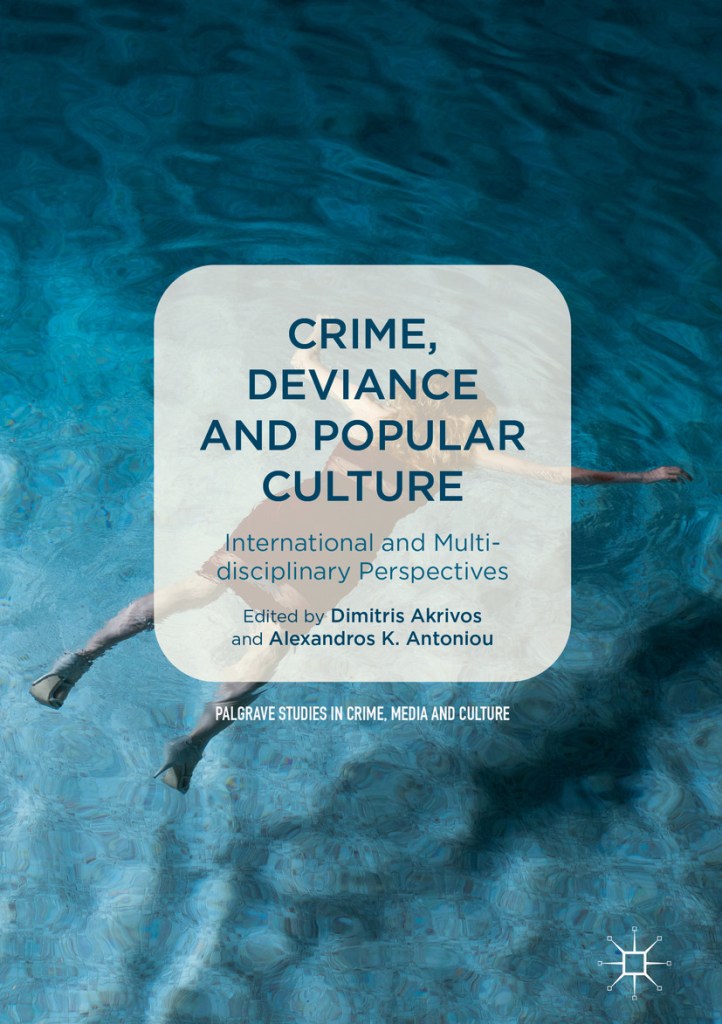
The book explores the links between crime, deviance and popular culture in our highly-mediatised era, offering an insight into the cultural processes through which particular practices acquire a criminal or deviant status, and come to be seen as social problems.
Crime, Deviance and Popular Culture brings together European, American and Australian scholars with various specialisms to provide an up-to-date analysis of some topical issues in 21st-century popular culture. Its chapters look at different aspects of popular culture, including fictional portrayals of the law and criminal justice system, the true crime genre, popular media constructions of sexual deviance and Islamophobia, sports, graffiti and outlaw biker subcultures.
The collection, which was among the top 25% most downloaded eBooks in Palgrave’s Crime, Media and Culture series in 2019, has been praised by reviewers for its ‘admirably broad’ scope (see Ashley Pearson, Ksenia Gałuskina and Thomas Giddens (2019) 32(2) International Journal for the Semiotics of Law 523).
By producing new empirical data through a wide range of case studies, it makes an original contribution to several disciplines, including criminology, sociology of deviance, social anthropology, media studies, cultural studies, television studies and linguistics.
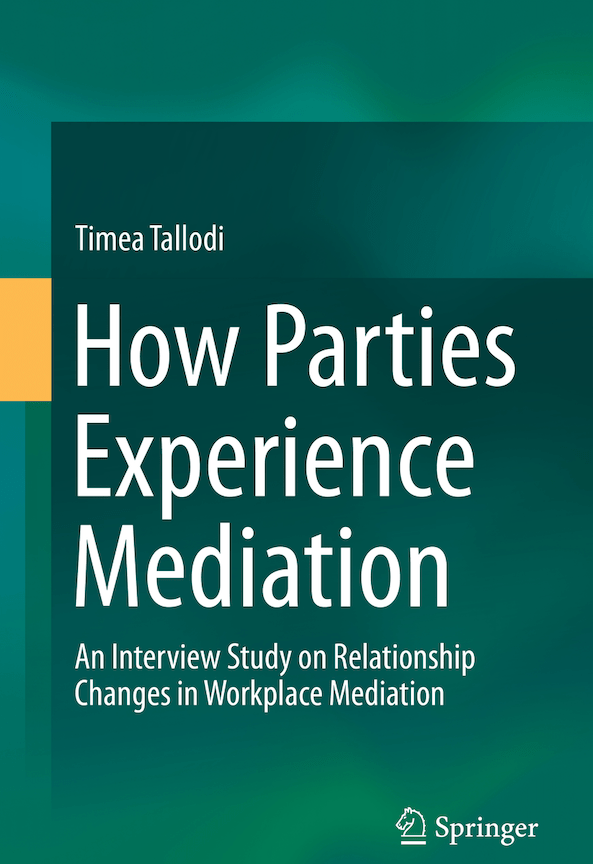
Dr Tallodi’s book is a detailed report of the first study in the literature that uses in-depth interviews with mediation parties and the qualitative methodology of interpretative phenomenological analysis in order to explore participants’ lived experiences of conflict and mediation.
The study focuses on exploring relational changes from the participants’ perspectives. Whilst mediation’s potential to induce changes in parties’ relationships as an advantage of the process is commonly mentioned in the literature, and is identified as a key to reconciliation, this topic has until now not been the object of interpretative qualitative enquiry.
The book combines truly interdisciplinary perspectives, drawing on the literatures on alternative dispute resolution, psychology and business. The applied methodological approach of interpretative phenomenological analysis, a popular methodology in psychology and an increasingly applied approach in other disciplines, e.g. human resources, occupational therapy, and management, adds to the interdisciplinary nature of the study. The phenomenological stance applied throughout the research process ensures a particularly rich data set and a nuanced interpretative analysis.
This pioneering research study seeks to enter mediation parties’ true experiences as closely as possible, moving beyond pre-existing theoretical, quantitative and large-scale qualitative explorations. The themes drawn out in the course of the analysis are discussed in the context of theory, research, and practice.
Dr Tallodi’s book advances knowledge about mediation both in relation to theory and practice. Whilst the study has been conducted in the employment context, it has implications for all areas of mediation where parties tend to have an on-going relationship after mediation, including cases in the fields of family, divorce, commercial, civil and peer mediation. The book offers innovative conclusions and recommendations for developing mediation practice, mediation training programmes, and further research.




 Essex Law Research Blog