COVID-19 Research on Vulnerable Communities Proves Influential

Photo by Kate Trifo

A publication featuring rapid responses to the impact of COVID-19 from a range of Essex experts has been recognised as influential by a panel providing evidence to government.

COVID-19, Law and Human Rights: Essex Dialogues, a 32-chapter collection featuring contributions from the School of LawHuman Rights Centre and School of Health and Social Care, has been cited in a new summary of research on the impact of COVID-19.

The summary, Rebuilding a Resilient Britain: Vulnerable Communities, looks at the relevant expert evidence in 11 Areas of Research Interest (ARIs), selected by Chief Scientific Advisors within the Government Office of Science.

The contributions of Essex experts are noted under two ARIs: “the role of local authorities in protecting vulnerable populations”; and “analysis of whether, where and how states or non-state actors use the disruption caused by the crisis to curtail minority rights or promote ideologies”.

Dr Carla Ferstman, who co-edited the Essex collection, said: “The goal of the publication was to bring together the widest possible array of scholars to think through the multiple, intersecting impacts of COVID-19, and to help frame the global research agenda. The interest in COVID-19, Law and Human Rights: Essex Dialogues has exceeded our initial expectations. It has fostered interdisciplinary research and has led to important new collaborations within academia and in numerous policy domains.”

COVID-19, Law and Human Rights: Essex Dialogues has been downloaded over 2,700 times since its publication in July 2020, making it the most downloaded single publication in this period on the University’s Research Repository. The individual chapters from the publication have resulted in an additional 5,500 downloads.

ARIs were developed as a result of the Nurse Review of Research Councils, which called on government departments to communicate clearly where their research objectives lie. The ARIs are an annually-updated list of priority research questions, chosen from a list of topics identified by government departments, which in turn invite academics to engage with government departments to inform policy making.

The report was produced by the Vulnerable Communities Working Group, which comprises 26 members including academics, civil servants, funders and civil society groups.

The foreword to their report notes: “Working across government and drawing from the extensive expertise of our academic community will be essential in the recovery from the COVID-19 pandemic, to rebuild a resilient Britain.”

This post originally appeared on the University of Essex news webpage and is reprocuded here with permission and thanks.

‘Old-fashioned alpha males’ against ‘professional homosexuals’: media justice and discriminatory reporting in the wake of the Greek #MeToo movement

Dr. Dimitris Akrivos, Lecturer in Media Law, University of Essex

From the exposure of Hollywood producer Harvey Weinstein’s crimes to the Westminster sexual harassment scandal, the #MeToo movement has in recent years spread around the world, empowering survivors of sexual violence to share their traumatic experiences on social and news media. It was not until January 2021, however, that the impact of the movement became apparent in Greece.

Talking in an online event about the protection of children in sports on the 14 January 2021, Greek Olympic medallist Sofia Bekatorou publicly accused the vice president of the Hellenic Sailing Federation of sexually assaulting her in 1998. Bekatorou’s allegations led to the emergence of the hashtag #metinSofia (i.e. with Sofia) on Twitter with many other athletes but also actresses, singers and influencers following her example and reporting their own experiences of physical and/or psychological victimisation by powerful men (including famous actor Giorgos Kimoulis as well as actor and former Deputy Minister of Social Security Pavlos Haikalis). It was no surprise that, due to the celebrity status of many of the alleged victims and perpetrators, such claims dominated the Greek news agenda during these past two months alongside stories about the COVID-19 pandemic.

In February 2020, the Greek #MeToo movement acquired even greater momentum with clear political ramifications when former director of Greece’s National Theatre Dimitris Lignadis was remanded over allegations of serial rape – some of which involved underage victims. Responding to criticisms for appointing Lignadis, culture minister Lina Mendoni stated that he is a ‘dangerous man’ who ‘deceived her’ and ‘with deep acting talent tried to convince her that he had nothing to do with all this’. At the same time, Lignadis’ defence attorney Alexis Kougias dismissed the allegations against his client as a ‘crude fabrication’ made by ‘professional homosexuals’.

The news media’s involvement in Lignadis’ and all the other cases forming part of the Greek #MeToo movement constitutes an indicative example of what Greer and McLaughlin (2010: 27) define as a trial-by-media: ‘a dynamic, impact-driven, news media-led process by which individuals – who may or may not be publicly known – are tried and sentenced in the “court of public opinion”.’ In the era of 24/7 news, media seek to perform an alternative function of ‘justice’ which runs parallel to that administered by formal institutional authorities. There is an undeniable benefit in shedding light to such historic cases of sexual violence and thereby encouraging an honest, free-from-stigma discussion around the issue. Despite its belated emergence (or possibly because of it) the Greek #MeToo appears to extend the boundaries of the movement even further by also placing emphasis on cases of gender-based workplace bullying as well as male victimisation.

The shortcomings of this ‘trial-by-media’, however, including its impact on the defendant’s right to a fair trial, the consequent reputational damage and the risk of vigilantism also need to be taken into consideration. In the context of the ongoing discussion on the allegations made, journalistic objectivity and due process can easily give way to moralising, sensationalist speculation about the motives and actions of the accused who are assumed to be ‘guilty until proven innocent’ and therefore deserving to be ‘named and shamed’.

In addition, the homophobic dimension of some of the relevant mediated discourse also need to be highlighted. From the Greek state television censoring a gay kiss from an episode of Downton Abbey to bishop Amvrosios publicly urging people to ‘spit on gays’ because they are ‘freaks of nature’ and the killing of LGBT+ activist Zak Kostopoulos by the police, there is still a lot of progress to be made in order for LGBT+ people to achieve equal rights in Greek society. This is something that became even more apparent with the recent rise of the Greek #MeToo.

Apart from Kougias building Lignadis’ defence around claims (in Greek) of ‘crude lies’ told by ‘professional homosexuals’ who are ‘untrustworthy personalities’, the language used in some relevant news stories in the Greek press has been salacious, offensive and discriminatory: indicatively, tabloid newspapers ran controversial front-page stories with headlines like ‘Fa—[anti-gay slur] and paedophile bathhouse brings down the government’ (Makeleio, 20 February 2021), ‘Dirty nights with Ali and Saleem: dark-skinned boys at Lignadis’ disposal’ (Espresso, 25 February 2021) and ‘Homosexuals, perverts and paedophiles run the country with Mitsotakis [the incumbent Greek PM] in charge’ (Makeleio, 27 February 2021).

Such stories clearly associate homosexuality with paedophilia, creating a ‘signification spiral’ (Hall et al., Policing the Crisis, 1978) in the context of which both behaviours are constructed as sexual ‘perversions’. Such an association is intrinsically linked to and largely legitimised by the patriarchal discourse used by some of the accused to explain their actions – for example, Haikalis’ claim that he is an ‘old-fashioned alpha male’ – which also favours a view of non-heterosexual masculinities as deviant and socially reprehensible (Buchbinder, Studying Men and Masculinities, 2013).

There is extensive research on moral panics and the media’s role in marginalising social groups, portraying them as ‘folk devils’ who allegedly behave in ways that pose a risk towards society’s dominant moral values (Cohen, Folk Devils and Moral Panics, 2002[1972]). The aforementioned homophobic reporting can largely be made sense of within this framework. What is disconcerting, however, in the case of Greek media is not merely the exposure but most importantly the limited protection offered to LGBT+ people against such prejudicial and sensational media coverage on a regulatory level.

On the one hand, ESIEA, which is main trade union of Greek journalists based in Athens, provides in its Ethical Guidelines for Journalists (in Greek) that news reporting should be free from ‘discrimination based on nationality, sex, ethnicity, religion, political beliefs, financial situation and social status’ [Article 2(a)]. Although discrimination on the basis of gender identity or sexual orientation could in principle fall under the broad category of ‘social status’, it could be argued that the Code’s failure to refer explicitly to this particular form of discrimination creates an ambiguity which allows cases of homophobic reporting like those mentioned earlier to emerge without any threat of serious sanctions.

On the other hand, the National Council for Radio and Television (NCRT), which is the main regulator for public and private broadcast Greek media, seemingly adopts a more inclusive approach in its Code of Ethics for News and other Current Affairs and Political Programmes (in Greek): Article 4.1 of the Code specifically states that discriminatory reporting based on sexual orientation is not allowed while Article 4.2, which prohibits demeaning comments towards ‘ethnic and religious minorities and other vulnerable or powerless social groups’ (emphasis added), potentially covers sexual minorities too even if these are not explicitly mentioned.

This prima facie protection from discriminatory reporting offered by the NCRT Code to LGBT+ people is contradicted by the Council’s regulatory practice which has on several occasions led LGBT+ supporters to accuse NCRT of institutional homophobia and transphobia. For instance, in 2013, NCRT rejected (in Greek) the request of the Athens Pride organisers to air the event’s TV spot on all major Greek TV stations free of charge on the grounds that the spot ‘could not be described as one with a social message’.

Similarly, in 2010, NCRT imposed a fine of €20,000 on the Star Channel afternoon show Fotis and Maria Live for interviewing trans actress and author Betty Vakalidou based on the following rationale (emphasis added):

‘the issue of homosexuality (the sexual preference for individuals of the same sex) and of sex change with or without surgical intervention that was presented in the show constitutes a social issue and a reality that concerns only a small minority of people. It constitutes a condition that goes beyond the normal and, for that reason, it largely sounds strange to the underage viewer… The presentation of information about the sex life of homosexuals or transsexuals, about the sex change procedure and the feelings and experiences of the woman being interviewed, could possibly have a negative impact on underage viewers.’

Such discourse not only fails to protect LGBT+ people from discrimination but has the potential to add to their vulnerability and marginalisation even further by portraying them as ‘others’ who live outside the boundaries of the normal, heterosexual society. By prioritising a moralistic argument about how a discussion on LGBT+ issues might affect underage viewers, it also neglects the impact that prejudicial media portrayals or the lack of media representation can have on LGBT+ people’s mental well-being, self-image and aspirations. Positive LGBT+ representation in the news and entertainment media can play a key role in promoting social acceptance and tackling homophobic and transphobic violence. In a country like Greece where, according to a 2020 survey by the EU Agency for Fundamental Rights, 73% of LGBTI individuals avoid holding hands in public out of fear of being assaulted, threatened or harassed (one of the highest percentages among the 28 EU member states), it is profoundly disappointing and alarming that regulatory bodies like the NCRT fail to see the importance of responsible media reporting in creating a more inclusive Greek society and thereby improving LGBT+ individuals’ quality of life.

Finally, it is worth noting that, in our multi-mediated world, those identified as ‘folk devils’ and their advocates can use different outlets to challenge their demonisation in mainstream media instead of being completely defenceless against it. Following Kougias’ statement about his client’s reputation being tarnished by ‘professional homosexuals’, several well-known public figures hastened to criticise the lawyer’s language on news and social media: songwriter Foivos Delivorias condemned (in Greek) Kougias’ attempt to associate homosexuality with paedophilia and rape while, in a sarcastic move, both he and journalist Elena Akrita changed their employment statuses on Facebook to ‘Employed at Professional Homosexuals’.

The power to resist the conservative ideology of traditional media, however, does not change the fact that more work is required by media professionals and the relevant authorities in order to approach and report on the complex issues raised by the #MeToo movement sensitively. The Greek #MeToo movement can be seen as a tipping point which has the potential to effect societal change by eliminating the stigma attached to those issues and encouraging an open dialogue around them. But, as shown by some of the news coverage in former National Theatre director Dimitris Lignadis’ case, more responsible reporting is needed for this potential to be materialised.

In an attempt to show it is taking these allegations seriously (and perhaps also to divert attention away from its own unforeseen implication in Lignadis’ scandal), the Greek government set up the website metoogreece.gr to provide victims with the contact details of relevant support services. Allegations of rape, sexual assault, paedophilia and bullying against Lignadis and other powerful men of the Greek show business still dominate the Greek media at the time of writing. The exact number of victims and perpetrators, the actual impact of the ongoing ‘trial-by-media’ on due process and ultimately the extent to which the Greek #MeToo movement will succeed in rocking the hetero-patriarchal foundations of the Greek society remain to be seen.

This piece was originally published on The International Forum for Responsible Media and is reproduced here with permission and thanks.
Galindo: COVID-19 Unearths Ghosts of Spain’s ‘Dirty War’

The death of a former General convicted for murder divides Spain

Enrique Rodríguez Galindo. Screen capture of TV channel LaSexta’s video on YouTube

Dr. Koldo Casla, Lecturer in Law, University of Essex

Enrique Rodríguez Galindo died on February 13, 2021, with COVID-19, at 82 years of age.

The former general of Spain’s gendarmerie force, the Guardia Civil, Rodríguez Galindo headed the garrison of Intxaurrondo in the Basque city of Donostia-San Sebastián in the 1980s and 90s. At that time, police officers were frequently targeted by ETA, the Basque pro-independence armed group that extorted and threatened thousands of people, killing 850 over half a century until it was forced to put an end to its violence in 2011. Lack of popular support and effective police action were important factors for why ETA came to an end.

Rodríguez Galindo was in charge of anti-terrorism action in very difficult circumstances. Yet, he was also a kidnapper and a murderer himself.

This is what Spain’s High Court concluded in 2000, and it was confirmed a year later by the Supreme Court. Rodríguez Galindo was sentenced to 75 years in prison for ordering the kidnapping and killing of José Antonio Lasa and José Ignacio Zabala. They were tortured and executed in 1983 by death squads known as GAL, the “Antiterrorist Liberation Groups.” They were buried with quicklime in the mistaken expectation that the chemistry would make the remains disappear for good. The bodies were found in 1985, and medical examiners could identify them only in 1995.

Out of 75 years, Rodríguez Galindo only spent five in prison. He was granted a partial release in 2005 and parole in 2013.

In 2021, Rodríguez Galindo’s death awoke Spain’s ghosts of the past.

Secretly funded by the Spanish Government, GAL was responsible for no fewer than 27 extrajudicial executions between 1983 and 1987 in what is known as the “dirty war”.Some victims were alleged ETA members, such as Lasa and Zabala, others simply bystanders in the wrong place at the wrong time. In 1998, Spain’s Home Secretary José Barrionuevo and his deputy Rafael Vera were imprisoned for their responsibility in GAL; Felipe González, Prime Minister at the time, was photographed hugging them goodbye at the jail’s gate. In an interview in 2010, González declared cryptically: “I had to decide whether to blow up the leaders of ETA. I said no. And I don’t know if I made a mistake.” Much has been speculated about González’s involvement in GAL, but so far nothing sufficiently definitive has been proven.

As pointed out by the scholar Omar Encarnación, GAL was “a continuation rather than a departure of the State’s counter-terrorism strategies” after Franco’s dictatorship, which ended in 1975. GAL was the result of a less than perfect transition to democracy, where institutions were not cleaned up, resulting in the lack of democratic control over the police, the militarized Guardia Civil, and the military intelligence. GAL’s existence also emboldened ETA, giving them discursive ammunition to dispute the democratic character of Spain, and offering them the chance to present themselves as victims of state-sponsored repression.

Some of the reactions to Rodríguez Galindo’s death are proof that segments of Spanish society have a lot of work to do to face their demons.

In its obituary, the widely sold newspaper El País spoke of the General’s “dazzling record of service,” tainted only by the “shadow” of “supposedly being part of the so-called dirty war.” One would think that the word “supposedly would no longer be necessary considering Galindo’s court sentence.

Macarena Olona, Member of Parliament of the far-right Vox, the third-largest party in Spain, wrote on Twitter: “May the earth rest lightly on you, my general.”

“May the earth rest lightly on you, my General. Today, more than ever, Intxaurrondo is in our hearts. Rest in Peace.”

On the same social platform, her fellow party member sitting in the European Parliament, Jorge Buxadé, wished that “perpetual light shine upon him.”

The death of General Rodríguez Galindo is another opportunity given to us by social media to block, denounce and identify the accounts of those who live and promote hatred of Spain and its laws.

May he rest in peace. And may the perpetual light shine upon him.

The sister of one of Rodríguez Galindo’s confirmed victims, Pili Zabala said on television on February 14 that she had tried to get in touch with Rodríguez Galindo to urge him to take responsibility for the pain he had caused her family. She wanted him to admit what he did had been wrong, but she never heard back from him. Now, Zabala is seeking full accountability: Galindo “was an army man, he was obeying orders, and it is clear to me that he received orders from his superiors, who were politicians.” Zabala is hoping that former Prime Minister Felipe González will eventually sit in the dock.

In 2000, Provincial Governor in Donostia-San Sebastián, Juan María Jauregi, had given evidence in court about Rodríguez Galindo’s involvement in the killing of Lasa and Zabala. Twenty years later, in light of a Twitterstorm of eulogies for the general hours after the announcement of his death, Jauregi’s daughter, Maria Jauregi, shared:

These words by my father come to mind, which I will never forget: “I don’t know who will kill me, ETA or Galindo himself”

It was ETA in the end, and it happened in 2000. His widow, Maixabel Lasa, and their daughter, Maria, became two of the most powerful voices against hatred and for justice and reparations for all victims of human rights abuses in the Basque Country.

Today, it is worth recalling these words by Pablo de Greiff, the former UN Special Rapporteur on Truth, Justice and Reparations, after his mission to Spain in 2014:

“The strength of democratic institutions must be measured not by their ability to ignore certain issues, especially those that refer to fundamental rights, but rather by their ability to manage them effectively, however complex and awkward they may be”.

This piece was first published on Global Voices and is reproduced here under a Creative Commons Licence.

Capabilities, Capacity and Consent: Sexual Intimacy in the Court of Protection

Photo by Sinitta Leunen

Dr. Jaime Lindsey, Lecturer in Law at the University of Essex has a new article published in the Journal of Law and Society. The article is entitled ‘Capabilities, capacity, and consent: sexual intimacy in the Court of Protection’ and is co-authored with Professor Rosie Harding of the Birmingham Law School.

The article uses original data from research at the Court of Protection to explore capacity to consent to sex in practice. It argues that the approach under the Mental Capacity Act 2005 fails to place appropriate focus on consent as central to understanding sexual capacity.

The capabilities approach to justice is then used to demonstrate the limitations of the existing legal approach to capacity to consent to sex, and to argue that the protective focus of the legal test would be better centred on the social risks resulting from non‐consensual sex and exploitation.

Finally, the article argues that, rather than focusing on a medicalized approach to understanding sexual intimacy, an analysis based on capabilities theory provides conceptual tools to support arguments for additional resources to help disabled people to realize their rights to sexual intimacy.

The article is published Open Access and is available here.

Supporting the Colombian Transitional Justice Process

Image by Pixabay

GCRF@Essex interview questions: Prof. Sabine Michalowski and Prof. Clara Sandoval-Villalba

Partners/organisations: Dejusticia, a Colombian Think-Do-Tank

What is your research about?

Colombia and the FARC (Revolutionary Armed Forces of Colombia—People’s Army; Spanish: Fuerzas Armadas Revolucionarias de Colombia) signed a comprehensive peace agreement in 2016 which devises a transitional justice system to respond to the atrocities suffered by more than 9 million victims over various decades of armed conflict. The focus of our research is the transitional justice system (mechanisms and processes) which was designed by the peace agreement. In particular, our research focuses on one of the key transitional justice mechanisms: the Special Jurisdiction for Peace (SJP), which was created to ensure accountability for the atrocities, especially on how its work can be supported and strengthened to fulfil victims’ right to justice, reparation, and truth.

What activities did your GCRF@Essex funding support?

Our GCRF@Essex funding supported trips to Colombia to build and strengthen networks and contacts, hold events such as meetings with colleagues at the Special Jurisdiction for Peace about the challenges they are facing. We also organised meetings to receive feedback from relevant stakeholders on our research, and on future research that would be of relevance for Colombian transitional justice actors.

We also hired Colombian researchers to write policy papers and other documents, for example, a guide on how the Colombian Special Jurisdiction should deal with economic actors and how to define legal concepts that are of crucial importance for the work of the Special Jurisdiction for Peace. We launched these publications at events in Bogota.

We also obtained GCRF@Essex funded fellowships for several Colombian colleagues to attend the Human Rights Centre Research Methods summer school at Essex or to spend some research time at Essex to develop further research projects. For example, a key GCRF@Essex funded activity was to carry out joint research with Dejusticia, a Colombia-based research and advocacy organisation dedicated to the strengthening of the rule of law and the promotion of social justice and human rights in Colombia and the Global South. We successfully applied with Dejusticia colleagues to an AHRC GCRF urgency funding call and are currently working with Dejusticia and the Bonavero Institute for Human Rights at the University of Oxford on the AHRC funded project: Legitimacy, accountability, victims’ participation and reparation in transitional justice settings – lessons from and for Colombia. GCRF@Essex funds have supported our work on various legal and other issues that have emerged from this AHRC grant. For example, work on potential alternative sanctions for those responsible for mass atrocities who confess their crimes before the Special Jurisdiction for Peace.

You have been looking at the Special Jurisdiction for Peace (SJP) in Colombia, how is your project benefitting the country and which Sustainable Development Goals (SDGs) are being addressed?

Our project benefits the country by strengthening the work of the Colombian Special Jurisdiction for Peace (SJP), which plays a central role for ending impunity, achieving accountability for conflict related crimes and justice for victims. Through assisting the SJP we ultimately support the goals of consolidating peace and promoting reconciliation. The SJP is working under enormously challenging circumstances, as Colombia is a highly polarised country and the implementation of the peace agreement, and the legitimacy of the SJP, are highly contested. In that context, it is of crucial importance to support the SJP’s work. The legal framework within which this jurisdiction is working is new not only in Colombia but also worldwide. Colombia’s transitional justice approach is highly innovative and ambitious and that translates into big challenges that need to be overcome on a daily basis. The daily work of the SJP raises many conceptual challenges that are relevant for advancing SDGs 16 (Promoting Peace, Justice and Strong Institutions), 10 (Reducing Inequalities), and 5 (promoting gender equality). Our research contributes to Colombia’s achieving these goals by providing urgently needed recommendations to the SJP, particularly on key legal concepts such as the criteria for the selection of cases, victim participation and reparation. All of this strengthens the work of the SJP.

What tips would you give to other people applying for projects funded by the Global Challenge Research Fund?

The main advice would be to invest a lot of time and effort in building in-country academic and non-academic networks and devise projects with partners and stakeholders in the relevant countries to maximise the impact of the research.

Your GCRF activities have involved various colleagues from Colombia, especially Dejusticia and the SJP, how did you find your collaborators?

Initially, we built the connection with Dejusticia more than a decade ago, in the context of a project focused on linking corporate accountability and transitional justice, funded by a British Academy UK Latin America links grant. To that event, we invited a colleague from Dejusticia to a seminar at Essex who then contributed to an edited collection that followed from that project. We sustained and broadened our links with Dejusticia through regular visits to Colombia where we would hold meetings with them and gradually started to design and carry out joint projects.

Collaboration with the Special Jurisdiction for Peace partly came about through professional contacts who work at the SJP, but also through regular meetings jointly organised with Dejusticia where we would provide a space to exchange experiences and be kept updated with the main challenges the SJP is facing. This information feeds back into our work and makes it relevant to the work of the SJP which in turn helps to broaden our networks in Colombia.

What were the main challenges you encountered working on these collaborative projects?

Obtaining the necessary funding to keep the projects going and finding the time for our involvement.

How do your GCRF funded projects support your wider research plans?

Our research plans have greatly benefited from GCRF funding, as our research is impact focused and the GCRF funded projects permitted us to focus on our areas of interest while at the same time devising impact work which we consider of significant importance in the area of transitional justice. Importantly, GCRF funding has permitted us to tackle relevant issues that have come to our attention in the middle of other research, and to respond to them effectively by having access to the necessary human and other resources to carry out quality and timely research.

This interview first appeared on the website of the University of Essex and is reproduced on our research blog with permission and thanks.

Spain’s New Minimum Income Scheme: A Victory and A Historic Failure

Photo by Daniel Prado

Dr. Koldo Casla, Lecturer in Law, University of Essex

This could be the most significant test of Spain’s fairness as a society.

Starting last month, Spain has a minimum income scheme in place. Considering some of the international coverage, you would be forgiven for thinking it is some sort of universal basic income. It is not so. It is rather a social assistance programme for the poorest families, similar to the ones existing in other European countries. Households will be allowed to claim between 462 and 1,015 Euro depending on their size and composition. The benefit will be compatible with other sources of income, in which case the amount of the benefit would be lowered accordingly.

It is a very last resort, which, believe it or not, the fourth largest economy in the Euro-area did not have until now, not at least for the whole country, and not one that deserved that name.

If it works well, this initiative has the potential for alleviating the most severe forms of social exclusion. Spain has the dishonour of having one the highest rates of child poverty in the EU: one in four children live below relative poverty in households that get less than 60% of the median income. After a long decade of austerity policies, this is a victory for the left, possibly the most significant one since equal marriage (2005), the social care law (2006) and the historical memory law (2007).

But, as well as a victory, it is also the expression of a huge policy and political failure. Spain’s regions and nationalities have had the power and the responsibility to protect the most vulnerable for more than three decades. However, by and large they have failed to do so, in a systematic breach of the human rights to social security and to an adequate standard of living.

The 1978 Constitution established that social security should be maintained “for all citizens (to) guarantee adequate social assistance and benefits in situations of hardship” (Article 41). Spain does have social security with public pensions, including non-contributory pensions, unemployment protection and other economic benefits for those temporarily unable to work for different reasons. But a lot of people suffer long-term unemployment, work in extremely precarious jobs, or are simply left behind by the system. The Constitution also bestowed on regions and nationalities the power to set up complementary social assistance schemes (Article 148.1.20), and all 17 of them accepted this responsibility in their respective statutes of self-government.

Starting with the Basque Country in 1989 and Andalusia in 1990, each region has created its own system. But there is huge variation between them in terms of coverage, adequacy and conditionality.

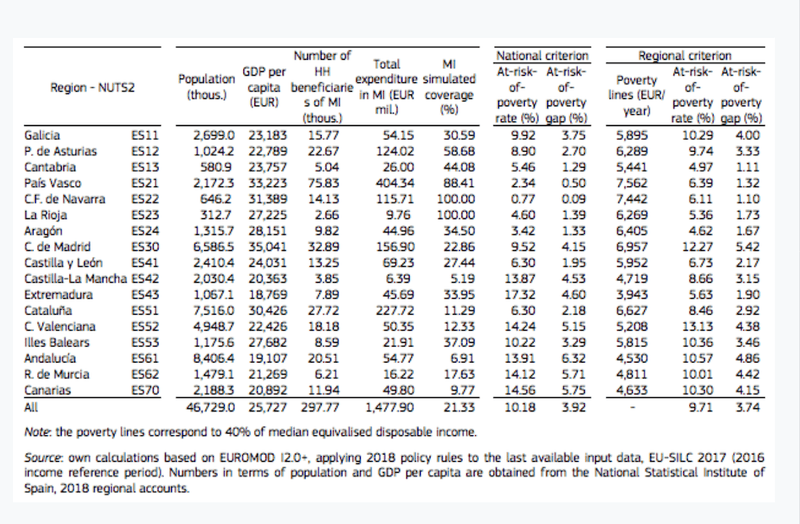
As seen in the table below (based on data from 2018), Madrid and the Basque Country are two of the richest regions, with similar levels of GDP per capita. Yet, despite having one third of Madrid’s population, and half the poverty level (6.4 for 12.3%), the Basque scheme reaches 2.3 times more people and public expenditure is 2.6 times greater. The Basque programme covers 88% of those in greatest need, compared to 23% in the case of Madrid.

With the exception of Navarre, La Rioja and the Basque Country, the vast majority of regions leave out half of the population that meet the economic criteria. The general average is just 21.33%, which means that almost eight in 10 people are unable to get the economic support they need. With just over 8% of the country’s population, nearly 38% of all recipients, living in the Basque Country, Navarra or Asturias, the three regions accumulate 43% of all of Spain’s public spending on minimum income.

Source: Adrián Hernández, Fidel Picos and Sara Riscado, “Moving towards fairer regional minimum income schemes in Spain”, JRC Working Papers on Taxation and Structural Reforms, European Commission, April 2020, p. 12

The austerity of the 2010s created an ever-greater need for a people’s quantitative easing. However, because of limited resources in some cases, and ideological blindness and lack of interest in others, for three decades the regional public authorities failed to fulfil the right to social assistance recognised in Article 13 of the European Social Charter, leaving millions of people behind.

Looking at the small print

Let us hope Spain’s new minimum income scheme will mark a turning point. For now, it is too early to tell if it will match up to the expectations. A number of issues remain unclear and are concerning.

For example, the coverage is arbitrarily limited to people between 23 and 65 years of age. Public authorities at the central, regional and local levels should urgently develop truly accessible and non-bureaucratic procedures. Considering the digital divide, it is essential to establish a system by which individuals can request this benefit from social services face-to-face. In light of the concerning experiences in other countries, observers must watch out for the possible misuse of sanctions and conditionalities. Just as crucial, existing regional schemes should be retained and developed to complement the new central benefit.

The real test will come when the flashlights focus on something else. If the practical questions get answered, and if conservatives do not get rid of it when they return to power whenever they do, then we will be able to celebrate this as one of the most important victories of the left.

This could be the most substantial policy for the people at greater risk of harm, disadvantage and poverty. This could be the most significant test of Spain’s fairness as a society.

The elephant in the room is that none of this would have happened without Covid-19. But this cannot be a passing whim, nor a PR stunt for the left-leaning coalition government. The right-wing Popular Party and the extreme-right Vox seem very confused. Some of their leaders have spoken against this initiative with hyperbolic references to the nanny-State. However, they did not dare to vote against it when the debate came to Parliament in mid-June.

The real test will come when the flashlights focus on something else. If the practical questions get answered, and if conservatives do not get rid of it when they return to power whenever they do, then we will be able to celebrate this as one of the most important victories of the left.

This could be the most substantial policy for the people at greater risk of harm, disadvantage and poverty. This could be the most significant test of Spain’s fairness as a society.

This post first appeared on Open Democracy and is reproduced here with permission and thanks.

Protecting Vulnerable Adults from Abuse: New Publication

Photo by Külli Kittus

Dr. Jaime Lindsey, Lecturer in Law, University of Essex

Dr. Jaime Lindsey recently published an article in Child and Family Law Quarterly (Volume 32, Issue 2, pp. 157-176), titled ‘Protecting vulnerable adults from abuse: under-protection and over-protection in adult safeguarding and mental capacity law’.

The article concerns the intersection between adult safeguarding and mental capacity law; an area which raises a number of difficult issues for lawyers, policy makers and health and social care professionals when thinking about the extent to which the civil law ought to be used to respond to abuse of adults with impaired mental capacity.

The article draws on original empirical data to show that adults vulnerable to abuse are left under-protected in some cases and over-protected in others. In particular, it argues that the Mental Capacity Act 2005 has become a tool for protecting vulnerable adults from abuse. Moreover, this is done in ways that restrict and control the vulnerable victim, rather than targeting the perpetrator.

Learning from developments in the domestic abuse sphere, including the Domestic Abuse Bill currently going through Parliament, Dr. Lindsey argues that safeguarding adults law should instead focus on perpetrators of abuse by developing a Safeguarding Adults Protection Order (SAPO), instead of resorting to mental capacity law in these challenging cases.

The article is available on LexisLibrary and a copy can be requested via the University’s Research Repository here.

International Law, the Paradox of Plenty and the Making of Resource-Driven Conflict

Image by skeeze

Dr Eliana Cusato, Lecturer in Law, University of Essex, has published a paper titled ‘International law, the paradox of plenty and the making of resource-driven conflict’.

This article intervenes in legal debates on the relationship between natural resource extraction and armed conflict. Since the 1990s there has been a proliferation of international/global initiatives to end wars fuelled through the exploitation of ‘conflict resources’ and improve resource management in fragile, conflict and post-conflict countries. Examples of such developments include the use of commodity sanctions by the UN Security Council to restrict trade in ‘conflict resources’ and multi-stakeholder initiatives, such as the Extractive Industry Transparency Initiative. International courts have also dealt with resource exploitation in conflict situations (e.g. the International Court of Justice in the Armed Activities Case) expanding the scope of international provisions, such as prohibition of pillage.

While the consensus in the field is that these international interventions have improved the governance of natural resources in war-torn and post-conflict countries (although enforcement remains a key concern), the capacity of the law to engage with questions of resource access and distribution, which may be at the root of these conflicts, is rarely discussed. Yet, as the peacebuilding literature tells us, a failure to address socio-economic grievances may weaken the chances of positive peace and reproduce inequalities important to conflict causation. In other words, although the objective of normative/institutional interventions is to reinforce international peace and security, they seem to ignore a crucial part of the picture. This is the puzzle at the core of the article.

Until now international legal scholarship has focused on ways to improve the protection of natural resources in conflict and post-conflict scenarios to reinforce the chances of creating more stable and sustainable societies. Limited, if any, attention has been paid to the political, economic, and theoretical assumptions underpinning international rules and how these assumptions shape current responses to violence/conflict in the Global South. The aim of this article is to fill this gap, by exploring the influence of the resource curse theory (or paradox of plenty) upon legal and institutional developments in this field.

The overall argument is that the uncritical acceptance of the paradox plenty (and its hidden propositions) by scholars, institutions, and civil society lead to a marginalisation of distributive concerns at the root of violent conflict in the Global South. To demonstrate the pervasiveness of the theory in legal practices and the problems with its understanding of the causes and dynamics of resource wars, I use the Sierra Leonean and Liberian TCs as a case study.

Ultimately, this article is a reminder of the risks of accepting a certain vision of the world as a given and using it to develop policies and normative solutions without questioning the structures and values upon which that vision is premised. It is an attempt ‘to defamiliarize these ways of imagining the world and is a first step in addressing the argument that understanding the world in that way is somehow normal’.

This article is published in Leiden Journal of International Law and is available here.

Police and Crime Commissioners’ power “corrosive,” research finds

Image by Fungai Tichawangana

The power of Police and Crime Commissioners (PCCs) to remove Chief Constables from office is having a “corrosive” effect on policing and police accountability, research undertaken at the University of Essex indicates.

The research, by Dr Simon Cooper of our School of Law, identifies two new and significant concerns regarding PCCs’ powers. He is calling for a select committee inquiry to re-examine the system for holding Chief Constables to account.

Dr Cooper gained unprecedented access to key figures from all sides, interviewing PCCs, Chief Constables and members of Police and Crime Panels (PCPs) in five police forces, as well as the person responsible for introducing the current system and one of the most senior figures in policing at a national level.

Dr Cooper said:

The interviews conducted for this research find the PCC’s power to remove their Chief Constable has already compromised the independence of these senior officers. As currently formulated, the PCC’s s. 38 power creates an environment in which it would be possible for a PCC – effectively a lay person – to command, overrule and potentially even control a Chief Constable. We urgently require a select committee inquiry to re-examine a PCC’s power to remove their Chief Constable.

The introduction, in 2012, of elected PCCs was a key element of Prime Minister David Cameron’s Big Society, billed as the replacement of an outdated bureaucracy with devolved, democratically-accountable oversight.

The PCC’s s. 38 power, which gives a PCC the exclusive power to remove their Chief Constable from power, and to exercise a broad discretion in reaching this decision, was seen as vital to delivering accountability.

Dr Cooper’s research, which was published in this year’s Volume 4 of the Criminal Law Review (pp. 291-305) and attracted the attention of The Times (£), identifies two new areas of concern. First, a PCC’s ability to remove their Chief Constable could cause an instability in police leadership and a potential culture of compliance, as Chief Constables – many close to retirement – avoid conflict with their PCC. The ease with which a PCC could remove a Chief Constable – contrasted with the complex process for removing a PCC – is seen as having resulted in a concentration of power at odds with the principles of good governance. Second, Chief Constables could be developing a practice of abstention and risk, becoming indebted to their PCC.

Senior figures interviewed by Dr Cooper also noted a ripple effect at the rank of Chief Constable, as progression to the most senior rank is no longer seen as attractive.

Interviewed by Dr Cooper, one PCC noted:

There has been a power shift, it’s a significant change and it’s no surprise that about half of the Chief Constables have gone.

Dr Cooper’s call is for a select committee inquiry to re-examine the s. 38 power, with the suggestion that the currently-limited powers of PCPs could be increased, a Code of Practice introduced and the Policing Protocol amended to encourage PCPs to proactively seek the professional advice of Her Majesty’s Inspectorate of Constabulary and Fire & Rescue Service when a PCC decides to remove a Chief Constable.

The s. 38 power has proven highly controversial. In May 2013, The House of Commons Home Office Committee argued it was “operationally disruptive, and costly, and damaging to the police and individuals concerned.” In the same year, the Stevens Review suggested that this power risked “exerting a damaging chilling effect over the leadership of the police service.”

This post originally appeared on the website of the University of Essex and is reproduced here with permission and thanks.

Grandparents: Anchors in Uncertain Times

Photo by Paolo Bendandi

Dr. Samantha Davey, Lecturer in Law at the University of Essex, explores family dynamics in the context of grandparents as primary caregivers.

Grandparents may live miles or even continents away from their grandchildren. Pre-existing relationships may have been affected adversely because of Coronavirus-related self-isolation. Regardless of current events, many grandparents have played, and will continue to play, a pivotal role in the lives of their grandchildren.

Grandparents’ involvement may range from helping parents via part-time childcare to providing full-time care for children, in circumstances where children cannot be raised by their parents. The circumstances in which grandparents may become full-time carers will vary. Some parents voluntarily relinquish children into the care of grandparents. In other sad cases, Social Services may become involved in children’s lives due to issues faced by parents including alcohol addiction, drug abuse or mental illness which have led to child neglect or abuse.

In such cases, provision of care by grandparents will not necessarily have been at the parents’ behest. In circumstances such as these, grandparents are of particular importance since these children would otherwise be placed in foster care. Furthermore, some children would be placed for adoption, with a permanent loss of legal ties and relationships with birth parents and other family members, including grandparents.

Where grandparents provide an alternative care option to adoption, this route is not without challenges. Potentially, grandparents face conflicts due to a moral obligation to balance the interests of their offspring with, a moral and potentially legal obligation to protect the best interests of their grandchildren.

There are cases, for instance, where it may be appropriate for children to have only supervised contact with their parents or none at all. Furthermore, grandparents may face difficulties in receiving financial support or practical support for children who may have special educational or emotional needs.

Despite the challenges faced by grandparents, the care they provide is preferable to adoption. Indeed, when grandparents look after their grandchildren, they may well protect them from further uncertainty via foster care. This option also makes it possible to avoid the long-term severance of the legal tie between children and their birth family. In effect then, grandparents can be seen not solely as care providers but as a vital link to children’s birth family.

Unfortunately, grandparents lack automatic rights which are enjoyed by parents such as party status in legal proceedings. The involvement and importance of grandparents in children’s lives is not reflected in legislation. The government has many priorities. Reforming the law in relation to grandparents is simply not one of them. But is it time to open up a discussion on this issue? Should grandparents’ involvement in children’s lives warrant acknowledgement in legislation?

For further discussion of grandparents in the context of adoption cases read: Samantha Davey, A Failure of Proportion: Non-Consensual Adoption in England and Wales (Hart Publishing 2020). This book provides a general overview of the issues faced where adoption takes place without parental consent and considers the vital role of grandparents’ provision of care as a viable alternative to adoption.

In due course a workshop on grandparents’ rights, law and social policy will be taking place at the University of Essex. The date of this is to be announced in the future due to the lockdown which is in place currently. If you are interested in producing a paper for this event, you are a grandparent affected by these issues or you have an interest in cases of adoption without parental consent please contact Dr Samantha Davey at smdave@essex.ac.uk.

A version of this article was first published on the MIHE Blog.