Community Radio Station Found in Breach of Ofcom’s Offensiveness Rules

Dr. Alexandros Antoniou, Lecturer in Media Law, University of Essex

On 16 December 2019, Ofcom, the United Kingdom’s communications regulator, found that Radio Caroline had breached Section Two of its Code, which outlines standards for broadcast content so as to provide members of the public with adequate protection from harmful and offensive material.

Radio Caroline, which was founded in 1964 and broadcast from international waters, had been rendered an illegal (pirate) station by the Marine Broadcasting Offences Act 1967, but 50 years later, in June 2017, Caroline was granted a community radio licence by Ofcom. Community radio services are provided on a not-for-profit basis and focus on the delivery of “specific social benefits to a particular geographical community.”

Radio Caroline AM Broadcasting Ltd now holds the licence for Radio Caroline. The station was given the medium wave frequency of 648kHz (which was once used by the BBC World Service) and now broadcasts in Suffolk and northern parts of Essex. It plays a wide range of album music from the 1960s to the present day, with an audience consisting primarily of individuals aged 45 and over.

On 13 September 2019, Ofcom received a complaint concerning Caroline’s Top Fifteens programme which is broadcast every weekday morning from 9 a.m. to 10 a.m. In particular, the complaint related to the broadcast of the English rock band Radiohead’s track “Creep”, which contained three instances of the word “fucking”.

Rule 2.3 of the Ofcom Broadcasting Code stipulates that broadcasters, in applying generally accepted standards, must ensure that potentially offensive language is justified by the context. Context includes, but is not limited to, the service on which the material is broadcast, the time of broadcast as well as the size, composition and likely audience expectations. The same rule also states that “appropriate information should also be broadcast where it would assist in avoiding or minimising offence”.

The licensee acknowledged that there was “no justification for the use of explicit language”. It also stated that it would not have “knowingly play[ed] such a track”, which was aired due to a “simple error” between two volunteers who shared the tasks of scheduling the tracks and voicing links. In order to mitigate the risk of recurrence of this problem, Radio Caroline responded that they were planning to devise a single database of music so that tracks would not be selected from external sources. Moreover, listener suggestions for tracks would be examined by a staff member and only added to the available list if the content was deemed “acceptable”. The licensee further explained that it had not broadcast an apology “because the problem was not identified until it was brought to [its] notice many days later”.

Ofcom noted the steps Radio Caroline said it was taking and the fact that the language had been broadcast live in error. However, bearing in mind its research, which indicates that the word “fuck” is considered by audiences to be among the strongest and most offensive terms, the regulator held that the majority of listeners at this time of day were “unlikely to have expected to hear the most offensive language”. It took particular note of the fact that the broadcaster had failed to apologise and concluded that Top Fifteens had breached Rule 2.3 of its Code.

This post first appeared on the legal database IRIS Merlin and is reproduced here with permission and thanks. The original post can be accessed here.


International Co-operation on Platform Governance

Lorna Woods, Professor of Internet Law at the University of Essex and co-author of the Carnegie UK Trust’s proposals for Harm Reduction on Social Media, gave evidence on 7 November 2019 at the International Grand Committee on Disinformation and Fake News in Dublin. The Committee, formed of Parliamentarians from eleven countries, met for the third time, having previously convened in London and Ottawa.

The focus of the Dublin session was on “advancing international collaboration in the regulation of harmful content, hate speech and electoral interference online”. The session took place a day after a workshop on the theme of “international co-operation on platform governance”, facilitated by the Centre for International Governance Innovation (CIGI) and at which both Lorna Woods and Will Perrin participated in panel discussions.

In her written statement to the Grand Committee, Professor Woods set out the following perspective on the theme of international collaboration:

To work effectively together, Parliamentarians should develop a common language not just about the problems that exist but also possible mechanisms for moving towards a solution.

Two of the main difficulties when considering action in relation to online disinformation and fake news are scale and context of the content involved. Some platforms have an almost unimaginable amount of content uploaded and shared per second in different languages and with meanings that may have specific relevance for particular groups. Dealing with this situation on the basis of individual items of content is difficult.

An alternative way of considering solutions, and one proposed by the Carnegie UK Trust work in this area, is to look not at the content itself, but at the underlying systems which allow content to be shared and specifically how design and business choices affect our information environment. Social media platforms (as well as other service providers in the internet distribution chain) are not content-neutral. Whether or not they were intended so to do, they encourage and reward some content over other items of content. Some platforms – because of their design features – seem to have a greater problem with fake news than others. Some of this may be about size but it may also be about design choices: for example, the ease with which stories are forwarded on, or embedded from another source in the process decontextualising the material; the prioritisation of ‘click bait’ and stories stoking outrage. Looking at the information system behind the content focusses attention of the mechanisms by which disinformation spread, which to a large extent remain constant from jurisdiction to jurisdiction and over time, rather than questions of individual content which change frequently and also raises the question of what particular content means and whether it is true or not.

The proposal put forward by the Carnegie UK Trust is for a statutory duty of care. The duty of care is a process-based obligation orientated towards the reduction of harm on the Internet. The obligation is to consider the effect of the services/tools that are being offered and how they are being used, especially bearing in mind their design features. Where harm is or becomes likely as a result of the service, the obligation on the service provider is to take steps to mitigate. The existence of ‘problem content’ is an indicator of a process problem, but ultimately success is measured by reference to care in design, development and maintenance of the service not by the existence of particular items of content. The use of the duty of care model is not a ‘silver bullet’ and there may well be instances when additional, targetted action is needed.

A process-focussed duty at systems level has advantages in the international context of disinformation on the internet:

  • it mitigates against concerns about scale
  • it minimises risks and difficulties arising from understanding meaning and context in different environments; and
  • it thus allows a single, common approach to be taken internationally.

The International Grand Committee will hold a press conference on its conclusions at the end of its Dublin session.

This piece originally appeared on the CarnegieUK Trust website and is reproduced here with permission and thanks. Read the original post here.

‘Milk-shaking’ political figures and irresponsible advertising

Dr. Alexandros Antoniou, Lecturer in Media Law, University of Essex

On 2 October 2019, the Advertising Standards Authority (ASA), the UK’s advertising watchdog, banned a promotional tweet on Burger King’s Twitter page on the grounds that it condoned anti-social behaviour.

Background

In May 2019, a 32-year-old man launched a milkshake at Nigel Farage, the Brexit Party leader, as he campaigned in Newcastle ahead of the European elections. The man pleaded guilty to common assault and criminal damage at North Tyneside Magistrates’ Court and was ordered to pay compensation and carry out unpaid work. District Judge Bernard Begley was unimpressed by the claim that his act was a “right of protest” and called instead the incident an “act of crass stupidity”.

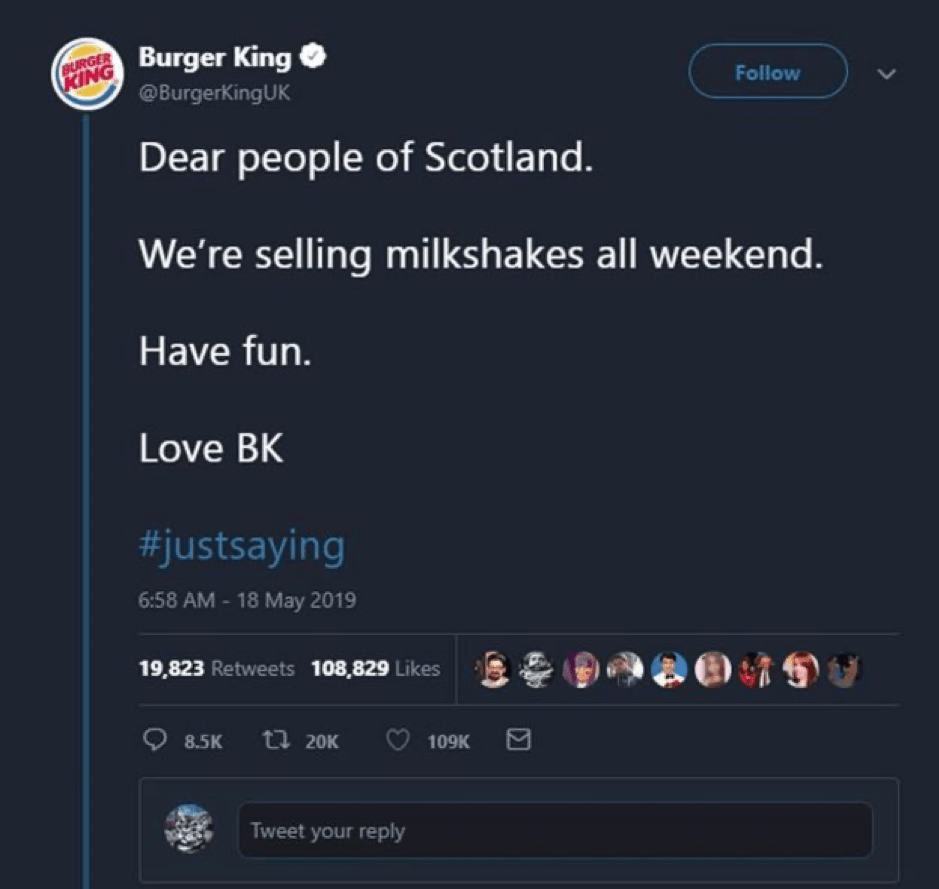
In response to this incident, an Edinburgh-based McDonald’s branch announced in May that it chose not to sell milkshakes while a Brexit political rally, addressed by Farage, was held nearby. However, Burger King’s approach was different. Shortly after the McDonald’s announcement, they tweeted:

Is ‘milkshaking’ becoming a habit?

The tweet, which was retweeted more than 19,000 times, attracted 24 complaints because it was believed to encourage violence. A follow-up tweet by Burger King made clear that this was not the intention behind it, stating that they would never endorse violence.

But ‘milkshaking’ appears to be emerging as a growing tactic in protest against right-wing political figures. ‘Milkshaking’ causes people to look profoundly embarrassed in front of the press, without however inflicting any substantial harm. In addition to suit cleaning costs, Farage was awarded compensation for inappropriate “distress and inconvenience”. He tweeted that normal campaigning was becoming impossible because some ‘remainers’ (i.e. individuals in favour of the UK remaining in the EU) had been “radicalised”.

The English Defence League (EDL) leader Tommy Robinson and the failed UKIP candidate Carl Benjamin also had food and milkshakes repeatedly thrown at them during their European election campaigns. ‘Milkshaking’ seems to be taking off on the other side of the Atlantic too. It was reported in June 2019 that a woman threw an unspecified drink over Matt Gaetz, a pro-Trump Republican Congressman, as he was leaving a coffee shop in Florida. She was later charged with battery and released on bail.

The ASA ruling

Because of the wide media coverage of a spate of incidents of ‘milkshaking’ political figures, the ASA (whose remit includes claims made by companies on their own websites and in social media spaces under their control) considered that people who read the tweet were likely to understand it as a reference to those incidents.

Although the regulator recognised that the tweet may have been intended as “a tongue in cheek reaction” to the suspension of milkshake sales by the fast food giant’s competitor, it held that:

“in the context in which it appeared […] it would be understood as suggesting that Burger King milkshakes could be used instead by people to ‘milkshake’ Nigel Farage.”

The ASA held that the ad condoned such anti-social behaviour and irresponsibly encouraged further instances in breach of the regulator’s harm and offence rules, which require advertisers to avoid including in their marketing communications material “likely to condone or encourage behaviour that prejudices health or safety” (CAP Code, Rule 4.4). The ASA ruled that the ad must not appear again in its current form.

As speculation over the prospect of an early general election after MPs returned to Parliament is mounting, and campaign events possibly nearing, the ASA’s adjudication usefully reminds us to drink milkshakes responsibly.

Essays for sale? ‘Misleading’ essay writing ad banned by the ASA

Dr. Alexandros Antoniou, Lecturer in Media Law, University of Essex

On 11 September 2019, the Advertising Standards Authority (ASA), the UK’s advertising regulator, found that claims on the website of an essay writing service lacked adequate substantiation and breached the Authority’s rules on misleading advertising.

What was the ad about?

The ASA’s remit includes, since 2011, claims made by companies on their own websites and in social media spaces under their control. The contested advertisement appeared on the website http://www.proacademichelp.co.uk, which included on its home page the following text:

EXCELLENCE BEGINS HERE… There [sic] no better place than Proacademichelp.co.uk to get the best academic help. Professionals [sic] Assistance by highly qualified experts… FIRST ORDER DONE FOR FREE*

Services listed on the website included assignments and dissertations for several subjects including law, engineering and marketing. Further text read:

Quality Essays We don’t offer plagiarized or duplicate essay content. Our content is 100% original. Quality is what comes first for us.

Under the page titled ‘Essays’, additional text included the following statements:

Best Essays by Oxford and Cambridge Experts… We provide accurate and possibly best essays that are of highest standards. Our expert essayists make sure that they deliver you a first-rate quality of essay…

A disclaimer available on the website read in smaller text:

Proacademichelp.co.uk is offering services pertaining to editing, proofreading, formatting and consultation through its website while ensuring to comply with the laws and ethical norms of the industry. We do NOT [emphasis in the original] own any work given to us by clients. We do not offer any sort of writing services.

What were the regulatory issues raised?

One complainant challenged whether the statement ‘FIRST ORDER DONE FOR FREE*’ could be substantiated. Additionally, the ASA felt there were reasons for further investigation and queried whether the claim ‘best essays by Oxford and Cambridge experts’ could also be adequately substantiated and whether the website misleadingly implied that students could submit an essay they had bought as their own.

What was the ASA’s decision?

First of all, advertisers are required under the ASA’s Non-Broadcast Advertising Code (CAP Code) to address the regulator’s enquiries without delay. In an apparent disregard for the Code, Proacademichelp.co.uk provided no response. This resulted in a finding of breach of Rule 1.7 of the CAP Code (unreasonable delay).

Second, the ASA upheld the single complaint against the ad because it found no evidence that the claim ‘first order done for free*’ was a genuine offer. The statement on the website did not include any information about how to obtain the ‘free’ order, nor did it identify any further limitations or qualifications attached to it. As such, it failed to clarify the extent of the commitment the consumer must make to benefit from a free offer in breach of Rule 3.23 of the CAP Code.

Third, the ASA challenged the statement ‘Best Essays by Oxford and Cambridge Experts’. This was sensibly taken to imply that students who selected this essay writing service would receive high-quality essays from individuals who had attended prestigious Oxbridge institutions. Although this claim was likely to be regarded by consumers as objective, no evidence was provided whatsoever by Proacademichelp.co.uk to substantiate it. As a result, the ASA found that it violated its general principle under Rule 3.1 of the CAP Code, which requires advertisers to avoid including materially misleading statements in their commercial messages.

Last but not least, the regulator took issue with Proacademichelp.co.uk’s claims that the essays would be plagiarism-free. It considered that students likely to read them would understand that they could purchase and submit essays as their own without any consequences. The website did not, however, make clear that this was not the case and as such, it was found to have mislead consumers by omitting material information in breach of Rule 3.3 of the Code. The ASA also noted that the disclaimer provided was ‘insufficient’ to neutralise the unsubstantiated claims about non-plagiarised professionally written essays. The regulator concluded:

We told [Proacademichelp.co.uk] not to use the claim ‘best essays by Oxford and Cambridge experts’ and not to imply that students could submit an essay that they bought as their own without risks.

This is not the first time the ASA has grappled with claims made by essay writing companies. In 2013, the Authority ruled that Oxbridgeessays.com had breached its CAP code by offering a money-back guarantee that customers would receive ‘at least the grade they ordered’. Commissioning custom essays is a rapidly growing problem, which the higher education sector and legislation has been slow to address. Also known as ‘contract cheating’, this practice compromises the fairness of the assessment process and presents a real threat to academic integrity. A study conducted by Swansea University found that one in seven students globally is believed to have paid for someone to produce their assignment, ‘potentially representing 31 million students around the world’.

Offering a product which (the presence of disclaimers notwithstanding) can be used for the purposes of cheating in a programme of study is not compliant with the ASA’s core principle, which requires marketing communications to be ‘legal, decent, honest and truthful.’ The UK Advertising Code will not, however, apply to non-UK based websites offering custom essay writing services. This approach may have limited impact considering that many of these websites are based overseas (and are thus beyond the ASA’s jurisdiction). Nevertheless, the ASA’s ruling is a useful reminder that providers’ unsupported claims that their essays are ‘100% original’ or ‘100% plagiarism free’ are misleading and far from honest. Although such an advertised essay may not include any plagiarised text per se, submitting it and representing it as the student’s own work can amount to an act of plagiarism, which is a serious academic offence.

Advertising regulation: an insight into recent developments

On 14 June 2019, the Advertising Standards Authority, the UK’s advertising watchdog, introduced new rules which target ads featuring gender stereotypes likely to cause harm, or serious or widespread offence. The ban was imposed because the regulator found some portrayals could contribute to “limiting people’s potential”.

Dr. Alexandros Antoniou, Lecturer in Media Law, takes a look at the first ever ads to have been formally investigated by the Authority under its new rules. His piece on The International Forum for Responsible Media, can be accessed here.

Uber in London: the battle between public and private regulation

Dr Yseult Marique, Senior Lecturer in Law, University of Essex

Dr Yseult Marique and her co-author Enguerrand Marique have published a chapter, entitled ‘Uber in London: The battle between public and private regulation’, in the collection Uber & Taxis: Comparative Law Studies, which was edited by D Renders and R Noguellou (Bruylant 2018).

The expansion of Uber as a major transport provider over the last ten years transforms deeply what is expected from transportation policies in many capitals around the world. It also draws the attention on the digital economy and its social and economic consequences for drivers. Tensions arise about the best ways to tackle the externalities arising from the digital economy: should Uber be banned all together as it has been the case in Spain and France? Should it be more strictly regulated as in California? Or should the market be left to bring competition and self-regulation of some kinds? To try to better understand the strategies followed across the world, the book Uber & Taxis: Comparative Law Studies brings contributions pertaining to 22 countries together, looking in a systematic way into two specific areas: first, how were taxis regulated before the advent of Uber and similar digital platforms? Secondly, how has regulation changed since Uber appeared and how does it address the specific social, economic and environmental challenges posed by Uber?

Our book chapter tries to answer these questions in the specific case of London. London is especially emblematic for its taxis and black cabs. It has also undergone a dramatic expansion of private hire (‘PH’) (such as Uber) in a very short time: in 2011, there were only 77,000 taxis and PH drivers throughout England. In 2017, the taxi and PH market in London represented ca. 150,000 drivers, i.e. nearly 40 % of the overall 356,000 licenced drivers on the English market. Very few aspects of this market are regulated. The quality of taxi drivers, the standards of vehicles and fares are subject to regulation mainly. However, the number of taxis is not limited, and taxis have no monopoly: besides taxis, PH has been operating since the 1960s and regulated since 1998. Therefore, the market is left largely unregulated regarding its outcomes themselves.

Such an expansion brings specific challenges for London in terms of the number of drivers to control and how to ensure that this control could be maintained at an appropriate level. It also means that many Uber drivers were not professional as black cab drivers had previously been, making the need arise for a range of driving practices to be policed (e.g. taxi ranks and priority lanes). Yet, London manages to address these challenges without new powers being delegated to it or without having to invent new regulatory tools. In short, the regulatory toolbox is at first sight satisfying. Let us unpack this claim before reflecting on it.

Transport for London’s (TfL) toolkit includes licensing, which has two main noticeable features: a) a fit for purpose test for drivers and b) a licensing fee. These two features have been tweaked in the case of Uber. Firstly, the fit for purpose test is no longer applied by Transport for London itself in the PH system (such as Uber). It has been transferred to Uber which now bears the risks of poor assessment of drivers’ qualities (i.e. withdrawal of the license). Secondly, the licensing fee became more differentiated. In the case of Uber, it has been multiplied by 1000 (Yes!) and stands now at £ 2,900,000 payable over 5 years. Other aspects such as a technical test, an English test, waiting times, tariffs and taxi meters, and hotlines have all been subjects to discussions and tensions. For instance, establishing a hotline for non-urgent matters is a significant burden for Uber, while not proving efficient. Similarly, the use of a taximeter, and of smartphone computing time and distance into a price, has been challenged, but ultimately accepted by the courts. Small differences remain to distinguish taxis from PH. For instance, upon a reference for a preliminary ruling to the European Court of Justice by English courts, the court recognized that ‘instant hailing’ was distinct from ‘hailing’. Waiting time and waiting areas cannot end up decreasing public safety. Yet, regulatory principles basically have not been changed after the advent of Uber in London.  

The regulation of Uber in London triggers three comments. First, the main problem brought by Uber is not the availability of regulatory tools to address Uber’s innovative features, but the need for TfL to adapt its enforcement strategy. In looking for ways to ensure compliance in a changed environment, more inspectors are needed, which is costly for TfL, yet extremely important to ensure clients’ security all over the city. Here, TfL made Uber bear in the first place the extra costs that it generated for TfL. Secondly, the London Mayor is not satisfied with the current solution and he has asked the national level to get broader powers to regulate private hire (and to impose a maximum number of licence). Thirdly, Uber is only one part of the transport policy in London. The overall policy objective in London is to ensure more sustainable transport, which means that too many cars – Uber car or otherwise – are not welcome in London. A range of measures are thus taken to seek to limit their use in general. At the same time, a broad range of transport means is welcome as it makes mobility more flexible. In short, London can see Uber both as a blessing and a curse – what matters is not to ban it, only to keep it within reasonable measure. This leads TfL to seek to tweak Uber’s licence to adapt it to the ongoing changes in the ways in which mobility platforms work. Here a striking development is the fact that Uber is now operating in London under a short-term licence that is regularly renewed subject to modifications. Such practice of short-termism compels economic actors to behave on their best at all time, mindful to take social interest to hart rather than thinking about price cuts in the long term. A creative way to keep Uber under TfL’s control without making any drastic innovative changes to the regulatory tools?