By Professor Ting Xu, Essex Law School
On 16 May 2025, Professor Ting Xu presented at the Open University’s online legal histories conference, Land and Property Beyond the Centenary, marking 100 years since the transformative property law reforms of 1925 in England and Wales. The centenary offered a rich opportunity to reflect not only on English legal history, but also to look beyond it—to consider alternative models of property governance across time and place.
Professor Xu’s presentation, ‘Beyond 1925: Households, Property, and State Governance—Comparative Perspectives from Rural China’, grew out of her recent research on Resilience, Institutional Change, and Household Property in Rural China. This work draws on Chinese legal history, interdisciplinary scholarship on resilience, and Martha Fineman’s vulnerability theory to rethink how we understand property systems, particularly in contexts that don’t conform to liberal assumptions.
For a field so often shaped by Western, individualist models, rural China offers a compelling case that challenges many taken-for-granted ideas in property law. In her presentation, Professor Xu asked: what sustains property systems under pressure? And what might English legal history gain by looking East?
Revisiting the 1925 Reforms
The 1925 property law reforms in England and Wales were undoubtedly revolutionary. They sought to simplify and modernise a fragmented land system, advancing values such as clarity and certainty of title and ease of transfer—cornerstones of a liberal, market-oriented property regime. Yet, even within this liberal framework, English law has long recognised informal interests, especially within the household. Trusts over the family home, for example, remain one of the most contested and evolving areas in property law.
As Robert Ellickson has argued, the household operates largely through informal norms, rather than strict legal rules. These norms—based on intimacy, trust, and shared routines—are efficient and reduce the need for legal intervention. But the limits of this view become clear when we account for issues of dependency, vulnerability, and inequality—particularly in household governance.
Feminist scholars such as Martha Fineman have pushed back against the liberal ideal of the autonomous, self-sufficient property holder. Fineman’s vulnerability theory reminds us that all human beings experience dependency and vulnerability at various points in their lives, and that resilience—our ability to navigate life’s inevitable challenges—is deeply shaped by institutions and their willingness to support us.

A Shift in Perspective: Property as Adaptive Governance
Inspired by Fineman and Ellickson, but also moving beyond them, Professor Xu’s presentation invited the audience to shift how we think about property. Rather than focusing only on legal certainty or formal title, what if we view property as a form of adaptive governance? And what if, instead of seeing informality as a deviation or a problem, we understand it as a site of institutional adaptation (and innovation)—particularly in systems that have long relied on collective, state-controlled, or non-liberal traditions?
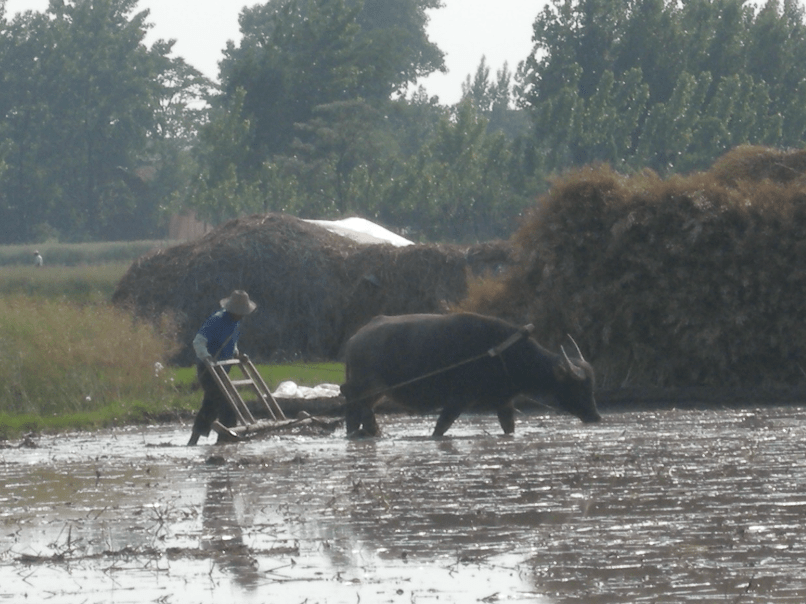
To explore these questions, Professor Xu turned to the rural Chinese household and its role in property governance during the 20th century. From imperial systems of collective responsibility, through Maoist collectivisation, to the post-1978 rural reforms, the household has served as a key governance unit adapted to profound ecological, socio-economic, and political transformations.
The model that crystallised in the late 1970s and 1980s was the Household Responsibility System (HRS). Under this system, rural land remained collectively owned, but the rights to use and benefit from land were contracted to individual households. These households gained control over key production decisions—like what crops to grow or how to invest, while still being part of a broader collective governance framework.
The HRS was not a spontaneous market-driven reform. It was an institutional innovation shaped by history, political negotiation, and grassroots experimentation. It was also a response to crisis: the failures of collectivised agriculture and the need to revive rural productivity without dismantling state oversight altogether.

Resilience Over Certainty
In legal terms, the HRS is striking. It doesn’t offer private ownership in the liberal sense. Nor does it offer full certainty or enforceability by Western standards. Yet it has endured, evolved, and adapted across decades of political and socio-economic transformation.
From a resilience theory perspective—drawn from ecological and institutional scholarship—this makes perfect sense. Systems survive not because they are static or clear-cut, but because they can bend without breaking. They absorb shocks, adapt to new conditions, and renegotiate relationships among actors and institutions.
In her presentation, Professor Xu argued that property should be understood as a socio-ecological system—an evolving interaction among resources (e.g., land and housing), governance structures, and legal rights and entitlements (she calls the interaction of these three elements ‘a resilience triad’). As discussed above, what is often ignored is the governance aspect—one key component of property. In the Chinese context, the household plays a central role in this socio-ecological system. Beyond being a mere private unit, it is a resilient institution, from lineage structures and collective responsibility systems to contemporary contracting practices.
The Gendered Dimensions of Informality
However, as Fineman’s work reminds us, we must be cautious not to romanticise informality or resilience. Systems that appear stable at the surface can mask deep inequalities.
One of the clearest examples in the Chinese case is gender. Although households contract with the collective, land contracts are often issued in the name of the male head. Women’s rights to land are frequently tied to marital and registration status. When households divide or dissolve—due to divorce or migration, for instance—women may lose access to land altogether.
This parallels, in some ways, the difficulties faced in English co-ownership disputes, where informal arrangements and non-financial contributions (such as caregiving) can be difficult to assert legally. In both contexts, legal informality without institutional support leaves vulnerable members at risk.
Resilience, then, must be understood not simply as survival or adaptation, but as something that must be supported—and made just—through institutional design. This is where Fineman’s idea of the responsive state becomes important. Whether in liberal or non-liberal contexts, property systems that work in practice are those that can support resilience equitably, not just functionally.
What Can English Legal History Learn from China?
Presenting this work at the Open University conference sparked excellent conversations. While many in the audience were not experts on China, they immediately saw the relevance of these ideas to broader legal questions. What happens to property under conditions of uncertainty—whether ecological, economic, or political? How do communities maintain access and control when formal systems fall short?
There is no one-size-fits-all model. But the Chinese experience shows that property systems can be stable without being rigid, and adaptive without relying entirely on individual title. It also reminds us that households, communities, and informal institutions are not remnants of the past, but active sites of governance in the present.
As we reflect on 100 years since the 1925 property reforms, this moment invites us to think globally and historically. The liberal vision of property—rooted in autonomy, clarity, and marketability—has achieved many successes. But it is not the only way property works. And in an era of climate stress, displacement, and inequality, it may not always be the most resilient one.
Looking Ahead
Professor Xu’s research continues to explore how property systems evolve under pressure, and what we can learn by comparing across legal traditions and historical trajectories. She is particularly interested in how non-liberal or hybrid institutions help sustain access to land and resources—not only in China, but also in other parts of the Global South and beyond.
Legal history offers us more than a story of how we got here—it offers tools for reimagining where we might go next. As we face global challenges that affect land, livelihoods, and governance, property law will need to become more adaptive, more relational, and more responsive.
Rethinking property through resilience is one way to start.







 Essex Law Research Blog