Professor Clara Sandoval, from the School of Law at the University of Essex (and Co-Director of the Essex Transitional Justice Network), is a part of the Human Rights Law Implementation project and contributed a post on The Power of Hearings: Unleashing Compliance with Judgments at the Inter-American Court of Human Rights.
In this, Professor Sandoval argues that while the dynamics of implementation are multi-factored and multi-actored, human rights bodies like the Inter-American Court of Human Rights do more than mere monitoring of orders; rather, they trigger and cajole implementation in different ways.
From Wikimedia Commons, the free media repository
The online page where all posts, and more on the project, can be accessed here. All posts are available in various languages (English, French and Spanish and, in some cases, also Russian). The following is a list of current posts – to read these please visit the project website here.
Introduction Christian De Vos and Rachel Murray
The Power of Hearings: Unleashing Compliance with Judgments at the Inter-American Court of Human Rights Clara Sandoval
Taking Rights Seriously: Canada’s Disappointing Human Rights Implementation Record Paola Limon
Reflections on the Role of Civil Society Organizations in Implementing Cases from the African Commission and Court Felix Agbor Nkongho
Addressing Cote d’Ivoire’s Statelessness Problem: Utilizing Multiple Tools to Support Implementation of Judgments Amon Dongo and Alpha Sesay
Litigating Torture in Central Asia: Lessons Learned from Kyrgyzstan and Kazakhstan Masha Lisitsyna and Anastassiya Miller
Some Justice out of Repression and Reprisals: On the Plight of Human Rights Defenders in Azerbaijan Philip Leach
The Power of Persistence: How NGOs can Ensure that Judgments Lead to Justice Alice Donald
How Can NGOs Push for Implementation—and What’s Stopping Them? A Conversation with NGO Leaders in the Americas, Africa and Europe A conversation with Viviana Krsticevic, Gaye Sowe, and George Stafford facilitated by Anne-Katrin Speck
A New Court for Human Rights Cases: The Court of Justice of the European Union Márta Pardavi and Kersty McCourt
More than the Sum of our Parts: Reflections on Collective Implementation of Economic, Social and Cultural Rights Decisions Susie Talbot
Carla Ferstman and Noora Arajärvi, University of Essex, published a report which assesses the UK Overseas Operations (Service Personnel and Veterans) Bill, which makes provision about legal proceedings and consideration of derogation from the European Convention on Human Rights in connection with operations of the armed forces outside the British Islands.
The Bill was introduced in Parliament on 4 November 2020 by Mr Ben Wallace, Secretary of State for Defence of the United Kingdom, and sets out a series of measures intended to make it more difficult to prosecute current and former Service personnel for conduct occurring more than five years ago when operating overseas.
The Bill also restricts judicial discretion to allow civil claims for personal injury and/or death and claims under the Human Rights Act 1998 in respect of overseas operations by requiring the court to consider additional factors (on top of those that already exist in law) when deciding whether to allow a claim outside the set limitation periods.
The proposed legislation has provoked considerable debate in both Houses of Parliament, amongst former service personnel, lawyers, academics and civil society. Much of the discussion surrounding the Bill has also focused on the extent to which the proposed changes to how decisions about potential prosecutions are taken will negatively impact upon the capacity for the UK to implement its obligations under international human rights law and the International Criminal Court statute.
The focus of this report
The report focuses on civil claims for personal injury and/or death and claims under the Human Rights Act 1998 in respect of overseas operations.
The Overseas Operations (Service Personnel and Veterans) Bill sets out several rationales for the introduction of the reforms to civil and human rights claims, and the authors of the report saw value in scrutinising these justifications in some depth, given the significance of the proposed reforms and the limited attention they have received to date.
As the report explains, the civil claim longstop would have the effect of shielding the Ministry of Defence from public scrutiny and legal accountability and would take away crucial means by which to ensure transparency and to promote institutional lessons learned.
To make this assessment, Carla Ferstman and Noora Arajärvi carried out a review of civil and human rights judgments pertaining to overseas operations, issued within the last twenty years. These have mainly concerned claims against the Ministry of Defence, though their sample has also included claims involving overseas engagements by the security services and other parts of government to the extent relevant.
The report argues:
Considering the checks and balances within the UK legal system and how it operates as a whole, impeding access to civil and human rights claims ignores the vital role such claims play in ensuring that criminal investigations and prosecutions and related accountability processes are not shut down prematurely. A crucial means of oversight will be lost.
Victims’ access to reparation is an important value worthy of protection and a fundamental and obligatory aspect of UK human rights obligations. This is especially the case for claims involving wrongful death, torture, and ill-treatment; and
The introduction of limitation periods for civil and human rights claims without a possibility for judges to be able to use their discretion to extend them where the exigencies of the circumstances so require, is a significant and unjustifiable limitation of claimants’ access to reparation.
The webinar is taking place on 20 Apr. 2021 at 5pm CET (4pm UK, 6pm Kenya, 11am US Eastern Time)
Dr. Emily Jones, Lecturer in Law at the University of Essex, joins a great panel of speakers with her paper titled: “Posthuman Feminism and the Rights of Nature”.
International environmental law is anthropocentric, categorising the environment and non-human animals as objects to be exploited for human needs. This anthropocentrism has contributed to the law’s inability to address environmental deterioration.
In her paper, Dr. Jones will draw on posthuman feminist theory and resonances between these theories and the emerging legal recognition of the rights of nature to challenge and re-think the anthropocentrism at the heart of international environmental law.
The following presenters join Dr. Jones on the panel of speakers for Tuesday’s event:
Atieno Mboya Samandari (Emory): “Ecofeminist Approaches to Climate Change”
Ellen Spannagel (McGill): “The Experiences and Resistance of Gender, Sexual, and Romantic Minorities to the Climate Crisis”
Nicholas Stump (West Virginia): “Radical Intersections: Critical Environmental Human Rights and an Ecofeminist Ecosocialism in the U.S. Appalachian Region”
Chair: Dina Lupin (Vienna)
To attend the webinar, register using the link on the GNHRE’s website here.
The announcement of a peace deal in the Nagorno-Karabakh conflict on the night of 9-10 November 2020 marked the end of 28 years of hostilities between Azerbaijan and Armenia. Tensions leading to the 1991-94 war had begun in 1987 with the violent expulsion of 200,000 Azerbaijanis from the Armenian region of Kafan, which resulted in dozens of deaths. Although, in 1993, the UN Security Council had adopted four resolutions demanding the immediate withdrawal of all occupying Armenian forces from all occupied territories in Azerbaijan, these were never enforced.
In the light of further territorial claims made by the Armenian government on Georgia and Turkey, the article fills two key gaps – thus rectifying resultant false equivalences – within the discourse on the Nagorno-Karabakh conflict. First, from the perspective of international humanitarian law, no distinction has been made between attacks on the occupied territories and other (non-occupied) cities in Azerbaijan. Second, from the perspective of international criminal law, the 1992 Khojaly massacre (recognised by some states as a genocide) of Azerbaijanis is frequently compared to the Sumgait pogroms which killed 26 Armenians, despite the latter atrocity having been fully addressed under domestic law in the absence of state complicity. The Khojaly massacre, is, by contrast, staunchly denied by the Armenian government and diaspora groups alike.
As chronicled in a Human Rights Watch / Helsinki report, before the attack, the Azerbaijani town of Khojaly had been home to some 6,000 people, including those who had fled there previously from other parts of Nagorno-Karabakh after Armenian forces had invaded their villages in the winter of 1991-92. On the night of 25-26 February 1992, Armenian forces seized Khojaly. As residents fled, Armenian forces fired on them. After the massacre, more than 300 bodies showing evidence of a violent death were submitted for forensic examination, of which many had been scalped, had body parts removed, or been otherwise mutilated.
The article also addresses France’s contentious role in the OSCE Minsk Group (the body formerly tasked with attaining peace between Armenia and Azerbaijan) in view of the French government’s secret deals with Armenian terrorist groups.
With the adequacy of military jurisdiction over violations of international law being questioned in certain spheres, the article explores the role and limits of military jurisdiction in combating impunity for violations of International Humanitarian Law (IHL), the body of law which regulates situations of armed conflict.
The article demonstrates that that the unique context of armed conflict and military operations can provide important reasons to retain and strengthen military justice systems to combat impunity for certain violations of IHL, especially to suppress non-criminal or administrative violations.
For jurisdiction over criminal offences (including war crimes), the adequacy of military or civilian systems will depend on domestic, regional, and international factors which are difficult to generalise. Increased scrutiny under international human rights law into the impact of these justice systems on the rights of individuals has led to restrictions on the format and scope of military jurisdiction, yet States have implemented these obligations in different ways at a domestic level. What is clear in all cases is that the systems of justice used must respect international standards of fair trial and general principles of justice.
There is a need to continue the discussion on the adequacy of military justice in combating impunity for violations of international law. Claire Simmons’ article highlights the importance for such debates to address State obligations in a holistic manner, including by recognising the applicability of different bodies of international law, differences in domestic legal systems, and applicable legislation in times of both peace and war. Such a holistic approach is crucial to promoting accountability under international law while protecting the rights of both those accused of offences as well as those affected by violations in armed conflict.
Dr. Anil Yilmaz Vastardis, Senior Lecturer and Co-Director of the Essex Business and Human Rights Project, School of Law and Human Rights Centre, University of Essex
In my recently published book The Nationality of Corporate Investors under International Investment Law(Hart Publishing 2020), I dissect the relationship between international investment law, corporate law and the concept of nationality. I argue that this relationship has been problematic from host states’ and their communities’ perspective, for it creates a free market for manufactured corporate nationalities enabling wealthy investors to access investment treaty protections to challenge regulatory measures.
Scrolling through the UNCTAD investment dispute settlement database, one can detect, even without reading the awards or decisions, that some businesses publicly known to be corporate nationals of a particular state seek protection under investment treaties of other states. For instance, the UNCTAD database shows a claim filed by Chevron against the Philippines in 2019. One would expect this claim to be filed under the US-Philippines investment treaty, as Chevron Corporation is incorporated and headquartered in the US. But it appears from the UNCTAD investment agreements database that there is no investment treaty between the US and the Philippines. Instead, Chevron filed this claim under the Philippines-Switzerland investment treaty utilising its Swiss subsidiary Chevron Overseas Finance GmbH.
One investor, convenient nationalities
This practice of nationality shopping is relatively common and largely permitted in investment treaty practice. It is enabled by investment treaty texts and generous arbitral interpretations of a corporation’s link to its alleged home state. In the example of Chevron, while it certainly has a corporate presence in Switzerland, through which it may have channelled its investments to the Philippines, the question remains as to whether this alone makes Chevron a Swiss investor. The relevant investment treaty defines a protected Swiss ‘investor’ to include any company incorporated under Swiss law. According to this definition, Chevron in the Philippines is a Swiss investor and not a US investor. However, according to two prior investment treaty claims that Chevron filed against Ecuador, it is a US investor. This is not an isolated instance. In its 2011 claim against Australia, Philip Morris argued it was a Hong Kong investor, whilst at the same time arguing in a 2010 claim against Uruguay that it was a Swiss investor. Philip Morris is a well known, US – headquartered tobacco company. But in investment treaty claims, it has never been a US investor. Similarly, Mobil initiated a claim against Venezuela in 2007 as a Dutch investor and against Argentina in 1999 as a US investor. Total was a French investor in its claim against Argentina in 2004, but it was a Dutch investor in a claim against Uganda in 2015.
Good governance and development narratives no longer justify manufactured nationalities
There are many similar instances of less well-known corporate investors relying on manufactured corporate identities or nationalities in order to invoke investment treaty protections. And all of this is often permitted within the boundaries of investment treaty law and corporate law. Taking a page from Katharina Pistor’s Code of Capital, we can understand investment treaties and corporate law principles as offering a legal coding of foreign investment that enables investors to change identity so as to increase the durability and priority of their interests. Those in favour of this flexibility of investment treaty law argue that we should focus on the bigger picture: the objective of investment treaty law to enhance good governance and economic development would be better achieved if all investors had access to treaty protections and investment arbitration, regardless of their origin or nationality. Thus, it is in line with the objectives of investment treaties to interpret the concept of investor or corporate nationality expansively and flexibly – so much so that an investor can be a national of one state for the purpose of one claim and a national of another state for the purpose of another claim.
The good governance and development narratives of investment treaties, however, have been challenged by recent empirical work. After 20 years of proliferation of investment treaty claims, the evidence is lacking to support these narratives as justification for expanding the personal scope of investment treaty protections. States have begun to pay some attention to the personal scope of their investment treaties, especially for corporate investors, in newly negotiated investment treaties. Increasingly, states are adopting more detailed clauses that require a corporate investor to have a stronger connection to its home state than merely being incorporated in that jurisdiction. The question of personal scope of investment treaty protection is also considered by the UNCITRAL Working Group III as one of the reform areas to overcome consistency and correctness problems in investor-state dispute settlement. The recently published UNCTAD IIA Reform Accelerator also identifies ‘investor’ definitions among the eight key provisions of investment treaties in most need for reform. The objectives of these reform efforts are to tighten the definition of ‘investor’ and introduce ‘denial of benefits’ clauses to prevent corporate investors’ reliance on tenuous links with a home state to access treaty protection.
Reform and the pitfalls ahead
Reform is crucial in the area of personal coverage of treaties to (1) restore the reciprocal nature of investment treaty protections and (2) to avoid the reforms pursued by states on substantive investment treaty standards being side-stepped by investors by relying on the remaining older generation investment treaties. As I argue in my book, the permissive definitions of investor in older treaties and expansive interpretations of even the tighter definitions by arbitral tribunals have resulted in undermining the reciprocal nature of investment treaty commitments among states. There is no barrier for a US investor to rely on investment treaty protections for its investments in the Philippines, despite the two countries not having committed to extending such protection to each other’s investors. The definitions of investor, coupled with the convenience of creating corporate entities, artificially transform the standards of protection included in investment treaties into pseudo-erga omnes obligations for states which can be invoked by any investor, whether or not they are genuinely covered by a treaty. While reform of treaties is necessary to reverse this trend, treaty wording alone may not offer the tightening of standards the states are aiming for. Investment arbitration tribunals continue to have decisive input over the interpretation of treaty standards. This means that even tighter standards can be loosened in the process of arbitral interpretation. One of the key reforms added to investor definitions is to require that a protected investor has its real seat or substantial business activities in the home state. Yet, in a recent arbitral award in Mera Investment v Serbia, the tribunal interpreted the concept of real seat as the place of incorporation and permitted a shell corporation indirectly owned by nationals of the host state to benefit from the investment treaty, despite the investor lacking the genuine connections to the home state sought in the investment treaty. Thus, textual reform of treaties may not achieve the outcomes desired with the current model of investment arbitration.
The second consequence of the current definitions of investor and arbitral interpretations is that they can undermine substantive investment treaty reforms pursued by host states. This is due to investors’ ability to adopt a new, or rely on an existing corporate nationality, established using subsidiaries or mailbox companies and based on tenuous links with a home state that has an older generation treaty with the host state. In this way investors, who may genuinely be nationals of a home state that has recently signed a reformed treaty with the host state, can sidestep the reformed treaty and rely on an older generation treaty to bring its claim against the host state. Many new investment treaties introduce more nuanced substantive standards of protection and exceptions to the application of standards such as the FET standard or indirect expropriation in the areas of policies and measures introduced in the public interest. If, for instance, a Canadian investor within the EU wishes to avoid the provisions safeguarding the host state’s right to regulate to achieve legitimate public policy objectives enshrined in CETA, it can rely on an older generation investment treaty signed by the relevant EU member state and a third state in whose territory the investor can set up a shell corporation or has an existing subsidiary to reroute its investment before filing a claim and before a dispute becomes reasonably foreseeable.
Conclusion
Many states are working on reforming their investment treaties to curb the excesses of the older generation investment treaties. Unlike their first-generation counterparts, these newer generation treaties are being negotiated with greater attention to detail and lessons learned. The process for any state to reform its entire investment treaty programme can take a significant amount of time. In the meantime, investor definitions in treaties and expansive interpretation of this notion by arbitral tribunals can allow backdoor access for investors to older generation treaties via subsidiaries or shell corporations based in third countries. Even if a state reforms all its treaties and tightens investor definitions and includes denial of benefits clauses, there will still be a risk of arbitral tribunals undermining the objectives of the parties by interpreting the concepts incorrectly, as was done in Mera Investment v Serbia. The problems with both investment treaty texts and the decisive interpretative influence exercised by arbitral tribunals over those texts indicate that even serious change to one aspect of the investment treaty system, in isolation, can be undermined in the absence of more systemic reform.
The author would like to thank Daria Davitti, Nathalie Bernasconi, Paolo Vargiu, and Zoe Phillips Williams for their helpful comments.This post was originally published on Investment Treaty News.
In the cover article of The Nation’s 8-15 February issue, Dr. Tara Van Ho, Lecturer in Law at the University of Essex, asserts that businesses operating in Kenya should have predicted that the 2007 national election would result in violence and taken appropriate measures to protect ethnic minority workers.
In ‘Blood on the Tea Leaves,’ author Maria Hengeveld details the story of ‘Anne,’ a worker at a tea plantation in Kenya. The plantation is owned by a subsidiary of London-based Unilever, a multinational purveyor of household goods. Anne, her husband, and her daughters were raped in their home on the plantation. Her husband was one of 11 plantation residents killed. Those who were tortured and killed were members of minority ethnic groups that were believed to have opposed the politician favoured by the population in the area surrounding the plantation. Anne and her co-complainants have argued that Unilever had a responsibility to ensure their safety in light of the severity of the harm posed to them from election-related violence. Dr. Van Ho concurs.
After a tort case against Unilever was dismissed by the English Court of Appeal, the Kenyan claimants wrote to the UN Working Group on Business and Human Rights. The Working Group has a mandate to receive complaints that either a state or business (and sometimes both) has failed to meet the standards set out in the UN Guiding Principles on Business and Human Rights, currently the most authoritative statement on the responsibilities of businesses and states when the former harms human rights. The Working Group can intervene to encourage businesses to abide by their responsibilities, and to correct misinterpretations or misapplications of the Guiding Principles.
In The Nation article, Dr. Van Ho indicates that Unilever’s efforts to prevent Anne and others from accessing an adequate remedy run afoul of what the Guiding Principles expect of businesses.
Dr. Van Ho, her Essex Business and Human Rights Project (EBHR) co-director Dr. Anil Yilmaz Vastardis and Lisa Kadel (then an Essex LLM student and EBHR frontrunner), have previously criticized the English Court of Appeal decision.
The article examines how the regional organizations in Europe and Southeast Asia have redesigned the global regime on human trafficking established by the United Nations Palermo Protocol to suit the dominant regional agendas in the European Union (EU) and the Association of Southeast Asian Nations (ASEAN).
Map indicating locations of European Union and ASEAN | Source: Wikimedia Commons
In seeking to consolidate and coordinate the implementation of the global anti-trafficking action across their respective member states, these regional actors have shaped and promoted fundamentally different understanding of the phenomenon of human trafficking and the actions needed to address it.
These findings challenge general assumptions about the universality and coherence of the growing international legal framework on human trafficking and show the capacity of regional actors to redefine international treaties in line with their specific mandates, pressing concerns and dominant agendas.
Dr. Jovanovic’s article can be accessed through the publisher’s website here.
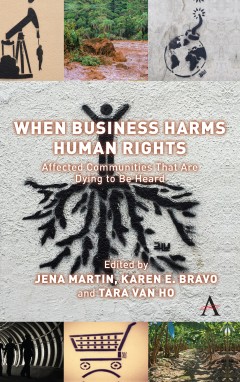
In doing so, the book reveals common experiences despite different legal and cultural systems, with victims identifying how businesses have failed to conduct appropriate due diligence and how existing legal structures are inadequate for ensuring victims can access appropriate remedies when their human rights are harmed.
In her own chapter, Dr. Van Ho examines how a mining company upended the lives and communities surrounding the village of Cajamarca, Colombia, by planning to exploit resources without consultation and in a manner that threatened the water safety and security of an entire region.
While many books briefly feature the experiences of victims, this book is intended to place victims at the centre of their own story. In response to the reported experiences, the editors draw important conclusions and make a series of proposals for international and domestic policymakers. When Business Harms Human Rights: Affected Communities that Are Dying to be Heard is available from Anthem Press (260 pages; £80.00, $125.00).
Recent reports that the government of China has been forcing members of the Muslim minority Uyghur community to labour in the supply chains of western companies have raised a series of questions for other governments and individual businesses about how to respond to such an egregious violation of international human rights law standards.
Annachiara Biondi from Vogue Business has covered the story with a focus on the cotton supply and fashion retailers, and they have turned to Essex Law School’s Dr. Tara Van Ho for guidance on the appropriate standards to be employed.
In a September 2020 article, Dr. Van Ho helped explain the differences between the EU and US approaches to the revelations. In a January 2021 article, she considered the legitimacy and adequacy of the UK’s new controls.
As Dr. Van Ho explains in the January article, the severity of the alleged violations in Xinjiang call for a strong response to ensure that UK companies are not contributing to the violations by using forced labour in their supply chains. Measures announced by the UK government last month, Dr. Van Ho concludes, are not yet strong enough.











 Essex Law Research Blog