In October 2021, Arne Vermeerbergen, Ayşe Uzun Demir, Charlotte Dickson and Parkhi Saxena took on this project. They came with varying degrees of prior knowledge, but for all of them, the scope and complexity of the project was a steep learning curve which they all took on with great enthusiasm. This was one of the six projects of the HRC Clinic of the University of Essex in 2021-22 (the annual report of the Clinic’s activities can be found here).
To give a brief overview of the scope of the project, there are 45 Thematic Mandate and 13 Country Mandate Holders, variously titled Special Rapporteurs, Independent Experts or members of a Working Group. They are supported by the Office of the High Commissioner for Human Rights (OHCHR). They are a Charter mechanism and so are not tied to any particular human rights treaty, but they all have their own separate mandates.
Clearly, the Country Mandate Holders focus on human rights in that country, but the thematic SPMHs focus on their mandate globally; they may issue thematic reports, communications, statements and undertake country visits on their mandate followed by a country report. SPMHs change regularly and a new one may have more or less knowledge of persons within the mandate of UNHCR.
Initially limited to refugees, UNHCR’s mandate has expanded over the past eight decades to include stateless persons and conflict-driven internally displaced persons (IDPs) within the Global Protection Cluster. And UNHCR staff move in and out of headquarters and between countries and regional offices in the field.
Maintaining links in such circumstances is not straightforward and the Clinic Project was about improving communication along with expanding interaction. The Team needed to learn all about the Mandates, but also about UNHCR’s mandate and its operations, as well as the interaction between different parts of the UN: UNHCR, OHCHR, and the independent Mandate Holders.
The desk-based research showed that there was a wide variation in engagement by SPMHs with persons in UNHCR’s mandate, and sometimes there was no carry-over when the SPMH changed. While there is an obvious link between the Special Rapporteurs on the human rights of internally displaced persons and on the human rights of migrants, nearly every thematic SPMH has some relevance to refugees, IDPs and stateless persons – violence and discrimination against women might spark flight and be a constant threat during protracted displacement, minorities are often persecuted and have to flee, the threat to freedom of religion and belief is often the reason for seeking refugee status abroad, transitional justice may be essential for refugees and IDPs to feel it is secure to return. To substantiate the desk-based research, the Team also interviewed SPMHs, their OHCHR support teams and relevant sections in UNHCR HQ and the regions.
Their report made clear the need for greater training for SPMHs regarding UNHCR’s protection mandate, but also for improving awareness of the usefulness of SPMHs to UNHCR’s field operations – UNHCR achieves most of its successes through quiet diplomacy from its in-country missions to 137 countries. Over 80% of the 100 million forcibly displaced persons within UNHCR’s mandate are living in low- or middle-income countries, many that are not party to any refugee convention or even international human rights law treaty. A lot of what UNHCR does has to remain confidential, in much the same ways as the ICRC. However, SPMHs can and should speak out about rights violations and while SPMHs are there for every victim, they are also there for refugees, IDPs and stateless persons.
What the Team also highlighted was UNHCR’s cross-border perspective compared to SPMHs that either are mandated for one country or are carrying out country visits. While the independence of all parties needs to be maintained, the potential for coherent and coordinated intervention cannot be doubted.
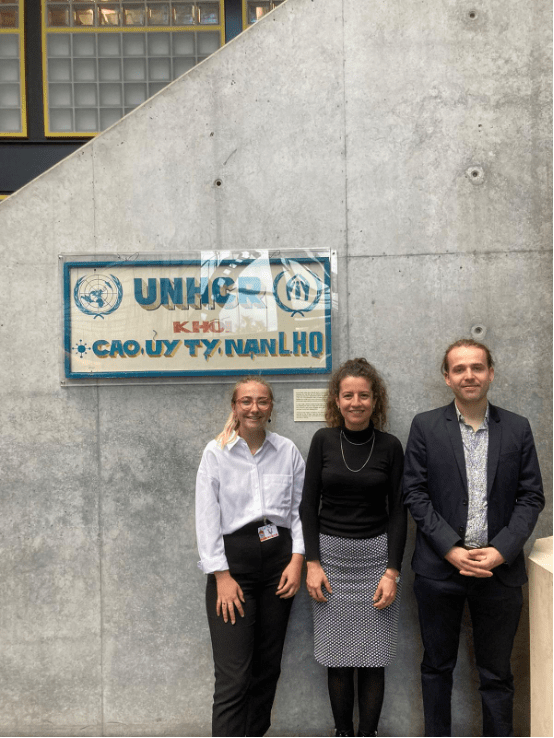
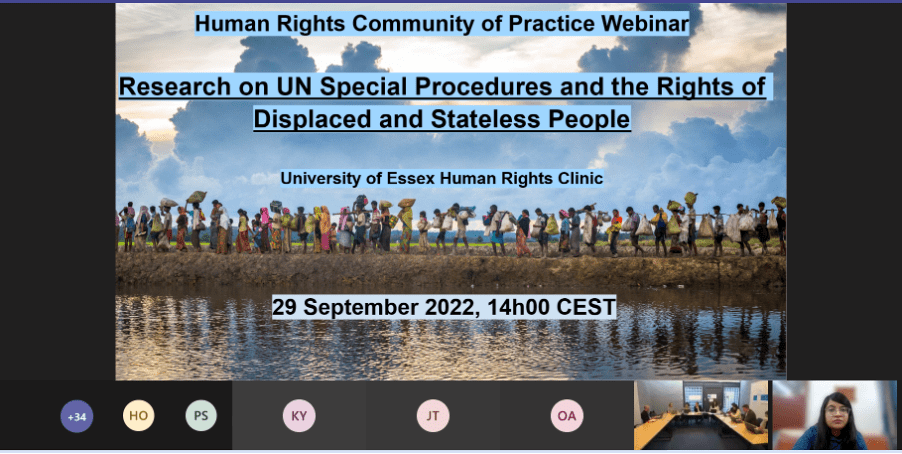
In recognition of their continued association with the project, the Team received the Essex Law School Bursary of the 2021-22 academic year. Furthermore, to promote their findings, the Team were invited by Peter Swiniarski of the HRLU, who hard worked with them all year, to speak at the UNHCR HQ in Geneva on 29 September 2022. They prepared over the Summer and then, with a little specific planning on the night before and in the morning, three of them in person, Arne, Ayşe, and Charlie, with Parkhi joining online from India as she prepared to take up her new position as Assistant Lecturer at Jindal Global Law School, presented in Lecture Room 4 in UNHCR to members of the HRLU and to about 40 field officers around the world.
A picture of the online presentation (inset: ongoing session in UNHCR HQ, Parkhi Saxena presenting online)
It was a fantastic success and the following day, a former Essex student, now based in Mogadishu for UNHCR, Sebastian Herwig, contacted Prof. Geoff Gilbert (who supervised the project) to congratulate them. This was insightful, beyond Masters-level, impactful research that will affect UNHCR, OHCHR and SPMHs as they all seek to enhance the human rights of persons within their mandates.
The Team summed up their year-long experience in a few words:
We were fortunate to work on a project that was incredibly interesting yet very challenging. We hope that the outcomes of our research can make a difference to UNHCR’s and SPMH’s work in building better lives for those forced from their homes.
We are delighted to announce the details of a fascinating workshop taking place on 29-30 August 2022 in Molyvos, Greece. This international workshop aims to explore the relationship between freedom and proportionality, bringing together human rights law doctrine and philosophical theorising.
It will do so by pursuing two main themes:
Is there a morally valuable – albeit overridable – freedom to engage in potentially harmful behaviour or should the concept of freedom be inherently limited by the reasonable interests of others?
Is the proportionality test, as applied in human rights law, committed to a particular philosophical conception of freedom? If so, is that conception morally justified?
Underlying these abstract questions are urgent issues of practice about the balance between the individual and society, the correct interpretation and application of rights, and the role of courts and other state institutions in their protection. For example, the relationship between freedom and proportionality is at the heart of controversies over the lawfulness of government measures aiming to tackle the COVID-19 pandemic such as restrictions of movement and economic activity and compulsory vaccinations.
The issue is typically framed in terms of the proportionality between the public benefit of these measures and the intensity of the interference with human rights. However, for many scholars, this framing is deeply problematic. It assumes that such restrictions amount to losses of valuable rights, which must be offset by an overriding public benefit. But, so the argument goes, we do not have even a prima facie right to be a public threat e.g. by carrying a contagious virus. To think otherwise is to assume a highly individualistic and antisocial notion of personal freedom. And yet arguably this assumption underpins the proportionality doctrine, inasmuch as claimants must clear a relatively easy hurdle to establish that a restriction amounts to a prima facie interference with their human rights. As a result, almost any activity or personal preference, however harmful, triggers a proportionality assessment.
By ensuring that proportionality best reflects moral notions of freedom, we vindicate it and guide its use towards the optimal results. The workshop has this dual aim, to elucidate legal doctrine through sustained theoretical scrutiny and improve it, so that it can successfully address contemporary challenges in human rights law.
The workshop is hybrid. Most of the speakers will meet in Molyvos (Greece), the hometown of Stavros Tsakyrakis, who spearheaded the aforementioned line of attack against proportionality. But the proceedings will also be accessible via a Zoom webinar that is open to everyone. The workshop’s programme and registration details can be found below:
Cristina Blanco, PhD candidate at the School of Law, University of Essex, was awarded the PhD Fieldwork Grant 2021-22 by the Socio-Legal Studies Association (SLSA). Cristina’s research focuses on the interactions between Amazonian onto-epistemologies, international law (IL) and human rights in the context of an investment project.
In the Amazonian rivers, water flow varies significantly with the seasons. During the dry season, low water levels hinder the navigation of large vessels. Although the peoples inhabiting the Amazon rainforest have travelled and traded using these rivers over centuries, the fluctuating navigability prevents uninterrupted large-scale transport. This is the main reason why the Peruvian state is promoting the “Amazonian Waterway”, an infrastructure project that consists of removing sediments from the bottom of the main Amazonian rivers.
The Amazonian Waterway is far from being an isolated project. It rather reflects the neoliberal developmental paradigm favoured by IL (Escobar 2011, Pahuja 2011, Eslava 2019). In addition to generating serious socio-environmental impacts, the project hides a profound conflict of ways of understanding the world.
The Amazonian indigenous peoples conceive the territory as a space inhabited by human and non-human entities, a conception that challenges the very definition of what we call “nature”. The sharp distinction between humans and non-humans that governs the Western world and underlies modern (international) law is not necessarily present in Amazonian cosmologies (Viveiros de Castro 2004, De la Cadena 2010, Descola 2013).
For the Kukama-Kukamiria people, for instance, the territory is inhabited by different “categories of people” living in a “plurality of worlds” (Tello 2014). The river is an (aquatic) world in itself, inhabited by beings endowed with their own subjectivity and intentionality (Rivas 2011). Therefore, thinking from the Amazon means not only standing in a geographically different place but also thinking onto-epistemically different.
In this scenario, the main problem the research seeks to explore is that IL does not take this onto-epistemic diversity seriously. Instead, it frames the issue as a cultural question of relevance to indigenous collective rights. While such rights play an indispensable role in protecting indigenous worldviews, they are insufficient to prevent their elimination.
This, in turn, has important implications in areas as critical as the Amazon. Trying to make sense of IL from the Amazon, this case study provides the opportunity to explore how to move from the impact of IL in the Amazon (historically aimed at its internationalisation) to enable the influence of Amazonian epistemologies on IL. This exercise of “Amazonising IL” enables us to reveal the epistemological richness of the Amazonian cosmovision and explore its potential for rethinking IL.
The research has three main methodological components. Substantively, it is a socio-legal research that takes as the unit of analysis the interactions between IL, human rights and the Amazonian worldview relevant to the case study. In analytical terms, it has an interdisciplinary approach theoretically informed by Amazonian studies and critical approaches to IL. As for the empirical component, it uses a case study method based on qualitative analysis of documentary and visual information, as well as in-depth semi-structured interviews.
The fieldwork was possible thanks to the valuable support of the SLSA.
Viveiros de Castro, E. (2004). Perspectivismo e multinaturalismo en la América indígena. Tierra adentro: territorio indígena y percepción del entorno. A. Surrallés and P. Hierro. Copenhague, IWGIA: 37-82. https://www.iwgia.org/images/publications/0331_tierra_adentro.pdf
By Dr. Koldo Casla, Lecturer in Law and the Director of the Human Rights Centre Clinic
In the 2008 case of McCann v UK, which concerned the eviction of a family renting a house from a local authority in England, the European Court of Human Rights established that:
“(T)he loss of one’s home is a most extreme form of interference with the right to respect for the home. Any person at risk of an interference of this magnitude should in principle be able to have the proportionality of the measure determined by an independent tribunal”.
Para 50, emphasis added
In a decision on admissibility ten years later, FJM v UK, the Court restricted the principle above to evictions in the public sector. Despite the wording in McCann, the proportionality test would not really apply to any person, but only to tenants in the same situation McCann found himself in, namely, social/public housing tenants.
In my new article in European Human Rights Law Review, I argue that the European Court of Human Rights should reconsider the position expressed in FJM v UK, and establish that evictions with no proportionality test are contrary to the right to home of Article 8 ECHR, also in the private rental sector
In FJM v UK, the European Court went as far as to say that, if tenants were entitled to require national judges to examine the proportionality of an eviction before ordering the possession of their home, ‘the resulting impact on the private rental sector would be wholly unpredictable and potentially very damaging’ (para 43, emphasis added).
This article shows that this need not be the case, and that in fact before reaching such a conclusion the European Court should have examined European comparative practice and national legal orders, as well as other human rights obligations. This article makes the case for a proportionality assessment of all evictions, irrespective of public or private ownership. The scope of the margin of appreciation requires an analysis of the common ground that may exist in European comparative practice and in light of other international human rights obligations accepted in the continent. The social function of homeownership provides the ground to achieve a better balance between the right to private property, the right to private and family life, and the right to housing.
Neither Article 11 ICESCR (on the right to adequate housing) nor Article 8 ECHR (on the right to home as part of private and family life) would give tenants a blank check to stop paying their rent or to break the lease in any other way. And giving judges the power to assess the proportionality of an eviction in the private rental sector would not fix all the housing problems. But it would be an important first step towards a more balanced relationship between landlords and tenants.
The amount of the award is £250,000 for a 12-month project, which began in June 2022. The project team involves Dr. Jovanovic as a Principal Investigator (PI), Dr. Patrick Burland of the International Organization for Migration (IOM) UK as a Co-Investigator (Co-I), and a group of researchers from the Hibiscus Initiatives, a non-governmental organisation that works with prisoners.
The project investigates what happens to the survivors of modern slavery who end up in prisons in the United Kingdom and the extent to which the existing legislation and policies provide an opportunity for them to be identified and access the necessary support and assistance.
The project has two central objectives:
First, to provide a critical appraisal of the existing law and policy applicable to survivors of modern slavery in prisons in the UK and consider their compatibility with binding international obligations in this field. In doing so, we will identify the gaps and blind spots of the relevant laws and policies and articulate actions/reforms needed to bring domestic law and policy in line with the UK’s international obligations.
Second, to evaluate current institutional practices, which are meant to give effect to the relevant law and policy. In other words, even if the research finds that the applicable laws and policies are adequate and in line with international law, do practices follow their letter and spirit? We will seek to identify the reasons for discrepancies between the rules and their application and propose actions needed to bring practices in line with the rules.
The research is conducted through both the desktop analysis of the relevant sources using a doctrinal method as well as by interviewing the survivors of modern slavery who have been in prison in the UK and other stakeholders, such as the government officials, civil society actors, lawyers, and members of the prison administration.
This project is part of the portfolio of five projects examining the impact of wider laws and policies on modern slavery funded by the MSPEC. Further details about Marija’s and the other four projects included in the portfolio will be provided in a detailed announcement by the Modern Slavery PEC in due course.
The Modern Slavery PEC is an AHRC-funded, Strategic Priorities Fund Centre, created by the investment of public funding to enhance understanding of modern slavery and transform the effectiveness of laws and policies designed to address it. The Centre funds research and works with funded research to enhance the evidence it creates and maximise its impact potential.
Investigations into alleged violations of international humanitarian law and international human rights law in armed conflict are crucial to the implementation of these bodies of law.
There are, however, numerous legal and practical challenges that arise when considering a State’s obligations under international law with regard to such investigations.
These include establishing the bases and scope of the duty to investigate under both bodies of law, and determining the way in which these investigations must be carried out.
Furthermore, addressing the framework for investigations in armed conflict necessarily requires an examination of the interplay of international humanitarian law and international human rights law.
In her new chapter in the latest edition of the Research Handbook on Human Rights and Humanitarian Law, Dr. Claire Simmons, a researcher at the Essex Armed Conflict and Crisis Hub (under Essex’s Human Rights Centre), focuses on the concept of effectiveness of investigations under international law.
Dr. Simmons addresses, in particular, the legal and practical challenges surrounding the conduct of investigations in armed conflict, taking into account the complementary way in which both bodies of law interact.
Research Handbook on Human Rights and Humanitarian Law, edited by Robert Kolb, Gloria Gaggioli, and Pavle Kilibarda
Dr. Emily Jones, Senior Lecturer in the School of Law and Human Rights Centre at the University of Essex, became a member of the United Nations Expert Knowledge Network on Harmony with Nature.
Dr. Jones offers below her input on the theme of Earth Jurisprudence.
Earth Jurisprudence is a philosophy of law and human governance that is based on the idea that humans are only one part of a wider community of beings and that the welfare of each member of that community is dependent on the welfare of the Earth as a whole.
What would the practice of Earth-centered Law look like from an Earth Jurisprudence perspective? How is that different from how Earth-centered Law is generally practiced now? And, what are the benefits of practicing Earth-centered Law from an Earth Jurisprudence perspective?
I am an international lawyer so I will comment mostly from within that field. Right now, I don’t think the law accommodates an Earth jurisprudence approach at all. Even international environmental law, the area of international law that is there to protect the environment, is very anthropocentric. We can see this by looking at the principle of sustainable development.
This is arguably the main overarching principle of international environmental law. This principle broadly notes that development needs must be sustainable for the environment. However, as scholars Usha Natarajan and Kishan Kohdy have noted, the principle is seldom used ‘to call for less development.’ Overall, this principle sets up a system whereby the environment is seen as a resource to be exploited, an object, with humans being the only subjects in this paradigm.
An Earth jurisprudence perspective would challenge that paradigm. We need to move from the current legal position which sees the environment as an exploitable object and start challenging human exceptionalism. Humans are deeply connected to their environments, impacting on and being impacted by them. An Earth jurisprudence perspective will push the law to see those relationships as opposed to always seeing humans as distinct from and superior to their natural environments. This shift will be urgently needed if we are to address the pressing environmental challenges of our times.
What promising approaches would you recommend for achieving the implementation of an Earth-centered worldview for Earth-centered Law?
I find a lot of hope in the emerging recognition of the Rights of Nature. The Rights of Nature are increasingly gaining traction and have now been recognized in over 27 countries on all continents. States are increasingly interested in applying Rights of Nature approaches and so this is something I think we need to push for.
Personally, I am interested in how we can start applying the Rights of Nature in international law. So far, the Rights of Nature have mostly been applied in local contexts e.g. to a river or a specific area where the boundaries are legally defined. However, for the Rights of Nature to have a global impact, they need to be applied globally. After all, ecosystems are not bounded entities but are deeply connected to one another. The UN Harmony with Nature Program has been key in getting the Rights of Nature on the international agenda, but there is a lot more work that still needs to be done.
I also think we need to do a lot more work to continue to amplify the voices of Indigenous peoples. There is so much knowledge that has, for centuries, been ignored and silenced. It can also not be forgotten that, while Indigenous peoples have not been involved in all instances of the recognition of the Rights of Nature, and not all Indigenous peoples support the Rights of Nature, with some questioning the Eurocentrism of the term “rights”, Indigenous worldviews instigated this movement. The Rights of Nature, as noted, represent a key shift in re-thinking out currently anthropocentric legal frames, and it is no coincidence that Indigenous peoples have played such a vital role in this moment thus far.
I also find hope in emerging calls for degrowth approaches. This is one way that we may start to challenge some of the dominant economic models and ways of thinking that justify the exploitation of the environment for so-called economic needs.
What key problems or obstacles do you see as impeding the implementation of an Earth-centered worldview in Earth-centered Law?
I think the key challenge, and one that international environmental law as a field has long faced, is getting things done. International law is based on state consent and states, as we know, are not always very forthcoming when it comes to protecting the environment.
There are many factors at play here, including the state’s need to promote its own economic development but also the pressure put on by powerful corporations. Our global order is so focused on neoliberal economics, on profit and on prioritizing the needs of corporations.
Pushing people to think differently, to think beyond those entrenched systems of thought and power, will be difficult, but I think we will get there – we have to!
What are the top recommendations for priority, near-term action to move Earth-centered Law toward an Earth Jurisprudence approach? What are the specific, longer-term priorities for action?
Promote the Rights of Nature globally. This means taking local, regional and international actions to get this on the agenda of lawmakers.
Engage the public. For us to move towards a legal system based on Earth jurisprudence, we need to ensure people are on board and are calling for this. The Rights of Nature sounds interesting to people when they first hear it but we need to work harder to explain this to people and why it matters.
In terms of getting the Rights of Nature on the international legal agenda, I think the next step will be applying the Rights of Nature to case studies. We have some examples from domestic legal systems where the Rights of Nature have been applied but, for the most part, how we can put this into action in international law remains unclear. We need to start doing that detailed work to show states and other stakeholders exactly how it can be done.
This Q&A is available on the UN’s Harmony with Nature Experts’ Library.
In the 1990s, Bruce Ackerman defined ‘constitutional moments’ as historic milestones of intense deliberation and change in a country’s politics, change that reflects in the country’s constitutional settlement.
Since October 2019, Chile is going through its own constitutional moment, a moment that began with popular resistance against rising public transport fees in the capital Santiago.
Social Rights and the Constitutional Moment seizes the opportunity of this unique moment to unpack the context, difficulties, opportunities, and merits to enhance the status of environmental and social rights (health, housing, education, and social security) in a country’s constitution.
Social Rights and the Constitutional Moment (Hart 2022): please see below contents and links to chapter summaries
In 2020-2021, this partnership brought together practitioners and academics from Chile and other countries (Argentina, Brazil, Canada, Colombia, Ireland, Mexico, South Africa, Spain, the United Kingdom and the United States) to share and learn from international and comparative practice with the goal of informing the ongoing process of constitutional reform in Chile.
More than thirty contributions were compiled and submitted to members of the constitutional convention and other public authorities in the country in September 2021. This new book presents an extended version of a selection of those essays.
Still today, with laudable exceptions (such as this, this, this, this and this), the majority of comparative constitutional studies in the English language tend to focus on the United States and Europe, and the analysis of peripheral legal systems, when it exists, can only be found on the sidelines as a more or less blatant afterthought. Unlike common practice in comparative constitutional law, this book is anchored in Latin America, building from Chile.
Drawing on the analysis of both academics and practitioners, the book provides rigorous answers to the fundamental questions raised by the construction of a new constitutional bill of rights that embraces climate and social justice.
With an international and comparative perspective, chapters look at political economy, the judicial enforceability of social rights, implications of the privatisation of public services, and the importance of active participation of most vulnerable groups in a constitutional drafting process.
Ahead of the referendum on a new constitution for Chile in the second half of 2022, this collection is timely and relevant and will have a direct impact on how best to legislate effectively for social rights in Chile and beyond.
Photo of Richard Ratcliffe at the candlelit vigil outside the Foreign Office on Friday 05 Nov. 2021, eleven days into his hunger strike, via Flickr.
Professor Carla Ferstman is a lawyer and an activist. Before joining the School of Law in 2018, she directed REDRESS, an organization dedicated to helping torture survivors in all parts of the world to seek justice for all the harm they suffered. That is where she first met Richard Ratcliffe, the husband of Nazanin Zaghari Ratcliffe who was released earlier this week on 15 March 2022 after almost six years of being kept as a hostage in Iran.
Kate Clayton, Senior Communications Officer at the University of Essex, spoke to Carla to find out more about her perspective on Nazanin’s journey to freedom and to ask her what lessons we might be able to draw from her case.
Why has the plight of Nazanin and her family resonated with so many people in the UK and beyond?
On a human level, it is hard to fathom what it must feel like to have one’s family torn apart by such an arbitrary, brutal act and to feel so powerless over so many years. So this was about compassion first of all. But also, Richard’s advocacy, his unwillingness to be quieted in the face of the injustice he and Nazanin faced helped to bring and keep people on board.
Do you think there were any turning points in the campaign?
Yes, several, and I will focus on the positive ones.
First, is the recognition by the UN Working Group on Arbitrary Detention that Nazanin’s detention was arbitrary, that she was likely to have been arrested because of her status as a dual Iranian-British national, and that she should be immediately released. This 2016 decision made it clear that this was no ordinary criminal case where the UK should sit back and wait for justice to take its course. No, Nazanin was being targeted. Removing the veneer of a criminal justice justification for her detention was really important because it helped to move the UK Government towards a position where it understood that it had to act. Passivity was not an option.
Second, was the coming together of many of the families of detainees, mainly dual nationals and Iranian nationals with foreign links. This was crucial to change the narrative about what was happening. All the stories were so similar – this was a form of hostage-taking. It was also important to counter isolation and build a sense of common solidarity.
Third, was the 2019 decision by then Foreign Secretary Jeremy Hunt to grant Nazanin diplomatic protection, meaning that the UK Government had recognised formally that the harm caused to Nazanin was a harm to the UK Government and one for which it could intervene as a state to state claim. This was a landmark recognition.
Fourth, was the March 2022 repayment by the UK of a £400m debt that had been outstanding since the 1970s in relation to an outstanding order for military equipment.
You managed to involve Essex students in the campaign. How did this go?
Iran’s human rights record was being considered by the UN Human Rights Council in Geneva through its universal periodic review process. The students, under the auspices of the Human Rights Centre Clinic helped prepare a submission on behalf of seven families to highlight the injustice of their situation. This came at a really important time and was a start of much more robust joint advocacy by families of detainees. This was quite a unique opportunity for the students to work on such a concrete, live case involving real people undergoing serious human rights violations in real-time.
Have campaigns like this impacted your academic research?
Indeed, I just recently co-authored with my colleague Dr Marina Sharpe a journal article which considers whether the arbitrary detention of dual and foreign nationals in Iran violates the Convention on the Taking of Hostages and may constitute a crime against humanity. We hope this will be useful to ongoing scholarly debates and also assist the many organisations who are following these issues and governments whose citizens continue to be affected by the practice.
What do you think comes next for Nazanin and Richard?
One of the wonderful things about the freedom they now have is that it is absolutely for them to figure out their next steps. Something we may all take for granted, I imagine for them feels very luxurious.
What next for the other cases?
There are still so many people who remain arbitrarily detained in Iran in a hostage context, many for multiple years, under very difficult circumstances. And the practice is also happening in more and more countries. The advocacy must continue until the practice stops.
This piece was first published on the Blog of the University of Essex and is reproduced on the ELR Blog with permission and thanks.
Russia is no longer a member state of the Council of Europe. On 16 March, the Committee of Ministers (CM) of the Council of Europe decided, “in the context of the procedure launched under Article 8 of the Statute of the Council of Europe, that the Russian Federation ceases to be a member of the Council of Europe”. The decision was effective immediately. This came just a day after the Parliamentary Assembly of the Council of Europe (PACE) unanimously recommended that ‘the Committee of Ministers should request the Russian Federation to immediately withdraw from the Council of Europe’ and, if Russia does not comply, ‘that the Committee of Ministers determines the immediate possible date from which the Russian Federation would cease to be a member of the Council of Europe’. At the same time, shortly before PACE voted on this matter, the Russian Federation had submitted a formal notification to the Secretary-General indicating that it would withdraw from the Council of Europe under Article 7 of the Statute, and that it would denounce the European Convention on Human Rights. This post will revisit some of the key decisions of the last three weeks, demonstrating how these decisions could shed light on legal ambiguities surrounding withdrawal, suspension and expulsion from the Council of Europe.
Suspension and Expulsion
After its invasion of Ukraine, an obvious and fundamental violation of international law, the Council of Europe has clearly taken a firm stance against Russia. It was understood that, after more than two decades of a turbulent relationship, the war in Ukraine could not warrant anything less than an immediate and clear reaction. Thus, the Secretary-General, the Committee of Ministers, the President of the Venice Commission – among others – have all condemned on multiple occasions and in the strongest terms the invasion. For the first time, Article 8 of the Council of Europe Statute was relied upon on 25 February to suspend Russia’s rights of representation in the Council of Europe. The European Court of Human Rights also granted urgent interimmeasures, asking Russia to refrain from military attacks against civilians and civilian objects and abstain from blocking and terminating the activities of Novaya Gazeta. On 15 March and 16 March the PACE and CM adopted the aforementioned historic opinion and decision, respectively.
Questions surrounding the withdrawal, suspension and expulsion from the Council of Europe had not been the subject of extensive scholarly analysis, until the insightful study by Dzehtsiarou and Coffey of 2019. The key provisions are indeed Articles 7 and 8 of the Council of Europe’s Statute – but, as Milanovic observed, the wording of these provisions is not ideal. These provisions should be read alongside Article 3 of the Statute, which states the values of the Council of Europe. Thus, the clear political determination of the Council of Europe’s organs to request Russia to withdraw took place in the context of a number of legal ambiguities surrounding the relationship between Articles 8 and 7, in particular. After all, this is the first time that Article 8 is enforced against a member state. In that sense, the expulsion decision against Russia has shed light on the applicable legal framework in a number of ways, as will be shown below.
Key decisions since 24 February
The exposition of key decisions of the CM and PACE is selective and focused on the scope of the post; all decisions or further information is available here:
24 February: The CM decides to hold an extraordinary meeting on 25 February to examine measures to be taken under Article 8.
25 February: The CM decides, under Article 8, to suspend Russia’s rights of representation in the Council of Europe. Resolution CM/Res(2022)1 on 2 March clarifies that the suspension concerns the CM, PACE, the Congress of Local and Regional Authorities and committees set up under Articles 15.a, 16 and 17 of the Statute.
10 March: Russia announces (albeit not formally triggering Article 7) its intention of not participating in the Council of Europe.
10 March: On the same day, the CM decides to consult PACE with a view to deciding further measures against Russia under Article 8. PACE had already decided, on 25 February, to hold an extraordinary meeting on 14 and 15 March to discuss the consequences of the Russian Federation’s aggression against Ukraine.
14 March: PACE begins the extraordinary meeting; the members show clear support for the further use of Article 8. A draft report on the ‘Consequences of the Russian Federation’s aggression against Ukraine’ is circulated among members.
15 March: Shortly before the vote, the Russian Federation submits its letter under Article 7 and also notifies the Secretary-General of its intention to denounce the European Convention on Human Rights (ECHR) under Article 58 ECHR. The President of the Assembly (rightly, as will be shown below) informs the members that the Article 7 letter will in no way impact the discussions and the vote on the further use of Article 8.
15 March: PACE votes unanimously in favour of the CM requesting Russia to withdraw from the Council of Europe ‘immediately’.
15 March: After the vote, the Secretary-General, the Chair of the CM and PACE’s President make a joint statement on the ‘exclusion’ of Russia, indicating that it can no longer be a member of the organisation.
16 March: The CM decides to end Russia’s membership with immediate effect, namely from 16 March 2022.
A two-step process against Russia and the role of the Assembly
The first point to be noted is that, on this occasion, Article 8 was used as a two-step process. The first step was the suspension decision on 25 February. The second step was that of ‘expulsion’. Thus, the further use of Article 8 referred to in the decision of 10 March concerned the second step, which is that of ‘expulsion’. Nevertheless, Article 8 is not ideally worded as it refers to Article 7. This matter is returned to below. The question as to why the Parliamentary Assembly was not consulted more extensively (see below) prior to the suspension decision of 25 February could be answered with reference to Statutory Resolution (51) 30, Admission of new members (annexed to the Statute), which also refers to withdrawal:
The Committee of Ministers, before inviting a State to become a Member or Associate Member of the Council of Europe, in accordance with Articles 4 and 5 of the Statute, or inviting a Member of the Council of Europe to withdraw, in accordance with Article 8, shall first consult the Consultative (Parliamentary) Assembly in accordance with existing practice.
The above provision indicates that the Parliamentary Assembly should be consulted prior to the request to withdraw under Article 8 – but not necessarily in the case of suspension. It was possibly felt that it was of the utmost importance to activate immediately Article 8 and proceed with the suspension decision that it entailed on 25 February. However, the Decision of 25 February was adopted ‘[f]ollowing an exchange of views with the Parliamentary Assembly in the Joint Committee’, so clearly the Parliamentary Assembly was involved.
Simultaneously, it is worth noting that Article 8 of the Statute is not the only provision which could have been drafted in a clearer way. Indeed, the above provision in Statutory Resolution (51) 30 is not ideally worded, too. In particular, it refers to an ‘invitation to withdraw’, while Article 8 indicates that this is not an invitation but rather a request.
Russia’s expulsion and the full separation of Articles 7 and 8
When the Assembly prepared and circulated the draft report on the further use of Article 8, it was not known, it appears, that Russia would submit the Article 7 letter shortly afterwards. When that was announced, the Parliamentary Assembly rightly continued with the consideration of the use of Article 8 despite the activation of Article 7. As von Gall argued, even if Article 7 would be triggered by Russia, the organs of the Council of Europe would still need to proceed with the request to leave under Article 8. As she explained, ambiguities surrounding membership of the Council of Europe should not be used to undermine the mandate of the organization. Nothing in the text of the Statute appears to suggest that such a move is not legally permissible.
It is now known that Article 7 was triggered by Russia on 15 March. The above sequence of decisions indicates that the Council of Europe organs were determined to force Russia to withdraw – in effect, to expel it from the organization. The Article 7 letter was an attempt by Russia to avoid that. It is important to recall that, under the text of Article 7, the withdrawal takes effect at the end of the financial year. Simultaneously, one of the amendments that were adopted in the report of the Assembly concerned precisely the addition of the word ‘immediately’ – which brings to the fore the question of the timing of withdrawal and the possibility of immediate expulsion (which, as we know now, is exactly what has happened). Leaving aside the timing of withdrawal, and contrary to Article 8, Article 7 provides for a ‘voluntary withdrawal’ (p. 65) – which clearly is not the case here as we are before the most serious violation of Article 3 of the Statute.
As the draft, and then the adopted Opinion, confirm, the Assembly was of the view that no discretion should be left to the Committee, and it thought so even before the submission of the Article 7 letter. This is legally significant because Article 8 provides that if the state does not comply, the Committee ‘may decide’ that the state is not a member after a specific date. Of course, the Opinion of the Assembly is not binding as the Committee makes the decision – but, as already noted, it proved very influential.
In this context, the activation of Article 7 by the Russian Federation on 15 March (and the withdrawal at the end of the financial year that it implied) inevitably brought to the fore the interplay between Articles 8 and 7 of the Statute. Article 8 provides that the Committee of Ministers can request a state ‘to withdraw under Article 7’. Simultaneously, it has already been mentioned that Article 7 provides for a voluntary withdrawal and also that the use of Article 8 is autonomous from Article 7: a state cannot use Article 7 at will to evade the consequences of the use of Article 8 by the Council of Europe.
The decision to expel immediately was made by the Committee, taking into account the Opinion of the Assembly. After this sequence of decisions, Article 8 could have been interpreted by the CM in at least two ways. First, as implying a connection with Article 7 in the following way: that the request to withdraw if the state complies would take place under the terms of Article 7, namely by the end of the financial year. Differently put, that an ‘expulsion’ on a specific date (including with immediate effect) could only take place once it was established that the member state in question is unwilling to cooperate. This situation could be viewed as a de facto expulsion, even if legally Russia would remain a member state until the end of the financial year. By analogy, the example that Klein provides (p. 66) of the Greek military junta would be of relevance (Greece, having declared its withdrawal under Article 7, was de facto suspended from December 1969 until the end of the next financial year).
Second, Article 8 could be (and indeed was) interpreted as enshrining a right to terminate the state’s membership immediately, regardless of whether or not the state cooperates. This position strengthens the connection between Articles 3 and 8, thereby providing for the possibility of immediate expulsion regardless of the willingness of the state. As Dzehtsiarou observed, ‘Russia was suspended as a result of aggression and gross violations of the values and principles of the organisation’ and therefore ‘the termination of membership should be imminent’.
These considerations were certainly taken into account in the Opinion of the Assembly. Arguably, the Committee went even further than the Opinion by ceasing Russia’s membership with immediate effect (ie without a ‘request’). Thus, Article 8 was fully dissociated from Article 7 and provided for the immediate expulsion from the organization. In doing so, the Council of Europe organs and the CM in particular emphasised that (i) this was clearly not a voluntary withdrawal but an expulsion (ii) the terms and timeframe of expulsion would be determined by the Council of Europe and not Russia.
The clear separation of Article 8 from Article 7 could also have implications for the difficult question of whether Russia is bound by the ECHR for the next six months (see Article 58 ECHR). Plausible arguments have been provided in both directions, and clearly this matter will be the subject of much discussion. Until a decision is made, one would be inclined to think that precisely because Article 8 was interpreted and applied in this way (i.e. immediate expulsion), the starting point would be that the ECHR ceased to apply on 16 March as well.
Conclusion
Russia’s exit from the Council of Europe (and from the European Convention on Human Rights, on which more generally see here and here) was an inevitable and necessary decision which has of course consequences, especially because, as the Council of Europe leaders acknowledged, it deprives the Russian people of access to the European Court of Human Rights (for a broader discussion see the aforementioned article, p. 467 et seq). But ultimately, in every step of this process, and in light of the seriousness of the violations of Article 3, it was the Council of Europe suspending, requesting to leave, and eventually expelling Russia. In this context, the full separation of Articles 7 and 8 is legally and politically significant.
The author would like to thank (with the usual disclaimer) Kanstantsin Dzehtsiarou and Kushtrim Istrefi for very helpful comments on earlier versions.
This article was first published on 17 March 2022 on the ECHR Blog and is reproduced on the ELR Blog with permission and thanks. The original piece can be accessed here.





 Essex Law Research Blog