
Digitalizing the End-to-End International Trade Finance Process and the Law

Photo by Chris Liverani on Unsplash

By Dr Mohammed Khair Alshaleel, Essex Law School

Trade finance is one of the backbones of global trade. By its nature, it is a heavily paper-based industry as it relies on ownership of title documents. Processes that currently support the global trade finance ecosystem are extremely focused on documentation and checking. An end-to-end process can often take weeks to complete.

The spread of digitalization and digital services in the broader society has led to calls for similar applications in the trade finance sector. However, embracing digital innovations in the trade finance industry has been very slow, trailing behind the rapid digitalization advancements made by the financial services and banking sectors.

Many of the complexities in trade finance are driven by the fact that each trade finance transaction requires the input of a large number of entities in different locations worldwide, including, for example, buyers, sellers, banks, customs authorities, insurance companies and carriers. Each entity has a unique mix of internal and external requirements to comply with. Importantly, they are at very different levels on the technology adoption curve. These variations present one of the main challenges for the trade finance industry to digitalize.

The emergence and adoption of new technologies in trade finance and trade generally have made full digitalization possible. Digitalization here refers to the incorporation of digital technologies into traditional trade finance processes and practices.

Legal framework and ecosystem collaboration

Dr Alshaleel’s research raises novel questions about whether the current trade finance legal framework is sufficient for allowing the transition to a fully digital system and whether the legal obstacles concerning the developments in technological applications in the trade finance industry are reflected in the international standards and rules.

His new article ‘Digitalizing the End-to-End International Trade Finance Process and the Law: A Mission for the Entire Ecosystem’, which is by the European Business Law Review, identifies the key challenges and barriers that impede the successful digitalization of the end-to-end trade finance process, and the factors that contribute to, or hinder, the attainment of critical mass in the adoption of digitalization within the trade finance ecosystem.

The article argues that technical innovation is only one piece of the puzzle and effective legal frameworks as well as recognized standards are essential to accelerate the digitalization journey. It also posits that digitalizing an end-to-end trade finance process is a mission for the entire trade finance ecosystem: successfully digitalizing the full trade finance process requires cooperation and buy-in from all the players involved.

Finally, Dr. Alshaleel’s analysis also emphasizes that deeper coordination and collaboration between the parties in the trade finance ecosystem is crucial in helping digitalization reach critical mass.
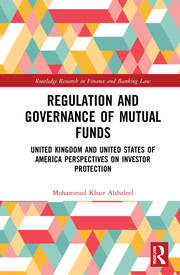

Regulation and Governance of Mutual Funds: United Kingdom and United States of America Perspectives on Investor Protection

Image credit: routledge.com

By Dr Mohammed Alshaleel, Essex Law School

Dr Mohammed Alshaleel recently published Regulation and Governance of Mutual Funds: United Kingdom and United States of America Perspectives on Investor Protection. This book provides a detailed analysis of mutual fund regulations and governance in the UK from the investor protection perspective. It comprehensively describes mutual funds by their function, social utility, and legal attributes, examining the level of protection provided to retail investors under existing regulations.

Mutual funds are externally managed with fund ownership separated out from their management, which carries a potential conflict of interest between the self-interests of the fund management and each fund’s investors. The book provides an in-depth analysis of this agency problem in the mutual fund industry, comparing the competing governance models in the UK and the US and the supervision of management activities.

In the UK, the book investigates the main governance mechanisms, including disclosure, the effectiveness of voting rights, and the role of the Financial Conduct Authority in protecting investors. It also considers the role of prudential regulations in protecting mutual fund investors, with a particular focus on risk management and mutual fund liquidity crisis. The book further investigates the impact of the withdrawal of the UK from the European Union (Brexit) on the industry and what this means for the future of the undertakings for collective investment in transferable securities (UCITS) in the UK.

The concept of mutual funds is still not clearly understood, so this book will clearly define the different legal and practical aspects of mutual funds. It will be the first substantial study of mutual fund governance mechanisms under the existing mutual fund laws and regulations in the UK.

Further information on this book can be found here.

Grant Success: Digitalising International Trade Finance Process

Photo by Austin Distel

Dr. Onyeka Osuji (Reader in Law, University of Essex) and Dr. Mohammed Khair Alshaleel (Lecturer in Law, University of Essex) were successful in securing funding from Qatar National Research Foundation for an International Conference on Digitalising International Trade Finance Process: Interrelationships, Constraints, Opportunities and Perspectives.

The conference is a collaborative event of the School of Law at the University of Essex School of Law and the College of Law Hamad Bin Khalifa University Qatar (HBKU). Dr. Alexander Ezenagu and Dr. Georgios Dimitropoulos (both attached to HBKU) are also principal investigators in the research team.

One of the objectives of this international conference is to investigate relevant difficulties, including national, regional and international perspectives and whether they are limited to specific sectors (or widespread) and the role of digitalisation of trade finance in their resolution.

The second objective is to explore the linkages between digitalisation and trade finance and provide insights for improving the legal and institutional framework. 

The two-day international conference will be held at Hamad Bin Khalifa University Qatar in October 2021

The UK and the EU’s Fifth Anti-Money Laundering Directive: Exceeding Expectations

Image by Alexas_Fotos

Dr. Mohammed Khair Alshaleel, Lecturer in Law, University of Essex, published a new article on ‘The UK and the EU’s Fifth Anti-Money Laundering Directive: Exceeding Expectations’.

The article considers the UK implementation of the Fifth Money Laundering Directive. It examines the key changes introduced by the new Directive and their impact on the UK anti-money laundering regime.

Given the evolving nature of threats relating to money laundering and the latest technological developments, this article argues that the UK has decided to go beyond the EU minimum requirements.

The paper outlines the concept of money laundering and the UK legal framework of anti-money laundering, before assessing the main changes and their effects on the UK anti-money laundering regime.

The article was published on European Company Law (Volume 17, Issue 4, pp. 123-132), and can be access here.

Money Market Funds Reforms in the US and the EU

Dr Mohammed Alshaleel, Lecturer in Law at the University of Essex, published an article titled ‘Money Market Funds Reforms in the US and the EU: The Quest for Financial Stability’.

The article considers the impact of money market funds (MMFs) reforms in the US and the EU on the money market fund industry and global financial stability. The 2008 financial crisis proved that MMFs are a source of considerable instability to the global financial system, and highlighted their susceptibility to runs. The shareholders’ incentive to redeem their shares before others do when there is a perception that the MMFs might suffer a loss makes MMFs vulnerable to runs. Given this reality, the article argues that the emphasis of the financial regulators on achieving the stability of the entire financial system after the 2008 financial crisis necessitates the strictness of the new reforms.

Divided into six parts, the article outlines the attributes and classification of MMFs, the definition of financial stability, and the run and systemic risk posed by MMFs during the financial crisis, before assessing the MMFs’ reforms in the US and the EU and the impacts of these reforms on the MMFs industry and global financial stability system. The major component of the US reform is the introduction of the floating net asset value (FNAV), where an MMF’s share price will fluctuate to reflect the daily market value of the fund assets. In the EU the new regulation provides investors with a high degree of optionality for investing by introducing Low Volatility Net Asset Value (LVNAV) MMFs.

The article concludes that despite that, the reforms are likely to jeopardise the viability of some categories of MMFs, they enhance global financial stability, and the complexity of the reforms has made MMFs more appropriate products to financial institutions’ investors than retail investors.

The article is published in Volume 31, Issue 2, pp. 303-335 of the European Business Law Review and can be accessed here.