
The EU-CIEMBLY project organized an internal staff training workshop from November 4th to 6th at the Universidad Complutense de Madrid, Spain. The primary goal of the workshop was to advance and harmonize the partners’ understanding of the theoretical and analytical framework, essential for designing and implementing an inclusive and intersectional European Citizens’ Assembly (CA). The event aimed to equip the project team with both normative tools and empirical insights essential for creating an inclusive deliberative process throughout the project. Dr Anastasia Karatzia, Dr Niall O’Connor, and Dr. Sam Woodward represented at the workshop the University of Essex team, which also includes Dr. Rebecca Warren and Prof. Ileana Steccolini from Essex Business School.
The workshop’s agenda included various presentations and structured discussions designed to engage participants deeply with key project objectives. The first segment of the event provided an introduction to intersectionality, a conceptual framework that examines the interconnected nature of social categories such as gender, nationality, ability, age and more, and how they combine to affect individuals’ experiences of inequality and exclusion. Participants engaged with this concept to explore how intersectional equality, inclusion, and deliberation could be effectively applied in the design and implementation of a CA.
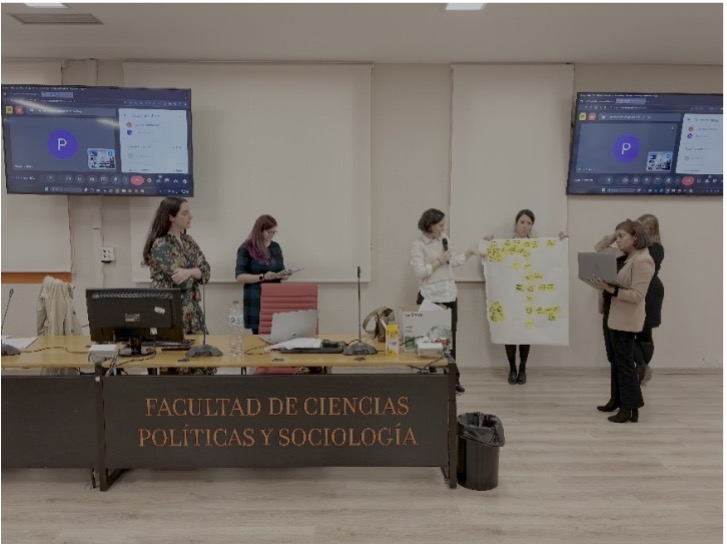
Following this, the participants explored the three key components of a CA which are governance and organization, sampling and recruitment, and deliberation and facilitation. Break-out group discussions were featured, where participants were divided into smaller groups to brainstorm ways to enhance intersectional equality and inclusion across the various stages of the CA. Facilitators documented the insights shared during these discussions and later presented the findings to the broader group for collective reflection.
On the second day of the workshop, four theoretical models for an intersectional CA were discussed in detail, with the understanding that these could evolve based on ongoing feedback and the evolving needs of the project. The workshop concluded with discussions on the development of the glossary with complicated terms along with a presentation of the project’s language policy to guarantee that all materials and discussions are accessible and inclusive.
A few words about the project:
The EU-CIEMBLY project started on January 1, 2024, with the main goal of creating an innovative and inclusive EU CA that addresses issues of intersectionality, inclusiveness, and equality in European Union political life. The project seeks to improve the landscape of participatory and deliberative democratic mechanisms firstly by providing an analytical framework and prototype for establishing the Assembly at the European Union level, with potential for adaptation at national and local levels of European Union Member States. The project draws on an academic and theoretical understanding of intersectionality, equality, and power relations. Furthermore, EU-CIEMBLY emphasizes open research practices, including open access, optimal research data management, early open sharing, and the involvement of knowledge actors.
The project will develop several activities, with one of its biggest milestones being the three upcoming pilot CAs: a local pilot, a national pilot, and a transnational pilot involving citizens from up to six countries across diverse regions of the European Union. EU-CIEMBLY has a duration of four years and is funded by the European Union under the Horizon Europe research and innovation program. The consortium consists of eleven partner organizations, bringing a wide range of expertise and knowledge related to the project’s scope and objectives.
The project deliverables so far:
Since the project’s launch, the team has produced:
- Extensive Literature Review: An in-depth literature review in the form of a bibliographic map was conducted to develop the analytical framework for the EU Citizens’ Assembly.
- The Analytical and Normative Framework of the project, which clearly integrates intersectionality into the inclusivity, equality, and deliberation dimensions of Citizens’ Assemblies.
- An exploration of several Theoretical Models for Inclusive Citizens’ Assemblies: The Theoretical Models for an Intersectional and Inclusive Citizens’ Assembly were developed and reviewed during the session in Madrid.
For further information, you may visit the project’s website at www.eu-ciembly.eu and its social networks on Facebook , Instagram and Twitter. For more information on the University of Essex involvement in the project please visit https://www.essex.ac.uk/research-projects/eu-ciembly
Our project embraces multilingualism! Should an accurate translation for specific sections of this Press Release, please contact us at eu-ciembly@ij.uc.pt
This project has received funding from the European Union’s Horizon Europe research and innovation program under grant agreement number 101132694. This press release reflects only the author’s view. The Commission is not responsible for its content or any use that may be made of the information it contains.



 Essex Law Research Blog