The Persistent and Pernicious Abuse of Insolvency Law: What’s Next after Virgin Atlantic?

Image by skeeze

Dr. Eugenio Vaccari, Lecturer in Law, University of Essex

England is no stranger to strategic or – at times – abusive use of insolvency provisions.

In the early 2000s, a mechanism frequently used by debtors to retain the control of distressed companies at the expense of their creditors was pre-packaged administration. Following some empirical studies and a public consultation, the Coalition Government introduced some changes to the insolvency system to address the concerns from the industry and practitioners. Yet, it seems that Parliament will have to turn again its attention to similar issues in the not-so-distant future.

In fact, the recent case of Virgin Atlantic, which filed for Chapter 15 protection in the USA to shield itself from the claims of its creditors, as well as other trends in the rescue practice, bring back to the fore the ongoing issue of strategic or abusive use of insolvency provisions.

This blog post briefly discusses whether, and the extent to which, we should be worried by these growing trends in the rescue “industry”.

Pre-Packaged Administrations

Pre-packaged administrations are a hybrid form of corporate rescue. These procedures combine the benefits of informal workouts with the properties of formal procedures.

In a pre-packaged administration, the sale of the distressed business is negotiated before the debtor files for insolvency. Usually, the buyer is a person connected to the debtor’s existing shareholders, sometimes even the existing shareholders or directors. The sale is effected shortly after the debtor files for insolvency, leaving the creditors with no remedies and abysmally low returns for the money they lent to the debtor.

In a paper published at the beginning of this year,[1] Dr. Vaccari identified the characteristics that make a pre-packaged administration abusive. This happens when the sale is determined by a close group of players, who collusively act solely to sidestep or subvert insolvency rules and extract value from the company. To be abusive, such actions should cause undue financial harm to the creditors and fail the “next best alternative” valuation standard.

Conscious of the risks associated with pre-packaged administrations, the Coalition Government launched a study into these proceedings which resulted in the Graham Review (2014) as well as in minor regulatory changes. Some of the industry-led measures introduced following the Graham Report are currently under review. The recently enacted Corporate Insolvency and Governance Act 2020 introduced an extension[2] to end of June 2021 to the power to legislate on sales to connected persons, which was granted by the Small Business, Enterprise and Employment Act 2015 (‘SBEEA 2015’) but expired in May 2020.

It seems accurate to claim that the risks of abusive use of pre-packaged administrations, especially in sales to connected parties, have been significantly curtailed since the regulatory and industry-led changes introduced in 2015. Nevertheless, shareholders and directors have not embraced overnight a new, more inclusive and stakeholder-oriented approach to the management of corporate crises. As a result, the rescue industry has developed new mechanisms to sidestep and at times subvert insolvency rules, for the purpose of promoting the interests of out-of-money players (such as shareholders and directors) at the expense of the residual claimants in insolvency (i.e. secured and unsecured creditors).

Recent Trends

Some recent, high profile cases show the emergence of new trends in corporate rescue practice, designed to sidestep or subvert insolvency rules. These trends are light-touch administrations (LTAs), temporary stays on creditors’ claims – sometimes effected internationally – and reverse mergers.

In LTAs, administrators rely on paragraph 64(1), Schedule B1 of the Insolvency Act 1986 to allow the existing directors of an insolvent company to continue exercising certain board powers during an administration procedure. This practice, however, undermines one of the pillars of the English corporate insolvency framework, i.e. that those responsible for the debtor’s failure are not allowed to run the company in insolvency. The idea behind this choice is that independent insolvency practitioners are better placed than existing directors to protect and promote the interests of creditors as a whole, without necessarily affecting the chances of the debtor to be rescued or sold on a going concern basis.

In LTAs, the existing directors are not free to do whatever they want. Directors usually sign with the administrator a consent protocol, prepared by the Insolvency Lawyers Association and the City of London Law Society. Such a protocol introduces restrictions to the use of directors’ powers in order to safeguard the interests of other creditors and stakeholders. However, in a recent article yet to be published,[3] Dr. Vaccari conducted a doctrinal analysis of the guidance provided by the courts in running LTAs and concluded that the interests of unsecured creditors are unduly affected by these procedures.

The recent events in Debenhams’ restructuring support the early findings in Dr. Vaccari’s article. Debenhams became the first high street business in the UK to enter a LTA process in April 2020, after sales plummeted under the nationwide lockdown. To date, Debenhams’ lenders and owners are “highly supportive” of the LTA process and are funding the administration fees. The process is likely to result in a sale of the profitable assets of the business by the end of September 2020.

So, all good? Not really. In the meanwhile, Debenhams is not paying its landlords and suppliers, with the exception of essential ones. Many workers are paid by the Government (and the taxpayers) through the Job Retention Scheme. Also, this LTA represented the third time the retailer underwent some form of insolvency procedure in less than a year. Earlier attempts included a pre-packaged administration after rejecting financial support from Sports Direct’s owner Mike Ashley and a company voluntary arrangement.

In other words, Debenhams is a “zombie” business, something out of The Walking Dead. It has already been killed several times by the market; it is a failed business, yet it is still operating for the benefit of existing shareholders and directors.

Debenhams is not the only recent case of strategic use of insolvency provisions. After the rejection of a bailout request by the UK Government, Virgin Atlantic worked on a £1.2 bln rescue deal with some of its shareholders and private investors to stave off collapse. It is likely that the negotiations will go ahead – despite the shaky financial situation of the company – thanks to a moratorium or stay on executory actions by the creditors. This moratorium is one of the innovations introduced by the Corporate Insolvency and Governance Act 2020[4] and it has been used as part of a restructuring plan procedure under the newly introduced part 26A of the Companies Act 2006.

However, Virgin Atlantic has assets all over the world. In order to protect them from executory actions, the company sought recognition of the English stay under Chapter 15 of the U.S. Bankruptcy Code. Chapter 15 is a part of the U.S. Bankruptcy Code designed to facilitate cooperation between U.S. and foreign courts. It was added to the code in 2005 by the Bankruptcy Abuse Prevention and Consumer Protection Act, and it allows foreign individuals or companies to file for bankruptcy protection in the U.S. in cases where assets in more than one country are involved. When the order is granted, it is usually recognised all over the world, thus protecting the debtor’s assets against creditors’ predatory actions.

Often, Chapter 15 is filed in conjunction with a primary proceeding brought in another country, typically the debtor’s home country. However, no such proceeding has been opened with reference to Virgin Atlantic. The restructuring plan mentioned above is a company, rather than an insolvency procedure, which means that creditors are less protected than in insolvency. The effect of the Chapter 15 filing is, therefore, to give world-wide recognition to a private agreement negotiated by the company’s directors and key creditors with the support of existing shareholders. A vote on the plan from the wide range of creditors who have legitimate claims against the company will not take place until late August, with a confirmation hearing scheduled for the beginning of September. As a result, the outcome of the Virgin Atlantic case is not dissimilar from Debenhams’ one: the claims of out-of-money shareholders and directors are prioritised against the legitimate interests, rights and claims of other, less sophisticated creditors.

Finally, a practice that it is emerging with renewed preponderance is the use of “reverse mergers” or “reverse takeovers”. A reverse merger is a merger in which a private company becomes public by acquiring and merging with another public company. If the public company files for insolvency first, sells all its assets but keeps its legal standing, the private buyer can go public by merging with the public, insolvent company. In this way, the private buyer avoids the complicated and expensive compliance process of becoming a public company by merging with the insolvent, public debtor. Additionally, all licences, permits, quotas, clearances, registration, concessions etc. conferred on the insolvent debtor will continue with the buyer despite the changing of hands of the controlling interest.

This may, in theory, seem a good idea to maximise the value of the insolvent debtor. Ultimately, the debtor’s listing in the stock exchange (and its public nature) is an asset. What’s wrong in selling it?

First and foremost, the fact is that compliance regulations are sidestepped. Unlike a traditional Initial Public Offering (IPO), reverse merger disclosure documents are generally not reviewed by securities commissions; only by the exchange on which the two companies propose to list. Although this reduces the regulatory burden on issuers, it also dispenses with an important element of investor protection.

These regulations are not simply procedures designed to make life difficult to companies that want to go public. These are procedures designed to protect investors and, ultimately, creditors.

Additionally, another reason to opt for a merger rather than a purchase is if the target company has significant net operating losses that the buyer might be able to use to reduce its tax liabilities. Finally, reverse mergers do not necessarily require concurrent or any kind of financing, as they can take place with a share exchange.

In the U.S. the process has been used by several companies, particularly by start-ups in the automotive sector. These include Nikola Motors, Lordstown, Fisker Automotive, Velodyne Lidar and bus-maker Proterra. At the time of writing, Nikola Motors has a stock exchange value exceeding US$2 bln, while Lordstown has a stock market value of US$1.6 bln. If you haven’t heard these names before, you’re not the only one. Both Nikola and Lordstown have yet to produce their first (electric) vehicle!

It is not surprising that all these companies relied on reverse mergers to go public. Reverse mergers involve less regulatory scrutiny, are cheaper in terms of professional and other expenses, faster than a traditional IPO and able to avoid or minimize market and execution risk on their going-public transactions. Which, ultimately, brings us to the question: are reverse mergers of an insolvent public company a trick or a threat for the debtor’s stakeholders?!?

What’s Next

The Government should respond promptly to these new trends emerging from practice. The commitment to promoting a rescue culture and – more generally – the rescue of distressed yet viable businesses cannot come at the expense of “everything else”. Cases like Debenhams, Virgin Atlantic and the U.S. listing of automotive start-ups suggest that the market is unable at the moment to self-regulate.

The Covid-19 pandemic accelerated a trend towards the strategic or abusive use of insolvency provisions. If unchecked, this trend can only result in more insolvencies and higher taxes.

If suppliers are not paid, the above-mentioned insolvencies will create a domino effect in the industry and they will result in further filings. As for taxes, Dr. Vaccari mentioned in a previous blog post that the re-introduction of the Crown preference is expected to increase the returns to the HMRC. However, higher numbers of insolvency procedures and a downturn of the economy are likely to affect the capacity of companies to generate revenue and – as a result – to pay taxes. If companies pay less taxes and the Government is forced to spend more in subsidies to companies and employees, this is likely to result in cuts to public services and higher rates of taxes for people and companies alike.

The publications mentioned in this article are available on Westlaw, Researchgate.net and Academia.edu. Dr. Vaccari regularly discusses insolvency matters on Twitter and LinkedIn.


[1] E Vaccari, ‘English pre-packaged Corporate Rescue Procedures: Is There a Case for Propping Industry Self-Regulation and Industry-Led Measures such as the Pre-Pack Pool?’ (2020) 31(3) I.C.C.L.R. 170, 184-185.

[2] Section 8 of the Act.

[3] E Vaccari, ‘Corporate Insolvency Reforms in England: Rescuing a “Broken Bench”? A Critical Analysis of Light Touch Administrations and New Restructuring Plans’ (2020) I.C.C.L.R. (forthcoming).

[4] Sections 1-6 of the Act.

The Crown Preference is Law (Again): Spinning the Clock Back to Early-2000s?

Image by Steve Buissinne

Dr. Eugenio Vaccari, Lecturer in Law, University of Essex

The Pari Passu Principle

In corporate insolvency procedures, not all creditors are alike. This is despite the pari passu principle.

The pari passu principle is often said to be a fundamental rule of any corporate insolvency law system. It holds that, when the proceeds generated by the sale of debtor’s assets are distributed to creditors as part of an insolvency procedure, they have to be shared rateably. In other words, each creditor is entitled to a share of these proceeds that corresponds to the percentage of debt owed by the company to its creditors.

Imagine that a company has creditors for £100,000. Creditor A has a claim for £1,000, creditor B for £5,000. The company is insolvent and it is liquidated. The sale generates £50,000 of proceeds available to be distributed to the creditors. While it would have been possible to say that, for instance, older creditors or creditors with larger claims are paid first, the pari passsu principle states that all creditors are treated alike. As a result, creditor A will receive 1% of these proceeds (£500), while creditor B will receive 5% of them (£2,500).

There are, of course, exceptions to the pari passu principle.

First, the pari passu principle applies only to assets that are available for distribution. For instance, a bank may have granted a mortgage to the debtor to buy a property, and the debtor may have given that property as a collateral to the bank. If the debtor becomes insolvent, the proceeds generated by the sale of that property are distributed first to the bank and then, if anything is left, to the other creditors.

Secondly, the law might introduce exceptions to this principle in order to prioritise the payment to creditors that are deemed particularly worthy of additional protection.

The Law

Until the Enterprise Act 2002, the Inland Revenue and HM Customs & Excise (now HMRC) were granted a status as preferential creditors for certain debts listed in Schedule 6 of the Insolvency Act 1986. As a result, debts owed to the them had to be fully paid before any distribution to floating charge holders, pension schemes and unsecured creditors (among others) was made.

This preferential status granted these agencies a stream of £60-90 million each year in insolvencies. Section 251 of the Enterprise Act 2002, however, abolished the Crown’s status as preferential creditor and introduced a new regime (the ‘prescribed part’) wherein a portion of the distributions in liquidation was ring-fenced specifically for unsecured creditors.

Back in the 2018 Budget, mixed in with many other tweaks, the Government announced a seemingly innocuous change to the way in which business insolvencies will be handled from 6 April 2020 (later postponed to insolvencies commencing on or after 1 December 2020, irrespective of the date that the tax debts were incurred or the date of the qualifying floating charge).

Without attracting much publicity, the announced move was codified in sections 98 and 99 of the Finance Act 2020, which received Royal Assent on 22nd of July 2020. As a result, HMRC gained secondary preferential treatment over non-preferential and floating charge holders – often banks that have loaned money to firms – for uncapped amounts of VAT, Pay As You Earn (‘PAYE’) income tax, student loan repayments, employee National Insurance Contributions (‘NICs’) or construction industry scheme deductions.

In a related development, Parliament also approved the Insolvency Act 1986 (Prescribed Part) (Amendment) Order 2020. The effect of this Act is to increase the prescribed part from £600,000 to £800,000. However, this change does not apply to floating charges created before 6 April 2020.

So What?

The Government argues that giving HMRC priority for collecting taxes paid by employees and customers to companies is appropriate. These represent taxes that are paid by citizens with the full expectation that they are used to fund public services. Absent any form of priority, this money actually gets distributed to creditors instead. As a result, the Exchequer should move ahead of others in the pecking order and give HMRC a better chance of reclaiming the £185m per year they lose.

These explanations do not appear totally sound. The creation of the prescribed part and the increase of its cap to £800,000 served the purpose of ensuring that at least some of this money is paid back to the HMRC and used to fund public services. What has not been properly considered is the impact the Crown preference and the increased prescribed part will have on: (i) the wider lending market and access to finance; as well as (ii) corporate rescue practices.

With reference to lending practices, the new system disproportionately affects floating charge holders and unsecured creditors. The abolition of administrative receivership – a procedure controlled by lenders – by the Enterprise Act 2002 was compensated by the loss of preferential status for the HMRC. The re-introduction of such preference means that lenders in general and floating charge holders in particular will be pushed to lend money at higher interest rates, as lenders have no idea as to the tax arrears of any borrower on a day to day basis.

Lenders now face a double blow (increased prescribed part and Crown preference) in relation to realisations from the floating charge. They are, therefore, likely to reduce the amounts that they lend to businesses, to take account of the dilution in the realisations that they would receive in insolvency. This is a particularly unwelcome outcome in the current marketplace.

Lenders are even more likely to seek fixed charge (where possible) and to introduce covenants for reviewing the debtor’s tax liabilities. Such liabilities are likely to increase significantly in the next few months, as VAT payments due by businesses between March and June 2020 have been deferred until the end of the 2020/21 tax year. Lenders may also insist that a borrower holds tax reserves to deal with liabilities to HMRC and, in large operations, on group structures which minimise the dilution from Crown preference.

Finally, unsecured creditors may choose to protect themselves by keeping their payment terms as tight as possible and limiting the number of days that credit is offered for.

Additionally, and perhaps more importantly, such move may hamper the willingness to support an enterprise and rescue culture, which was the main justification for the abolition of the Crown’s preference. This is because HMRC’s gain is the other creditors’ loss, especially considering that the taxes classified under the preferential claim are ‘uncapped’ (while before the enactment of the Enterprise Act 2002 they were capped to amounts due to up to 1 year before the commencement of the procedure).

Despite assurances to the contrary, the existence of a preferential treatment may push the HMRC to exercise increased control over the insolvency process and promote early petitions for liquidation in the hope of higher return.

Also, the HMRC has never historically been particularly supportive of reorganisation efforts. This means that distressed companies may have to file for a new restructuring plan under part 26A of the Companies Act 2006 and seek a court-approved cross-class cram-down to overcome the HMRC’s negative vote. Such an approach would increase cost, litigation and time needed for the reorganisation effort, thus potentially pushing viable debtors out of business.

There are other elements that militate against the re-introduction of such preferential status. HMRC currently have the ability to robustly manage their debt. HMRC have powers not available to other unsecured creditors, including the ability to take enforcement action without a court order to seize assets and to deduct amounts directly from bank accounts.

HMRC have the power to issue Personal Liability Notices to corporate officers for a failure to pay National Insurance Contributions (NICs) or future unpaid payroll taxes. HMRC also have the power to insist on upfront security deposits where there is a genuine risk of non-payment of PAYE, NICs or Value Added Tax (VAT). Similarly, HMRC may issue Accelerated Payment Notices for disputed tax debts.

One of the key features of the English corporate insolvency framework is its focus on promoting business rescue and, more in general, a rescue culture, as evidenced in previous papers[1] by the author of this post. The recent long-term changes introduced by the Corporate Insolvency and Governance Act 2020 seemed to go in the direction of strengthening the rescue attitude. It makes, therefore, little sense to introduce policies designed to help businesses survive the Covid-19 pandemic and, at the same time, reduce their ability to borrow cheaply. The re-introduction of the preferential status for certain unpaid taxes spins the clock back to 2003 and is likely to hurt the existing, fragile business recovery.

The publications mentioned in this article are available on Westlaw, Researchgate.net and Academia.edu. Dr. Vaccari regularly discusses insolvency matters on Twitter and LinkedIn.


[1] E Vaccari ‘English Pre-Packaged Corporate Rescue Procedures: Is there a Case for Propping Industry Self-Regulation and Industry-Led Measures such as the Pre-Pack Pool?’ (2020) 31(3) I.C.C.L.R. 169; E Vaccari, ‘Corporate Insolvency Reforms in England: Rescuing a “Broken Bench”? A Critical Analysis of Light Touch Administrations and New Restructuring Plans’ (2020) I.C.C.L.R. (accepted for publication); E Vaccari, ‘The New ‘Alert Procedure’ in Italy: Regarder au-delà du modèle français?’ (2020) I.I.R. (accepted for publication).

Pre-Pack Pool, Quo Vadis?

Image by Vinson Tan

Dr. Eugenio Vaccari, Lecturer in Law, University of Essex

Failure is a fact of life in any sphere of human activity.[1] Each individual can share stories of their personal failures in life. Some of these failures make us stronger, more successful and resilient in the long run.

Beside events that only affect us in the personal sphere, there are other more “tangible” failures, which affect our profession, assets and capacity to generate income.

In this respect, companies are no different from human beings. Companies – even successful ones – may fail to invent, launch and promote a new product on the market or simply generate enough cash to cover development costs of a product that otherwise met the consumers’ favour. If failure is not limited to a single product, it may threaten the survival of the company.

However, failure may also be determined by external factors, such as a sudden lack of demand from the consumer’s side (as in the aftermath of the Covid-19 pandemic) or an unexpected increase in interest rates. These external factors – either alone or coupled with other causes – may push a company into a formal insolvency proceeding.

More frequently than not, companies that are pushed into insolvency for the pressure exerted by external factors may still be viable. Yet, the only people who have the expertise and knowledge, as well as the courage to invest in a failing business, are usually the existing owners and directors of the ailing company.

Under English law, one of the most popular methods by means of which existing owners buy back an insolvent company, thus preserving its core business and as many jobs as possible, is called pre-pack administration (‘pre-pack’).

In a “pre-pack”, a prospective buyer and key creditors conclude an agreement on the sale or restructuring of the company in advance of statutory administration procedures. In a “connected pre-pack”, the buyer is usually the seller – the owners buy back a significant portion of the company minus a sizeable amount of its existing debt.

Clearly, connected pre-packs raise issues of transparency, fairness and valuation of the debtor’s assets. Creditors may feel that they are paid a pittance while the existing owners are set free without punishment and retain the control of assets that could have generated more money if liquidated in a competitive procedure, such as through a properly advertised auction procedure.

To allay the fears of disgruntled creditors, the Government introduced in 2015 the Pre-Pack Pool (‘the Pool’). The Pool is an independent body of experienced business people that gives an opinion on whether the connected pre-pack sale is reasonable and in the best interests of creditors.

The Pool has proven effective in dealing with connected pre-packs, as evidenced by the most recent sale of Go Outdoors. In this case, the debtor was sold back by its previous owner JD Sports by means of a deal cleared by the Pool in less than 24 hours. The Pool has risen to prominence, to the extent that it has been taken as a model for recent innovations in other jurisdictions, such as the business panel in Italian alert procedures. Dr. Vaccari is working on a paper (due to be published in August 2020 in the International Insolvency Review) which will disclose the links between the English Pool and the Italian panel.

Furthermore, Dr. Vaccari has already analysed in two recent articles [2] the reasons behind the low uptake rate of this voluntary measure (less than 10% of eligible cases are referred to the Pool) and how the Pool should be reformed to deal more effectively with the risks associated with connected pre-packs.

The Corporate Insolvency and Governance Act 2020, which came into effect on 25 June 2020 (‘the Act’), presented the perfect opportunity to deal with the issues associated with connected pre-packs. It is, however, disappointing to see that the Government and Parliament have turned a blind eye on connected pre-packs and have been deaf to the requests from the industry to make the referral to the Pool compulsory in these procedures.

The Act includes several measures that are likely to make the English framework more rescue-oriented and efficient, such as a new restructuring procedure and the ban on the enforceability of ipso facto clauses. Unfortunately, no ink was spilled for a very useful mechanism on the brink of collapse.

It is to be hoped that the Pool’s latest cry for help will not end up in being a late pious expectation of salvation by means of Parliamentary intervention. There are valid reasons to believe that such an intervention is forthcoming, as section 8 of the Act revives the Government’s power to review connected pre-packs and related instruments, included the Pool. This power, originally granted by the Small Business Enterprise and Employment Act 2015, lapsed in May 2020 but has now been extended to the end of June 2021.

The publications mentioned in this article are available on Westlaw, Researchgate.net and Academia.edu. Dr. Vaccari regularly discusses insolvency matters on Twitter and LinkedIn.


Notes:

[1] V Finch and D Milman, Corporate Insolvency Law: Perspectives and Principles (3rd edn, CUP 2017) 123.

[2] E Vaccari, ‘Pre-Pack Pool: Is It Worth It?’ (2018) 29(12) I.C.C.L.R. 697; E Vaccari ‘English Pre-Packaged Corporate Rescue Procedures: Is there a Case for Propping Industry Self-Regulation and Industry-Led Measures such as the Pre-Pack Pool?’ (2020) 31(3) I.C.C.L.R. 169.

The New Corporate Insolvency and Governance Act 2020 – An Extraordinary Act for Extraordinary Times? A Quick Look at the Act’s Time-Restricted Measures

Image by Elliot Alderson

Dr. Eugenio Vaccari, Lecturer in Law, University of Essex

I. The Corporate Insolvency and Governance Act 2020

On 25 June 2020, the Corporate Insolvency and Governance Act 2020 (‘the Act’) completed its progress in the Parliament and received Royal Assent. The Act has unanimously been hailed by the insolvency community as the most significant regulatory reform in the United Kingdom in the past 20 years.

The Act represents the culmination of a debate on regulatory reforms commenced in 2016 and continued in 2018. This debate was made more urgent by the need not to fall behind the European Union and by the inadequacies of the system evidenced by recent corporate scandals (Carillion) and systemic failures (airline industry).

While some of the measures are the result of long-planned reforms the Government has previously consulted upon, some changes are temporary in nature and they are designed to provide companies with the breathing space and flexibility needed to deal with the economic impact of the Covid-19 pandemic.

This blog-post briefly discusses the relevance and impact of the time-limited measures introduced by the Act. The Act’s long-term regulatory reforms were discussed in a separate post here.

II. Time-Limited Measures

The most significant changes affecting insolvency rules are: (i) a suspension of statutory demands and restrictions on winding-up petitions;[1] (ii) a suspension of liability for wrongful trading;[2] and (iii) an extension to end of June 2021 to the power to legislate on sales to connected persons, which was granted by the Small Business, Enterprise and Employment Act 2015 (‘SBEEA 2015’) but expired in May 2020.[3]

The Act also allows for temporary flexibility regarding other administrative burdens, such as the holding of annual general meetings (AGMs) and filing requirements. These temporary measures, however, fall outside the remit of this blog-post as they do not deal with insolvency provisions.

With reference to statutory demands and winding-up petitions, the Coronavirus Act 2020 introduced a moratorium on commercial landlords to enforce the forfeiture of commercial leases for unpaid rent. This measure was designed to protect companies unable to trade during the lock-down period introduced by the Government to limit the spread of Covid-19.

However, landlords sidestepped this original ban by serving statutory demands on businesses followed by winding-up petitions. The Corporate Insolvency and Governance Act 2020 addresses this loophole by introducing temporary provisions to void statutory demands made between 1 March and 30 September 2020.

Statutory demands can still be served as this may trigger a termination clause under an existing contract. However:

  1. service of a statutory demand without the treat of a winding-up petition is of limited benefit;
  2. defaults in debtor’s facility documents or commercial contracts are usually equally triggered by ordinary as opposed to statutory demands;
  3. even if these clauses are triggered, the creditor might still not be able to enforce the termination as such option might be prevented by the newly enforced ban on ipso facto clauses discussed here.

The Act also restricts winding-up petitions based on statutory demands from 27 April to 30 September 2020. For the same period, it also prevents creditors from presenting a winding-up petition unless they have reasonable grounds to believe that: (a) the Covid-19 pandemic has not had a “financial effect” on the debtor company; or (b) the facts by reference to which the relevant ground applies would have arisen even if the Covid-19 pandemic had not had a financial effect on the company.

These temporary measures are intended to prevent aggressive creditor actions against otherwise viable companies that are struggling because of the consequences of the Covid-19 pandemic.

As mentioned before, creditors can still commence a winding-up petition if they prove that the Covid-19 pandemic had no “financial effect” on the debtor. This bar is very low, as in virtually all sectors of the economy the Covid-19 pandemic produced financial effects on the debtors. This is particularly true for the worst affected sectors, such as the airline industry, non-essential retail, hospitality and leisure sectors (where revenue has been nil or restricted as a result of the lockdown and social distancing measures). Still, creditors may be able to submit a winding-up petition based on aged and undisputed debts that pre-date the Covid-19 pandemic.

As for the suspension of liability for wrongful trading, the Act suspends the liability arising from wrongful trading (sections 214 and 246ZB of the Insolvency Act 1986) in the period 1 March to 30 September 2020.

Under wrongful trading provisions, directors face personal liability on debts incurred by their company. This is, if they decided to continue trading while they knew or ought to have known that the company was unlikely to avoid entering insolvent liquidation or administration. For directors who may have previously rushed to liquidate their businesses with these provisions in mind, this suspension should help delay that process.

III. Preliminary Assessment

There is no doubt that the Act complements the Coronavirus Act 2020 with a series of more measures designed to provide companies with the much-needed temporary relief to cope with the impact of the Covid-19 pandemic.

However, all that glitters is not gold.

With reference to the use of statutory demands and winding-up petitions, the Business Secretary originally advocated for the introduction of these measures to safeguard the UK high street against aggressive debt recovery actions during the Covid-19 pandemic (Alok Sharma, 23 April 2020). However, the temporary provisions as enacted are not sector specific. They apply to any registered or unregistered company that can be the subject of a winding-up petition. They also apply in relation to any debt owed by a debtor company, not just rent or other commercial lease liabilities. As a result, there is the risk that this temporary protection is used in a strategic manner by otherwise non-distressed firms as a leverage in negotiations with their creditors, in order to reduce outstanding and future liabilities arising from ongoing executory contracts.

Additionally, while the Act does not introduce a blanket ban on presenting winding-up petitions, the Government, some professionals and non-specialist publications are suggesting the contrary, thus causing potential confusion in the business community.

The Act also provides that if a winding-up order has been made in relation to a debtor in the period between 27 April 2020 and the day before the Act came into force, the order is void if it does not meet the new requirements for the making of an order. The retrospective nature of this provision can lead to significant challenges in practice. For instance, if the procedure has already commenced, it is not clear what happens to the debts incurred during the procedure, as they normally enjoy a super-priority status. However, it is expected that few orders were made on this basis in the past few weeks, as the judiciary was aware of the content of the Bill and enforced a ban on winding-up petitions before the Act was passed.[4]

Dr. Vaccari has already evidenced in a paper published by the University of Essex[5] and at the St Petersburg’s International Legal Forum the limits of the other, most significant temporary measures introduced by the Act, i.e. the suspension of liability for wrongful trading.

The comments made in the House of Lords debates indicate that the Government was aware of some of the limits evidenced in the above-mentioned papers. The Government stressed in these debates that its intention is that there should be no liability for wrongful trading until 30 September 2020. However, under the Act courts are only instructed “to assume that the [director] is not responsible for any worsening of the financial position of the company or its creditors that occurs during the relevant period”.[6] Therefore, applicants may still seem to have the power to demonstrate that the directors acted in breach of the wrongful trading provisions as outlined in sections 214 and 246ZB of the Insolvency Act 1986 for actions taken before the end of September of this year.

The Act does not affect the several other provisions. These include the rules on fraudulent trading[7] and transactions defrauding creditors,[8] on undervalue or preferential transactions,[9] as well as the director disqualification regime[10] and the general directors’ duties.[11] All these rules, therefore, continue to apply. Particularly, the common law duty of directors to give consideration to the interests of creditors when a company is in the zone of insolvency[12] is preserved and remains in full force.

Sections 12(3) and (4) of the Act clarify that the suspension of liability for wrongful trading does not apply to a variety of companies. These include (among others) insurance companies, banks (including investment banks and firms), building societies, friendly societies, credit unions, public-private partnership project companies and overseas companies with corresponding functions. In other words, a good deal of medium and large enterprises are excluded from the scope of this provision without any apparent justification.

Additionally, unlike the provisions on statutory demands and winding-up petitions, the rules on wrongful trading state that there is no requirement to show that the company’s worsening financial position was due to the Covid-19 pandemic. 

The Act adopts a blanket approach: liability for losses incurred in the relevant period is waived, irrespective of whether the losses are incurred because of the Covid-19 pandemic. This blanket approach raises issues of potential abuse of the law if the office holders cannot hold the directors accountable for losses that are not caused by the Covid-19 pandemic.

As a result of all these considerations (and the others mentioned in the publication cited above), a measure in theory designed to “remove the threat of personal liability” caused by the Covid-19 pandemic on businesses (Alok Sharma, 28 March 2020) is likely to lift significant restrictions on the arbitrary exercise of powers by rogue directors. This is likely to significantly and negatively affect creditors’ rights and the rule of law. It is highly unlikely that the suspension of liability for wrongful trading results in being a “jail-free card” (although it is salient to note that we are discussing civil, as opposed to criminal, liability issues).

A final contentious aspect is represented by the power granted to the Secretary of State to temporarily (for up to six months) amend corporate insolvency primary and secondary legislation and related measures to deal with the consequences of the Covid-19 pandemic on companies. This power is virtually unrestricted as no effective check-and-balance system is put into place.

IV. Concluding Remarks

The Act provides much-needed temporary relief for distressed companies.  However, given the speed with which the Act has been passed, the complexity of the legislation, and some questionable legislative choices, there are undoubtedly areas of ambiguity and potential challenge.

The extent to the Act will help companies navigate through the Covid-19 pandemic is far from clear. More importantly, the legislation, whilst very welcome for debtors, does not deal with the substantive problem of debt being built up and long-term balance sheet issues.

In fact, the Act provides no solution for debtors once the restrictions expire. At that point (end of September 2020), the debtors may have significant arrears of debt. These issues are particularly acute in those sectors of the economy that have been worst affected by the Covid-19 pandemic. As a result, these time-restricted measures may have the unintended effect of postponing the unavoidable, reducing returns to creditors and resulting in a spike of liquidation-oriented procedures in the last quarter of this year.

The publications mentioned in this article are available here, on Westlaw, Researchgate.net and Academia.edu. Dr. Vaccari regularly discusses insolvency matters on Twitter and LinkedIn.


[1] Sections 10-11 of the Act.

[2] Sections 12-13 of the Act.

[3] Section 8 of the Act.

[4] Re A Company (Injunction to Restrain Presentation of Petition) [2020] EWHC 1406 (Ch), [2020] 6 WLUK 13 – restraining the presentation of a winding-up petition against a company which had been unable to pay its rent as a result of the Covid-19 pandemic by taking into account the likelihood of the change in the law represented by the relevant provisions of the Corporate Insolvency and Governance Bill 2020.

[5] The paper makes reference to the Bill, but the wording of the relevant provisions has not changed in the Act.

[6] Section 12(1) of the Act.

[7] Section 213 of the Insolvency Act 1986.

[8] Section 423 of the Insolvency Act 1986.

[9] Sections 238 and 239 of the Insolvency Act 1986.

[10] As outlined in the Company Directors Disqualification Act 1986.

[11] Chapter 2, Companies Act 2006. These include the duties to act within their powers, to exercise independent judgement, to avoid conflicts of interest and to exercise reasonable care, skill and diligence.

[12] Section 172(3) of the Companies Act 2006.

The New Corporate Insolvency and Governance Act 2020 – An Extraordinary Act for Extraordinary Times? A Quick Look at the Act’s Long-Term Statutory Reforms

Image by Markus Winkler

Dr. Eugenio Vaccari, Lecturer in Law, University of Essex

I. The Corporate Insolvency and Governance Act 2020

On 25 June 2020, the Corporate Insolvency and Governance Act 2020 (‘the Act’) completed its progress in the Parliament and received Royal Assent. The Act has unanimously been hailed by the insolvency community as the most significant regulatory reform in the United Kingdom in the past 20 years.

The Act represents the culmination of a debate on regulatory reforms commenced in 2016 and continued in 2018. This debate was made more urgent by the need not to fall behind the European Union and by the inadequacies of the system evidenced by recent corporate scandals (Carillion) and systemic failures (airline industry). While some of the measures are the result of long-planned reforms the Government has previously consulted upon, some changes are temporary in nature and they are designed to provide companies with the breathing space and flexibility needed to deal with the economic impact of the Covid-19 pandemic.

This blog post briefly discusses the relevance and impact of the long-term regulatory reforms introduced by the Act. Time-restricted measures are discussed in a separate blog-post.

II. Long-Term Reforms

The most significant changes in the area are: (i) a short free-standing company moratorium;[1] (ii) a new restructuring plan procedure;[2] (iii) a general ban on the enforceability of ipso facto clauses.[3]

The moratorium gives struggling businesses a 20-business day opportunity to consider a rescue plan, extendable by the directors for a further 20 business days or, with creditor consent, up to a year.

The moratorium is triggered by the directors of the ailing company filing the relevant documents at court (out-of-court process) or by an order of the court following the debtor’s application (in-court process). The latter is of primary interest for overseas companies or where the debtor has been served with a winding-up petition.

The aim of the moratorium is to facilitate the rescue of the company (as opposed to the rescue of only the business) through a company voluntary arrangement (‘CVA’), a restructuring plan, an informal workout or another formal insolvency procedure (e.g. pre-packaged administration).

During this period, the company remains under the control of its directors (debtor-in-possession procedure), but there are restrictions on the transactions that the companies can complete during a moratorium. For instance, new security can only be granted with the monitor’s consent and if they think the grant of the security will support the rescue of the company. Disposal of company’s property is only admissible if it is made in the ordinary course of business, with the monitor’s consent or following a court order. Other restrictions apply to loans of more than £500, certain transactions (e.g. collateral security) and payments for pre-moratorium debts.

No legal action can be taken against the debtor’s assets without leave of the court. There can be no enforcement of security (except financial collateral or collateral security charges) and no repossession of goods under hire-purchase agreements or retention-of-title clauses. In addition, during a moratorium, the holder of an uncrystallised floating charge on the property of the company is prohibited from giving notice which would have the effect of either (i) causing the floating charge to crystallise; or (ii) restricting the disposal of the property of the company. All these restrictions provide debtors with powerful tools to continue trading normally during moratorium.

Similar to what happens in other insolvency procedures (including the new restructuring plan), landlords cannot exercise their rights of forfeiture and may be forced to accept a reduction in their rents. This raises concerns that other landlords will follow Intu Group into administration procedures because the reduced rents (if and when paid) would be insufficient to meet their long-term liabilities.

The moratorium process is overseen by a monitor who must be a licenced insolvency practitioner (‘IP’). During this process:

  1. the monitor must remain of the view that a rescue of the company as a going concern is possible, otherwise the moratorium must be brought to an early termination;
  2. certain pre-moratorium debts are subject to a “payment holiday”;
  3. other pre-moratorium debts and all debts incurred during the moratorium must be paid in full as they fall due (or even earlier in case of pre-moratorium debt subject to acceleration).

In particular, the debtor must continue to pay certain of its debts, including new supplies and rent in respect of the moratorium period, as well as amounts due under financial contracts.

Financial contracts usually include acceleration clauses that are triggered by any insolvency event, including the moratorium described above. The early version of the Bill granted super priority status to these debts, if the debtor entered into an insolvency proceeding shortly after the moratorium. Amendments in the House of Lords removed the super priority status to the accelerated portion of these debts. At the same time, financial lenders can still accelerate the payments of these debts, causing the early termination of the moratorium and the rescue attempts because financial debts are not subject to a payment holiday.

Debts incurred under the moratorium are given priority ranking if the debtor falls into a formal insolvency procedure within 12 weeks from the end of the moratorium. The Act provides for the right to challenge the monitor’s or the directors’ actions, decisions or failure to act on the grounds of (actual or prospective) unfair harm to the applicant. There is also a right for a subsequently appointed office holder to challenge the monitor’s remuneration as excessive. Finally, the Act creates new offences of fraud during, or in anticipation of, a moratorium and false representation to obtain a moratorium.

The restructuring plan procedure is a powerful and flexible court-supervised restructuring process. This debtor-in-possession procedure allows struggling companies, or their creditors or members, to propose a new restructuring plan to rescue the company or part of its business, enable complex debt arrangements to be restructured and support the injection of new rescue finance.

The court involvement is limited to two hearings. In the first one, the courts are asked to convene the meeting and examine the proposed class composition. In the second hearing, the courts sanction the vote and approve the plan if the statutory conditions for approval are met and if it is just and equitable to do so. The sanctioned plan is binding on both secured and unsecured creditors.

The restructuring plan procedure is available to all companies that are encountering, or are likely to encounter, financial difficulties that are affecting, or will or may affect, their ability to carry on business as a going concern.[4] There is, therefore, no need for the debtor to be insolvent. As long as there is some form of compromise or arrangement to deal with the company’s financial difficulties, the plan is virtually a blank canvas.

Such procedure is modelled after the successful schemes of arrangement.[5] For the plan to be approved, it must receive the assent of 75 percent in value of each class of creditors. It is salient to note that two requirements applicable to schemes and CVAs have not been replicated with reference to the new restructuring plan procedure, thus making it easier to achieve the requisite majority. These are the requirements that more than half in value of unconnected creditors and that the majority in number vote in favour of the plan.

To further facilitate the approval of the plan, the new restructuring procedure features a cross-class cram-down. The cram-down mechanism allows dissenting classes of creditors to be bound by the plan, if sanctioned by the court as fair and equitable, and if the court is satisfied that those creditors would be no worse off than if the company entered an alternative insolvency procedure. The plan, however, needs to have received the assent of at least one class of creditors who would receive a payment, or have a genuine economic interest in the company, in the event of the relevant alternative.

The House of Lords’ removal of the protections initially included for creditors with aircraft-related interests means that that they can be compromised by a scheme or restructuring plan. This is welcome news for the distressed airline industry, which can now make use of those processes.

The new restructuring plan procedure is a more powerful and flexible mechanism than the existing schemes and CVAs. Unlike CVAs, it can bind secured creditors and creditors’ rights are not diluted, as they vote in classes of uniform interests rather than as a whole. Unlike schemes, dissenting classes can be bound by the plan. Additionally, the majority threshold is lower compared to the analogous requirements for the approval of schemes and CVAs.

The Act also widens the scope of the restriction on the enforceability of termination clauses from essential suppliers (sections 233-233A of the Insolvency Act 1986) to all kinds of suppliers. This measure applies where a company has entered an insolvency or restructuring procedure or obtains a moratorium during this period of crisis. As a result of this, the company’s suppliers will not be able to rely on contractual terms to stop supplying, or doing “any other thing” such as varying the contract terms with the company (for example: increasing the price of supplies), because the debtor becomes subject to a relevant insolvency procedure. Suppliers are also banned from insisting on payment of sums falling due prior to the insolvency as a condition of continued supply. The Government granted a wider protection than other jurisdictions (namely, the USA and Australia) by extending the ban to the termination of a contract or supply to breaches which occurred prior to the relevant insolvency procedure.

The customer is required to pay for any supplies made once it is in the insolvency process. The measure contains safeguards to ensure that suppliers can be relieved of the requirement to supply if it causes hardship to their business. Suppliers also retain the power to terminate these contracts for breaches that occurred after the commencement of the insolvency procedure and – in any case – with the permission of the office holder or director (depending on the procedure).

Up until 30 September 2020, small suppliers are exempt from the proposed changes and can (if they choose) terminate the supply contract. This is a temporary exemption designed to address the current difficulties faced by UK companies as a consequence of the Covid-19 pandemic, while permanent exclusions apply for the benefit of certain financial contracts and institutions.

III. Preliminary Assessment

There is no doubt that the Act represents a significant, much-needed overhaul of the English corporate insolvency framework. It is most likely that the reforms briefly described in this blog will enhance the corporate rescue attitude of the English framework; the attractiveness of this system for foreign enterprises; as well as the country’s standing in the Doing Business Report, particularly with reference to the “Resolving Insolvency” indicator.

However, all that glitters is not gold.

With reference to the company moratorium, while it provides a payment holiday for certain types of pre-moratorium debts, its scope does not extend to loans, liabilities arising under a contract/instrument involving financial services, as well as rents, wages, salaries and redundancy payments. The carve-out of such debts means that a company could still require access to significant funds during a moratorium. As a result, the moratorium could be of limited use where the company is subject to significant financing arrangements for which a payment holiday is not granted.

Another significant carve-out is with reference to the “rent in respect of a period during the moratorium”. However, this could lead to strategically timed moratoria, especially if the rent is payable in arrears (which is frequently the case in commercial contracts). In this case, the debtor might file soon after the quarterly payment for the pre-moratorium period is due. In this way, the debtor would avoid making any rent payment for the pre-moratorium period and would postpone any rent payment for the moratorium period for another four months.

The absence of any super-priority status of funding provided during the moratorium and the possibility for lenders to accelerate their debt in a moratorium may present serious obstacles to the use of such procedure by distressed companies (even if the House of Lord removed the super-priority status for accelerated financial debts, as outlined above).

With reference to the restructuring plan procedure, valuation will be a key aspect in the new process, as it will play a pivotal role to address any complaints from crammed down creditors as well as to assess which creditors are out of the money and can be excluded from the voting process. However, as Dr. Vaccari evidenced in two previous papers,[6] valuation is an extremely controversial process.

There is also the risk of reverse cram-down, or “cram-up”. This is when the restructuring plan procedure is used in a strategic manner by junior classes of creditors and/or the company’s members to “impose” a plan on dissenting senior creditors. Courts could in theory discourage this practice by not sanctioning plans that are not “just and equitable”. However, English courts have proven reluctant to interfere with business judgments. Additionally, the absence of any absolute priority rule – which was nevertheless touted when the reforms were first announced in August 2018 – may further promote a liberal judicial approach in the sanctioning hearing.

With reference to termination clauses, the Act provides no definition of what “hardship” and “any other thing” mean. Hardship is the major exclusion that suppliers can invoke to terminate a contract. “Any other thing” refers to the actions that suppliers are banned to take because the debtor entered into a relevant insolvency procedure. These are key concepts and the lack of statutory guidance on them is likely to represent an area of future dispute to be resolved by the courts.

The new discipline of termination clauses applies to the relevant insolvency procedures commenced on or after the day on which the Act came into force (27 June 2020). As a result, they will apply in respect of contracts entered into before as well as after that date, with the result of significantly restricting (for pre-Act contracts) the autonomy of the signatory parties as well as the predictability of such contracts. This vulnus to the principle of freedom of contract is particularly striking and surprising, considering that the latest changes to termination clauses introduced by the SBEEA 2015 apply to contracts entered into or after the date in which the SBEEA 2015 entered into force (1 October 2015).

To conclude on this topic, the Government introduced a long list of excluded companies and particular types of contracts. The latter include certain financial institutions and various financial and capital-markets contracts. Critically, these broad exclusions capture lending contracts, with the result that there is no obligation to continue to supply finance to companies in a relevant insolvency procedure.

IV. Concluding Remarks

There is no doubt that the Corporate Insolvency and Governance Act 2020 represents the most significant reform of the English corporate insolvency framework since the reforms introduced by the Enterprise Act 2002. As evidenced in this blog paper, the Act provides very useful additions to the restructuring toolkit and much-needed temporary and long-term relief for distressed businesses.

However, given the speed with which the Act has been passed, the complexity of the legislation, and some questionable legislative choices, there are undoubtedly areas of ambiguity and potential challenge. It is far from clear to what extent the Act will make the English framework more flexible, efficient and resilient to sudden changes of the economic environment.

The publications mentioned in this article are available on Westlaw, Researchgate.net and Academia.edu. Dr. Vaccari regularly discusses insolvency matters on Twitter and LinkedIn.


[1] Sections 1-6 of the Act.

[2] Schedule 9 of the Act.

[3] Sections 14-19 of the Act.

[4] Schedule 9 of the Act.

[5] Part 26 Companies Act 2006.

[6] E Vaccari, ‘Broken Companies or Broken System? Charting the English Insolvency Valuation Framework in Search for Fairness’ (2020) 35(4) JIBLR 135; E Vaccari, ‘Promoting Fairness in English Insolvency Valuation Cases’ (2020) 29(2) Int. Insolv. Rev. 1.

The Restrictive Approach to Legal Representation in Arbitration Proceedings and its Unintended Consequences in Nigeria

Arbitration by Nick Youngson CC BY-SA 3.0 Alpha Stock Images

Fikayo Taiwo, PhD candidate at the University of Essex, published in the Journal of International Arbitration an article titled ‘The Restrictive Approach to Legal Representation in Arbitration Proceedings and Its Unintended Consequences in Nigeria’.

The issue of legal representation in arbitration proceedings accounts for one of the sub-factors of ‘formal legal structure’ and ‘national arbitration law’ that disputing parties consider before choosing a seat of arbitration. Indeed, the ability of disputing parties in arbitration to freely select their desired representatives is embedded in the foundational principle of party autonomy, which continues to act as an incentive to settle cross-border disputes through international arbitration. However, while this may be the norm, a few countries take a different approach.

In Nigeria, a literal interpretation of the national arbitration rules prevents parties from selecting persons not admitted to the Nigerian bar as their representatives in arbitration proceedings. Upon being approached, courts of coordinate jurisdiction have interpreted the provisions in different ways. Therefore, this article examines the probable impact of this position on parties’ non-selection of the jurisdiction and its law in international arbitration proceedings. The article identifies scope for reform in the law and makes suggestions for creating a more liberal legislative and judicial framework in order to promote Nigeria as a seat of international arbitration.

The full article is published in Issue 2, Volume 37 of the Journal of International Arbitration and can be accessed here.

Whose Autonomy is it Anyway? Freedom of Contract, the Right to Work and the General Principles of EU Law

Dr Niall O’Connor, Lecturer in Law at the University of Essex, has authored an article exploring the significance, in the employment context, of freedom of contract as a fundamental right in article 16 of the EU Charter of Fundamental Rights (the Charter).

For the first half of its existence, few could have foreseen that article 16 would soon be at the centre of debates surrounding the precise place of business freedoms within EU employment law. This has changed following a number of controversial decisions in which the Court of Justice of the EU (CJEU) relied on article 16 to undermine the effectiveness of employee-protective legislation.

This article examines the nature of freedom of contract as both a fundamental right and a general principle of EU law and its effects in the employment context. Critical Legal Studies (CLS) is relied on to show that existing arguments as to the use of Article 16 as a radical tool in the employment context have been both exaggerated and underplayed.

Finally, the article explores potential counterweights to freedom of contract as a fundamental right, notably the right to work found in article 15 of the Charter.

The article was published as an Advance Article on 6 November 2019 in the Industrial Law Journal and is currently free to access here.

Cross-Border Mergers in the EU: Shareholders’ Derivative Suits Against Corporate Directors

Dr Georgios Zouridakis, Lecturer in Law at the University of Essex, has published a new chapter in the edited collection Cross-Border Mergers: EU Perspectives and National Experiences (Springer 2019).

Dr Zouridakis’ study shows that shareholders championing corporate interests may face several obstacles following cross-border mergers within the EU, depending on whether the suit is temporally prior to the merger or vice versa. The fact that, post-merger, the company ceases to exist (and is succeeded by another entity in another jurisdiction), gives rise to issues regarding the application of rules intrinsic to the mechanics of derivative suits and particularly those on: continuous ownership; contemporaneous ownership; costs; and on the requirement for shareholders to first demand the board to take action.    

Given that the derivative suit, in all its variations, is a form of shareholder-led representative action, provided by most European countries – and often the only such available – this chapter argues in favour of a policy facilitating such shareholders’ enforcement of corporate claims in the cross-border merger context. 

Dr Zouridakis’ chapter is included in the collection Cross-Border Mergers, which was edited by Dr. Thomas Papadopoulos and published by Springer in October 2019.

This edited volume focuses on specific, crucially important structural measures that foster corporate change, namely cross-border mergers. Such cross-border transactions play a key role in business reality, economic theory and corporate, financial and capital markets law. Since the adoption of the Cross-border Mergers Directive, these mergers have been regulated by specific legal provisions in EU member states.

This book analyses various aspects of the directive, closely examining this harmonised area of EU company law and critically evaluating cross-border mergers as a method of corporate restructuring in order to gain insights into their fundamental mechanisms. It comprehensively discusses the practicalities of EU harmonisation of cross-border mergers, linking it to corporate restructuring in general, while also taking the transposition of the directive into account.

Exploring specific angles of the Cross-border Mergers Directive in the light of European and national company law, the book is divided into three sections: the first section focuses on EU and comparative aspects of the Cross-border Mergers Directive, while the second examines the interaction of the directive with other areas of law (capital markets law, competition law, employment law, tax law, civil procedure). Lastly, the third section describes the various member states’ experiences of implementing the Cross-border Mergers Directive.

Research Updates on Corporate Governance, Corporate Responsibility and Corporate Regulation

Dr. Onyeka Osuji, Reader in Law, has been busy this year publishing and presenting his research at an international conference. Here are a few updates on his recent activities:

Corporate Governance Publications

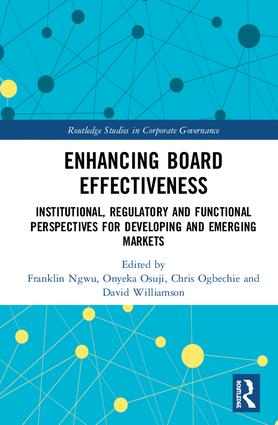
Edited book: F Ngwu, O Osuji, C Ogbechie and D Williamson (eds), Enhancing Board Effectiveness: Institutional, Regulatory and Functional Perspectives for Developing and Emerging Markets (Routledge 2019).

Enhancing Board Effectiveness seeks to examine the conceptualization and role of the board in a variety of contexts and articulate solutions for improving the effectiveness of the board, especially in developing and emerging markets. Enhancing Board Effectiveness therefore addresses the following central questions:

  1. To what extent is the concept and role of the board evolving?
  2. What rights, powers, responsibilities and other contemporary and historical experiences can enhance the effectiveness of the board, especially in the particular contexts of developing and emerging markets?
  3. What socio-economic, political, regulatory and institutional factors/actors influence the effectiveness of the board and how can the policies and practices of such actors exert such influences?
  4. In what ways can a reconstructed concept of the board serve as a tool for theoretical, analytical, regulatory and pragmatic assessment of its effectiveness?

In examining these issues, Enhancing Board Effectiveness investigates theoretical, socio-economic, historical, empirical, regulatory, comparative and inter-disciplinary approaches. Academics in the relevant fields of accounting, behavioural psychology/economics, development studies, financial regulation, law and management/organizational studies, political economy and, public administration will find this book of high interest.

Book chapter: O Osuji, ‘Club Theory and Performance Evaluation’ in F Ngwu, O Osuji, C Ogbechie and D Williamson (eds), Enhancing Board Effectiveness: Institutional, Regulatory and Functional Perspectives for Developing and Emerging Markets (Routledge 2019).

This chapter applies the club theoretic model to contextualise voluntary clubs in public interest regulation through corporate governance, particularly in the developing and emerging markets. Drawing on the political theory of corporation and the institutional perspective, the chapter proposes an enforced self-regulatory system for directors’ individual and collective performance evaluation that centres on voluntary clubs and is propped by facilitative public regulation. It argues that when voluntary clubs are properly and legally equipped to effectively perform corporate governance regulatory roles, directors, shareholders, market participants, stakeholders and society can all benefit.

While it frames corporate governance clubs within regulatory institutional frameworks, the chapter demonstrates the impact of voluntary rules, standards and procedures on individual director and board effectiveness and therefore aligns private governance with broader society expectations. It highlights internal, external and independent quantitative and qualitative methods for evaluating board performance and demonstrates how barriers to improvement can be identified and tackled and how positive factors for effectiveness can be recognised and improved on.

The proposals include research, training, education and other methods for continuous individual and collective development, operation of stringent voluntary clubs at industry and sub-sector levels, preventative, retributive and corrective enforcement measures, club membership as a prerequisite, performance-related certification, licensing and disqualification, and facilitative public regulation. 

Corporate Responsibility Publications

Book chapter: O Osuji, ‘Tackling Corruption through Corporate Social Responsibility’ in J Ellis (ed), Corruption, Social Sciences and the Law: Exploration Across the Disciplines (Routledge 2019)

This chapter examines how corporate social responsibility (CSR) can be used as an effective solution to official corruption, especially in developing countries. Despite wide-ranging legal interventions, official corruption persists as a significant public interest issue for various reasons. It is shown that the law’s limited scope and effectiveness has engendered alternative and complementary anti-corruption regulation opportunities within the scope of CSR. Ideally, CSR can help to identify gaps in substantive law and enforcement process and how to plug them. However, the anti-corruption impact of CSR seems modest to date.

The chapter proceeds to establish the theoretical linkages between CSR and anti-corruption principally through the political CSR, governance CSR and institutional theoretic models. It identifies effective self-regulation, accountability and responsible global leadership as the core principles of an anti-corruption CSR paradigm before outlining its components. It demonstrates how corporate conscience, whistleblowing and individual and collective responsibility can overcome informal signals and ends with a restatement of the challenges and opportunities in using CSR for anti-corruption promotion. Before concluding, the chapter outlines certain steps corporations can undertake to demonstrate anti-corruption CSR.

Conference paper: Dr. Osuji was invited to present at the Sixth Annual Conference of the Kuwait International Law School (May 2019) a paper entitled ‘Corporate Social Responsibility, Stakeholder Needs and Sustainable Development: Overcoming Contextual and Regulatory Challenges through the Values Paradigm’.

The emergence of sustainable development as a matter of global concern has been complemented by the recognition of the roles of different segments of society in promoting it. As the Sustainable Development Goals 2015 (SDGs) exemplify, corporations and other private stakeholders are increasingly regarded as active partners in the sustainable development agenda. The tools for advancing corporate and stakeholder involvement in sustainable development therefore includes corporate social responsibility (CSR), which was originally conceived as a voluntary management tool.

Four elements of CSR are arguably critical in relation to sustainable development. First, despite its traditional conception, one of the consequences of the growing global influence of CSR is that corporations, especially the large, high profile and consumer-facing ones, realistically do not have the option of ‘doing nothing’ with regards to socio-economic issues such as sustainable development. Second, the stakeholder framework of CSR implicitly acknowledges contextualism while sustainable development, as the SDGs show, also accept contextual priorities. Third, notwithstanding the universalist/internationalist theory, the concept of glocalisation recognises that local and global standards can co-exist in a mutually reinforcing manner. The fourth significant factor is the emergent recognition of CSR as a potential complementary regulatory tool by public and private authorities (Osuji, 2015; Osuji and Obibuaku, 2016). As exemplified by regulatory actions in some jurisdictions, the regulation of CSR enables its application to suit the sustainable development agenda of specific jurisdictional contexts. Overall, orthodox CSR practice seems to have followed a ‘stakeholder needs’ approach which can adapt CSR to promote sustainable development as a voluntary or regulated activity. 

Nonetheless, the following questions arise:

  1. Are there implications for using the stakeholder needs CSR model in promoting sustainable development in a specific jurisdictional context?
  2. Does contextualism allow a ‘values’ approach to CSR even when it is being used as a regulatory tool?
  3. To what extent can a ‘values’ CSR approach improve or complement the stakeholder needs model in addressing sustainable development in specific jurisdictional contexts?

Drawing on the institutional, including Scott (2001, 2008), and stakeholder theoretic models, this paper argues that a stakeholder needs CSR model may be inadequate for advancing sustainable development, especially in an emerging country context. The issues this raises include disguised motivations, insufficient clarity of goals, unintended assumption of legal responsibility and covert corruption. An alternative to the stakeholder needs model is the values approach which has sociological and institutional foundations.

The paper demonstrates that a values paradigm is feasible and may be an imperative aid for applying the stakeholder needs CSR model to sustainable development. The values paradigm can improve effectiveness of a regulated CSR as a sustainable development promotion and private regulation mechanism.  

Corporate Regulation Publication

Edited book: J Griffin, HK Chan, O Osuji and H Choo, 3D Printing: the development of a technical licensing framework with a focus on China (Routledge 2019).

The book is an output of the AHRC (Arts and Humanities Research Council) funded project, entitled ‘A Technological Licensing Framework for 3D Printed Content: A Focus on China’.

More specifically, it is a collection of materials, relating to empirical interviews, a work placement, workshops and publications that have been carried out in one of the world leading research projects into the legal impact of 3D printing. The project was funded by the AHRC and Newton Fund, and was largely carried out within China. It was designed to establish the perceived legal challenges faced by 3D printing companies, as well as a technical framework for an operational automated technical licensing system.

The main research questions addressed by this work are the following:

  1. How can an automated licensing platform framework enable 3D printing companies to licence 3D printed content and files in new ways? Examples would be online databases and/or the printing of 3D computer game characters.
  2. What is an effective technological solution to online licensing of 3D content?
  3. What is the impact of such a system upon copyright law, in particular copyright law in China and copyright law internationally?
  4. How will this pioneer the development of law that is digital in nature?

Workshop on ‘Brexit: Regulatory Challenges for Business Law’

10 May 2019 10.00am – 5.00pm University of Essex, Wivenhoe Park, Colchester, CO4 3SQ

The UK’s withdrawal from the EU will result in far-reaching, significant consequences for the regulatory spheres of both the UK and the remaining Member States. Even after the completion of the withdrawal process, EU laws will still impact businesses operating in the UK, both directly and indirectly. Fields which are most likely to be affected include product specifications, competition, employment, health and safety, banking and financial services, company law, insolvency, consumer protection and insurance. Despite this, there continues to be gaps in the research which has been carried out to explore the ultimate consequences of Brexit on the business regulatory environment.

This workshop, organised by the Commercial Law Cluster at the University of Essex, aimed to cover this research gap by exploring the opportunities and risks faced by UK business in this time of legislative change. In particular, this workshop focused on three key legal fields: (i) finance and banking law; (ii) corporate law; and (iii) maritime and insurance law.

The purpose of this workshop was to raise awareness and foster debate on the rules that will govern the UK after Brexit. The regulatory changes for each of these three economic sectors were discussed in separate panels. In each panel, invited speakers provided an overview of the opportunities and challenges faced by businesses. Invited discussants then complemented these presentations with views from both academia and legal practice.

The programme and speakers included:

Welcome: Professor Theodore Konstadinides (University of Essex)

Keynote Presentation: Professor Takis Tridimas (King’s College London; Matrix Chambers)

Session One: Finance and Banking

Financial Markets: Professor Stuart Weinstein (Aston University) and Dr Flora Huang (University of Essex)

Banking Supervision: Dr Menelaos Markakis (Erasmus University Rotterdam) and Dr Anastasia Karatzia (University of Essex)

Session Two: Corporate Law

Chair: Dr Eugenio Vaccari

Company Law: Professor Janet Dine (Queen Mary University of London) and Dr Marios Koutsias (University of Essex)

Insolvency Law: Hamish Anderson (Norton Rose Fulbright) and José Carles (Carles Cuesta Abogados y Asesores Financieros, Madrid)

Employment Law: Dr Jennifer Gant (University College Cork) and Dr Niall O’Connor (University of Essex)

Session Three: Maritime, Shipping and Insurance

Chair: Dr Lijie Song

Shipping: Zoumpoulia (Lia) Amaxilati (Queen Mary University of London) and Dr Durand Cupido (University of Essex)

Insurance: Dr Keren Wu (University of East Anglia) and Dr Anna Antoniou (University of Essex)

Closing Presentation: Professor Steve Peers (University of Essex)