Booze, Bottles and Brussels: Member States’ Dilemma on Alcohol Health Warnings

By Dr Nikhil Gokani, Lecturer in Consumer Protection and Public Health Law, Essex Law School

Nikhil is Chair of the Alcohol Labelling and Health Warning International Expert Group at the European Alcohol Policy Alliance, Vice President of the Law Section at the European Public Health Association, and member of the Technical Advisory Group on Alcohol Labelling at WHO.

This blog is a condensed version of N Gokani, ‘Booze, Bottles and Brussels: Member States’ Dilemma on Alcohol Health Warnings’ (2024) 13(2) Journal of European Consumer and Market Law 97-102. The full article is available here. An open access version is also available here.

An example of an alcohol health warning. Pictured here as used in the Yukon Study.

Alcohol and the need for effective alcohol labelling

Alcohol is a causal factor in more than 200 diseases, injuries and disabilities. Even at lower levels of consumption, alcohol is associated with increased risks of heart diseases and stroke, liver cirrhosis, cancers and foetal alcohol disorders. In the EU, alcohol consumption causes between 255,000 and 290,000 deaths per year. Beyond health, alcohol results in significant social and economic losses to individuals and society at large.

Despite negative consequences of drinking alcohol, consumer awareness of its harms is low. The World Health Organization (‘WHO’) has repeatedly called on States to provide consumers with essential information through alcohol labelling. The EU has itself acknowledged the importance of consumer alcohol information, reflecting the foundation of EU consumer protection policy that consumers can be empowered through becoming well informed.

EU level regulation of alcohol labelling

Current EU rules in Regulation 1169/2011 on the provision of food information to consumers (‘FIC Regulation’) require alcoholic beverages with a content over 1.2% alcohol by volume (‘ABV’) to include alcohol strength on the label. Similar health-related information, including ingredients list and a nutrition declaration, which are required on the labels of most food products, are exempt for alcoholic beverages above 1.2% ABV. EU law does not require other health-related information to appear on the label.

Member State developments on alcohol labelling

Health-related warnings are not explicitly addressed under EU law and several Member States have introduced national mandatory labelling rules. These have focused on two forms on messaging: mandatory label labelling relating to the age of consumption and messaging against drinking during pregnancy.

In October 2018, Ireland signed into law its Public Health (Alcohol) Act 2018. In May 2023, Ireland signed into law as its Public Health (Alcohol) (Labelling) Regulations 2023. From May 2026, non-reusable alcohol containers will be required to include the following labelling.
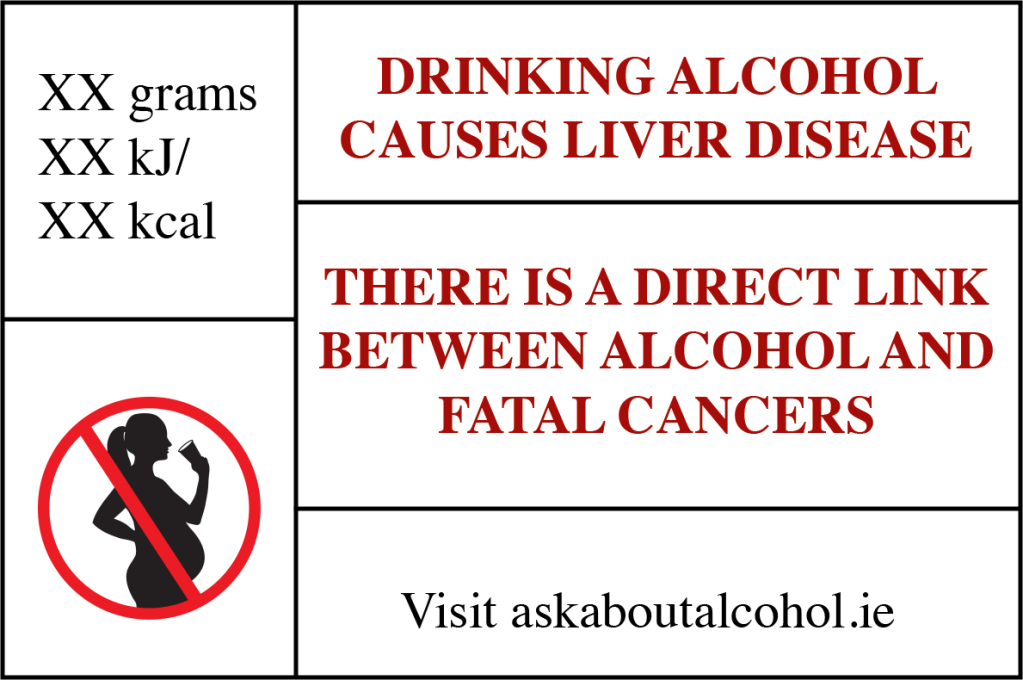
While feedback from civil society organisations representing public health and consumer protection expressed strong support, industry bodies from across the globe responded opposing the measure. The feedback questioned the compatibility of the Irish Regulations, and warning labelling in general, with EU law in three key ways, which are addressed in turn below.

Legal objection 1: The Irish rules constitute a discriminatory barrier to free movement

Alcohol labelling is harmonised at EU level. National labelling rules fall within the scope of the FIC Regulation. National alcohol warning labelling rules are allowed under two different sets of rules in the FIC Regulation – depending on whether or not warning labelling would be considered to be “specifically” harmonised by the FIC Regulation.

On the one hand, health warnings are not specifically mentioned in the FIC Regulation. This suggest that health warning labelling is not “specifically” harmonised. Under this interpretation, Member States may introduce national rules. This is allowed providing that these are not contrary to general EU Treaty provisions.

On the other hand, the full list of mandatory labelling particulars (eg list of ingredients, use by date) have been listed in the FIC Regulation. This suggests that the mandatory labelling has been “specifically” harmonised. Under this interpretation, Member States may not introduce national rules unless the FIC Regulation includes a derogation. The FIC Regulation does indeed include a derogation. Article 39(1) allows Member States may adopt rules requiring additional mandatory particulars justified on public health or consumer protection grounds. This is allowed providing that Member States do not undermine the FIC Regulation and that the national rules are not contrary to general EU Treaty provisions.

Therefore, irrespective of the different interpretations of the FIC Regulation, Member States seem able to move forward with national warning labelling.

Legal objection 2: The Irish rules are not consistent with existing EU harmonisation

The FIC Regulation requires that Member States may not undermine its base protection in Article 7. Therefore, national labelling shall be “accurate”, “clear and easy to understand” and “not be misleading”.

Accurate: Taking the Irish labelling as case study, this labelling is accurate according to scientific consensus. Evidence that “Drinking alcohol causes liver disease” is well-stablished. The evidence on the dangers of drinking during pregnancy is also clear. No amount of alcohol is considered safe during pregnancy. There is also well-established evidence that “There is a direct link between alcohol and fatal cancers”. Alcohol is classified as a group 1 carcinogen by the WHO International Agency for Research on Cancer.

Clear: The requirement that information is “clear” relates to legibility and visibility. The Irish warnings meet this requirement not least as they appear against a white background, are within a black box and have a minimum size.

Not misleading: The Irish labelling is also not misleading. In line with broader consumer protection in the internal market, compliance with information rules is assessed against the behaviour of the “average consumer who is reasonably well informed and reasonably observant and circumspect taking into account social, cultural and linguistic factors”. This notional average is an active player in the market who reads information, has background knowledge, is critical towards information, does not take information literally, and will not be misled easily if sufficient information is available. This average consumer is likely to understand the meaning of the Irish labelling. The pregnancy warning simply advises women not to drink during pregnancy as per national health guidance. The message that “There is a direct link between alcohol and fatal cancers” communicates association with fatal cancers but does not go as far as communicating a direct causal relationship notwithstanding the well-established evidence on causation. The warning that “Drinking alcohol causes liver disease” is not misleading as liver disease occurs with even relatively lower levels of consumption.

Therefore, the Irish rules appear compatible with existing EU harmonisation.

Legal objection 3: The Irish rules are not proportionate

National alcohol labelling must also be proportionate, which it is when it is suitable and necessary to achieve its objective.

Legitimate objective:The primary objective for warning labelling is to inform consumers. It is also a part of a broader, secondary objective of reducing consumption and harms. As the Irish Regulations have been introduced under the Article 39 derogation, the objectives are limited to “the protection of public health” and “the protection of consumers”. Alcohol control clearly falls within these broad grounds as the CJEU has consistently held.

Suitability:Under the suitability limb of proportionality, it is necessary to determine whether the proposed labelling can attain its objectives of informing consumers and contributing to a reduction in consumption as part of a broader suite of measures. In respect of the primary objective, evidence demonstrates that there is a deficit of knowledge about the health consequences of alcohol consumption and labelling informs consumers. Studies show that alcohol health warnings leads to increased knowledge of health risks. Indeed, EU law already requires certain food products to be labelled with health warnings. As regards the secondary objective, evidence shows the contribution of labelling to reduction in harms and consumption.

Necessity:Under the necessity limb of proportionality, it must be determined whether a less intrusive measure can be equally effective as the proposed labelling to attain the objectives. Other measures are not equally effective. Labelling is available at both the point of purchase and point of consumption. Labelling is available on every container. It is targeted so that everyone can see the label when they see alcohol, but its visibility is in proportion to the number of containers a person consumes. It mitigates the effect of promotional marketing messaging on labelling. Ongoing costs are minimal.

Therefore, the Irish rules appear proportionate.

Moving towards effective alcohol health warning labelling

The objection raised by industry, that EU food law is a barrier to national alcohol health warning labelling rules, are demonstrably wrong. Therefore, in the absence of EU level action, Member States must take responsibility for moving forward independently. Let us hope the rest of the EU follows Ireland’s lead.

Nevertheless, EU institutions must support Member States to tackle alcohol-related harm. Tides appeared to be turning with Europe’s Beating Cancer Plan, in which the Commission committed to introducing proposals on alcohol health warning labelling by the end of 2023, but the deadline passed with no action. Let us also hope the EU decides to prioritise the health of consumers over the interests of economic actors.

Alcohol labelling and warnings: how progress at the Codex Alimentarius Commission can help States overcome challenges at the World Trade Organization

By Nikhil Gokani, Lecturer in Law, Essex Law School, University of Essex

In this post, Nikhil Gokani writes about the work he is involved in on developing international standards, which can help countries navigate challenges under the rules of the World Trade Organization. Nikhil works on food and alcohol labelling regulation in the UK, EU and globally. He is chair of the Alcohol Labelling and Health Warning International Expert Group at the European Alcohol Policy Alliance (Eurocare). He is also a member of the Technical Advisory Group on Alcohol Labelling at WHO.

Alcohol-related harm and consumer protection

Consuming alcohol is a causal factor in more than 200 diseases, injuries and other health conditions. Alcohol consumption affects other people, such as family, friends, colleagues and strangers. Globally, about 3 million deaths each year result from the use of alcohol. Beyond health, there are significant social and economic burdens.

Consumers do not have sufficient knowledge about the content and effects of alcoholic beverages. Most consumers are unaware of the energy and nutrition values (such as amount of carbohydrates) and ingredients. Few consumers are aware of the health risks, such as alcohol causing at least seven cancers.

Alcohol labelling and global progress

Alcohol labelling is an important source of information for consumers. Labelling is unique in providing information at both the point of purchase and consumption. Labelling improves knowledge. It is an effective measure to help ensure consumers are well-informed and not misled. Increasing evidence also shows that health information can empower consumers to make healthier consumption decisions, including drinking less.

Unfortunately, few countries in the world require that consumers are given essential facts on labelling, such as ingredients lists and nutrition declarations. Even fewer countries require beverages to be labelled with information warning consumers about the hazards of drinking alcohol.

The most recent success was in Ireland where new rules will require alcohol packaging to display warnings that “Drinking alcohol causes liver disease”, “There is a direct link between alcohol and fatal cancers” and a pictogram showing that alcohol can harm the unborn child if drunk during pregnancy. Countries like Ireland, unfortunately, face international legal challenges, particularly under international trade law.

International trade law and international standards

International trade law can constrain the regulatory autonomy of States. Significant to alcohol labelling is the World Trade Organization (WTO) Agreement on Technical Barriers to Trade (TBT Agreement). Most significantly, Article 2.2 of the TBT Agreement states that technical regulations, including rules on alcohol labelling, shall not create “unnecessary obstacles to international trade”. Technical regulations shall not be “more trade-restrictive than necessary to fulfil a legitimate objective”. Preventing alcohol-related harm is indeed a legitimate objective. However, many States trying to introduce better alcohol labelling rules have been challenged because other States have argued that labelling rules go beyond what is more trade-restrictive than “necessary”.

When a WTO State’s rule about alcohol labelling is challenged, international standards can either help or hinder them.

On the one hand, Article 2.4 of the TBT Agreement states that where “relevant international standards exist” States “shall use them…as a basis for their technical regulations” except when this would be ineffective or inappropriate Therefore, where international standards are not aligned with public health interests, they can make it harder for States to introduce effective national rules.

On the one hand, Article 2.5 of the TBT Agreement provides a powerful defence mechanism. It states that, when a technical regulation is “in accordance with relevant international standards”, there is a rebuttable presumption that the national rule does not create an unnecessary obstacle to international trade. Simply stated, where the State complies with a relevant international standard, they have a potentially strong defence for their labelling rules. Therefore, good international standards can be very powerful to help countries defend their national labelling policies.

Codex Alimentarius

An international standard is one which is made by a recognised body and compliance is voluntary. For alcohol labelling, there is indeed an international standard: the Codex Alimentarius is a collection of standards, guidelines and codes adopted by the Codex Alimentarius Commission.

Where alcohol labelling is in compliance with relevant Codex standards, States could use this as a defence under WTO rules. This underlines the importance of having good Codex standards that support effective national rules on alcohol labelling.

Significant progress has been made at the Codex Alimentarius Commission. Alcohol labelling was discussed at four Sessions of the Codex Committee on Food Labelling (CCFL). The Report of the 46th Session of CCFL noted “there was common ground on which to proceed with the work” but little further progress has since been made in recent years. At that Session, the Committee agreed that Russia, European Union and India with assistance from WHO and Eurocare would prepare a discussion paper for consideration at the next meeting. In fact, this was the first time this Committee included an NGO in the preparation of a discussion paper, which is a testament to the global leadership by Eurocare in this field.  Unfortunately, however, no discussion paper was submitted by Russia. Therefore, WHO and Eurocare each submitted their own discussion paper to keep the matter moving forward. The WHO representative spoke objectively and convincingly at the 47th meeting of CCFL. These efforts led to alcohol labelling remaining on the Codex agenda – something which several States, no doubt under the influence of the powerful alcohol industry, had resisted.

The Codex Alimentarius Commission has now started a new consultation process. It issued a Circular Letter which asks State members and Observers to comment on how work on developing alcohol standards should proceed.

For this consultation process to work best for public health and consumer protection, we need everyone to contact their governments (emails here) to demand effective progress at Codex. Please join us in these efforts!

European Commission’s Proposals to Revise Labelling Rules for Alcoholic Beverages

Image courtesy pxfuel

Dr Nikhil Gokani, Lecturer in Law, University of Essex, writes on the European Commission’s Roadmap on the ‘Proposal for a revision of Regulation (EU) No 1169/2011 on the provision of food information to consumers, for what concerns labelling rules on alcoholic beverages’.

This post is based on the response written by Dr Nikhil Gokani (Vice President, EUPHA-LAW) and Professor Amandine Garde (President, EUPHA-LAW; Law & NCD Unit, University of Liverpool) on behalf of the European Public Health Association.

In 2011, the European Union adopted Regulation (EU) No 1169/2011 on the provision of food information to consumers. Article 9 of this Regulation requires food products to be labelled with a nutrition declaration and an ingredients list. However, Article 16 of this Regulation specifically excludes alcoholic beverages from these requirements.

In 2017, the European Commission published its Report regarding the mandatory labelling of the list of ingredients and the nutrition declaration of alcoholic beverages which concluded, as public health and consumer protection organisations had been stating for many years, that no objective grounds justify the absence of information to consumers on ingredients and nutrition information on alcoholic beverages.

On 24th June 2021, the Commission released a Roadmap and Initial Impact Assessment on proposals to remedy the illogical and harmful labelling exemptions for alcohol. The Initial Impact Assessment identified three options. Option 0 would maintain the status quo. Option 1 would require mandatory nutrition and ingredient information for alcoholic beverages to be given off-label (for instance, on websites or on apps). Option 2 would require mandatory nutrition and ingredient labelling to be given directly on the label. Only option 2 should move forward for the following reasons.

Alcohol consumption is a significant public health concern

Alcohol consumption is associated not only with non-communicable diseases but also injuries and infectious disease. There is a direct relationship between higher levels of alcohol consumption and developing some cancers, liver diseases and cardiovascular diseases; and the level and pattern of drinking has a relationship with ischaemic heart and cerebrovascular diseases. Alcohol is a psychoactive substance which has dependence-producing properties, and the excessive consumption of alcohol ranks among the top risk factors for disease, disability and mortality. It is a causal factor in more than 200 disease and injury conditions.

Current ingredient and nutrition labelling on alcohol does not inform consumers

Alcohol commonly contains a variety of ingredients, such as wheat, barley, corn, rye, grapes, hops, histamine, sulphites and brewer’s yeast. One gram of alcohol contains seven calories, and together with sugar, heavy intake can significantly contribute to overweight and obesity.

There is increasing evidence that there is a deficit in consumer knowledge and understanding of the nutritional content and ingredients of alcoholic beverages as well as the consequences of alcohol consumption. Across the EU, consumers are interested in alcohol labelling.

In its 2006 Alcohol Strategy, the EU specifically aimed to ‘provide information to consumers so that they can make informed choices’ and to inform consumers about ‘the impact of harmful and hazardous alcohol consumption on health’. This is in line with the long held view the EU that well-informed consumers are empowered to make healthy purchasing and consumption decisions. As the Commission has plainly acknowledged in its Report regarding the mandatory labelling of the list of ingredients and the nutrition declaration of alcoholic beverages in 2017, there are no objective reasons for the exemptions.

Ingredient and nutrition labelling would promote high level of consumer and public health protection and promote the functioning of the internal market

It is extremely concerning indeed that alcoholic beverages containing more than 1.2% by volume of alcohol are exempt from the requirement of displaying a nutrition declaration and ingredients list. Once again, nothing justifies such an exemption on such harmful commodities.

Even when a nutrition declaration is provided on a voluntary basis, it can be limited to an energy-only declaration. This is insufficient. Effectively implemented nutrition and ingredients labelling would inform consumers about the content of alcoholic beverages and contribute to empowering consumers to make healthier alcohol purchasing and consumption decisions. This is particularly important bearing in mind the evidence referred to above regarding, firstly, the deficit of consumer information on alcoholic beverages and the appetite for such information, and secondly, the relationship between alcohol consumption and a wide range of diseases.

Moreover, several Members State have proposed or introduced measures acting on the derogation for ingredients labelling in Regulation (EU) No 1169/2011 on the provision of food information to consumers, as well as measures on nutrition labelling. Bearing in mind that alcoholic beverages are traded extensively within the internal market, there is a compelling rationale for the adoption of an EU-wide harmonised approach to the regulation of nutrition and ingredients labelling of alcoholic beverages to reduce market fragmentation.

On-label information is far more useful to consumers

It is well-established that, to be able to effectively inform consumers, information should be easily available, salient and well-perceived by consumers. On-label information is more readily accessible for consumers, particularly within in-store environments. Bearing in mind that consumers do not always search for nutrition and ingredient labelling, on-label information is more likely to be seen and read, which is particularly true for members of lower socioeconomic groups. This has been reflected in EU food law since the EU began regulating food information in the late 1970s. There is no reason to treat alcoholic beverages more leniently than other foods.

Option 2 of the Initial Impact Assessment is the only evidence-based option to meet the EU’s objectives of promoting a high level of consumer protection and public health.

The EU should also introduce other effective labelling, including front-of-pack labelling, to help empower consumers

The envisaged measures of back-of-pack nutrition labelling and ingredients labelling are just two forms of labelling to help inform consumers. To empower consumers to make healthier decisions, the EU should also develop proposals for mandatory front-of-pack labelling, mandatory serving size recommendations and per portion nutrition information, guidance on moderate levels of drinking and warnings on the health effects of consuming alcohol.[13] The Commission’s intention in the EU’s Beating Cancer Plan to make proposals on health warnings on alcohol labels by the end 2023 are supported. Not only does the WHO European Action Plan to Reduce the Harmful Use of Alcohol 2012–2020 call for ‘labelling similar to that used for foodstuffs, including alcohol and calorie content’ but also health warning. Moreover, empowerment by information can only be successful if voluntary forms of information and marketing are also regulated.

Over the years, the EU’s response to alcohol related harms has been substandard and it is high time that it rectified this failure through the adoption of evidence-based measures intended to limit the appeal, the acceptability and the affordability of alcoholic beverages. It is only then that it can claim that it has indeed complied with the obligation it derives from the EU Treaties and the EU Charter of Fundamental Rights and Freedoms to ensure a high level of public health protection in the development and implementation of all its policies, including its internal market and consumer protection policies.

Front-of-pack nutrition labelling in the EU: proposals for a mandatory EU-wide label

Dr Nikhil Gokani, Lecturer in Law, University of Essex.

The European Commission published its Farm-to-Fork Strategy on 20 May 2020. In this, the Commission declared that to ‘empower consumers to make informed, healthy and sustainable food choices’, the Commission will propose harmonised mandatory front-of-pack nutrition labelling (FoPNL) by the fourth quarter of 2022.

As part of these plans, the Commission published an inception impact assessment and published two initiative Roadmaps: “Food labelling – revision of rules on information provided to consumers” and “Facilitating healthier food choices – establishing nutrient profiles”. Feedback on these opened on 23rd December 2020 and will close on 3rd February 2021.

In this post, Dr Nikhil Gokani, whose research explores the regulation of FoPNL, which was also the topic of his PhD, briefly sets out his views on how the EU should proceed with the regulation of FoPNL. To further develop the understanding of the regulatory issues involved, and bearing in mind the Commission’s target for legislative proposals, Dr Gokani and Prof Amandine Garde (Law & Non-Communicable Diseases Unit, University of Liverpool) are organising a conference on FoPNL – to explore the national, EU and international regulatory issues – which is provisionally scheduled for September 2021.

Back-of-pack nutrition labelling (BoPNL) does not sufficiently contribute to informing consumers, promoting healthier diets or tackling the rise in overweight, obesity and diet-related non-communicable diseases.

Evidence is clear that consumers find BoPNL confusing. They do not perceive nor understand BoPNL well, and they are unable to use this type of labelling effectively to help them make healthier food purchasing and consumption decisions. This is particularly so for consumers of lower socioeconomic groups.

Interpretive front-of-pack nutrition labelling (FoPNL) is an evidence-based intervention to inform consumers, help them make healthier food purchasing and consumption decisions, whilst encouraging manufacturers to reformulate products to make them healthier.

Effectively presented FoPNL is better perceived relative to BoPNL. Surveys have shown high levels of use, and research on various FoPNL schemes has shown improved trolley outcomes. FoPNL has a statistically significant effect in steering consumers’ choices towards healthier products, whilst encouraging product reformulation.

Interpretive FoPNL has consistently been shown to be most effective in improving health-related understanding, reducing processing time and improving purchasing intentions, with simpler schemes generally being better understood.

The EU should introduce a mandatory, interpretive EU-wide FoPNL scheme.

EU law, as it stands, precludes Member States from adopting mandatory FoPNL at national level (Regulation No 1169/2011 on food information to consumers and Regulation No 1924/2006 on health and nutrition claims) and does not effectively promote the voluntary adoption of evidence-based FoPNL schemes.

To be most effective, FoPNL should be mandatory for all food products. Any exceptions should be limited and only permitted where there are clear evidence-based justifications. The introduction of a mandatory pan-EU FoPNL scheme in the EU would help ensure a high level of consumer protection and public health while improving the functioning of the internal market. Moreover, this would be consistent with the EU’s obligations to protect consumers and their health, and to comply with fundamental rights as mandated by the EU Treaties and the EU Charter.

FoPNL should be: developed in a transparent manner; based on effective stakeholder engagement with conflicts of interest managed; effective in improving outcomes for all population sub-groups; supported by well-resourced education campaigns; encourage product reformulation; permit the comparison of products within and between food categories; monitored and evaluated for effectiveness; and reviewed periodically.

The presentation of EU-wide FoPNL

The evidence base supports the introduction of a mandatory, interpretive pan-EU FoPNL scheme. Hence, the EU should not move forward with FoPNL option 0 (“Baseline” ie business as usual) nor FoPNL option 1 (“Nutrient-specific labels – numerical” eg NutrInform). With FoPNL option 3 (“endorsement logos” eg Keyhole), consumers tend to over-estimate the healthiness of products, and there is insufficient research on the effectiveness of this type of FoPNL. By contrast, research has shown that option 2 (colour coded eg Traffic Light Labelling) and option 4 (graded indicators eg Nutri-Score) are effective in meeting public health objectives of increasing salience, improving understanding and improving purchasing intention as well as actual purchasing decisions.

Relative to other schemes in use in the EU, Nutri-Score presents a number of advantages which favour its adoption across the EU. Firstly, Nutri-Score is widely supported by a broad range of stakeholders, including many public health organisations and consumers themselves. Secondly, Nutri-Score has been evaluated in several large-scale studies evaluating perception and comprehension in French populations. It has been shown to improve understanding and lead to better basket outcomes, particularly with consumers from more vulnerable populations. Thirdly, the scheme has been adopted by several Member States, which would facilitate its extension to other EU Member States.

The nutrient profiling model underlying EU-wide FoPNL

It is a prerequisite that the development of interpretive FoPNL is based on an evidence-based nutrient profiling model. This model should encourage consumption of fruit, vegetables and wholegrains and other health-promoting food categories and ingredients; and discourage the consumption of fat (especially trans and saturated fatty acids), sugar (especially free sugar) and salt. Smaller portion sizes, energy density, level of processing and artificiality of ingredients may also be reflected in the model. The model, and the way FoPNL displays the classification derived from the model, should permit meaningful comparisons in order to encourage healthier substitutions both within and between categories.  The model should classify food based on a scoring system which provides continuous gradations of healthiness of the food in order to encourage continuing reformulation. It should be based on uniform reference values (100g/ml)

Nutri-Score is based on a nutrient profiling model which was originally developed in the UK and was found to be largely consistent with French nutrition recommendations. A diet, which is consistent with recommendations derived from the model, was found to result in improved health markers amongst the population. There is evidence that the Nutri-Score nutrient profiling model would also be effective for diverse European populations.

However, the model would need to be altered to address certain criticisms. To this end, EFSA should be tasked with developing an objective, evidence-based model free from undue industry interference. Alternatively, noting the Commission’s failure to adopt nutrient profiling for the purposes of Article 4(1) of Regulation No 1924/2006, the development of this nutrient profiling should be tasked to a scientific committee of independent experts from across the EU.

In the absence of a mandatory pan-EU FoPNL scheme, the EU should not prohibit mandatory national schemes.

The controversies surrounding the adoption of Regulation 1169/2011 and Regulation 1924/2006 have shown that reaching consensus across Member States is likely to be extremely difficult. There is a real risk that, in the absence of sufficient political will, the EU may fail to adopt a single pan-EU mandatory FoPNL scheme. It is therefore important that the Impact Assessment anticipates these difficulties and contains an additional FoPNL option exploring the implications of a partial harmonisation scheme whereby EU law would permit Member States to introduce effective mandatory national schemes, as noted in the Presidency Conclusions on front-of-pack nutrition labelling, nutrient profiles and origin labelling of 15 December 2020.

The nutrient profiling model should also be used to regulate the use of health and nutrition claims more effectively, as mandated by Regulation No 1924/2006.

The controversies surrounding the adoption of Regulation 1169/2011 and Regulation 1924/2006 have shown that reaching consensus across Member States is likely to be extremely difficult. There is a real risk that, in the absence of sufficient political will, the EU may fail to adopt a single pan-EU mandatory FoPNL scheme. It is therefore important that the Impact Assessment anticipates these difficulties and contains an additional FoPNL option exploring the implications of a partial harmonisation scheme whereby EU law would permit Member States to introduce effective mandatory national schemes, as noted in the Presidency Conclusions on front-of-pack nutrition labelling, nutrient profiles and origin labelling of 15 December 2020.

The use of health and nutrition claims is a marketing tool intended to encourage consumers to purchase certain products. As claims lead to an increase in consumption and overall energy intake, it is important that they do not mislead consumers and, in particular, that they do not mask the overall nutrition profile of food products. Under Article 4 of Regulation No 1924/2006, the Commission should have adopted an EU-wide nutrient profiling model to restrict the use of food claims on unhealthy products by 19 January 2009. The Commission should finally fulfil this obligation as a priority to ensure that businesses operate within a level playing field and consumers are finally protected from the most misleading forms of commercial food information. It would be logical for FoPNL and food claims to be based on the same underlying nutrient profiling model.

The EU should extend mandatory back-of-pack and mandatory front-of-pack nutrition labelling to alcohol.

It is extremely concerning that alcoholic beverages containing more than 1.2% by volume of alcohol are exempt from the requirement of displaying a nutrition declaration. Even when such a declaration is provided on a voluntary basis, it can be limited to an energy-only declaration in a non-tabular format.

There is increasing evidence that there is a deficit in consumer knowledge and understanding of the nutritional content of alcoholic beverages and the consequences of their consumption. Moreover, consumers are interested in alcohol nutrition labelling across Member States. In any event, the exemption is illogical bearing in mind that EU consumer law, and the EU Alcohol Strategy of 2006 more specifically, aims to ‘provide information to consumers to make informed choices’.

Human Rights, Childhood Obesity and Health Inequalities

Photo courtesy unsplash.com (Brett Jordan)

Dr Nikhil Gokani, Lecturer in Law, University of Essex, has co-authored a new book chapter on human rights, childhood obesity and health inequalities with Dr Marine Friant-Perrot.

The prevalence of childhood obesity, and its rapid increase, is not distributed equally across populations. Some groups of children are more likely to live with obesity than others, with childhood obesity being strongly associated with belonging to socioeconomic groups consuming more energy-dense diets. These health inequalities are largely systematic, and are mostly the result of the social, political and economic environment in which children live and play.

Despite the creation of a health-promoting environment for all children being recognised by the international community as a matter of societal responsibility, inequalities in childhood obesity are growing. Within legal frameworks, social, cultural and economic rights are well placed to help reduce the prevalence of obesity. These human rights are inspired by the principle of solidarity and, as they are conceived as instruments of social transformation, they aim to provide corrective measures to economic liberalisation. As their essence is to protect everyone equally, the reduction of health inequalities in childhood obesity can be articulated within this human rights discourse.

This book chapter argues that, through helping to restore a real capacity for choice in food consumption, and thereby supporting healthier diets for every child, the right to non-discrimination on the basis of socioeconomic status and the principle of equality can be thought of as a foundation for realising social rights, in particular the right to health and the right to food. Moreover, it explores the implications of a human rights approach grounded in the right to non-discrimination for reducing health inequalities in childhood obesity prevention strategies. It calls for State implementation of restrictions on the marketing of unhealthy food to children as an evidence-based method to reduce inequalities and help better fulfil children’s right to non-discrimination and protect them from unnecessary commercial influences.

This book chapter was co-written with Marine Friant-Perrot (University of Nantes) and published in Amandine Garde, Joshua Curtis and Olivier De Schutter (editors), Ending Childhood Obesity: A Challenge at the Crossroads of International Economic and Human Rights Law (Elgar, December 2020).

The right to health must guide responses to COVID-19

Image by Raam Gottimukkala from Pixabay

Judith Bueno de Mesquita, Co-Deputy Director of the Human Rights Centre, and Lecturer in International Human Rights Law, University of Essex, has co-authored a Comment on ‘The right to health must guide responses to COVID-19’with Dr Dainius Puras (UN Special Rapporteur on the right to health), Luisa Cabal, Allan Maleche and Dr Benjamin Mason Meier.

While the impact of COVID-19 responses on human rights has elicited global attention and concern, much analysis has focused on tests of legitimacy for restrictions of civil and political rights, such as freedom of movement, freedom of association and privacy. Despite calls by the UN Secretary-General and the WHO to place the right to health at the centre of COVID-19 responses, this human right has been marginalized by Governments, as well as in many human rights analyses.

The Comment highlights that the human right to the enjoyment of the highest attainable standard of physical and mental health, protected in international human rights treaties, provides binding normative guidance for health-care systems, broader social responses, and global solidarity in the COVID-19 response. For example, the obligations on States deriving from the right to health require that States provide testing systems, personal protective equipment for frontline service providers, and health care, both for those suffering from COVID-19, as well as other essential healthcare services. It also requires actions beyond the health sector, to address social determinants of health which may be impacted by COVID 19, including through social distancing policies, which have a disproportionate impact on vulnerable and marginalized communities. Further, it requires States to protect vulnerable and marginalized communities, and to ensure that these communities participate in the design and implementation of COVID-19 responses.

One of the original features of international human rights law is that it supports both domestic and transboundary obligations. Thus, in the context of COVID-19, States must engage in international cooperation to support a coordinated global response, which has relevance across a range of fields such as the development of vaccines, economic sanctions, debt obligations and intellectual property. The right to health, as well as other rights, thus have an important role to play in responding to the call of the UN Secretary General for global solidarity in the COVID-19 response.

The Comment was originally published in 2020 by The Lancet, vol 359, p 1888.