The Changing Landscape of Lockdown Law

Image by Tumisu from Pixabay

Dr Samantha Davey, Lecturer in Law, University of Essex

The original position can be summarised by the Government’s mantra ‘stay home, save lives’ which became ingrained in the minds of the general public. We were permitted to leave the house for one of the following reasons only: daily exercise, medical need, caring for vulnerable individuals, to shop for essential supplies, and to go to work if it was not possible to work from home. All shops, except for those selling essential supplies such as food and medicines, were closed. We were no longer permitted to socialise, face-to-face, with people outside of our households. Social distancing became the new norm with guidance emphasising that people should maintain distances of 2m from individuals outside of our households. The changes led to the need for adjustments with many people working from home and children being educated from home. No one could have anticipated how different our lives would have become in 2020. Nor could we have predicted the restrictions on our civil liberties deemed necessary to protect the individuals most vulnerable to the virus such as the elderly and those with pre-existing health conditions. At first, many people accepted the legitimacy of these measures. Over time, however, many people in support of the Coronavirus Law and the corresponding guidance have become concerned over constraints on their civil liberties. 

The restrictions on our daily lives were (and still are) overwhelming and perplexing for many people. While these measures felt short of the tough stance taken in countries such as Russia and Spain, where people were not even allowed to leave their home for daily exercise, we are not used to the state having such control over our day-to-day lives. In the space of just over two months, not only has the legal landscape shifted dramatically but so has the social landscape. Actions once seemed natural, such as hugging and visiting close relatives, were deemed as potentially dangerous and unlawful. In order to hope to continue to enforce lockdown law, the guidance accompanying the law needs to be seen as legitimate since legitimacy fosters public obedience. 

At the time of writing, in June 2020, over 36,000 people in England have died from the coronavirus. The daily death toll has decreased gradually which has led to changes in the restrictions which will apply from June 1st and June 15th. From June 1st, schools re-opened (albeit just to reception, year 1 and year 6 pupils) and some workers were able to return to work, including those working at shops selling non-essential goods. We can now go out more than once a day for daily exercise, we will have more choices in which shops to visit and we can meet in groups of up to 6, if these meetings take place outside and there is social distance. Further relaxations are to follow on June 15th. Social distancing seems likely to continue for the foreseeable future although there are talks of reducing this from 2m to 1.5m. 

Since my original reflections on the coronavirus law, the social and legal landscape has changed significantly. From both an academic and a personal perspective, it is challenging to remain up to date with the guidance accompanying the Coronavirus Law. This law and the corresponding guidance have been likened, by some, to George Orwell’s works of fiction such as 1984. It is argued that the legitimacy of the government guidance is under threat. At best, the guidance lacks clarity and, at worst, is contestable, ambiguous and even contradictory in nature. Indeed, the government guidance accompanying the Coronavirus Law has been voluminous, confusing and, at times, contradictory. The rules change so rapidly that the metaphorical ink on the paper barely has the chance to dry before pages are ripped out and replaced with fresh pages. This raises issues about the diminishing legitimacy of such government guidance and perhaps even of the Coronavirus Law itself. What is the democratic legitimacy of guidance provided via policy documents, press briefs and pages on government websites? In other words, what democratic legitimacy does guidance have which has been created to support law?

The Coronavirus Law contains provisions which permitted the police to intervene to arrest those who had committed breaches of the social distancing requirements. Police have been involved in cases where, for example, large parties have been organised and when offences have been committed against key-workers, such as coughing on them. The key difference with the Coronavirus Law compared to many other laws is that it is emergency legislation which has not been through the usual checks and balances. Worse still, the law has been interpreted and applied in the light of rapidly evolving government guidance rather than a single, thoughtfully drafted policy document. The government has provided guidance on the law via website summaries, reports and press briefings. Sometimes these sources have been contradictory and have changed rapidly with the passage of time. Although laws change over time and what might constitute lawful conduct one day and not the next (and vice versa), it is argued that actions by state officials based on guidance rather than on specific provisions from the Coronavirus Law (such as police actions) raises issues of legitimacy. The far-reaching nature of the guidance and emphasis on controlling day-to-day conduct makes it difficult to be certain that the guidance is being observed. These are challenging times for the government and members of the public alike but law and documents which seek to define, interpret and assist in developing law ought to have legitimacy also. 

There is little doubt that the furore over Dominic Cummings and other senior government officials, who left their homes for non-essential reasons, in contradiction of the guidance provided by the Government, has led to questions about whether the public can be expected to follow guidance and face sanctions if they do not. In particular, if those in authority are not seen to follow guidance they have helped to create, it undermines the legitimacy of the guidance. The perception of differential treatment and the confusing nature of the guidance documents also serves to distract the public from the government’s main objective behind the Coronavirus Law: the protection of the health and well-being of vulnerable groups in society. Will these relaxations be welcome measures to improve the country’s economic and psychological well-being or measures which will lead to further confusion about government guidance and a corresponding weakening of the legitimacy of the Coronavirus Law itself? Only time will tell. 

Reforming the Computer Misuse Act 1990

Dr Audrey Guinchard, Senior Lecturer in Law at the University of Essex, is delighted to attend at Westminster today’s launch event for ‘Reforming the Computer Misuse Act 1990’. The reform project was undertaken by the Criminal Law Reform Now Network (CRLN Network), headed by Dr John Child (University of Birmingham), upon Audrey’s proposal to tackle, what she argues, are the many flaws of the Computer Misuse Act 1990 (CMA).

The breadth of the CMA offences is such that non-culpable actors are criminalised, whether they are security researchers, journalists, or academics working on cyber-threats. After a multi-stakeholders collaboration of two years, the project has led to a series of recommendations to make the CMA fit for the 21st century. We encourage you all to join the debate on twitter #CMAReform.

The full report is available on the CRLN Network website. Audrey’s research on the criminalisation of security research and the need for reform can be read here. For information on one of the leading industry representatives supporting the project, the NCC group, see here

Research Updates on Corporate Governance, Corporate Responsibility and Corporate Regulation

Dr. Onyeka Osuji, Reader in Law, has been busy this year publishing and presenting his research at an international conference. Here are a few updates on his recent activities:

Corporate Governance Publications

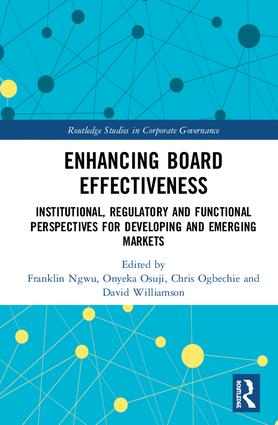
Edited book: F Ngwu, O Osuji, C Ogbechie and D Williamson (eds), Enhancing Board Effectiveness: Institutional, Regulatory and Functional Perspectives for Developing and Emerging Markets (Routledge 2019).

Enhancing Board Effectiveness seeks to examine the conceptualization and role of the board in a variety of contexts and articulate solutions for improving the effectiveness of the board, especially in developing and emerging markets. Enhancing Board Effectiveness therefore addresses the following central questions:

  1. To what extent is the concept and role of the board evolving?
  2. What rights, powers, responsibilities and other contemporary and historical experiences can enhance the effectiveness of the board, especially in the particular contexts of developing and emerging markets?
  3. What socio-economic, political, regulatory and institutional factors/actors influence the effectiveness of the board and how can the policies and practices of such actors exert such influences?
  4. In what ways can a reconstructed concept of the board serve as a tool for theoretical, analytical, regulatory and pragmatic assessment of its effectiveness?

In examining these issues, Enhancing Board Effectiveness investigates theoretical, socio-economic, historical, empirical, regulatory, comparative and inter-disciplinary approaches. Academics in the relevant fields of accounting, behavioural psychology/economics, development studies, financial regulation, law and management/organizational studies, political economy and, public administration will find this book of high interest.

Book chapter: O Osuji, ‘Club Theory and Performance Evaluation’ in F Ngwu, O Osuji, C Ogbechie and D Williamson (eds), Enhancing Board Effectiveness: Institutional, Regulatory and Functional Perspectives for Developing and Emerging Markets (Routledge 2019).

This chapter applies the club theoretic model to contextualise voluntary clubs in public interest regulation through corporate governance, particularly in the developing and emerging markets. Drawing on the political theory of corporation and the institutional perspective, the chapter proposes an enforced self-regulatory system for directors’ individual and collective performance evaluation that centres on voluntary clubs and is propped by facilitative public regulation. It argues that when voluntary clubs are properly and legally equipped to effectively perform corporate governance regulatory roles, directors, shareholders, market participants, stakeholders and society can all benefit.

While it frames corporate governance clubs within regulatory institutional frameworks, the chapter demonstrates the impact of voluntary rules, standards and procedures on individual director and board effectiveness and therefore aligns private governance with broader society expectations. It highlights internal, external and independent quantitative and qualitative methods for evaluating board performance and demonstrates how barriers to improvement can be identified and tackled and how positive factors for effectiveness can be recognised and improved on.

The proposals include research, training, education and other methods for continuous individual and collective development, operation of stringent voluntary clubs at industry and sub-sector levels, preventative, retributive and corrective enforcement measures, club membership as a prerequisite, performance-related certification, licensing and disqualification, and facilitative public regulation. 

Corporate Responsibility Publications

Book chapter: O Osuji, ‘Tackling Corruption through Corporate Social Responsibility’ in J Ellis (ed), Corruption, Social Sciences and the Law: Exploration Across the Disciplines (Routledge 2019)

This chapter examines how corporate social responsibility (CSR) can be used as an effective solution to official corruption, especially in developing countries. Despite wide-ranging legal interventions, official corruption persists as a significant public interest issue for various reasons. It is shown that the law’s limited scope and effectiveness has engendered alternative and complementary anti-corruption regulation opportunities within the scope of CSR. Ideally, CSR can help to identify gaps in substantive law and enforcement process and how to plug them. However, the anti-corruption impact of CSR seems modest to date.

The chapter proceeds to establish the theoretical linkages between CSR and anti-corruption principally through the political CSR, governance CSR and institutional theoretic models. It identifies effective self-regulation, accountability and responsible global leadership as the core principles of an anti-corruption CSR paradigm before outlining its components. It demonstrates how corporate conscience, whistleblowing and individual and collective responsibility can overcome informal signals and ends with a restatement of the challenges and opportunities in using CSR for anti-corruption promotion. Before concluding, the chapter outlines certain steps corporations can undertake to demonstrate anti-corruption CSR.

Conference paper: Dr. Osuji was invited to present at the Sixth Annual Conference of the Kuwait International Law School (May 2019) a paper entitled ‘Corporate Social Responsibility, Stakeholder Needs and Sustainable Development: Overcoming Contextual and Regulatory Challenges through the Values Paradigm’.

The emergence of sustainable development as a matter of global concern has been complemented by the recognition of the roles of different segments of society in promoting it. As the Sustainable Development Goals 2015 (SDGs) exemplify, corporations and other private stakeholders are increasingly regarded as active partners in the sustainable development agenda. The tools for advancing corporate and stakeholder involvement in sustainable development therefore includes corporate social responsibility (CSR), which was originally conceived as a voluntary management tool.

Four elements of CSR are arguably critical in relation to sustainable development. First, despite its traditional conception, one of the consequences of the growing global influence of CSR is that corporations, especially the large, high profile and consumer-facing ones, realistically do not have the option of ‘doing nothing’ with regards to socio-economic issues such as sustainable development. Second, the stakeholder framework of CSR implicitly acknowledges contextualism while sustainable development, as the SDGs show, also accept contextual priorities. Third, notwithstanding the universalist/internationalist theory, the concept of glocalisation recognises that local and global standards can co-exist in a mutually reinforcing manner. The fourth significant factor is the emergent recognition of CSR as a potential complementary regulatory tool by public and private authorities (Osuji, 2015; Osuji and Obibuaku, 2016). As exemplified by regulatory actions in some jurisdictions, the regulation of CSR enables its application to suit the sustainable development agenda of specific jurisdictional contexts. Overall, orthodox CSR practice seems to have followed a ‘stakeholder needs’ approach which can adapt CSR to promote sustainable development as a voluntary or regulated activity. 

Nonetheless, the following questions arise:

  1. Are there implications for using the stakeholder needs CSR model in promoting sustainable development in a specific jurisdictional context?
  2. Does contextualism allow a ‘values’ approach to CSR even when it is being used as a regulatory tool?
  3. To what extent can a ‘values’ CSR approach improve or complement the stakeholder needs model in addressing sustainable development in specific jurisdictional contexts?

Drawing on the institutional, including Scott (2001, 2008), and stakeholder theoretic models, this paper argues that a stakeholder needs CSR model may be inadequate for advancing sustainable development, especially in an emerging country context. The issues this raises include disguised motivations, insufficient clarity of goals, unintended assumption of legal responsibility and covert corruption. An alternative to the stakeholder needs model is the values approach which has sociological and institutional foundations.

The paper demonstrates that a values paradigm is feasible and may be an imperative aid for applying the stakeholder needs CSR model to sustainable development. The values paradigm can improve effectiveness of a regulated CSR as a sustainable development promotion and private regulation mechanism.  

Corporate Regulation Publication

Edited book: J Griffin, HK Chan, O Osuji and H Choo, 3D Printing: the development of a technical licensing framework with a focus on China (Routledge 2019).

The book is an output of the AHRC (Arts and Humanities Research Council) funded project, entitled ‘A Technological Licensing Framework for 3D Printed Content: A Focus on China’.

More specifically, it is a collection of materials, relating to empirical interviews, a work placement, workshops and publications that have been carried out in one of the world leading research projects into the legal impact of 3D printing. The project was funded by the AHRC and Newton Fund, and was largely carried out within China. It was designed to establish the perceived legal challenges faced by 3D printing companies, as well as a technical framework for an operational automated technical licensing system.

The main research questions addressed by this work are the following:

  1. How can an automated licensing platform framework enable 3D printing companies to licence 3D printed content and files in new ways? Examples would be online databases and/or the printing of 3D computer game characters.
  2. What is an effective technological solution to online licensing of 3D content?
  3. What is the impact of such a system upon copyright law, in particular copyright law in China and copyright law internationally?
  4. How will this pioneer the development of law that is digital in nature?

Workshop on ‘Brexit: Regulatory Challenges for Business Law’

10 May 2019 10.00am – 5.00pm University of Essex, Wivenhoe Park, Colchester, CO4 3SQ

The UK’s withdrawal from the EU will result in far-reaching, significant consequences for the regulatory spheres of both the UK and the remaining Member States. Even after the completion of the withdrawal process, EU laws will still impact businesses operating in the UK, both directly and indirectly. Fields which are most likely to be affected include product specifications, competition, employment, health and safety, banking and financial services, company law, insolvency, consumer protection and insurance. Despite this, there continues to be gaps in the research which has been carried out to explore the ultimate consequences of Brexit on the business regulatory environment.

This workshop, organised by the Commercial Law Cluster at the University of Essex, aimed to cover this research gap by exploring the opportunities and risks faced by UK business in this time of legislative change. In particular, this workshop focused on three key legal fields: (i) finance and banking law; (ii) corporate law; and (iii) maritime and insurance law.

The purpose of this workshop was to raise awareness and foster debate on the rules that will govern the UK after Brexit. The regulatory changes for each of these three economic sectors were discussed in separate panels. In each panel, invited speakers provided an overview of the opportunities and challenges faced by businesses. Invited discussants then complemented these presentations with views from both academia and legal practice.

The programme and speakers included:

Welcome: Professor Theodore Konstadinides (University of Essex)

Keynote Presentation: Professor Takis Tridimas (King’s College London; Matrix Chambers)

Session One: Finance and Banking

Financial Markets: Professor Stuart Weinstein (Aston University) and Dr Flora Huang (University of Essex)

Banking Supervision: Dr Menelaos Markakis (Erasmus University Rotterdam) and Dr Anastasia Karatzia (University of Essex)

Session Two: Corporate Law

Chair: Dr Eugenio Vaccari

Company Law: Professor Janet Dine (Queen Mary University of London) and Dr Marios Koutsias (University of Essex)

Insolvency Law: Hamish Anderson (Norton Rose Fulbright) and José Carles (Carles Cuesta Abogados y Asesores Financieros, Madrid)

Employment Law: Dr Jennifer Gant (University College Cork) and Dr Niall O’Connor (University of Essex)

Session Three: Maritime, Shipping and Insurance

Chair: Dr Lijie Song

Shipping: Zoumpoulia (Lia) Amaxilati (Queen Mary University of London) and Dr Durand Cupido (University of Essex)

Insurance: Dr Keren Wu (University of East Anglia) and Dr Anna Antoniou (University of Essex)

Closing Presentation: Professor Steve Peers (University of Essex)

Uber in London: the battle between public and private regulation

Dr Yseult Marique, Senior Lecturer in Law, University of Essex

Dr Yseult Marique and her co-author Enguerrand Marique have published a chapter, entitled ‘Uber in London: The battle between public and private regulation’, in the collection Uber & Taxis: Comparative Law Studies, which was edited by D Renders and R Noguellou (Bruylant 2018).

The expansion of Uber as a major transport provider over the last ten years transforms deeply what is expected from transportation policies in many capitals around the world. It also draws the attention on the digital economy and its social and economic consequences for drivers. Tensions arise about the best ways to tackle the externalities arising from the digital economy: should Uber be banned all together as it has been the case in Spain and France? Should it be more strictly regulated as in California? Or should the market be left to bring competition and self-regulation of some kinds? To try to better understand the strategies followed across the world, the book Uber & Taxis: Comparative Law Studies brings contributions pertaining to 22 countries together, looking in a systematic way into two specific areas: first, how were taxis regulated before the advent of Uber and similar digital platforms? Secondly, how has regulation changed since Uber appeared and how does it address the specific social, economic and environmental challenges posed by Uber?

Our book chapter tries to answer these questions in the specific case of London. London is especially emblematic for its taxis and black cabs. It has also undergone a dramatic expansion of private hire (‘PH’) (such as Uber) in a very short time: in 2011, there were only 77,000 taxis and PH drivers throughout England. In 2017, the taxi and PH market in London represented ca. 150,000 drivers, i.e. nearly 40 % of the overall 356,000 licenced drivers on the English market. Very few aspects of this market are regulated. The quality of taxi drivers, the standards of vehicles and fares are subject to regulation mainly. However, the number of taxis is not limited, and taxis have no monopoly: besides taxis, PH has been operating since the 1960s and regulated since 1998. Therefore, the market is left largely unregulated regarding its outcomes themselves.

Such an expansion brings specific challenges for London in terms of the number of drivers to control and how to ensure that this control could be maintained at an appropriate level. It also means that many Uber drivers were not professional as black cab drivers had previously been, making the need arise for a range of driving practices to be policed (e.g. taxi ranks and priority lanes). Yet, London manages to address these challenges without new powers being delegated to it or without having to invent new regulatory tools. In short, the regulatory toolbox is at first sight satisfying. Let us unpack this claim before reflecting on it.

Transport for London’s (TfL) toolkit includes licensing, which has two main noticeable features: a) a fit for purpose test for drivers and b) a licensing fee. These two features have been tweaked in the case of Uber. Firstly, the fit for purpose test is no longer applied by Transport for London itself in the PH system (such as Uber). It has been transferred to Uber which now bears the risks of poor assessment of drivers’ qualities (i.e. withdrawal of the license). Secondly, the licensing fee became more differentiated. In the case of Uber, it has been multiplied by 1000 (Yes!) and stands now at £ 2,900,000 payable over 5 years. Other aspects such as a technical test, an English test, waiting times, tariffs and taxi meters, and hotlines have all been subjects to discussions and tensions. For instance, establishing a hotline for non-urgent matters is a significant burden for Uber, while not proving efficient. Similarly, the use of a taximeter, and of smartphone computing time and distance into a price, has been challenged, but ultimately accepted by the courts. Small differences remain to distinguish taxis from PH. For instance, upon a reference for a preliminary ruling to the European Court of Justice by English courts, the court recognized that ‘instant hailing’ was distinct from ‘hailing’. Waiting time and waiting areas cannot end up decreasing public safety. Yet, regulatory principles basically have not been changed after the advent of Uber in London.  

The regulation of Uber in London triggers three comments. First, the main problem brought by Uber is not the availability of regulatory tools to address Uber’s innovative features, but the need for TfL to adapt its enforcement strategy. In looking for ways to ensure compliance in a changed environment, more inspectors are needed, which is costly for TfL, yet extremely important to ensure clients’ security all over the city. Here, TfL made Uber bear in the first place the extra costs that it generated for TfL. Secondly, the London Mayor is not satisfied with the current solution and he has asked the national level to get broader powers to regulate private hire (and to impose a maximum number of licence). Thirdly, Uber is only one part of the transport policy in London. The overall policy objective in London is to ensure more sustainable transport, which means that too many cars – Uber car or otherwise – are not welcome in London. A range of measures are thus taken to seek to limit their use in general. At the same time, a broad range of transport means is welcome as it makes mobility more flexible. In short, London can see Uber both as a blessing and a curse – what matters is not to ban it, only to keep it within reasonable measure. This leads TfL to seek to tweak Uber’s licence to adapt it to the ongoing changes in the ways in which mobility platforms work. Here a striking development is the fact that Uber is now operating in London under a short-term licence that is regularly renewed subject to modifications. Such practice of short-termism compels economic actors to behave on their best at all time, mindful to take social interest to hart rather than thinking about price cuts in the long term. A creative way to keep Uber under TfL’s control without making any drastic innovative changes to the regulatory tools?

Social Justice in EU Financial Consumer Law

Dr Andrea Fejős, Lecturer in Law, University of Essex

Dr Fejős’ recent paper for Tilburg Law Review considers how social justice influences EU financial consumer law. It provides a new way of looking at social justice in consumer law by showing that equality of status based social justice has increasingly come to the fore in modern EU financial consumer law.

This emergent and complex set of private and regulatory rules on credit, insurance, investment and payment products has responded to the consequences of inequality between financial firms and consumers by engaging in product and rights regulation that balances the parties’ rights and duties and protects consumers from the consequences of status-based inequality. Looking forward the paper recommends that this social justice approach must be made transparent and become an express part of EU law and policy, both in order to raise consumer trust in the internal market and to more clearly set the future law and policy agenda.

Photo credit: Fortegra Blog

Constitutional Pluralism in Ireland, the EU and the ECHR

A newly published book, The Triangular Constitution: Constitutional Pluralism in Ireland, the EU and the ECHR, by Tom Flynn, lecturer in law at the University of Essex, offers a fresh account of modern European constitutionalism. It uses the Irish constitutional order to demonstrate that, right across the European Union, the national constitution can no longer be understood on its own, in isolation from the EU legal order or from the European Convention on Human Rights.

The constitution is instead triangular, with these three legal orders forming the points of a triangle, and the relationship and interactions between them forming the triangle’s sides. It takes as its starting point the theory of constitutional pluralism, which suggests that overlapping constitutional orders are not necessarily arranged ‘on top of’ each other, but that they may be arranged heterarchically or flatly, without a hierarchy of superior and subordinate constitutions.

However, it departs from conventional accounts of this theory by emphasising that we must still pay close attention to jurisdictional specificity in order to understand the norms that regulate pluralist constitutions. It shows, through application of the theory to case studies, that any attempt to extract universal principles from the jurisdictionally contingent interactions between specific legal orders is fraught with difficulty. The book is an important contribution to constitutional theory in general, and constitutional pluralism in particular, and will be of great interest to scholars in the field.

Executory Contracts in Insolvency Law

Dr Eugenio Vaccari, lecturer at the University of Essex, School of Law, has recently co-edited a book with Professor Jason Chuah, Head of Department at the City Law School at City, University of London. The book, Executory Contracts in Insolvency Law: A Global Guide is published by Edward Elgar.

Executory Contracts in Insolvency Law is the result of a research project that lasted for more than 2 years. The purpose of this project was to cover a gap on the treatment of executory contracts in insolvency in academic and professional literature.

On the academic side, few papers have so far investigated the principles that should govern the treatment of executory contracts in insolvency. Why and to what extent should insolvent companies be allowed to terminate or continue their contracts upon filing for a formal insolvency proceeding? Should the procedure, the purpose of the procedure or simply the nature of the business determine the outcome of the contract?

On the professional side, Executory Contracts in Insolvency Law aims at providing a comprehensive yet easily accessible guide on the treatment of these contracts in a larger number of jurisdictions than any other study conducted in the field to date. In an increasingly globalised world, practitioners may find that termination clauses in commercial contracts are governed by one law, while the main contract is subject to either English or New York law. A comprehensive outline of the main features of these laws is essential to provide timely and informed advice to the parties.

Executory Contracts in Insolvency Law offers a unique, comprehensive, and up-to-date transnational study of the topic, including an analysis of certain countries which have never previously been undertaken in English. Written by experts in the field, with extensive practical and theoretical knowledge of both research and professional experience, this is a ground-breaking investigation into the philosophies and rationales behind the different policy choices adopted and implemented by a range of over 30 jurisdictions across the globe.

With contributions from more than 40 insolvency law experts, this book provides extensive coverage of executory contracts, encompassing both developed and developing countries, and drawing on not only so-called common and civil law systems, but also, countries with hybrid systems of law. The book explores ipso facto clauses, improvements that could be made, as well as casting light upon procedural and tactical issues and considerations when attempting to address executory contracts in different jurisdictions.

Providing a globalised and comparative perspective on executory contracts in insolvency law, this book will be an invaluable tool for legal practitioners requiring a cross border perspective on the subject, as well as for academics and researchers pursuing a study of the topic. It will also benefit policy makers and institutions seeking to introduce insolvency law reforms in their home countries.

High Court awards damages for libellous child grooming tweet


Alexandros K. Antoniou, Lecturer in Media Law, University of Essex*

On 19 December 2018, Mr. Justice Nicklin handed down the judgment in Monir v Wood, ordering the defendant, the chairman of a local branch of a political party, to pay GBP 40 000 in damages for a defamatory message sent by a branch member through the branch’s Twitter account. The judgment highlights the potential liability of those who set up social media accounts and then delegate responsibility to others to post on their behalf.

The claimant in this action was Zahir Monir, a businessman and Labour activist from Rotherham. He brought libel proceedings against Stephen Wood, the former chairman of the Bristol branch of the UK Independence Party (UKIP), over a tweet published on the branch’s Twitter account on 4 May 2015, shortly before that year’s General Election. Although it did not directly identify the claimant, the tweet comprised a photograph of him alongside the Labour MP for Rotherham, Sarah Champion, and another man. The text of the tweet, which evidently referred to the photograph, stated that the Labour candidate “stood with 2 suspended child grooming taxi drivers. DO NOT VOTE LABOUR.” The allegation against the claimant was false. Mr. Monir sued the chairman of the branch, Stephen Wood, contending that he had been defamed by the tweet and that Mr. Wood was legally responsible for it. However, the tweet had actually been written and posted by the vice chairman of the UKIP Bristol branch, John Langley, to whom responsibility for the operation and control of the account had been delegated by Mr. Wood.

On the facts, the Court found that “ultimate control” of the Twitter account remained vested in Mr. Wood “at all times”, as it was registered using his email address. The claimant complained to the defendant about the tweet on 8 May, but the defendant had not focused on the offending tweet’s precise terms until after the police intervened on 1 June. The defendant had also become aware of earlier racist postings by the vice chair, but nevertheless decided not to remove him from the account for reasons “clearly born of political expediency” given the forthcoming election.

As regards the issue of meaning, Nicklin J. took the view that the ordinary reasonable reader would understand the offending tweet to mean that “the two men were involved in the sexual abuse of children.” This was a “very seriously defamatory allegation” of conduct amounting to a serious criminal offence that would result in a substantial term of imprisonment following conviction. As such, the tweet was also deemed to have met the “serious harm” threshold under the Defamation Act 2013. Moreover, the judge was satisfied that Mr. Monir successfully established that the tweet at issue had been published to a number of people who understood the words in it to refer to him. Also, the republication of the tweet via WhatsApp was likely to have led to “a significant, but unquantifiable number of people” identifying the claimant from the photograph.

The defendant, who had not posted the tweet on the Bristol UKIP Twitter account himself, denied responsibility for its publication. After reviewing the relevant authorities, Nicklin J. concluded, however, that the defendant was liable for the tweet on the basis of agency: Mr. Wood had created the Bristol UKIP account and retained control over it both practically and by means of his authority as chairman of the Bristol branch. The libellous tweet was posted by Mr. Langley, not on his own account, but in his capacity as campaign manager in the course of executing the task delegated to him by the defendant, i.e. campaigning for Mr. Wood and Bristol UKIP. In Nicklin J.’s judgment, the evidence of Mr. Wood’s knowledge of the tweet in question was also sufficient to infer that “he acquiesced in and thereby authorised its continued publication.”

On the issue of remedies, Nicklin J. concluded that the gravity of the defamatory allegation put it “towards the top end of seriousness” for calculating damages. Although the scale of the publication was fairly limited, the Court assessed the significance of the publishees as well as the extent to which publication to them had tarnished the claimant’s reputation and increased his hurt and embarrassment. Further, the evidence of serious and significant reputational harm was compounded by the defendant’s “mean-spirited stance” and refusal to publicly apologise and withdraw the allegation. Nicklin J. found that the appropriate award was GBP 40 000. If this libel had been published in a national newspaper, a figure of GBP 250 000 or more would have been “easily justified.” Finally, there was no evidence of the defendant threatening to republish the offending tweet or anything similar and thus an injunction was unnecessary in the circumstances.

*Reblogged from IRIS Merlin blog

Behind the frosty glass: the EU’s Unfair Contract Terms Directive as a tool for justice in the modern financial sector


Dr Andrea Fejos, Lecturer in Law, University of Essex. Dr Fejos researches and teaches in the areas of consumer contract law and financial services law. She has published on a range of topics including on standard form contracts, unfair contract terms, consumer credit, consumer alternative dispute resolution and enforcement of consumer rights.


The 1993/13/EC Unfair Contract Terms Directive (hereinafter: the Directive) is among the oldest European consumer protection instruments, and recently became a catalyst for major legal reforms with social impact, improving the lives of millions of consumers.

The financial crisis hit many consumers hard, in particular making their mortgage loans more expensive than anticipated. Loan instalments could eat up most of the consumers’ income, posing a serious risk of poverty and homelessness. Since the contract terms regulate much of the relationship between consumers and financial firms, the detriment could often be traced back to one or more unfair contract terms. When consumers asked their national courts to remove these from their contracts, the national courts sought help from the EU’s Court of Justice (hereinafter: the Court) in interpreting their unfair contract terms provisions that are based on the Directive. In doing so, national courts came to ‘unexplored territory’.

In over a decade prior to the financial crisis there had been few chances for the Court to interpret the Directive. The Court was mostly asked to clarify the scope of the Directive’s Article 6, on the consequences of unfair terms. In doing so, it provided a valuable contribution to a high level of consumer protection e.g. obliging national courts to decide on the unfairness of a contract term also on their own motion, without an explicit request of the claimant and without establishing a time limit for asking national courts to rule on unfairness.

Unfortunately, despite the fact that the judgements of the Court are binding, many of these decisions and instructions by the Court were not respected in practice, meaning that these achievements had a limited real effect on consumer welfare.

A sleeping giant

In addition, some important aspects, such as the meaning of “transparency” of consumer contracts under Article 5 and 4(2) of the Directive, which affects the drafting and interpretation of contract terms, did not get sufficient attention. The Court also refrained from taking advantage of the presented opportunities in interpreting the general concepts of “good faith” and “significant imbalance” in the Directive’s test of fairness in Article 3(1). Apart from the first case when the Court declared a jurisdiction term unfair, the Court repeatedly reiterated its inability to rule on the fairness of particular contract terms, stressing that its powers were limited to providing general guidance on the concept of fairness, leaving the application of these general rules to the facts of the case to the national courts. In giving general guidance, the Court generally did no more than to repeat the text of the Directive. For more than a decade, the protective effect of this essential piece of EU consumer protection law depended on national courts’ interpretations, without a tangible overall effect on European consumer welfare.

This was changed by the financial crisis and its aftermath, which resulted in a virtual torrent of cases. The increased case-load pushed the Court to be more interventionist, and the effect of these judgments went way beyond individual cases.

A paradigm shift  

In 2013, the Court delivered its judgment in a landmark case known under the name of the consumer claimant “Aziz”. In this case the court considered the controversial Spanish mortgage enforcement procedure and ruled the national court’s inability to pause the mortgage enforcement procedure while the court rules on the fairness of a contract term is incompatible with European Union law. Importantly, the Court also gave general guidance on the understanding of the two limbs of the test of fairness in Article 3(1) of the Directive and for the very first time gave guidance in applying those general principles to specific contract terms: to payment acceleration terms (terms that allowed creditors to call in the entire debt upon default) and terms that fixed the interest payable upon default.

This judgment resulted in a major law reform in Spain. Incorporating the Aziz ruling, Law 1/2013 introduced important rules on making these loans cheaper and safer to use by capping the default interest and limiting the applicability of payment acceleration clauses (amending the Spanish Mortgage Act). It also strengthened the position of debtors in mortgage enforcement proceedings (amending the Civil Procedure Code).

The Court delivered another landmark decision in 2016 on Spanish “floor clauses”, clauses that capped the minimum interest rate to ensure the banks do not suffer loss in case of negative interest rates. Although the Spanish Supreme Court had already established the unfairness of these clauses, it had limited the effect of its judgment to the future. When the cases were referred to the European Court of Justice, the Court found this approach incompatible with the Directive. It ruled that unfair terms must be regarded as never having existed, and thus the position of consumers must be accordingly restored. The judgment was followed by the adoption of another new Spanish Law 1/2017 based on which consumers that suffered losses must have been repaid affecting 2.5 million mortgage holders.

Finally, the case of Kásler involved a mortgage loan indexed in foreign currency, a type of a loan common to many Member States causing particularly significant detriment in Hungary where these loans amounted to 90 percent of the mortgage portfolio. In Kásler, the Court delivered a valuable interpretation of Article 4(2) of the Directive, establishing that contract terms transferring the exchange rate risk onto consumers (where the banks more expensive selling rate of exchange was applied to calculate loan instalments) can only be exempted from the test of fairness (as an excluded “price” term) if they provide for an essential obligation under the contract and if they are understandable to the extent that consumers are able to estimate the economic consequences of the terms. This judgment ultimately resulted in the adoption of the Hungarian Act XXXVIII of 2014 that declared contract terms transferring the exchange rate risk onto consumers null and void, retroactively replacing these with the official exchange rate of the Hungarian National Bank. In addition, based on Act XL of 2014 banks were ordered to compensate individually every consumer for the loss that they have suffered.

The financial crisis and the surge of cases raised interesting (and perhaps for many controversial) questions on the relationship of courts and the legislator, however, in practice, these judgments delivered significant social justice for consumers. This recent case-law transformed the EU directive on unfair contract terms from being a “toothless tiger” to a potentially very powerful instrument, producing social justice effects that were probably not anticipated and that somewhat remained hidden as when one stands behind frosty glass.

Photo credit: Nerdwallet.com

* Reblogged from the BEUC blog