The expertise and leading-edge research of three Essex academics has informed a landmark judgment on police use of facial recognition.
On Tuesday 11 August, the Court of Appeal delivered its judgment in a case brought by civil liberties campaigner Ed Bridges and the campaigning organisation Liberty, challenging a previous decision in favour of South Wales Police.
Mr Bridges, who lives in Cardiff, argued that it was possible South Wales Police had captured an image of his face on two occasions, as a result of facial recognition technology being deployed.
He brought a claim for judicial review, arguing that South Wales Police’s approach to deployment was incompatible with the right to respect for private life under Article 8 of the European Convention on Human Rights, data protection legislation, and the Public Sector Equality Duty under section 149 of the Equality Act 2010.
In addition, an annex, detailing Professor Fussey and Dr Murray’s findings in relation to the Metropolitan Police Service, was attached to the Surveillance Camera Commissioner’s submission.
The Court of Appeal upheld the Bridges appeal on four of its five grounds.
Commenting on the judgment, Professor Pete Fussey said: “The Court’s findings in relation to the use of live facial recognition technology by South Wales Police are consistent with our findings regarding the Metropolitan Police Service, in particular that such deployments are not ‘in accordance with the law’, and that too much discretion is given to police in determining who should be placed on a watchlist. The Court of Appeal was entirely correct in concluding that facial recognition cannot be considered as equivalent to the use of CCTV. The use of advanced surveillance technologies like live facial recognition demands proper consideration and full parliamentary scrutiny.”
Dr Daragh Murray said: “The use of advanced surveillance technologies, like live facial recognition, represent a step change in police capability, with potentially significant consequences for the functioning of our democracy, in terms of how individuals develop and interact and how challenges to, or protests against, government policy evolve. The Court of Appeal’s findings today regarding South Wales Police are consistent with many of our own conclusions regarding the Metropolitan Police Service. This is an important decision, particularly the conclusion that deployments were not ‘in accordance with the law’. However, many issues remain to be addressed, including the broader societal impact of facial recognition. What is abundantly clear is that all police forces should pay greater attention to human rights law considerations before deciding to deploy new surveillance technologies.”
Professor Lorna Woods said: “The judgment in ruling that the police use of Automated Facial Recognition as it stands is unlawful is welcome, but it also highlights the problems arising from a system where new surveillance technologies can be deployed based on very general common law powers without adequate safeguards. New legislation on this topic is required, to address not only the proposed use of facial recognition technology, but police use of Artificial Intelligence generally.”
Professor Lorna Woods is Professor of Internet Law. She has extensive experience in the field of media policy and communications regulation, including social media and the Internet and developed, with Will Perrin, a social media duty of care, which has had significant influence on the direction on the UK Online Harms debate. Professor Woods is an established member of a broader network of advisors who support the Surveillance Camera Commissioner in his role.
Professor Pete Fussey and Dr Daragh Murray are co-authors of the independent report into the London Metropolitan Police Service’s trial of live facial recognition technology, published by the ERSC Human Rights, Big Data and Technology Project in July 2019. It remains the only fully independently-funded report into police use of live facial recognition technology in the UK.
South Wales Police said it would not be appealing the Court of Appeal judgment.
This story originally appeared on the University of Essex website and is reproduced on our blog with permission and thanks.
Her paper examined the distinction between legally enforceable status of the Coronavirus Act 2020 and the persuasive status of various Government guidance on the coronavirus on social relationships and communications. Her paper placed a particular focus on social distancing, social gatherings and the use of face masks.
Just to provide an overview, the Coronavirus Act 2020 was created via emergency powers and was fast-tracked into existence in just four days. As a consequence, this statute lacked the usual prolonged scrutiny which legislation receives from the Houses of Parliament. The urgency to create new law was to address the high numbers of people becoming seriously ill or dying due to contracting the coronavirus. The Conservative Government was under pressure to impose practical measures via law to reduce the spread of the virus, which had swept across the world, and to provide special protection for vulnerable members of society including the elderly and disabled.
Dr. Davey’s paper sought to address the legitimacy of ministerial coronavirus guidance which has been created through powers under the Coronavirus Act.
It placed a focus on social distancing, social gatherings and the use of face masks. In doing so, her paper explored the legitimacy of the coronavirus guidance and its application by public bodies, with reference to three of the Nolan principles on integrity, accountability and openness, which guide the conduct of public officials such as ministers.
The discussion considered how social and familial relationships are being increasingly regulated, including by criminal law, due to the guidance created by the Executive and applied by public bodies such as the police. A particular cause for concern is the extent to which members of the public and public bodies (such as police and councils) can fully appreciate the distinction between guidance, which is not usually legally enforceable, and legislation, which is legally enforceable.
Partners/organisations:Dejusticia, a Colombian Think-Do-Tank
What is your research about?
Colombia and the FARC (Revolutionary Armed Forces of Colombia—People’s Army; Spanish: Fuerzas Armadas Revolucionarias de Colombia) signed a comprehensive peace agreement in 2016 which devises a transitional justice system to respond to the atrocities suffered by more than 9 million victims over various decades of armed conflict. The focus of our research is the transitional justice system (mechanisms and processes) which was designed by the peace agreement. In particular, our research focuses on one of the key transitional justice mechanisms: the Special Jurisdiction for Peace (SJP), which was created to ensure accountability for the atrocities, especially on how its work can be supported and strengthened to fulfil victims’ right to justice, reparation, and truth.
What activities did your GCRF@Essex funding support?
Our GCRF@Essex funding supported trips to Colombia to build and strengthen networks and contacts, hold events such as meetings with colleagues at the Special Jurisdiction for Peace about the challenges they are facing. We also organised meetings to receive feedback from relevant stakeholders on our research, and on future research that would be of relevance for Colombian transitional justice actors.
We also hired Colombian researchers to write policy papers and other documents, for example, a guide on how the Colombian Special Jurisdiction should deal with economic actors and how to define legal concepts that are of crucial importance for the work of the Special Jurisdiction for Peace. We launched these publications at events in Bogota.
We also obtained GCRF@Essex funded fellowships for several Colombian colleagues to attend the Human Rights Centre Research Methods summer school at Essex or to spend some research time at Essex to develop further research projects. For example, a key GCRF@Essex funded activity was to carry out joint research with Dejusticia, a Colombia-based research and advocacy organisation dedicated to the strengthening of the rule of law and the promotion of social justice and human rights in Colombia and the Global South. We successfully applied with Dejusticia colleagues to an AHRC GCRF urgency funding call and are currently working with Dejusticia and the Bonavero Institute for Human Rights at the University of Oxford on the AHRC funded project: Legitimacy, accountability, victims’ participation and reparation in transitional justice settings – lessons from and for Colombia. GCRF@Essex funds have supported our work on various legal and other issues that have emerged from this AHRC grant. For example, work on potential alternative sanctions for those responsible for mass atrocities who confess their crimes before the Special Jurisdiction for Peace.
You have been looking at the Special Jurisdiction for Peace (SJP) in Colombia, how is your project benefitting the country and which Sustainable Development Goals (SDGs) are being addressed?
Our project benefits the country by strengthening the work of the Colombian Special Jurisdiction for Peace (SJP), which plays a central role for ending impunity, achieving accountability for conflict related crimes and justice for victims. Through assisting the SJP we ultimately support the goals of consolidating peace and promoting reconciliation. The SJP is working under enormously challenging circumstances, as Colombia is a highly polarised country and the implementation of the peace agreement, and the legitimacy of the SJP, are highly contested. In that context, it is of crucial importance to support the SJP’s work. The legal framework within which this jurisdiction is working is new not only in Colombia but also worldwide. Colombia’s transitional justice approach is highly innovative and ambitious and that translates into big challenges that need to be overcome on a daily basis. The daily work of the SJP raises many conceptual challenges that are relevant for advancing SDGs 16 (Promoting Peace, Justice and Strong Institutions), 10 (Reducing Inequalities), and 5 (promoting gender equality). Our research contributes to Colombia’s achieving these goals by providing urgently needed recommendations to the SJP, particularly on key legal concepts such as the criteria for the selection of cases, victim participation and reparation. All of this strengthens the work of the SJP.
What tips would you give to other people applying for projects funded by the Global Challenge Research Fund?
The main advice would be to invest a lot of time and effort in building in-country academic and non-academic networks and devise projects with partners and stakeholders in the relevant countries to maximise the impact of the research.
Your GCRF activities have involved various colleagues from Colombia, especially Dejusticia and the SJP, how did you find your collaborators?
Initially, we built the connection with Dejusticia more than a decade ago, in the context of a project focused on linking corporate accountability and transitional justice, funded by a British Academy UK Latin America links grant. To that event, we invited a colleague from Dejusticia to a seminar at Essex who then contributed to an edited collection that followed from that project. We sustained and broadened our links with Dejusticia through regular visits to Colombia where we would hold meetings with them and gradually started to design and carry out joint projects.
Collaboration with the Special Jurisdiction for Peace partly came about through professional contacts who work at the SJP, but also through regular meetings jointly organised with Dejusticia where we would provide a space to exchange experiences and be kept updated with the main challenges the SJP is facing. This information feeds back into our work and makes it relevant to the work of the SJP which in turn helps to broaden our networks in Colombia.
What were the main challenges you encountered working on these collaborative projects?
Obtaining the necessary funding to keep the projects going and finding the time for our involvement.
How do your GCRF funded projects support your wider research plans?
Our research plans have greatly benefited from GCRF funding, as our research is impact focused and the GCRF funded projects permitted us to focus on our areas of interest while at the same time devising impact work which we consider of significant importance in the area of transitional justice. Importantly, GCRF funding has permitted us to tackle relevant issues that have come to our attention in the middle of other research, and to respond to them effectively by having access to the necessary human and other resources to carry out quality and timely research.
The article is one of the few attempts to explore the meaning of exploitation in international law and the first to try articulating its legal parameters in the context of the human rights prohibition of ‘modern slavery’. This is a pressing task because of the proliferation of legislation, policy instruments, and academic work on ‘modern slavery’ and human trafficking, which rely heavily on the concept but do not define it.
By articulating the necessary and sufficient conditions for the notion of exploitation, the present study contributes to a better understanding, interpretation, and application of the prohibition of slavery, servitude, forced or compulsory labour, and human trafficking.
The article considers the UK implementation of the Fifth Money Laundering Directive. It examines the key changes introduced by the new Directive and their impact on the UK anti-money laundering regime.
Given the evolving nature of threats relating to money laundering and the latest technological developments, this article argues that the UK has decided to go beyond the EU minimum requirements.
The paper outlines the concept of money laundering and the UK legal framework of anti-money laundering, before assessing the main changes and their effects on the UK anti-money laundering regime.
The article was published on European Company Law (Volume 17, Issue 4, pp. 123-132), and can be access here.
The Court of Justice today handed down the much anticipated ruling on the legality of standard contractual clauses (SCCs) as a mechanism to transfer personal data outside the European Union. It forms part of Schrems’ campaign to challenge the ‘surveillance capitalism’ model on which many online businesses operate: there are other challenges to the behavioural advertising model ongoing. While this case is clearly significant for SCCs and Facebook’s operations, there is a larger picture that involves the Court’s stance against mass (or undifferentiated) surveillance. This formed part of the background to Schrems I (Case C-362/14, discussed here), but has also been relevant in European jurisprudence on the retention of communications data. This then brings us to a third reason why this judgment may be significant. The UK, like the US, has a system for mass surveillance and once we come to the end of the year data controllers in the EU will need to think of the mechanisms to allow personal data to flow to the UK. The approach of the Court to mass surveillance in Schrems II is therefore an indicator of the approach to a similar question in relation to the UK in 2021.
Background
The General Data Protection Regulation provides that transfer of personal data may only take place on one of the bases set out in the GDPR. The destination state may, for example, have an ‘adequacy decision’ that means that the state in question ensures an adequate (roughly equivalent) level of protection to the ensured by the GDPR (Article 45 GDPR). The original adequacy agreement in relation to the United States (safe harbour) was struck down in Schrems I because it failed to ensure that there was adequate protection on a number of grounds, some of which related to the safe harbour system itself, but some of which related to the law in the US, specifically that which allowed mass surveillance. While the safe harbour was replaced by the Privacy Shield under Decision 2016/1250 on the Privacy Shield (Privacy Shield Decision) which improved some of the weaknesses as regards the operation of the mechanism itself, including the introduction of an ombusdman system, little if anything has changed in relation to surveillance.
Another mechanism for transfer of personal data outside the EU is that of SCCs, which are private agreements between the transferor (data controller) and transferee. Article 46(1) GDPR states that where there is no adequacy decision “a controller or processor may transfer personal data to a third country or an international organisation only if the controller or processor has provided appropriate safeguards, and on condition that enforceable data subject rights and effective legal remedies for data subjects are available”. Article 46(2) GDPR lists possible mechanisms including standard data protection clauses. The Commission has produced a model form of these agreements in Commission Decision 2010/87 (SCC Decision).
Following the outcome of Schrems I, Schrems reformulated his complaint to the Irish Data Protection Commissioner (DPC) about data transfers arguing that the United States does not provide adequate protection as United States law requires Facebook Inc. to make the personal data transferred to it available to certain United States authorities, such as the National Security Agency (NSA) and the Federal Bureau of Investigation (FBI) and the data is used in a manner incompatible with the right to private life, and that therefore future transfers by Facebook should be suspended. These transfers are currently carried out on the basis of SCCs as approved by the SCC Decision. The DPC took the view that this complaint called into question the validity of that decision as well as the Privacy Shield Decision, which moved the issue back into the courts. The Irish High Court referred the question to the Court of Justice and it is the outcome in this ruling that we see today.
The Judgment
The Advocate General in his Opinion (discussed here) suggested to the Court that the SCC Decision was valid; the problem was the context in which it operated. He took the view that the Privacy Shield’s validity should be considered separately. Crucially, he held that data controllers need to determine the adequacy of protection in the destination state. This in practice is difficult; while a data controller might have some control over what the recipient does with the data (how processed, data security etc), it would have little control over the general legal environment. In any event, data controllers would be required to make specific country assessments on this, which could be challenged by dissatisfied data subjects. The Court took a slightly different approach. It agreed with its Advocate General that the SCC Decision was valid, but it struck down the Privacy Shield.
The Court made a number of findings. The first relates to the scope of inquiry and to competence. Given that national security lies outside the GDPR (and outside EU competence), should questions about the processing of data for purposes of public security, defence and State security be outside the scope of the GDPR rules. Following its position in Schrems I, the Court (like its Advocate General) rejected this argument [para 83, 86, 88]: the transfers of personal data by an economic operators for commercial purposes, even if that personal data is then processed by the authorities of the destination state for national security reasons, remains within the GDPR framework. Exclusions from the regime should be interpreted narrowly (citing Jehovan todistajat (Case C-25/17), discussed here).
In determining the level of protection the GDPR requires, the Court re-iterated its stance from Schrems I and following the reasoning of its Advocate General in this case held that we are looking for a level of protection “essentially equivalent” to that in the EU- and bearing in mind that the GDPR is understood in the light of the EU Charter. So not only must the terms of the SCCs themselves be taken into account but also the general legal environment in the destination State. The Court summarised:
…. the assessment of the level of protection afforded in the context of such a transfer must, in particular, take into consideration both the contractual clauses agreed between the controller or processor established in the European Union and the recipient of the transfer established in the third country concerned and, as regards any access by the public authorities of that third country to the personal data transferred, the relevant aspects of the legal system of that third country, in particular those set out, in a non-exhaustive manner, in Article 45(2) of [the GDPR].
[Para 105]
The Court noted that the national supervisory authorities are responsible for monitoring compliance with EU rules, and may check compliance with the requirements of the GDPR (following on from the position under the DPD established in Schrems I), and the national regulatory authorities have significant investigative powers. Where the SCCs are not complied with – or cannot be complied with – the national regulatory authorities must suspend or prohibit transfers and the Commission’s competence to draft SCCs does not restrict the powers of national authorities to review compliance in any way. In this the Court’s approach is broadly similar to that of the Advocate General. As regards an adequacy decision, a valid adequacy decision is binding, until such time as it may be declared invalid; this does not stop individuals from being able to complain.
Applying the principles to the SCC Decision, the Court noted that the standards bind only the parties to the agreement. Consequently, although there are situations in which, depending on the law and practices in force in the third country concerned, the recipient of such a transfer is in a position to guarantee the necessary protection of the data solely on the basis of standard data protection clauses, there are others in which the content of those standard clauses might not constitute a sufficient means of ensuring, in practice, the effective protection of personal data transferred to the third country concerned [para 126].
Does this possibility mean that the SCC Decision is necessarily invalid? The Court held not. Unlike an adequacy agreement which necessarily relates to a particular place, the SCC decision does not. The SCCs therefore may require supplementing to deal with issues in individual cases. Moreover, the SCC Decision includes effective mechanisms that make it possible to ensure compliance with EU standards [para 137]. Specifically, the SCC Decision imposes an obligation on a data exporter and the recipient of the data to verify, prior to any transfer, whether that level of protection is respected in the third country concerned. The recipient of the data must inform the data controller of any inability to comply with the SCCs, at which point the data controller is obliged to suspend transfers and/or terminate the contract. The SCC Decision is therefore valid; the implications of this in practice for this case were not drawn out. The Court in the end held that:
… unless there is a valid European Commission adequacy decision, the competent supervisory authority is required to suspend or prohibit a transfer of data to a third country pursuant to standard data protection clauses adopted by the Commission, if, in the view of that supervisory authority and in the light of all the circumstances of that transfer, those clauses are not or cannot be complied with in that third country and the protection of the data transferred that is required by EU law, in particular by Articles 45 and 46 of that regulation and by the Charter of Fundamental Rights, cannot be ensured by other means, where the controller or a processor has not itself suspended or put an end to the transfer [operative ground 3].
The existence of an adequacy decision is then key. Turning to the Privacy Shield Decision, the Court set the same analytical framework, emphasising the GDPR is understood in the light of the Charter and the rights to private life, to data protection and to an effective remedy. In assessing the decision, the Court noted that it awards primacy to the requirements of US national security, public interest and law enforcement, which the Court interpreted as condoning interference with the fundamental rights of persons whose data are transferred. In the view of the Court, access and use of personal data by US authorities are not limited in a way that is essentially equivalent to EU law – the surveillance programmes are not limited to what is strictly necessary and are disproportionate. Further, data subjects are not granted rights to take action before the courts against US authorities. The Ombudsperson mechanism, introduced by the Privacy Shield Decision as an improvement on the position under safe harbour, is insufficient. The Court therefore declared the Privacy Shield invalid.
Comment
The most obvious consequence of this ruling is that of how data transfers to the US can continue? The Privacy Shield is no more, and its demise has consequences for the operations of SCCs in practice. Given the weaknesses in the general legal system from the perspective of the Court of Justice, weaknesses over which the data controller/exporter can have little control, how can the requirements to individually assess adequacy be satisfied? Are there, however, any other mechanism on which data transfers could be carried out?
In this context, we should note how the Court has interpreted the provisions of Chapter V to create a common baseline for standards, despite differences in wording between Arts 45 and 46 GDPR. Article 45 deals with adequacy decisions and it requires that there is “an adequate level of protection”; Article 45(2) then lists elements to be taken into account – notably respect for the rule of law and human rights and “relevant legislation, both general and sectoral, including concerning public security, defence, national security and criminal law and the access of public authorities to personal data”. It was this provision that was interpreted in Schrems I to require a level of protection that is ‘essentially equivalent’. Article 46(1) – which is relevant to the other mechanisms by which transfers may take place, including agreements between public authorities and binding corporate rules as well as SCCs – says something different. Article 46(1) requires “appropriate safeguards” and “enforceable data subject rights and effective legal remedies for data subject”. This is then not necessarily the same – at least in terms of simple wording – as Article 45(1). The Court however has read Articles 46 and 45 together so as to ensure that, as required by Article 44, data subjects’ rights are not undermined. This brings the essential equivalence test across to Article 46 [see para 96] and not just SCCs, but all the other mechanisms for data transfer listed in Art 46(2). More specifically the factors to be taken into account when considering whether there are appropriate safeguards match the list set out in Article 45(2).
The Court also emphasised that the requirements of the GDPR must be understood in the light of the EU Charter as interpreted by the Court itself [para 100]. In this context, the backdrop of the Court’s approach to fundamental rights – specifically the right to private life in Art 7 EU Charter – is significant. The Court in a number of cases involving the bulk retention of communications and location data by telecommunications operators so that those data could be accessed by law enforcement and intelligence agencies found those requirements – because they applied in an undifferentiated manner irrespective of suspicion across the population – to be disproportionate (Digital Rights Ireland and Others, Cases C-293/12 and C-594/12; Tele2/Watson (Cases C-203/15 and C-698/15), discussed here and here). The Court has also criticised the use of passenger name records (PNR) data (Opinion 1/15 (EU-Canada PNR Agreement, discussed here)) and particular the use of automated processing. The Court in its review of the facts referred to a number of surveillance programmes and that the referring court had found that these were not ‘essentially equivalent’ to the standards guaranteed by Article 7 and 8 EU Charter. This would seemingly cause a problem not just for the adequacy agreement, but for an operator seeking to rely on SCCs – or on any other mechanism listed in Art 46(2).
This brings to the forefront Article 49 GDPR, referred to by the Court as filling any ‘vacuum’ that results from its judgment, which allows derogations for external transfers in specific situations, notably that the data subject has consented or that the transfer is necessary for the performance of a contract. While these might at first glance give some comfort to data controllers a couple of words of caution should be noted. First, these reflect the grounds for lawful processing and should be interpreted accordingly. Notably ‘explicit consent’ is a high bar – and all consent must be freely given, specific informed and unambiguous – and it should be linked to a specific processing purpose (on consent generally, see EDPB Guidelines). The ground that something is necessary for a contract does not cover all actions related to that contract – in general a rather narrow approach might be anticipated (see EDPB Guidance).
The final point relates to the UK. The UK perhaps infamously – also has an extensive surveillance regime which has been the subject of references to the Court of Justice (as well as a number of cases before the European Court of Human Rights). Crucially, the regime does have some oversight and there is an independent tribunal which has a relaxed approach to standing. Nonetheless, bulk collection of data is permissible under the Investigatory Powers Act, and it is an open question whether the Court of Justice would accept that this is necessary or proportionate, despite the changes brought in since the Tele2/Watson ruling on the communications data rules. Further, the UK has entered into some data sharing agreements with the US which have given rise to disquiet in some parts of the EU institutions. Whilst a member of the EU it benefitted in terms of data flows from not having to prove the adequacy of its safeguards. From 2021 that will change. In the light of the approach of the Court of Justice, which can be seen as reemphasising and embedding its stance on surveillance, obtaining an adequacy agreement may not be so easy for the UK and given the similarity in approach underpinning Articles 45 and 46 GDPR, other mechanisms for data flow may also run into problems if this is the case. For now, the jury is out.
This post originally appeared on the EU Law Analysis Blog and is reproduced here with permission and thanks.
On 30 April and 1 May 2020, the University of Essex (School of Law and Human Rights Centre) hosted a workshop on the subject of Human Rights and Climate Change.
Owing to the Covid 19 crisis it was necessary to hold the event as a webinar rather than an in person event at the university itself. However, this had the welcome side-effect of providing the opportunity for more students, scholars and experts than had originally been anticipated to engage and participate in the discussions.
The intention behind the workshop was to provide a forum for debate relating to certain practical themes within the relationship between human rights and climate change where further clarification of state responsibilities is still required.
Over the last ten years, the United Nations (UN) has acknowledged the strong links between human rights and climate change. In particular the Human Rights Council has issued numerous reports elaborating on those links and it has encouraged further work on the subject.
At the domestic level, many countries have environmental rights incorporated into their constitutions. The Paris Agreement acknowledged the human rights impacts of climate change and in 2019 the UN Special Rapporteur on Human Rights and the Environment (Dr David Boyd), issued a report that asserted that people have the ‘right to a safe climate’.
However, despite the variety of developments that have taken place in the field within a relatively short space of time, there is still much work that needs to be done to further elucidate the content of human rights responsibilities that states have relating to climate change and the ways that they should implement them.
Therefore, this workshop provided a focal point for debate related to specific areas where clarification is required. As the solutions to the issues in question inevitably require non-legal expertise to inform our understanding of the way that law should be developed, the workshop brought together a uniquely interdisciplinary group of participants from law, policy, engineering, science, public health, urban planning and architecture. In bridging the gap between law and other disciplines it is hoped that the workshop contributed to the development of collaborative inter-disciplinary approaches in the field.
The organisers of the workshop would like to thank all those who participated by giving presentations or chairing sessions, also the School of Law and Human Rights Centre at the University of Essex; the Centre for Architecture and Sustainable Environment (CASE) at the University of Kent; The Eastern ARC Fund for its invaluable support and all those, from many different parts of the world, who attended the event.
The following provides a summary of the panel sessions that were held over the two days:
Panel 1: Institutional Understandings of the Relationship Between Human Rights and Climate Change
Prof. Knox traced and explained and provided insights relating to the history of the relationship between human rights and climate at the institutional level up until 2015. Dr Boyd then gave an account of the developments that have been taking place since the Paris Agreement along with an explanation of the work that he has undertaken in his role as the UN Special Rapporteur.
Panel 2: Human Rights, Climate Change and Transitions to a Low-Carbon Urban Environments
This session brought together experts from the diverse fileds of urban planning, architecture, engineering and law to discuss the challenges of developing low-carbon cities (particularly in the Global South) and the role that human rights should play in that process. Speakers in this panel were: Dr. Silvio Caputo (University of Kent), Dr. Ruchi Choudhury (Cambridge) and Ms Naysa Ahuja (World Bank).
A video for this panel is not available.
Panel 3: Litigation on Human Rights and Climate Change
This panel focussed on the recent growth in climate change litigation around the world, taking stock of the role that human rights have played in it. Attention was given to litigation both at the international and domestic level, across different countries.
Panel 4: Climate Change and Rights-Based Approaches to Public Health
The fourth panel focussed on understanding the role that rights-based approaches can have in addressing climate-related public health issues and the role that international health institutions should play in developing climate change policy. The panel covered the role of the WHO, the development of benchmarks and standards, as well as recent litigation related to air pollution and public health in a climate context.
Panel 5: Conflict and Contestations Around Human Rights and Climate Change
The final session of the workshop problematised the idea of a straight-forward relationship between climate change and human rights. Contributions examined the ways human rights may conflict with certain climate change mitigation or adaptation actions, covering a wide range of topics from renewable energy to migration and transport. Panellists considered the pathways towards equitable outcomes and examined these from regional perspectives that included sub-saharan Africa, South America and the Pacific.
The four speakers in this panel were: Dr. Annalisa Savaresi (University of Sterling), Dr. Thoko Kaime (University of Essex), Patricia Iturregui (Catholic University of Peru) and Shanna McClain (NASA). The panel was chaired by Dr. Emily Jones (University of Essex).
Future Plans
A similar workshop is planned for the summer of 2021. More information will be made available in due course.
There are also plans to further collaborate with other institutions to develop inter-disciplinary workstreams that look at the practical application of human rights in tackling climate change.
Equality requires us to treat like cases alike. But who are the like cases? Does equality require similarity in the factual situation of those compared? Treating like cases alike is not necessarily as restrictive a formula as is often understood to be; neither does the comparator requirement have to be one of the problematic aspects of applying that formula. Much depends on how we choose to interpret the notion of likeness. This paper aims to propose an interpretation that is based not on the similarity of the situations, but on the similarity of the claims at hand. It does so with reference to the relevant case-law of the European Court of Human Rights. The basic goal is to show that such an alternative understanding of what likeness entails can prove particularly helpful both in terms of comprehending previous instances of the case-law of the Court as well as in terms of allowing for a more principled approach to prevail in the future.
The analysis unfolds in four main steps. The first step argues that the classic formulation of formal equality does not really require, as a matter of necessity, the tracking down of an “analogously situated” comparator and then it proposes a different normative framework for understanding “likeness”. The second step demonstrates how the proposed framework allows us to navigate through the (very close) interaction between the comparability and the justification stages without conflating the two. The third step deals with the way in which the approach advanced in this paper helps us bring the formal conception of equality closer to what is known as substantive equality, simply by enabling us to look at the requirement for “likeness” from a different angle. Finally, the fourth step explains how the perception of likeness as similarity in the weight of the legitimate interests involved can help provide clearer answers when the court faces difficult questions.
This post is based on: Charilaos Nikolaidis, ‘Rethinking Likeness and Comparability in Equality Claims Brought Before the European Court of Human Rights’, Public Law, Issue 3, July 2020, pp. 448-467. The full text is available for download below.
This material was first published by Thomson Reuters, trading as Sweet & Maxwell, 5 Canada Square, Canary Wharf, London, E14 5AQ, in Public Law as ‘Rethinking Likeness and Comparability in Equality Claims Brought Before the European Court of Human Rights’, Public Law, Issue 3, July 2020, pp. 448-467 and is reproduced by agreement with the publishers.
This could be the most significant test of Spain’s fairness as a society.
Starting last month, Spain has a minimum income scheme in place. Considering some of the international coverage, you would be forgiven for thinking it is some sort of universal basic income. It is not so. It is rather a social assistance programme for the poorest families, similar to the ones existing in other European countries. Households will be allowed to claim between 462 and 1,015 Euro depending on their size and composition. The benefit will be compatible with other sources of income, in which case the amount of the benefit would be lowered accordingly.
It is a very last resort, which, believe it or not, the fourth largest economy in the Euro-area did not have until now, not at least for the whole country, and not one that deserved that name.
If it works well, this initiative has the potential for alleviating the most severe forms of social exclusion. Spain has the dishonour of having one the highest rates of child poverty in the EU: one in four children live below relative poverty in households that get less than 60% of the median income. After a long decade of austerity policies, this is a victory for the left, possibly the most significant one since equal marriage (2005), the social care law (2006) and the historical memory law (2007).
But, as well as a victory, it is also the expression of a huge policy and political failure. Spain’s regions and nationalities have had the power and the responsibility to protect the most vulnerable for more than three decades. However, by and large they have failed to do so, in a systematic breach of the human rights to social security and to an adequate standard of living.
The 1978 Constitution established that social security should be maintained “for all citizens (to) guarantee adequate social assistance and benefits in situations of hardship” (Article 41). Spain does have social security with public pensions, including non-contributory pensions, unemployment protection and other economic benefits for those temporarily unable to work for different reasons. But a lot of people suffer long-term unemployment, work in extremely precarious jobs, or are simply left behind by the system. The Constitution also bestowed on regions and nationalities the power to set up complementary social assistance schemes (Article 148.1.20), and all 17 of them accepted this responsibility in their respective statutes of self-government.
Starting with the Basque Country in 1989 and Andalusia in 1990, each region has created its own system. But there is huge variation between them in terms of coverage, adequacy and conditionality.
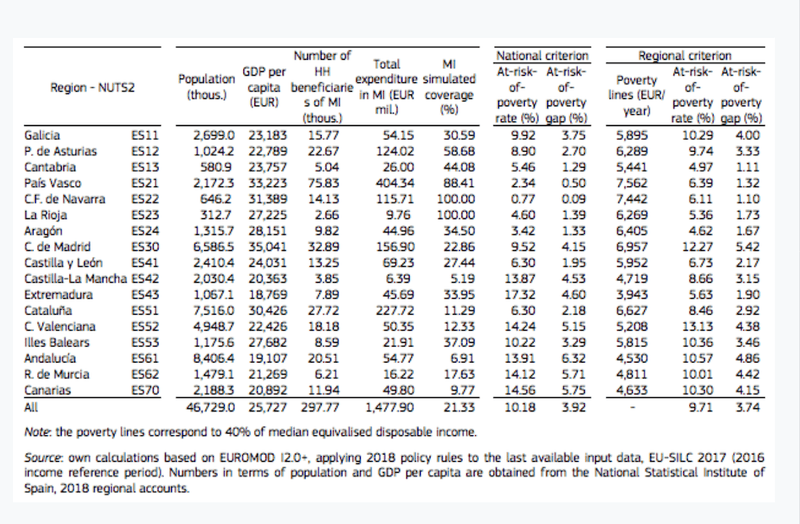
As seen in the table below (based on data from 2018), Madrid and the Basque Country are two of the richest regions, with similar levels of GDP per capita. Yet, despite having one third of Madrid’s population, and half the poverty level (6.4 for 12.3%), the Basque scheme reaches 2.3 times more people and public expenditure is 2.6 times greater. The Basque programme covers 88% of those in greatest need, compared to 23% in the case of Madrid.
With the exception of Navarre, La Rioja and the Basque Country, the vast majority of regions leave out half of the population that meet the economic criteria. The general average is just 21.33%, which means that almost eight in 10 people are unable to get the economic support they need. With just over 8% of the country’s population, nearly 38% of all recipients, living in the Basque Country, Navarra or Asturias, the three regions accumulate 43% of all of Spain’s public spending on minimum income.
Source: Adrián Hernández, Fidel Picos and Sara Riscado, “Moving towards fairer regional minimum income schemes in Spain”, JRC Working Papers on Taxation and Structural Reforms, European Commission, April 2020, p. 12
The austerity of the 2010s created an ever-greater need for a people’s quantitative easing. However, because of limited resources in some cases, and ideological blindness and lack of interest in others, for three decades the regional public authorities failed to fulfil the right to social assistance recognised in Article 13 of the European Social Charter, leaving millions of people behind.
Looking at the small print
Let us hope Spain’s new minimum income scheme will mark a turning point. For now, it is too early to tell if it will match up to the expectations. A number of issues remain unclear and are concerning.
For example, the coverage is arbitrarily limited to people between 23 and 65 years of age. Public authorities at the central, regional and local levels should urgently develop truly accessible and non-bureaucratic procedures. Considering the digital divide, it is essential to establish a system by which individuals can request this benefit from social services face-to-face. In light of the concerning experiences in other countries, observers must watch out for the possible misuse of sanctions and conditionalities. Just as crucial, existing regional schemes should be retained and developed to complement the new central benefit.
The real test will come when the flashlights focus on something else. If the practical questions get answered, and if conservatives do not get rid of it when they return to power whenever they do, then we will be able to celebrate this as one of the most important victories of the left.
This could be the most substantial policy for the people at greater risk of harm, disadvantage and poverty. This could be the most significant test of Spain’s fairness as a society.
The elephant in the room is that none of this would have happened without Covid-19. But this cannot be a passing whim, nor a PR stunt for the left-leaning coalition government. The right-wing Popular Party and the extreme-right Vox seem very confused. Some of their leaders have spoken against this initiative with hyperbolic references to the nanny-State. However, they did not dare to vote against it when the debate came to Parliament in mid-June.
The real test will come when the flashlights focus on something else. If the practical questions get answered, and if conservatives do not get rid of it when they return to power whenever they do, then we will be able to celebrate this as one of the most important victories of the left.
This could be the most substantial policy for the people at greater risk of harm, disadvantage and poverty. This could be the most significant test of Spain’s fairness as a society.
This post first appeared on Open Democracy and is reproduced here with permission and thanks.
England is no stranger to strategic or – at times – abusive use of insolvency provisions.
In the early 2000s, a mechanism frequently used by debtors to retain the control of distressed companies at the expense of their creditors was pre-packaged administration. Following some empirical studies and a public consultation, the Coalition Government introduced some changes to the insolvency system to address the concerns from the industry and practitioners. Yet, it seems that Parliament will have to turn again its attention to similar issues in the not-so-distant future.
In fact, the recent case of Virgin Atlantic, which filed for Chapter 15 protection in the USA to shield itself from the claims of its creditors, as well as other trends in the rescue practice, bring back to the fore the ongoing issue of strategic or abusive use of insolvency provisions.
This blog post briefly discusses whether, and the extent to which, we should be worried by these growing trends in the rescue “industry”.
Pre-Packaged Administrations
Pre-packaged administrations are a hybrid form of corporate rescue. These procedures combine the benefits of informal workouts with the properties of formal procedures.
In a pre-packaged administration, the sale of the distressed business is negotiated before the debtor files for insolvency. Usually, the buyer is a person connected to the debtor’s existing shareholders, sometimes even the existing shareholders or directors. The sale is effected shortly after the debtor files for insolvency, leaving the creditors with no remedies and abysmally low returns for the money they lent to the debtor.
In a paper published at the beginning of this year,[1] Dr. Vaccari identified the characteristics that make a pre-packaged administration abusive. This happens when the sale is determined by a close group of players, who collusively act solely to sidestep or subvert insolvency rules and extract value from the company. To be abusive, such actions should cause undue financial harm to the creditors and fail the “next best alternative” valuation standard.
Conscious of the risks associated with pre-packaged administrations, the Coalition Government launched a study into these proceedings which resulted in the Graham Review (2014) as well as in minor regulatory changes. Some of the industry-led measures introduced following the Graham Report are currently under review. The recently enacted Corporate Insolvency and Governance Act 2020 introduced an extension[2] to end of June 2021 to the power to legislate on sales to connected persons, which was granted by the Small Business, Enterprise and Employment Act 2015 (‘SBEEA 2015’) but expired in May 2020.
It seems accurate to claim that the risks of abusive use of pre-packaged administrations, especially in sales to connected parties, have been significantly curtailed since the regulatory and industry-led changes introduced in 2015. Nevertheless, shareholders and directors have not embraced overnight a new, more inclusive and stakeholder-oriented approach to the management of corporate crises. As a result, the rescue industry has developed new mechanisms to sidestep and at times subvert insolvency rules, for the purpose of promoting the interests of out-of-money players (such as shareholders and directors) at the expense of the residual claimants in insolvency (i.e. secured and unsecured creditors).
Recent Trends
Some recent, high profile cases show the emergence of new trends in corporate rescue practice, designed to sidestep or subvert insolvency rules. These trends are light-touch administrations (LTAs), temporary stays on creditors’ claims – sometimes effected internationally – and reverse mergers.
In LTAs, administrators rely on paragraph 64(1), Schedule B1 of the Insolvency Act 1986 to allow the existing directors of an insolvent company to continue exercising certain board powers during an administration procedure. This practice, however, undermines one of the pillars of the English corporate insolvency framework, i.e. that those responsible for the debtor’s failure are not allowed to run the company in insolvency. The idea behind this choice is that independent insolvency practitioners are better placed than existing directors to protect and promote the interests of creditors as a whole, without necessarily affecting the chances of the debtor to be rescued or sold on a going concern basis.
In LTAs, the existing directors are not free to do whatever they want. Directors usually sign with the administrator a consent protocol, prepared by the Insolvency Lawyers Association and the City of London Law Society. Such a protocol introduces restrictions to the use of directors’ powers in order to safeguard the interests of other creditors and stakeholders. However, in a recent article yet to be published,[3] Dr. Vaccari conducted a doctrinal analysis of the guidance provided by the courts in running LTAs and concluded that the interests of unsecured creditors are unduly affected by these procedures.
The recent events in Debenhams’ restructuring support the early findings in Dr. Vaccari’s article. Debenhams became the first high street business in the UK to enter a LTA process in April 2020, after sales plummeted under the nationwide lockdown. To date, Debenhams’ lenders and owners are “highly supportive” of the LTA process and are funding the administration fees. The process is likely to result in a sale of the profitable assets of the business by the end of September 2020.
So, all good? Not really. In the meanwhile, Debenhams is not paying its landlords and suppliers, with the exception of essential ones. Many workers are paid by the Government (and the taxpayers) through the Job Retention Scheme. Also, this LTA represented the third time the retailer underwent some form of insolvency procedure in less than a year. Earlier attempts included a pre-packaged administration after rejecting financial support from Sports Direct’s owner Mike Ashley and a company voluntary arrangement.
In other words, Debenhams is a “zombie” business, something out of The Walking Dead. It has already been killed several times by the market; it is a failed business, yet it is still operating for the benefit of existing shareholders and directors.
Debenhams is not the only recent case of strategic use of insolvency provisions. After the rejection of a bailout request by the UK Government, Virgin Atlantic worked on a £1.2 bln rescue deal with some of its shareholders and private investors to stave off collapse. It is likely that the negotiations will go ahead – despite the shaky financial situation of the company – thanks to a moratorium or stay on executory actions by the creditors. This moratorium is one of the innovations introduced by the Corporate Insolvency and Governance Act 2020[4] and it has been used as part of a restructuring plan procedure under the newly introduced part 26A of the Companies Act 2006.
However, Virgin Atlantic has assets all over the world. In order to protect them from executory actions, the company sought recognition of the English stay under Chapter 15 of the U.S. Bankruptcy Code. Chapter 15 is a part of the U.S. Bankruptcy Code designed to facilitate cooperation between U.S. and foreign courts. It was added to the code in 2005 by the Bankruptcy Abuse Prevention and Consumer Protection Act, and it allows foreign individuals or companies to file for bankruptcy protection in the U.S. in cases where assets in more than one country are involved. When the order is granted, it is usually recognised all over the world, thus protecting the debtor’s assets against creditors’ predatory actions.
Often, Chapter 15 is filed in conjunction with a primary proceeding brought in another country, typically the debtor’s home country. However, no such proceeding has been opened with reference to Virgin Atlantic. The restructuring plan mentioned above is a company, rather than an insolvency procedure, which means that creditors are less protected than in insolvency. The effect of the Chapter 15 filing is, therefore, to give world-wide recognition to a private agreement negotiated by the company’s directors and key creditors with the support of existing shareholders. A vote on the plan from the wide range of creditors who have legitimate claims against the company will not take place until late August, with a confirmation hearing scheduled for the beginning of September. As a result, the outcome of the Virgin Atlantic case is not dissimilar from Debenhams’ one: the claims of out-of-money shareholders and directors are prioritised against the legitimate interests, rights and claims of other, less sophisticated creditors.
Finally, a practice that it is emerging with renewed preponderance is the use of “reverse mergers” or “reverse takeovers”. A reverse merger is a merger in which a private company becomes public by acquiring and merging with another public company. If the public company files for insolvency first, sells all its assets but keeps its legal standing, the private buyer can go public by merging with the public, insolvent company. In this way, the private buyer avoids the complicated and expensive compliance process of becoming a public company by merging with the insolvent, public debtor. Additionally, all licences, permits, quotas, clearances, registration, concessions etc. conferred on the insolvent debtor will continue with the buyer despite the changing of hands of the controlling interest.
This may, in theory, seem a good idea to maximise the value of the insolvent debtor. Ultimately, the debtor’s listing in the stock exchange (and its public nature) is an asset. What’s wrong in selling it?
First and foremost, the fact is that compliance regulations are sidestepped. Unlike a traditional Initial Public Offering (IPO), reverse merger disclosure documents are generally not reviewed by securities commissions; only by the exchange on which the two companies propose to list. Although this reduces the regulatory burden on issuers, it also dispenses with an important element of investor protection.
These regulations are not simply procedures designed to make life difficult to companies that want to go public. These are procedures designed to protect investors and, ultimately, creditors.
Additionally, another reason to opt for a merger rather than a purchase is if the target company has significant net operating losses that the buyer might be able to use to reduce its tax liabilities. Finally, reverse mergers do not necessarily require concurrent or any kind of financing, as they can take place with a share exchange.
In the U.S. the process has been used by several companies, particularly by start-ups in the automotive sector. These include Nikola Motors, Lordstown, Fisker Automotive, Velodyne Lidar and bus-maker Proterra. At the time of writing, Nikola Motors has a stock exchange value exceeding US$2 bln, while Lordstown has a stock market value of US$1.6 bln. If you haven’t heard these names before, you’re not the only one. Both Nikola and Lordstown have yet to produce their first (electric) vehicle!
It is not surprising that all these companies relied on reverse mergers to go public. Reverse mergers involve less regulatory scrutiny, are cheaper in terms of professional and other expenses, faster than a traditional IPO and able to avoid or minimize market and execution risk on their going-public transactions. Which, ultimately, brings us to the question: are reverse mergers of an insolvent public company a trick or a threat for the debtor’s stakeholders?!?
What’s Next
The Government should respond promptly to these new trends emerging from practice. The commitment to promoting a rescue culture and – more generally – the rescue of distressed yet viable businesses cannot come at the expense of “everything else”. Cases like Debenhams, Virgin Atlantic and the U.S. listing of automotive start-ups suggest that the market is unable at the moment to self-regulate.
The Covid-19 pandemic accelerated a trend towards the strategic or abusive use of insolvency provisions. If unchecked, this trend can only result in more insolvencies and higher taxes.
If suppliers are not paid, the above-mentioned insolvencies will create a domino effect in the industry and they will result in further filings. As for taxes, Dr. Vaccari mentioned in a previous blog post that the re-introduction of the Crown preference is expected to increase the returns to the HMRC. However, higher numbers of insolvency procedures and a downturn of the economy are likely to affect the capacity of companies to generate revenue and – as a result – to pay taxes. If companies pay less taxes and the Government is forced to spend more in subsidies to companies and employees, this is likely to result in cuts to public services and higher rates of taxes for people and companies alike.
The publications mentioned in this article are available on Westlaw, Researchgate.net and Academia.edu. Dr. Vaccari regularly discusses insolvency matters on Twitter and LinkedIn.
[1] E Vaccari, ‘English pre-packaged Corporate Rescue Procedures: Is There a Case for Propping Industry Self-Regulation and Industry-Led Measures such as the Pre-Pack Pool?’ (2020) 31(3) I.C.C.L.R. 170, 184-185.
[3] E Vaccari, ‘Corporate Insolvency Reforms in England: Rescuing a “Broken Bench”? A Critical Analysis of Light Touch Administrations and New Restructuring Plans’ (2020) I.C.C.L.R. (forthcoming).









 Essex Law Research Blog