Global Roundtables on International Protection of Refugees: Exploring Laws on Climate-Induced Displacement and Refugee Travel Documents with Essex Law School and the UNHCR

 By Professor Geoff Gilbert 
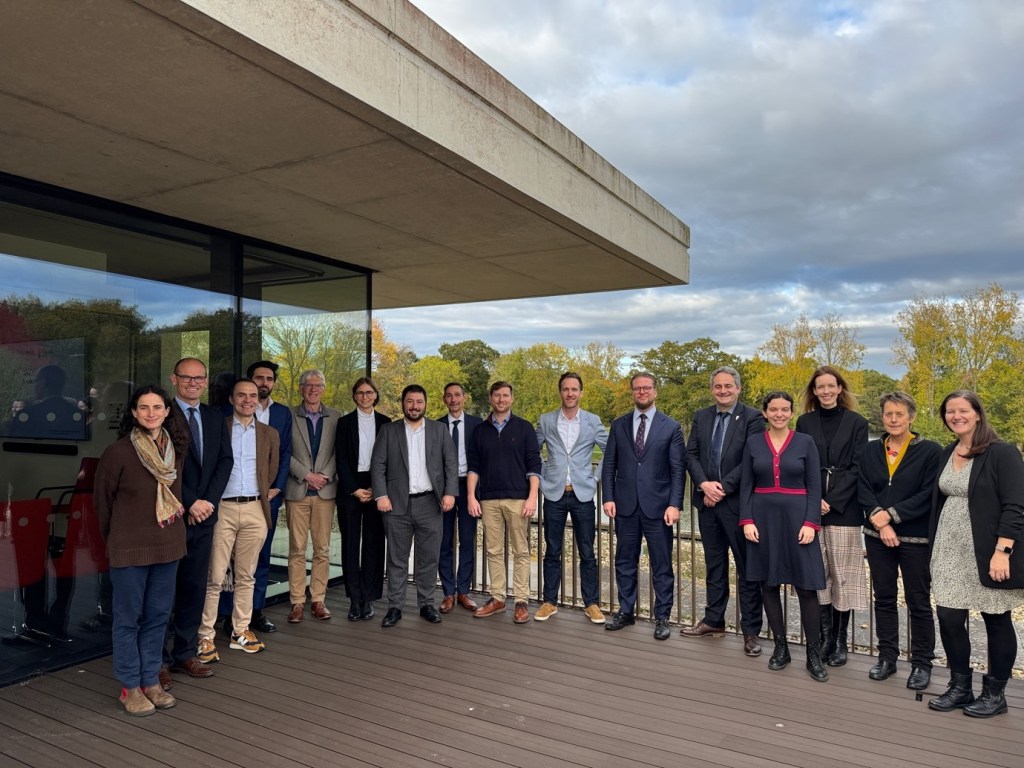
Participants from at the UNHCR-Essex Roundtable on travel documents for refugees, asylum seekers and stateless persons, October 2024 , Credit: Professor Geoff Gilbert

On 22 and 23 October, 17 people from a diverse set of organisations and backgrounds came together from all over the world on campus to discuss travel documents for forcibly displaced and stateless persons in need of international protection. On 23 October, over 60 people attended two online roundtables covering Africa, Europe, the Americas and Asia to consider a toolkit advisory on refugees and asylum seekers affected by climate-induced events or disasters. Professor Geoff Gilbert from Essex Law School hosted both events.  

First for the roundtable on climate-Induced displacement, Essex Law School & Human Rights Centre for a year has been working with the Kaldor Centre for International Refugee Law, UNSW, and the Center for Gender & Refugee Studies (CGRS), University of California College of the Laws, San Francisco, to draft a toolkit for practitioners, decision- and policy-makers on international protection in the context of climate induced events and disasters; it became part of a joint pledge to the 2023 Global Refugee Forum.  

Being forced to move across an international border as a consequence of a climate-induced or other disaster does not in and of itself qualify one as a refugee under the 1951 Convention relating to the Status of Refugees. However, as UNHCR made clear in 2020 in its Legal considerations regarding claims for international protection made in the context of the adverse effects of climate change and disasters, a person displaced in the context of climate induced or other disaster may also qualify under the 1951 Convention if they meet the criteria set out in Article 1A.2. Drought can often lead to conflicts between farmers and herders over access to water or a government may adversely discriminate against a minority ethnic group on its territory post-disaster. Equally, those who are already refugees or asylum seekers may be affected by disasters, too.  

In 2023, CGRS had produced a practice advisory for US lawyers bringing refugee status determination claims in US courts that prompted ELS-HRC and Kaldor to consult on a global equivalent dealing with international and regional refugee and human rights law. On 23 October that Practical Toolkit on ‘International Protection Principles for People Displaced Across Borders in the Context of Climate Change and Disasters’ was considered by over 60 expert academics (including Professor Karen Hulme), lawyers, judges, UNHCR staff and persons with lived experience of forced displacement from across the world. Those discussions will allow the authors, Professor Jane McAdam, Professor Kate Jastram, Dr Felipe Navarro, Dr Tamara Wood, and Professor Geoff Gilbert, to finalize this draft and disseminate it through UNHCR’s REFWorld and other specialist platforms in the next few weeks. 

Turning to the other Roundtable held on campus at the University of Essex Law School, the organisations involved included UNHCR, the International Civil Aviation Organization (ICAO), the International Organization for Migration, the EU Commission, and Frontex, as well as private sector actors, think tanks and persons with lived experience of forced displacement. The meeting also benefited greatly from the attendance of four Essex colleagues, Professor Ahmed Shaheed, former Special Rapporteur on the Human Rights Situation in Iran and on Freedom of Religion and Belief, Professor Paul Hunt, former member of the Committee on Economic, Social and Cultural Rights and Special Rapporteur on the Right to the Highest Attainable Standard of Health, Dr Matthew Gillett, Chair of the Working Group on Arbitrary Detention and a member of the Platform of Independent Experts on Refugee Rights (PIERR), and Dr Judith Bueno de Mesquita, adviser to the World Health Organisation. This roundtable discussed travel documents for persons in need of international protection, that is refugees, asylum seekers, internally displaced persons and stateless persons. 

At the end of 2023, there were 117.3m people within UNHCR’s mandate, 75% in low- or middle-income countries, and there were only 158,500 resettlement places across the world. Some would have managed to bring travel documents with them as they fled, but many are without. As such, they are trapped in the country where they are receiving protection. Even if they are in a state party to the 1951 Convention relating to the Status of Refugees or the 1954 Convention relating to the Status of Stateless Persons, then while Article 28 of both Conventions provide that the country of asylum shall provide a Convention Travel Document, it is only to refugees or stateless persons who are lawfully staying in the territory, a term that is undefined.  

As such, refugees and stateless persons not meeting the threshold, such as asylum seekers and those who have applied for refugee status but where the state has yet to make a decision granting leave to remain, for example, and any person in need of international protection in a non-Contracting state, has no opportunity to obtain a travel document; even Article 28 Convention Travel Documents might only last one to two years and they are difficult to renew outside the country of asylum. Thus, a more generic travel document more widely available to forcibly displaced and stateless persons would facilitate them achieving autonomy in finding a durable and sustainable solution. In part, this fits with the additional solution provided for through Complementary Pathways in paragraphs 85-100 of the Global Compact on Refugees, 2018 (GCR). Traditionally, the durable and sustainable solutions were only resettlement in a third country, local integration in the country of asylum and voluntary repatriation; complementary pathways might involve opportunities to take up employment opportunities or access education in a third country. 

The roundtable considered all the technical requirements for travel documents as set out in Annex 9, Facilitation, to the Chicago Convention on Civil Aviation 1944, administered by ICAO. As such, whatever the form of the travel document for persons in need of international protection, given that it will be machine readable, it should be accepted by all carriers. What cannot be guaranteed is that it will be accepted by the country of destination – that is always, even in the case of national passports, a matter of choice by the state having regard to the trustworthiness of the document.  

In this regard, though, it was suggested that one proposal to take forward is whether the right to leave and return from one’s country of nationality under Article 12 International Covenant on Civil and Political Rights and the right to legal recognition before the law under Article 16 thereof might generally grant everyone the right to a travel document, or at least in combination with the right to access the highest attainable standard of health (Article 12 International Covenant on Economic, Social and Cultural Rights), the right to access employment opportunities (Article 6 ICESCR) or education opportunities (Article 13 ICESCR), as well as the implicit guarantee of family reunification (Article 17 ICCPR). While that may require strategic litigation and engagement with governments to highlight their commitments under the international covenants and the GCR, it shows that ensuring autonomy for refugees and stateless persons and upholding their international human rights could facilitate the acquisition of travel documents. 

The two global roundtables facilitated by Essex Law School marked a significant step towards addressing the complex needs of forcibly displaced and stateless individuals, including those impacted by climate change. Bringing together global scholars, practitioners, and experts from diverse sectors, the discussions highlighted the urgency of accessible travel documents for refugees and comprehensive international protections. These insights will inform final revisions to the toolkit and strengthen advocacy for policies that support autonomy and uphold human rights for those seeking refuge across borders.  
Essex Law School Hosts ‘Supporting Families’ Conference on Advancing Family Justice

By Dr Samantha Davey

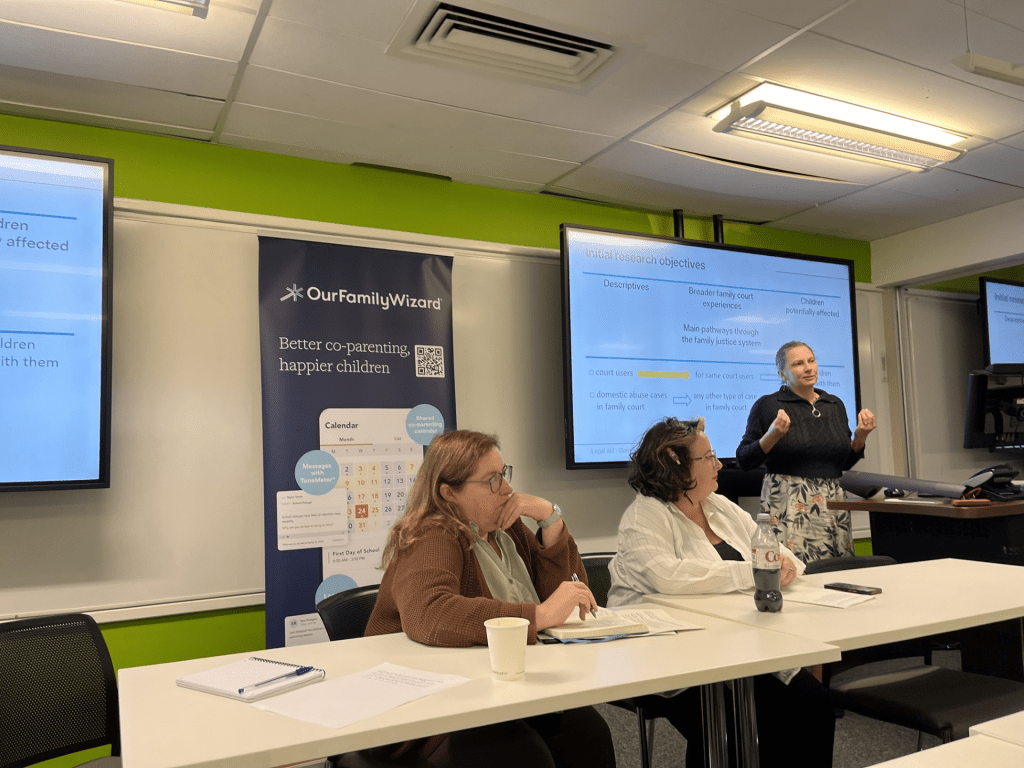
On September 20th, the Supporting Families conference was held, uniting a diverse group of speakers from various academic and professional backgrounds. The event was led by Dr Samantha Davey, a Lecturer in Law within the Essex Law School. The event was attended by academics from the University of Essex, as well as representatives from a number of other institutions including the University of Bristol, the University of Kent, with international contributors from Israel and Saudi Arabia, making it a global gathering focused on family justice. The event was kindly sponsored by Our Family Wizard.

Photo from the conference, credit: Dr Samatha Davey

The range of themes addressed at the conference centred on the challenges within the family justice system and explored innovative strategies for enhancing the experiences of families. The speakers presented on a wide array of issues such as legal barriers faced (for those such as litigants in person), psychological impacts of involvement in the family justice system, the growth of mediation as an important tool for families and the role of social work in supporting families to stay together and through the process of court proceedings. A presentation was delivered by Alicia Farran, a representative of the event’s sponsor Our Family Wizard, on its co-parenting app and the usefulness of online communication platforms as another tool to mediate disputes between couples in contact disputes. 

Photo from the conference, credit: Dr Samatha Davey

The conference was chaired by Dr Laure Sauve (University of Essex), Dr Olayinka Lewis (University of Essex), Liz Fisher Frank (Director of the Essex Law Clinic), and Liverpool barrister Celeste Greenwood (Exchange Chambers), who guided discussions and facilitated insightful dialogues throughout the day. We appreciate the dedication of Katherine Rose in assisting with the setup on the day and the Essex Law Clinic students who attended this event. 

Photo from the conference, credit: Dr Samatha Davey

Overall, the Supporting Families conference successfully brought together a multidisciplinary group of academics and practitioners in law, psychology, and social work, which led to important dialogue aimed at improving the family justice system for all users. If you have any questions about the conference or would be interested in presenting at any future events, please contact Dr Samantha Davey at smdave@essex.ac.uk .

Essex Law Scholars’ Contributions to the ICON•S Conference in Madrid 2024

The main chamber and the sala constitucional of Congreso de los Diputades in Madrid. Credit: Dr Tom Flynn.

By Yseult Marique, Theodore Konstadinides, Joel Colón-Ríos, Tom Flynn, Giulia Gentile, Esin Küçük, Etienne Durand, and Zhenbin Zuo

Essex Law School made a significant contribution to the ICON•S conference in Madrid in July 2024, with a substantial contingent of faculty and scholars in attendance. ICON•S is an international learned society with a worldwide membership of scholars – at all levels of seniority – working on different areas of public law and cognate disciplines in the humanities and social sciences. The Society was officially launched at its Inaugural Conference in Florence in June 2014, sponsored by the European University Institute and New York University School of Law. Since then, the Society has held annual meetings in New York (2015), Berlin (2016), Copenhagen (2017), Hong Kong (2018), Santiago de Chile (2019), online with ICON•S Mundo (2021), Wrocław (2022), and Wellington (2023). This year’s meeting (8-10 July), hosted by IE University in Madrid, attracted more than 2,000 delegates and was the largest meeting of the Society up to date.  

The conference’s plenary programme was organised around the theme of The Future of Public Law: Resilience, Sustainability, and Artificial Intelligence. The theme, as explained in the conference’s Call for Papers, sought to “foster reflection and discussion on the different transformations that public law is going through as a result of the major societal challenges of our time: the quest for sustainability, the AI revolution and, more generally, the need for resilience in a world of exponential change.” Alongside the plenary programme, there were hundreds of parallel panels allowing scholars and the broader community (including practitioners, judges, and policy makers) to present their work and/or take part in thematically organised panels on legal pluralism, global warning, freedom of speech electoral law, democratic theory, human rights, judicial review, and many other areas.  

The Essex Constitutional and Administrative Justice Initiative (CAJI) was in an excellent position to showcase the diversity of its interests and strengths both in terms of academic research and partnerships/collaboration across the world. CAJI Co-Director and Public Law Academic Lead, Professor Theodore Konstadinides noted how excellent the conference was to foster new collaborations and rejuvenate older relationships. For instance, he met with Professor Vanessa McDonnell (Associate Professor and Co-Director, uOttawa Public Law Centre) to discuss among else our respective partnership with Ottawa in public law and our newly-launched Canadian Constitutional Law module. He also reconnected with Giuseppe Martinico (Santa Anna in Pisa) in Madrid. Theodore also mentioned how the very stimulating environment of ICON•S kindled interests among our representatives to be more actively involved in the British Chapter of ICON•S in the future. 

We have contributed to a number of different themes and panels this year, some specific to sustainability (Etienne Durand), some specific to digitalisation (Dr Giulia Gentile) and some more general (Professor Theodore Konstadinides, Dr Esin Küçuk, Dr Tom Flynn, Professor Yseult Marique). In a nutshell, here some of the main highlights of the conference for our team.   

***

Professor Theodore Konstadinides chaired and participated in a panel entitled ‘Assessing the sub-constitutional space of the UK constituent nations in the post-Brexit constitution’. This panel discussed how within the EU multi-level order, governmental and legislative powers can be largely apportioned vertically at three tiers moving from regional to supranational: (i) substate-regional (e.g., Catalonia, Flanders, and Lombardy); (ii) (Member) State-national (e.g., Spain, Belgium, and Italy); and (iii) supranational, i.e., the European Union itself. The UK’s withdrawal from the EU apart from marking the first time that a Member State decided to put an abrupt end to the federalist ’sonderweg’ of ‘an ever closer union’, it meant that a number of powers that were exercised at the supranational level were ‘repatriated’. Four years after Brexit, this panel analysed the effect of such ‘repatriation’ on the sub-constitutional space of the UK constituent nations. It assessed whether this has happened at the expense of the devolved nations.

To do so, the three papers looked at the following areas of the UK’s post-Brexit territorial constitution: (i) foreign affairs (Professor Konstadinides, Essex and Professor Nikos Skoutaris, UEA); ii) the internal market (Ms Eleftheria Asimakopoulou, QMUL); and iii) digital governance (Dr Giulia Gentile, Essex). The picture that emerged from the papers highlighted the extent to which the UK constitutional order has proved its resilience – one of the themes of the 10th Annual conference. 

***

For her third participation to an ICON•S conference (after Copenhagen in 2017 and online at the ICON Mundo during the pandemic), Professor Yseult Marique was invited to take part in a panel, part of a twin session on judicial deference following the reversal of Chevron by the US Supreme Court in Loper a few weeks earlier. This twin session was organised by Professor Oren Tamir (Arizona) and Professor Mariolina Eliantionio (Maastricht).  This session was devoted to a comparison from European jurisdiction. Professor Marique’s co-presenters were colleagues drawn from past or present members of REALaw : Professor Luca de Lucia, Professor Luis Arroyo Jimenez, Professor Ferdinand Wollenschläger and Dr Pavlina Hubkova. The panel  discussed whether their respective jurisdictions (Italy, Spain, Germany, Czech Republic and Belgium) have a similar concept or functional equivalent to deference.

The other session proceeded in a similar manner for Common law jurisdictions (USA – Professor Susan Rose Ackerman; South Africa – Professor Cora Hoexter; New Zealand – Professor Dean Knight; and Canada – represented by a long-standing collaborator of CAJI, Professor Matthew Lewans). A series of blog pieces on this topic is likely to be published on REALaw blog in the upcoming year.  

***

Also very familiar with ICON•S, having presented in Wrocław in 2022 and in Wellington in 2023, Dr Tom Flynn was invited to take part in two sessions. One was a roundtable discussion of Radical Constitutional Pluralism in Europe (Routledge 2023) by Orlando Scarcello (KU Leuven). Dr Flynn had previously taken part in the book’s launch event on Zoom, and it was great to meet with Dr Scarcello and others in person to continue their discussion of the book. Dr Flynn’s presentation was entitled ‘Two Cheers for Substantive Pluralism’, and was a partial defence of the kind of substantive constitutional pluralism that Scarcello’s approach, with its specifically radical focus, discounts. 

The other was a panel organised by Professor Mikel Díez Sarasola (Universidad del País Vasco/Euskal Herriko Unibertsitatea) on ‘Plurinational States and their Constitutional Shape’. Dr Ewan Smith (UCL) and Dr Flynn presented together on ‘The idea of parity of esteem as a constitutional principle in Northern Ireland and beyond’, which will be the focus of a BA-funded conference they are organising in Belfast in April 2025 with colleagues Prof Katy Hayward and Anurag Deb (both QUB). 

After the panel, Professor Díez Sarasola was kind enough to organise a tour of the Congreso de los Diputades in Madrid, during which Tom was able to see the main chamber and the sala constitucional, among other parts of this magnificent building.

*** 

Also a former participant of  the ICON Mundo conference, Dr Giulia Gentile was involved in three panels as a speaker. The panels concerned (a) AI and good administration, with a presentation covering AI and actions for damages; (b) the future of EU rights in the Brexit era, with a presentation discussing data protection in the UK post-Brexit landscape; (c) AI and courts, with a paper unpacking the interplay between judicial independence and the EU AI Act. 

The panel on AI and actions for damages was a spin-off of a collaboration with Melanie Fink and Simona Demkova (both Leiden University) on AI and good administration. Her findings were published on DigiCon. The panel on EU rights after Brexit stems from collaboration and discussions with Essex colleague Theodore Konstadinides, with whom she is applying for a research funding bid on EU Citizens rights after Brexit. The final panel organised by Monika Zalnieriute offered Giulia the chance to discuss her forthcoming chapter on the AI Act and Judicial Independence to appear in the Cambridge Handbook on AI and Courts, edited by Dr Zalnieriute.  

***

Dr Esin Küçük was involved in two panels, presenting papers. The first presentation, titled “Resilience of the EU Constitutional Order in Times of Crises”, was part of a panel on EU solidarity during crises. The debate centred on how recent measures to manage crises have reshaped our understanding of solidarity within the EU framework. This paper is now under review for publication.

The second paper Dr Küçük presented, “EU’s Externalised Smart Borders: Türkiye as a Case Study”, explores the externalisation of EU borders in migration management and the implications of emerging technologies in the process from a human rights perspective. This paper, co-authored with Elif Kuşkonmaz, is currently under development, and we aim to evolve this initial research into a broader project. 

***

For his first participation to an ICON.S Conference, Dr Etienne Durand chaired the panel entitled ‘The Future of Energy Law: a Consumer-centric Legal Framework’, which featured Marie Beudels, (PhD Student in Law, University of Brussels, Belgium) and Dr Luka Martin Tomaszic (Assistant professeur, Alma Matar European University, Slovenia) as speakers.

The general aim of the discussions was to observe the changing nature of the role of energy consumers in their interaction with EU Law. The discussion was based on current developments in law and technology that enable energy consumers not only to benefit from the energy transition, but also to participate in bringing it about, thus playing an active role in (re)shaping the EU energy law itself. Taking these developments into consideration, the panel sought to identify the transformative power that energy consumers have or could have in shaping the future of European energy law, a hypothesis which we now aim to integrate into a broader research project.  

Dr Etienne Durand on the right at the ICON conference. Credit: Dr Etienne Durand.

*** 

Professor Joel Colón-Ríos first participated a panel titled “Navigating the Paradox: The Doctrine of Unconstitutional Constitutional Amendments”, where he commented on a paper by Sergio Verdugo (IE Madrid). His paper on the concept of a permanent constituent power was also presented in that panel by his co-author, Mariana Velasco Rivera (Maynooth). Later that day, Professor Colon-Rios chaired a roundtable titled “Deliberative Constitutionalism under Debate”, which featured papers by Cristina Lafont (Northwestern), Chiara Valentini (Bologna), Ana Cannilla (Glasgow), Roberto Gargarella (Pompeu Fabra, Torcuato di Tella), Yanina Welp (Albert Hirshman Democracy Centre), and Ignacio Guiffré (Pompeu Fabra).  

On Tuesday, Professor Colon-Rios participated in a panel on “Constitutional Identity in Times of Illiberalism”, where some of the papers that will appear in an International Journal of Constitutional Law symposium where presented, including his piece (“Constitutional Identity, Democracy, and Illiberal Change”), co-authored with Svenja Behrendt (Max Planck, Freiburg). Finally, he was one of the speakers in the book roundtable of Guido Smorto’s and Sabrina Ragone’s Comparative Law: A Very Short Introduction. This was Professor Colon-Rios’ fifth ICON’s conference, also having co-organised last year’s annual meeting in Wellington. 

***

Overall, the ICON•S provided a fascinating opportunity to learn from the Presidents and former President of the Human Rights Courts in Europe, Africa and South America; to meet up with old acquaintances and to catch up with the representatives of international publishing houses, always ready to provide feedback and chat about current and possible publishing projects. We were much bemused by how much Italians love Spain and very pleased to hear how lively the regional chapters were actively planning together for further activities (such as for instance the Benelux ICON•S Chapter.) The Essex Law team greatly enjoyed the event, and the team’s diverse work in public law contributes to excellent academic exchanges that we bring back to our undergraduate and postgraduate community as we are developing further our education curriculum and expanding our postgraduate research community in public law. We look forward to building stronger academic ties and impact at both in the UK and  globally.