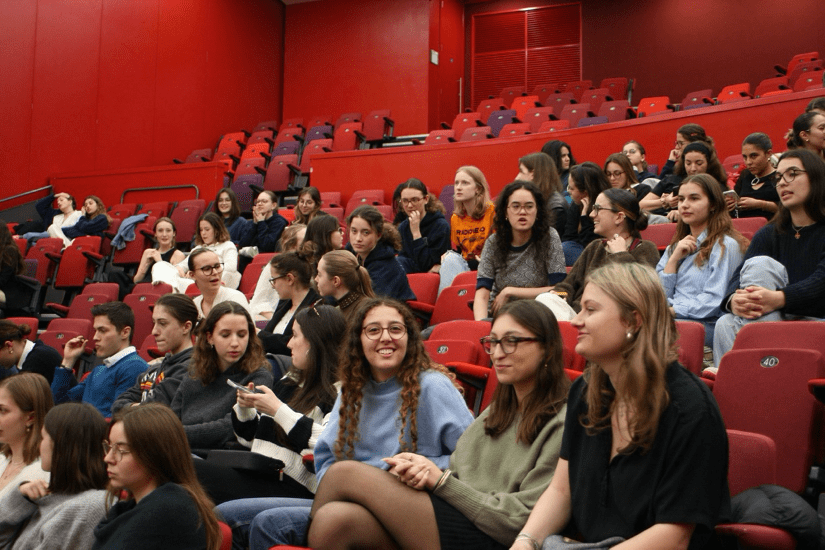
Presenters Liz Curran, Lee Hansen and Liz Fisher-Frank engage in a lively discussion during their session on ‘A Case for the Ambitious Use of Giving Voice to Values Throughout Legal Education’ at the IJCLE & ENCLE Conference held at the University of Amsterdam, July 22-24, 2024.
In our paper presentation titled ‘A Case for the Ambitious Use of Giving Voice to Values Throughout Legal Education’, at the recent conference of the International Journal of Clinical Legal Education and European Network of Clinical Legal Education at the University of Amsterdam 22 – 24 July 2004, my colleague Liz Fisher Frank and I, along with Liz Curran from Nottingham Law School, had the pleasure of sharing insights on the transformative potential of the Giving Voice to Values (GVV) methodology in legal education, emphasising its role in promoting ethical decision-making and behaviour among future legal professionals.
This paper draws from the presenters’ research interests in the pedagogy of clinical legal education. GVV is a ripe method for navigating values conflicts related to access to justice, a key area of research interest for all three presenters. The link between these two fields is explored at Essex, where Liz and I frequently use access to justice-based scenarios in our GVV teaching to help students effectively manage values conflicts concerning access to justice.
GVV, developed by Mary Gentile, was originally created within the context of business schools to address ethical challenges. It has now been successfully applied in various fields, including legal education, nursing, social work and the paramedical context. Being experienced in applying GVV across these domains, we advocated for its broad use in legal education. We underscored the necessity of preparing law students to tackle everyday challenges they will encounter in practice, arguing that traditional legal education may emphasise moral sensitivity and judgment while neglecting the crucial elements of moral motivation and courage.
In our workshop we made the case for a more expansive use of GVV throughout the legal curriculum, highlighting its capacity to provide law students with the tools to manage and prepare for values conflicts that may arise in their professional lives.
Implementing the GVV Approach in Legal Education
An important aspect of the discussion addressed the need to teach GVV responsibly. We recognised the potential harms that can flow to individuals in whistleblowing situations such as professional retaliation, personal stress and isolation. We emphasised that while GVV equips students with the skills to navigate these types of situations, it is also crucial to address the risks and challenges involved. This responsible approach ensures that students are not only prepared to voice their values but also understand the potential consequences and develop strategies to mitigate harm.
We also explored strategies for integrating GVV across various areas of legal education, including commercial awareness, human rights, employment law, and interdisciplinary studies. We argued that GVV’s principles are quite versatile and can enhance students’ understanding and engagement across these subjects. By embedding GVV in diverse courses, law schools can create a comprehensive, values-driven curriculum that thoroughly prepares students for their future roles as ethical practitioners.
The session also addressed practical considerations such as assessment and resource implications. We highlighted the importance of developing effective assessment methods to evaluate students’ understanding and application of GVV principles.
Reflective Exercise and Discussion
During the session, audience members expressed how their perspectives were changed by the frameworks presented. Members who had transitioned from legal practice to academia remarked that having these frameworks during their time in practice would have been incredibly useful. Participants were encouraged to engage in a practical exercise, where they practised initiating and navigating conversations about values conflicts.
This exercise aimed to build participants’ confidence and competence in addressing ethical issues. The exercise involved role-playing scenarios where participants were tasked with navigating an ethical challenge that they might encounter in their professional lives. In the scenario, participants played the roles of junior lawyers facing pressure from senior partners to engage in questionable practices. The participants had to identify their values, articulate their concerns and develop strategies to voice their objections effectively while maintaining professional relationships.
This role-playing activity not only highlighted the complexities of real-world ethical decision-making but also demonstrated GVV’s potential to empower individuals to act on their values. By providing a safe space for practice, the exercise showcased how law students and professionals could rehearse their responses to ethical challenges and build their confidence accordingly.
Reflective practice was also emphasised, with participants sharing their experiences and discussing what strategies worked, what didn’t and how they might approach similar situations differently in the future. This hands-on approach reinforced the importance of preparation and rehearsal in developing the skills needed for ethical practice.
The session concluded with a lively discussion on the ambitious use of GVV in legal education. Participants debated the merits and challenges of implementing GVV, sharing their perspectives on how this methodology could transform legal education and practice. Participants were keen to learn more about GVV, and indicated they may think about implementing it in their work; taking these frameworks back to diverse jurisdictions from all over the world.
We emphasised that a values-driven approach not only prepares students for the ethical complexities of legal practice but also cultivates a commitment to justice and integrity that will benefit the legal profession and society as a whole
By Laia Montserrat Chávez González and Renata Alejandra Medina Sánchez
The digital age has given businesses the opportunity to expand and establish their trade marks worldwide. As a result, they have been able to make themselves known to more consumers and increase their profits. A well-known trade mark has the power to create great economic value for businesses and strengthen a company’s branding in the marketplace.
With WhatsApp, Facebook, and Instagram dominating the social media landscape in the United Kingdom, brands are eager to bolster their presence on these platforms to effectively promote their products or services. However, the advent of e-commerce and social media platforms and the emergence of new technologies have created novel challenges for trade mark protection.
One of these challenges is trade mark infringement, which takes place when someone violates the exclusive rights attached to a registered trade mark without the owner’s authorisation or licence. In this evolving digital landscape, businesses must swiftly adapt and deploy suitable protection strategies to safeguard their trade mark rights online.
This blog post aims to elucidate trade mark infringement on social media for entrepreneurs, while outlining available protective measures within these platforms.
The importance of trade marks in the online business landscape
Social media platforms such as Facebook offer a highly promising opportunity for businesses to communicate with their audience in a fast and direct manner. Several studies have highlighted that these platforms are efficient channels to manage communication with customers and reach a broader audience, not only as a publicity channel but also as a way to attract new clients and recruit employees. In this sense, social media is a valuable tool for preserving and boosting brand reputation at minimal cost.
Brands build relationships with their customer base through offline methods such as offering personalised services, hosting events, and running loyalty programmes, as well as online methods including engaging on social media, utilising email marketing, fostering online communities, collecting, and acting on feedback, and providing responsive customer support. The real-time and multi-directional nature of social media facilitates communication and content usage, challenging offline communication models, such as radio and television advertisements. Social media now allows consumers to actively participate by sharing opinions and information, influencing brand perception.
To distinguish themselves and ensure their unique identity is recognised and protected across all platforms, brands rely on trade marks. Trade marks have the same role in the online business realm as they do in traditional markets: to differentiate goods and services. Therefore, their legal protection is crucial, not just to prevent consumer confusion but also to safeguard a business’ reputation.
In 2009, L’Oréal SA, a multinational cosmetics and beauty company, and other luxury brands filed a lawsuit against eBay for allowing the sale of counterfeit products bearing their trade marks on its platform. This example highlights the challenges that e-commerce platforms face in monitoring and preventing trade mark infringement by third-party sellers and emphasises the need for robust monitoring systems and cooperation between online platforms and brand owners to maintain consumer trust.
Understanding trade marks: some fundamental concepts
Entrepreneurs must grasp fundamental concepts associated with trade marks and their use in order to protect their brands from infringement on social media and maintain brand integrity in a competitive online marketplace. This section briefly outlines the importance and relevance of these concepts for trade marks.
Trade mark:A trade mark is any sign capable of being represented in a manner which enables the registrar and other competent authorities and the public to determine the clear and precise subject matter of the protection afforded to the proprietor, and of distinguishing goods or services of one undertaking from those of other undertakings. It may consist of words (including personal names), designs, letters, numerals or the shape of goods or their packaging.
Domain Names:Trade marks and domain names intersect in protecting brand identity online; while a trade mark provides rights to a brand name, securing a corresponding domain name, namely the unique address that people use to find the website on the internet, helps ensure exclusive use and prevents ‘cybersquatting’, i.e., the unauthorised registration of domain names resembling trade marked names.
Usernames: Trade marksextend to social media usernames, as usernames often serve as digital representations of trade marks. A username on social media can enhance brand recognition but might not guarantee trade mark protection.
Terms and conditions: They are legal agreements between a service provider and its client, which set the obligations and responsibilities of the parties. Platforms’ terms and conditions may restrict or regulate trade mark use to prevent confusion or misuse, ensuring brand integrity and user trust.
Branding: By integrating various elements such as logo, design, and mission, branding refers to the process of developing a positive image of a company or its products in customers’ minds. This is achieved by ensuring a consistent theme across all marketing channels, including social media, maintaining consistency in trade mark use, and adhering to trade mark laws.
Trade mark infringement
Infringement occurs when someone uses a trade mark that is substantially similar to a registered trade mark owned by another person, for products or services that are the same or similar to those covered by the registered trade mark. The following represent some common ways in which infringement can occur on social media:
Jacked usernames:
This refers to social media or online account usernames that are ‘hijacked’ by someone other than the trade mark owner, often to exploit a well-known trade mark’s reputation or value. This unauthorised use can mislead consumers and harm a brand. For instance, this could happen if someone other than Nike Inc. registers the username ‘nikeofficial’ on a social media platform. This unauthorised use could confuse consumers into thinking that the account is the official representation of the Nike brand, potentially infringing on Nike’s trade mark rights.
Hashtag hijacking:
Using a trade marked name or slogan as a hashtag without permission can be particularly problematic, especially if the hashtag is used in a way that could confuse consumers or dilute the brand’s identity. Using trade marked terms in hashtags accompanying social media posts should be avoided, unless the explicit permission from the trade mark owner has been obtained.
As a general rule, using a protected trade mark in a hashtag can risk infringement if it implies sponsorship, association, or endorsement by the trade mark owner. However, if the hashtag simply promotes the user’s own goods or services, indicating compatibility or common origin, it may be considered permissible.
Advertising and trade mark use:
Incorporating trade marks into social media advertising initiatives is very important for businesses. However, according to consumer law and domestic legislation applicable in each case, trade mark owners must ensure that advertisements adhere to trade mark laws, steering clear of any practices that could be deemed misleading or deceptive.
Claims made in social media ads must be substantiated, and the use of trade marks must not create a false impression about the product or service. Misleading use of trade marks can result in regulatory action, fines, and damage a business’ reputation. Moreover, social media ads employing registered trade marks must not suggest affiliations or product characteristics that are not true. For instance, implying that a product has certain qualities or is endorsed by a trade mark owner when it is not can be considered deceptive.
Misleading influencer partnerships:
Content creators, such as popular bloggers, online streamers, celebrities, social media personalities, have the power to influence customer’s buying behaviour. Including influencers in promoting products or services might seem like a good idea for businesses looking to expand their audience. Nevertheless, these collaborations should not involve making false claims about the benefits and effectiveness of what is being promoted.
In addition to the potential for misleading claims, influencers’ promotional content on social media has the potential to amount to trade mark infringement. When influencers use logos, brand names, or other trade marked elements without proper authorisation, they may inadvertently or deliberately create confusion about the source or sponsorship of the products or services being promoted. Such unauthorised uses, if not properly unmonitored, can mislead consumers into believing that there is an official partnership between the influencer and the trade mark owner, which might not exist. Such actions can dilute the brand’s identity and value, potentially resulting in legal disputes and damaging the reputation of both the influencer and the involved businesses.
Confusing similarity:
Using a sign that closely resembles an existing registered trade mark in a way that could confuse consumers could constitute infringement. Such confusion can arise from similar logos, names, or products/services offered under those trade marks, potentially leading consumers to mistake one for the other.
Consider, for instance, a scenario where a tech start-up called ‘AppLinx’ creates a logo closely resembling Apple’s iconic bitten apple and uses a name like ‘iLinx’ to promote its mobile app development services on social media. Users browsing their feed might mistake ‘iLinx’ for an Apple-affiliated service, potentially leading to trade mark infringement issues and confusion among consumers about the origin of the app development services.
Domain name infringement:
It should be remembered that trade marks represent intellectual property rights protecting brands and their associated products or services, but domain names are addresses used to access websites on the internet.
Domain name infringement can occur by registering a domain name that is deemed to be identical or confusingly similar to another party’s trade marked name or brand, known as ‘cybersquatting’. Such similarity can lead to confusion among consumers, potentially diverting traffic away from the rightful owner’s website or causing harm to their reputation.
Take the example of a reputable company, ‘XYZ Clothing,’ which owns the trade mark and domain name ‘XYZClothing.com.’ If another party registers the domain ‘XYZClothing.net’ and uses it to sell counterfeit goods, customers searching for ‘XYZ Clothing’ might stumble upon the ‘.net’ website, purchase lower quality products, and have a negative experience. This confusion and association of poor quality can damage XYZ Clothing’s reputation and lead to a loss of trust among consumers.
In the 2003 case of Harrods Limited v. Pete Lormer (WIPO Case No. D2003-0504), an American individual named Pete Lormer registered the domain name ‘www.harods.com’ which closely resembled the HARRODS registered trade mark. Users entering ‘www.harods.com’ were redirected to ’www.expedia.com’, suggesting a false sense of origin or sponsorship for any associated products, goods, or services. As a result, the Panel of the WIPO Arbitration and Mediation Center concluded that Lormer had registered and used the domain in bad faith, intending to exploit the HARRODS trade mark for commercial gain. Consequently, the Panel ordered the transfer of ‘harods.com’ to Harrods Limited.
Parody accounts:
Another issue that deserves attention is parody accounts mimicking the style of a well-known brand without clearly labelling themselves as satire. It involves social media profiles or online personas that use the likeness of a person, group, or organisation in their profile to discuss, satirise, or share information about that entity. Although this might be considered legal when the account name and profile clearly indicate that it is not affiliated with the original entity, using terms like ‘parody’, ‘fake’ or ‘fan’, can cross legal boundaries when they engage in trade mark infringement, impersonation, or deceptive practices when they mislead users.
One notable example involved a spoof Twitter account, @UKJCP, which operated under the name ‘UKJobCentrePlus not’ and had adapted the job placement body’s official logo. The account mocked Jobcentre Plus and welfare policies, attracting the then Conservative government’s fury. The Department for Work and Pensions (DWP) complained to Twitter that the account was set up ‘with a malicious intent’ to undermine the work of Jobcentre Plus, but Twitter (now X), after initially suspending the account, eventually restored it because it allowed at the time parody accounts as long as they were clearly labelled as such.
Ensuring trade mark integrity amidst digital challenges
In conclusion, the digital landscape offers both vast opportunities and significant challenges for trade mark protection. Navigating trade mark protection in today’s digital age requires a deep understanding of the evolving dynamics of social media and e-commerce platforms. As brands increasingly engage with their audience on platforms like Facebook and Instagram, the risk of trade mark infringement and misleading advertising also increases. Therefore, businesses must implement rigorous measures to protect their trade marks. These measures may include monitoring for unauthorised use, ensuring transparent endorsement disclosures, and working with social media platforms to enforce policies effectively.
To preserve consumer trust and protect brand integrity in today’s competitive digital marketplace, businesses must prioritise transparency and implement robust trade mark protection strategies. A proactive approach to trade mark protection empowers brands, ensuring their sustained success and reputation. At the same time, the active involvement of social media platforms in developing and enforcing trade mark protection policies is essential in enhancing enforcement against trade mark infringement.
About the authors
Laia Montserrat Chávez González is currently in her final semester for a double degree in Law and Economics at Tec de Monterrey in Mexico, and in parallel pursuing an LLM in International Commercial and Business Law at the University of Essex. Laia has advised national and international clients on trade mark registrations and feasibility studies, and managed administrative procedures with the Mexican Institute of Intellectual Property. Passionate about protecting creativity and innovation, she also oversaw intellectual property aspects in transactions, ensuring compliance across different legal systems and facilitating trade mark rights transfers.
Renata Alejandra Medina Sánchez is a lawyer who graduated from the Pontifical Catholic University of Ecuador, with a Senior Specialization in Business Law from the Universidad Andina Simón Bolívar, and a Master’s in Contemporary Contracting from the Universidad Externado de Colombia. She is currently pursuing an LLM in Corporate Social Responsibility and Business at the University of Essex. She holds extensive experience in corporate, contractual, labour, tax, and commercial law. Throughout her career, she has collaborated with both domestic and foreign companies, assisting them from their establishment to the expansion of their operations. Her expertise encompasses involvement in merger and acquisition processes, as well as the drafting and negotiation of contracts.
The time has come for the Essex Law Research editorial team to swap our legal tomes for some sun hats and lemonade! We’re taking a summer break to recharge our intellectual batteries and embrace the season of relaxation.
Fear not, for our commitment to delivering insightful legal scholarship remains steadfast, so the ELR blog will transition to an intermittent posting schedule.
We will return to our regular scheduling with the next academic year, refreshed and with thought-provoking content. Until then, enjoy the summer, stay curious, and keep an eye out for our sporadic updates!
ParLaure Sauve, Co-Directrice du Double-Diplôme Droit anglais et français (Université d’Essex)
Le 19 mars dernier, plus de 90 étudiants du double-diplôme ont assisté à la remise de prix d’un concours de droit constitutionnel. L’objectif de cette compétition était de faire réfléchir les étudiants sur la Constitution actuelle : quelle sont les améliorations possibles du texte de 1958?
La toute récente dissolution de l’Assemblée nationale par le Président Emmanuel Macron et les tensions entourant les récentes élections législatives montre la nécessité de révision de la Constitution. Les excellentes propositions de réforme présentées par les douze équipes ayant participé au concours, fidèles à l’esprit républicain, peuvent être vues comme une lueur d’espoir dans ce climat d’incertitude et d’angoisse. Appelés à voter depuis peu, juristes et acteurs politiques de la France et de l’Europe de demain, les étudiants du double-diplôme ont montré que la «valeur n’attend point le nombre des années» (Pierre Corneille, Le Cid).
Concours de la meilleure proposition de réforme constitutionnelle: des étudiants en droit revendiquent plus de Démocratie
Par Maëlle Prugnolle, étudiante en première année de droit au sein du Double diplôme en droit français et droit anglais (Université d’Essex)
En démocratie, la participation des citoyens au pouvoir est en principe centrale. Or, avec l’adoption lors de la Révolution française de 1789 du système représentatif, la participation citoyenne se manifeste essentiellement dans le suffrage, limitant fortement le rôle des citoyens. Il en va ainsi en matière constitutionnelle, les citoyens étant associés soit indirectement (par le biais de représentants élus par les citoyens) soit directement (par le biais de référendums) à l’établissement et à la révision de la Constitution. Alors que la Constitution est le texte fondamental comprenant les règles organisant les pouvoirs publics, le fonctionnement des institutions et les libertés des citoyens, le très faible nombre de révisions constitutionnelles adoptées par référendum sous la Vème République (seulement deux en 1962 et en 2000), ainsi que l’absence d’initiative populaire en matière constitutionnelle restreignent encore davantage la capacité des citoyens à exercer pleinement leur rôle. Face à ce constat, l’expérience du concours de la meilleure proposition de réforme constitutionnelle organisée à l’Université d’Essex est riche d’enseignements:
Elle montre tout d’abord que les étudiants souhaitent proposer des améliorations à notre texte constitutionnel.
Elle montre ensuite que la majorité des propositions, notamment la proposition de l’équipe gagnante, appellent à des formes plus directes et accrues de participation populaire/citoyenne.
Qu’est ce que le concours de la meilleure proposition de réforme constitutionnelle?
Inspirée par des expériences similaires organisées dans plusieurs universités françaises, notamment celle de Caen, Eugénie Duval (Lecturer à l’Université d’Essex), a eu l’idée de créer ce concours à Essex. Ouvert aux étudiants de première et deuxième année du double diplôme de droit français et droit anglais, le concours a eu pour objectif d’offrir à ceux-ci un moyen innovant d’en apprendre davantage sur le droit constitutionnel français et de mettre leurs connaissances en pratique. En effet, comme l’a souligné Etienne Durand (Lecturer à l’Université d’Essex), membre du jury, le droit constitutionnel, avec ses concepts abstraits et ses bases théoriques et politiques complexes, déstabilise souvent les étudiants de première année de droit. En tant que fondement de l’ordre juridique, la maîtrise du texte constitutionnel est perçue comme laborieuse. À Essex, le rythme particulièrement soutenu des cours, exacerbe ces difficultés, pouvant fausser la perception globale du droit. Le concours de la meilleure proposition de réforme constitutionnelle a alors permis de donner vie aux notions de droit constitutionnel étudiées en cours, de mieux comprendre les enjeux qui le parcourent, et ainsi d’avoir l’opportunité de «réfléchir et remettre en question la Constitution et son fonctionnement» (Retour d’étudiantes concourantes: Annaëlle Paul-Dauphin et Margot Giguere).
Pour cette première édition, le concours a rencontré un franc succès avec la participation de 12 équipes, composées d’étudiants de première et de deuxième année (soit 32 participants). Cette collaboration interpromotionnelle a permis de combiner les connaissances en droit constitutionnel des premières années avec la maîtrise plus avancée des méthodologies et des réflexes juridiques des deuxièmes années. Les étudiants ont eu quatre semaines pour réfléchir et proposer l’équivalent d’une proposition de loi constitutionnelle avec un intitulé, un exposé des motifs et un ou plusieurs articles contenant la révision proposée. Il a alors fallu que les participants fassent preuve d’analyse critique et de créativité, se familiarisent avec la recherche et la littérature technique relative au sujet choisi, et établissent des liens entre les aspects théoriques et pratiques de la proposition. Pour les aider, après deux semaines de travail en équipe une rencontre a été organisée par Eugénie Duval, Sophie Duroy, et Etienne Durand, afin que les étudiants aient un retour sur leurs travaux.
Liste des propositions des 12 équipes concourantes:
Proposition de loi constitutionnelle visant au renforcement de la démocratie semi-directe sous la Veme République (Élodie Leatham-Smith, Margaux Mimalé, et Inès Robert-Archambeau)
Proposition de loi constitutionnelle visant à relocaliser la démocratie au profit d’une implication plus direct des citoyens (Annaëlle Paul-Dauphin, Margot Giguere)
Proposition de loi constitutionnelle pour une démocratie plus représentative, respectueuse de la séparation des pouvoirs et une modernisation des institutions de la Ve République (Clarisse Videau, Harrisson Chauve, Maxence Debruyne-Robert)
Proposition de loi constitutionnelle visant à protéger et à garantir les droits fondamentaux des femmes relatif aux violences verbales et physiques et, à l’interruption volontaire de grossesse(Alix Chambariere, Maëlle Daude)
Loi constitutionnelle d’intégration des enjeux contemporains à la Constitution de la Ve République (Romane Houeix, Aurélien Wogue, Étienne Raout)
Proposition de loi constitutionnelle visant à renforcer le contrôle des actions parlementaires et des membres du gouvernement afin de protéger le principe constitutionnel d’égalité (Joséphine De Bazelaire, Cholé Hairie, Naomie Hosdez)
Proposition de loi constitutionnelle pour un renouveau de la participation citoyenne (Clémentine Raveleau-Torres, Manon Cusco)
Proposition de loi constitutionnelle visant à protéger et à garantir les droits et libertés fondamentaux contenus dans la Déclaration Universelle des Droits de l’Homme de 1948 (Axelle Khalfi, Hind Boucceredj)
Proposition de loi constitutionnelle visant à réformer l’élection du Président de la République au suffrage universel direct et encadrer ses pouvoirs pour une lecture parlementaire de la Constitution(Line Simon, Sarah Loron, Aloïs Moliard)
Proposition de loi constitutionnelle relative à la procédure législative et la dénationalisation du Parlement (Yasmin Jemmett, Lou Frere, Fatou Ndiaye)
Proposition de loi constitutionnelle visant à protéger l’usage et l’apprentissage des langues régionales (Loïza Gestin, Sarah Payan, Charlotte Gimenez-Ares)
Proposition de loi constitutionnelle relative à la composition de l’Assemblée Nationale ainsi qu’à la désignation du premier ministre(Inès Piguel, Audrey Trancart, Romain Ballestra)
Les participants au concours ont également dû travailler sur leur capacité à s’exprimer à l’oral et à travailler et collaborer en équipe, afin de préparer leur passage à l’oral lors de la cérémonie de remise de prix. À l’issue des délibérations du jury (composé de quatre membres de l’équipe enseignante du Double diplôme), quatre propositions ont été retenues: la proposition gagnante, mais également trois autres propositions pour le «prix étudiant».
En effet, le corps professoral désirait que soit également décerné un «prix étudiant», qui récompenserait la proposition élue directement par les étudiants du double-diplôme. Lors de la cérémonie du 19 mars 2024, les 3 équipes pré-sélectionnées ont ainsi pu, munies d’un support visuel ou non, présenter leur projet devant les 90 étudiants présents.
Étudiants du double-diplôme présent lors de la cérémonie de remise des prix
Ces derniers ont alors voté à l’issue de ces présentations pour qui leur proposition préférée. La proposition qui a remporté le plus de suffrages fut celle de de Romane Houeix, Aurélien Wogue et Étienne Raout, intitulée l’«intégration des enjeux contemporains à la Constitution de la Vème République».
Étienne Raout, Romane Houeix et Aurélien Wogue: Équipe ayant remporté le prix étudiant
En plus de l’équipe gagnante et du prix étudiant, l’équipe de Line Simon, Sarah Loron, et Aloïs Moliard s’est vu décerner le troisième prix avec leur proposition de réforme constitutionnelle visant à «réformer l’élection du Président de la République au suffrage universel direct et encadrer ses pouvoirs pour une lecture parlementaire de la Constitution».
Line Simon, Aloïs Moliard, et Sarah Loron présentant leur proposition de réforme constitutionnelle, arrivés en 3e place
Les trois équipes arrivées en tête, ont reçu plusieurs prix pour les récompenser. Les gagnantes ont remporté une demi-journée découverte à l’ambassade de France à Londres, mais également, au meme titre que les deux autres équipes, des livres offerts par les Éditions Lefebvre-Dalloz et une visite du cabinet d’Aurore Brunet, ancienne étudiante du double-diplôme aujourd’hui avocate en Corporate Law chez Loyens Loeff.
Qu’est-ce une bonne proposition de révision constitutionnelle?
Les membres du jury du concours, ont lors de leurs délibérations appuyé leur décision sur plusieurs critères essentiels. En premier lieu, la rigueur juridique qui implique une connaissance approfondie de l’état actuel du droit constitutionnel, ainsi que de la hiérarchie des normes et des procédures nécessaires pour mettre en œuvre la réforme proposée. Il était crucial de démontrer pourquoi le changement apporté ne peut pas se contenter d’une simple évolution législative ou réglementaire, mais nécessite une révision constitutionnelle. Les fondements juridiques à l’appui des développements devaient alors systématiquement apparaître pour renforcer la crédibilité de la proposition.
Ensuite, la clarté de la présentation était cruciale. Il était important de bien expliquer pourquoi le changement est nécessaire, en quoi l’état actuel du droit pose problème, et comment la révision constitutionnelle peut corriger ce problème. Il convenait également de détailler les implications concrètes du changement proposé, en expliquant comment il affecterait le quotidien des citoyens. Une présentation claire et bien structurée permettait de bien faire comprendre les enjeux de la réforme, en dépit, le cas échéant de sa forte technicité. De fait, comme l’a souligné Laure Sauvé, membre du jury et directrice du Double diplôme, « il était important que les propositions soient limpides pour être parfaitement compréhensibles par l’ensemble des citoyens. Une présentation claire et accessible permet de s’assurer que tous les citoyens, quel que soit leur niveau de connaissance en droit, soient en mesure de comprendre et évaluer la pertinence et l’impact de la proposition ».
Le style rédactionnel et la qualité formelle ont également joué un rôle déterminant. Que ce soit dans le texte de la proposition ou dans le support de présentation, l’absence de fautes, de formulations peu claires ou d’erreurs de langage était essentielle. Une rédaction soignée et un support de présentation original et bien conçu comme une vidéo (parfois avec une note d’humour), ou même un site internet, ont pu en effet grandement améliorer l’impact de la proposition.
Enfin, l’originalité des propositions a également été prise en compte. Il était d’ailleurs essentiel pour Eugénie Duval que les étudiants choisissent un sujet et une problématique qui les intéressent vraiment, afin d’apporter un regard neuf et une approche originale et unique. Cela s’est reflété dans la qualité de l’argumentation et de la présentation de toutes les propositions, ce qui n’a pas manqué d’impressionner grandement le jury.
L’équipe gagnante: Proposition de loi constitutionnelle visant au renforcement de la démocratie semi-directe sous la Vème République
Elodie Leatham-Smith, Margot Mimalé et Inès Robert-Archambeau: Gagnantes de cette première édition du concours de la meilleure proposition de réforme constitutionnelle
Immédiatement séduites par l’idée d’un concours mettant en pratique une matière «coup de cœur» et leur offrant l’opportunité de défendre leurs idées, Élodie Leatham-Smith, Margaux Mimalé, et Inès Robert-Archambeau, étudiantes de première année, ont fait l’unanimité. Les membres du jury ont salué la grande qualité rédactionnelle de leur proposition de révision constitutionnelle. Par ailleurs l’argumentaire juridique et factuel très établi, porté par une véritable démarche scientifique, le lien systématique entre les propositions et une situation sociale problématique, l’explication constitutionnelle du projet et l’apport que leur révision pourrait avoir, ont séduit le jury.
Néanmoins, leur cheminement de pensée a été long. Après avoir initialement envisagé une réforme similaire à celle de 2008, modifiant la Constitution article par article, elles ont finalement décidé de se concentrer sur l’approfondissement de la démocratie semi-directe. En constatant que les changements de 2008 — qui accordaient plus de pouvoir au législatif et réduisaient celui de l’exécutif — avaient conduit pour elles à une certaine «inefficacité», et, que le référendum d’initiative partagée était resté «inabouti en raison de son manque de réalisme», elles adoptèrent une nouvelle approche. Leur objectif a donc été de proposer un renforcement du pouvoir et de la voix du peuple en approfondissant la démocratie semi-directe et en assurant l’efficacité des réformes de 2008 susvisées.
Elles ont également été inspirées et motivées par l’actualité en France. Elles ont en effet constaté que les citoyens étaient véritablement mis de côté, souvent réduits à de simples spectateurs dans l’attente d’une décision, notamment en ce qui concerne l’inscription de l’Interruption Volontaire de Grossesse dans la Constitution, plutôt que d’être des acteurs directs de cette décision. Elles ont jugé cette situation inacceptable, surtout compte tenu de l’importance de cette proposition.
La proposition de loi constitutionnelle présentée par Élodie Leatham-Smith, Margaux Mimalé, et Inès Robert-Archambeau vise à adapter la Constitution de la Vème République aux réalités contemporaines en matière démocratique. La proposition part d’une illustration concrète d’une crise de la représentation démocratique en France, caractérisée par une abstention électorale croissante (de 22,8% en 1958 à 52,3% en 2022, aux élections législatives) et une perte de confiance des citoyens envers les institutions et la classe politique.
Elles ont alors décidé de renforcer la démocratie semi-directe en France en introduisant plusieurs mesures clés.
Affirmer le caractère participatif de notre régime politique: Tout d’abord, leur proposition de loi prévoit d’ajouter explicitement à l’article 3 de la Constitution que «la République française est une démocratie semi-directe», clarifiant ainsi le caractère participatif du système politique.
Faciliter l’organisation des référendums En modifiant l’article 11 de la Constitution, leur proposition vise à abaisser les seuils nécessaires pour l’initiative des référendums et à introduire des référendums d’initiative partagée, pouvant être lancés par le Parlement ou par le peuple via des pétitions. Cela permettrait alors de pouvoir faire évoluer la Constitution «au rythme de notre société», et de pouvoir enfin faire en sorte que les citoyens soient dotés d’un pouvoir de proposition, suspension et abrogation d’une disposition législative. Selon les étudiantes: «Le référendum d’initiative partagée ne serait alors plus un simple leurre ou illusion démocratique mais le véritable aboutissement d’une volonté vieille de plusieurs siècles».
Institutionnaliser les Conventions Citoyennes: Depuis la réforme de 2021, les conventions citoyennes, composées de membres tirés au sort, assistent le Conseil économique, social et environnemental (CESE). Elles favorisent le débat sociétal, comme la convention sur la fin de vie en 2023, mais leur impact reste limité, dépendant du CESE ou du gouvernement. Pour consolider leur rôle, il est proposé de les institutionnaliser en tant qu’outil parlementaire via l’article 51-3 de la Constitution, renforçant ainsi la participation citoyenne dans le processus législatif.
Faciliter les référendums locaux: Le référendum, bien que prévu en France à l’échelle locale depuis 2003, est limité par des conditions strictes qui entravent sa mise en œuvre. Pour impliquer davantage les citoyens, comme en Suisse ou dans la démocratie athénienne, il est proposé d’assouplir ses conditions d’application en réformant l’article 72-1 de la Constitution. Cela permettrait d’offrir aux citoyens un véritable pouvoir décisionnaire dans leur collectivité, proche de leur vie quotidienne.
La suppression de l’alinéa 3 de l’article 89 de la Constitution: L’alinéa 3 de l’article 89 de la Constitution devrait selon cette équipe être supprimé pour permettre au peuple de décider directement des modifications constitutionnelles. Par exemple, les Citoyens n’auraient pas dû attendre la décision du Parlement réuni en Congrès le 4 mars 2023, et auraient du pouvoir s’exprimer directement par les urnes sur le droit à l’interruption volontaire de grossesse.
Aurore Brunet, ancienne étudiante du double-diplôme et aujourd’hui avocate, qui remet le prix à l’équipe gagnante
Ce concours a offert aux étudiants la possibilité de montrer leur intérêt pour les questions constitutionnelles et d’être force de proposition. À l’image de l’équipe gagnante, les 32 étudiants ayant participé au concours ont témoigné d’une réelle volonté de renouer avec une démocratie plus directe, avec la parole, les envies et les besoins des citoyens. Enfin, il est apparu comme évident que l’intégration des jeunes générations au sein de ces défis démocratiques, qui seront très bientôt les leurs, est pour eux une priorité fondamentale et une source de grande motivation.
Remerciements: L’équipe du double-diplôme tient à remercier vivement Aurore Brunet ainsi que le cabinet Loyens Loeff, les Éditions Lefebvre-Dalloz et l’Ambassade de France au Royaume-Uni. Merci enfin à Maëlle Prugnolle pour son implication dans l’organisation de ce concours.
In our digitally interconnected world, the allure of Hollywood and music sensations captivates millions, drawing admirers into the intimate orbit of their idols. Falling under the spell of a celebrity crush is a common aspect of adolescent development, but today’s heightened accessibility can foster a dangerous sense of entitlement among fans.
The recent conviction of Harry Styles’ stalker, who inundated him with 8,000 cards in under a month, vividly illustrates the alarming consequences of overstepping boundaries in the perceived intimacy between fans and celebrities. Notably, journalist Emily Maitlis, The Crown actress Claire Foy, and TV presenter Jeremy Vine have all experienced similar stalking incidents.
A range of audience engagement
We connect to media figures in different ways, from deeply empathising with a cherished character’s experiences to feeling a sense of closeness with TV hosts who become a familiar presence in our lives. For example, a beloved TV character’s joys and sorrows might deeply resonate with audiences, leading to shared emotional experiences.
Sometimes we immerse ourselves in a character’s narrative to the extent that their joys and sorrows become intimately felt experiences (e.g., a deep sense of sadness when a beloved TV character undergoes a loss), regardless of their disparate backgrounds or life journeys.
Repeated exposure and personal disclosures from media personalities can create a sense of closeness in viewers, despite the lack of direct interaction, as when a TV host becomes a familiar presence in our daily lives. These connections, known as parasocial relationships, thrive on perceived intimacy but lack reciprocity.
Fandom, marked by intense admiration, elevates parasocial relationships to pedestals and becomes deeply ingrained in one’s identity. This devotion can extend beyond individual characters to entire shows or franchises, manifesting in activities like collecting merchandise and engaging with online fan communities.
Our ties to fictional characters, the actors embodying them, and influential media figures vary but collectively form a spectrum of audience involvement. This intricate web of seemingly harmless bonds can morph into toxic obsessions, as seen in the case of Emily Maitlis’ stalker, whose “unrequited love” for the former news anchor led to repeated breaches of a restraining order.
However, it is not merely a gradual escalation of these connections; rather, individuals (possibly battling mental health challenges) may harbour various motivations ranging from vengeance, retribution, and loneliness to resentment, a yearning for reconciliation, or a quest for control. They may hold delusions, such as “erotomania,” believing someone loves them and will eventually reciprocate. Their behaviour might stem from an obsessive fixation on a specific cause or issue.
In the complex realm of fandom culture, the law starts by recognising that beneath the celebrity veneer of flawless posts and red-carpet appearances lies a real person with vulnerabilities. Like everyone, they too deserve a zone of privacy which comprises different layers of protection.
The sanctum core
Picture your life as a mansion, with each room symbolising different facets: thoughts, emotions and personal endeavours. Encircling this mansion is a protective perimeter of a privacy zone, shielding specific aspects of your life from unwanted intrusion, be it by strangers, acquaintances, or the government. Maintaining the integrity of these restricted areas is left to a mixed legal environment encompassing civil remedies and criminal offences, including racially or religiously aggravated variants.
Secretly monitoring someone’s activities or lingering around their home without valid cause gravely endangers this zone. Claire Foy’s stalker, who had become “infatuated” with the actress, received a stalking protection order after appearing uninvited at her doorstep, leaving her “scared” of her doorbell ringing and feeling “helpless” in her own home. Sending unsolicited “gifts” is also associated with stalking, as demonstrated by Styles’ relentless pursuer who sent countless unsettling letters and hand-delivered two to the singer’s address, causing “serious alarm or distress”.
An intimate ecosystem
Importantly, the mansion’s private enclave embodies more than an inner sanctuary where people can live autonomously while shutting out the external world. Our private sphere also safeguards our personal growth and ability to nurture relationships, constituting a “private social life.”
When stalking rises to the level of inducing fear of violence or has a “substantial adverse effect” on someone’s regular activities, e.g., forcing a celebrity to make significant changes to their lifestyle, the law steps in to protect victims, including innocent bystanders who might experience direct intrusion themselves.
For example, Emily Maitlis’ stalker showed “breath-taking persistence” in contacting his victim and her mother, while Foy’s stalker had emailed the actress’ sister and texted her ex-boyfriend. Such conduct warrants legal intervention because it can severely impair someone’s ability to freely establish normal social networks and ultimately increases isolation, amplifying the disruptive impact on their support systems.
Advancements in communications technology have driven the surge in “cyberstalking”. For example, presenter Jeremy Vine’s stalker “weaponised the internet”, sending relentless emails identifying his home address and instilling fear for his family’s safety. Such digital variations of traditional stalking might also be pursued through communications offences, including the newly enacted “threatening communications” offence.
FOUR indicators
Behaviours may vary but they frequently exhibit a consistent pattern of Fixated, Obsessive, Unwanted and Repeated (FOUR) actions, violating not only a person’s inner circle privacy zone but also the outer sphere of their private social life.
While rooted in natural admiration for talent and charisma, celebrity worship can blur the line between harmless adoration and harmful obsession, particularly in an age dominated by social media that gives unprecedented access to our favourite stars. Legal boundaries delineate genuine appreciation from repetitive, oppressive conduct that jeopardises someone else’s well-being.
Photo of the ICC (seated in The Hague) by Roel Wijnants on Flickr
On 6 June 2024, the International Federation of Human Rights (FIDH) filed an Article 15 Communication to the International Criminal Court (ICC) in The Hague, regarding speech crimes by Russian political and media figures, including Dmitry Medvedev, Dmitry Kiselyov, and Vladimir Solovyov. This marks an important step in the direction of accountability for hate speech and incitement to genocide.
The Communication, covering the period since the beginning of the full-scale Russian invasion of Ukraine in 2022, was produced in conjunction with several organisations as co-contributors, including the Essex Digital Verification Unit (DVU). Over several months in early 2024, members of the DVU contributed to the project, analysing statements by Dmitry Kiselyov and Vladimir Solovyov to identify possible instances of incitement.
An Article 15 Communication is a submission to the Prosecutor of the ICC, which aims to draw their attention to possible human rights violations. The Communication outlines the situation, the individuals it is brought against, as well as the alleged crimes that the Communication proposes for investigation. The Prosecutor will consider the facts presented, and on their basis might decide to start an investigation of the activities mentioned, which, in turn, might lead to arrest warrants against the persons behind these activities.
Source: International Federation for Human Rights (FIDH)
As a result of the research, numerous inflammatory statements by these figures were identified and analysed. They included the denial of the existence of Ukrainians as a separate nation, accusations of Nazism towards Ukrainian leadership and citizens, as well as calls to carry on the war against Ukraine until the said “Nazism” is destroyed. All of these statements were recorded and forwarded to FIDH in order to be used in preparation of the Article 15 Communication.
“Hateful rhetoric has played a crucial role in Russia’s criminal campaign in Ukraine”, stated FIDH. It added that “Our organisations believe that in the context of crimes against humanity hate speech is a separate offense that warrants greater scrutiny by the International Criminal Court. Our Communication provides ample evidence substantiating the need to further investigate these acts and ultimately issue arrest warrants.”
Dr. Matthew Gillett, Senior Lecturer at Essex Law School and a leader of the Essex DVU, contributed to the writing of the Article 15 Communication itself, and its launch on 6 June 2024. As a former international prosecutor and the co-producer of the Hartford Guidelines on Speech Crimes under International Criminal Law, he was glad to see the guidelines used as a basis for this ground-breaking speech crimes Communication to the ICC.
The Essex DVU’s mission is to enhance global investigations into human rights violations through the application of open-source research methodologies. Its activities leverage the transformative advancements in digital communications technology in recent years, notably the ubiquitous use of social media platforms and smartphones, and the growing use of this technology to obtain evidence of human rights violations and atrocity crimes.











 Essex Law Research Blog