The Grandparents United for Children Conference at Leeds Beckett Law School on 21 November 2023 saw a gathering of individuals passionate about addressing the challenges faced by grandparents who lose contact with their grandchildren.
The hybrid presentation by Dr. Samantha Davey of the University of Essex and Dr. Charlotte Bendall of the University of Birmingham on their research into mediation shed light on the complexities and potential solutions surrounding this issue.
Drs. Davey and Bendall delved into the intricacies of mediation, focusing on the formidable challenges encountered by grandparents in contact disputes. The discussion centred on the notable absence of explicit references to grandparents in the Children Act 1989, rendering them devoid of certain rights. This regulatory gap exposes the vulnerability of grandparental contact, with subsequent re-establishment proving to be particularly challenging.
Their interest extended towards a comprehensive examination of grandparents’ encounters with both court processes and mediation, drawing insightful comparisons between the two. A key objective was to gain an understanding of grandparents’ experiences and to explore avenues for improving the existing system.
Threads of FeelingEach square stitched together by a grandparent estranged from their grandchild.
The event was organised by Tina Gallagher from Grandparents United for Children and chaired by Jasvinder Sanghera, a prominent advocate for women’s human rights. The conference provided an important platform for grandparents, academics, legal practitioners, and child welfare professionals to share their experiences and expertise.
The conference featured the perspectives of both grandparents and grandchildren. It also included a poignant and personal address from Jay Kontzle, an actor from the popular ITV soap opera Emmerdale Farm.
Jay’s heartfelt reflections on being raised by his maternal grandparents resonated deeply with the audience, reinforcing the importance of intergenerational relationships and how grandparents can influence the identity of their grandchildren.
The experience of a grandparent, estranged from her grandchild.The experience of another grandparent diistant from their cherished grandchildAnother grandparent feeling disconnected from their grandchild
Overall, the Grandparents United for Children Conference was a success, fostering thought-provoking conversations, and serving as a catalyst for meaningful action to support grandparents and grandchildren facing these challenging circumstances.
Drs. Bendall and Davey are currently recruiting grandparents, mediators, and solicitors for a research study on their experiences of court and mediation. If you are interested or know someone else who would like to participate, please contact Dr. Davey at smdave@essex.ac.uk.
In addition to hosting an event for our Alumni, Professors Michalowski and Sandoval and Dr Van Ho will speak at side events, focusing on issues arising from business operations in conflict-affected areas.
Professors Michalowski and Sandoval will address a side event organised by the Colombian Mission on the potential of securing accountability for business actors by that state’s Special Jurisdiction for Peace (JEP). They will join Roberto Vidal, a member of the JEP. This event, titled “Accountability of economic actors for grave human rights violations as part of transitional justice processes” will be delivered in English on Monday, 27 November from 11-12.30pm in Room VII at the Palais des Nations.
The remainder of this post will address the controversy of the Lundin-Aker case and information about our alumni gathering in Geneva.
Dr. Tara Van HoProfessor Sabine Michalowski
Allegations of war crimes by Swedish company Lundin
Non-governmental organisations and victims have long alleged that Lundin was complicit in war crimes committed in Sudan between 1998-2002 (the location is now located in South Sudan following the state’s 2011 independence). Allegedly, Lundin asked the Sudanese military to ensure the security of their oil field with either knowledge or indifference that this would result in the commission of war crimes.
As Dr. Van Ho has previously discussed on the prominent international justice podcast Asymmetrical Haircuts, transnational criminal prosecutions of corporate executives for war crimes remain rare, despite a large number of significant and well-substantiated allegations against multinational corporations.
In 2014, Dr. Van Ho published her chapter on the rarity of successful corporate criminal prosecutions for human rights and humanitarian law violations in conflict-affected areas and oppressive regimes. Since then, the landscape of corporate criminal prosecutions has not significantly changed, making the Lundin case the most significant prosecution of corporate executives since the Nuremberg trials.
The 2014 piece was only one in a series by Dr. Van Ho exploring the responsibility of corporations for terminating and remedying human rights violations committed in the context of conflicts. She now has a grant from Open Society Foundations for a study into the business responsibility to remediate international crimes, including war crimes, and the standards businesses should apply when exiting a conflict-affected area.
The controversial acquisition by Aker
On 21 December 2021—approximately five weeks after the Swedish prosecutors announced its charges—Aker announced its acquisition of Lundin, to be carried out in three stages starting in July 2022. The merger allegedly leaves just enough assets to cover any criminal fines levied as a result of the prosecutions but would deny remedies to Sudanese and South Sudanese victims.
Those victims were expected to make civil claims against the company following a successful criminal prosecution, a common practice in civil law states that both reduces the potential of conflict civil and criminal judgements as well as the costs and risks victims must otherwise undertake themselves when litigating a civil claim against a large multinational company. The arrangements for the merger and acquisitions also appear to include a clause indemnifying Aker from any further claims brought against Lundin as a result of its actions in Sudan.
In other words: the acquisition appears to deny the South Sudanese victims of war crimes an opportunity to pursue their right to an effective remedy.
A Panel Discussing the Effort to Secure Justice
In response to the merger and acquisition, 8 South Sudanese and European NGOs have filed a complaint before the OECD National Contact Point in Norway alleging Aker BP failed to adequately conduct the human rights due diligence expected of the company under the OECD’s 2011 Guidelines for Multinational Enterprises.
Dr. Van Ho has a forthcoming book chapter, co-authored with Dr Eugenio Vaccari of Royal Holloway, on the need for human rights due diligence during corporate insolvency proceedings, a topic intimately related to the denial of remedies through corporate mergers and acquisitions. She has spoken with Dr Vaccari and others about the issue of remedies in corporate insolvency proceedings as part of the INSOL International podcast.
In Geneva, Dr. Van Ho will discuss the intricacies of this case, focusing on how the right to an effective remedy should factor into mergers and acquisitions and what both the prosecution and the OECD complaint should tell us about the state of corporate accountability in the context of conflict.
While in-person capacity in Geneva is limited, the event will also be live-streamed and you can register to attend the event here.
In the first week of November, I participated in a workshop on advancing the implementation of positive rulings on economic, social, cultural and environmental rights. The event took place in Johannesburg, South Africa, and it was jointly convened by Amnesty International and the International Network for Economic, Social and Cultural Rights (ESCR-Net). Taking stock of the discussion, some of us also held a meeting of the steering committee of the working group on strategic litigation of ESCR-Net.
The event gave us the opportunity to talk about specific examples of what is working and what not in strategic litigation around the world, with a particular focus on cases from Africa (South Africa, Kenya, Gambia and Malawi), but also from India (workers’ rights and the right to food), Canada (right to health of undocumented migrants), Ecuador (land rights of Sarayaku indigenous people) and Spain (evictions in the private rental sector).
The team deliberated on strategic approaches to address the challenges posed by the uncertainties associated with litigation and its enduring consequences. Emphasis was placed on the critical role of civil society in spearheading the identification of concerns and the implementation of judicial decisions.
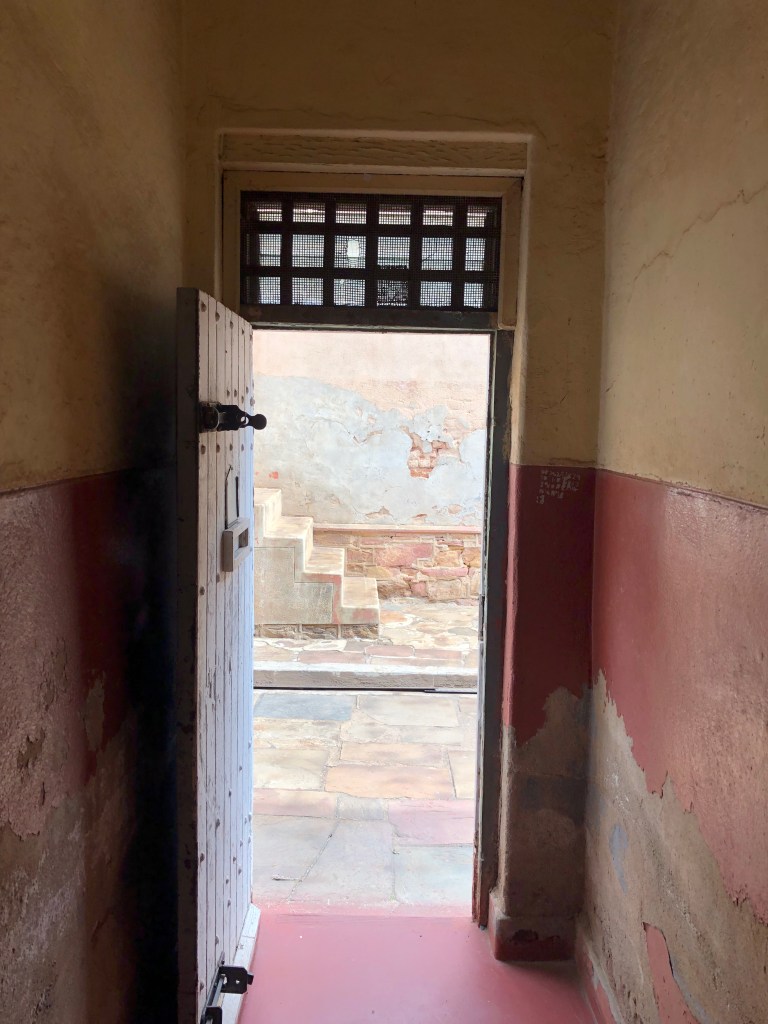
We had the privilege of visiting the South African Constitutional Court, possibly the most important national court as regards the justiciability of socio-economic rights globally. The building is full of symbolism appealing to values of transparency, culture and accessibility of justice. It is built on top of the remains of a brutal prison of the apartheid regime. Gandhi and Mandela spent time there. The location is a powerful message about learning from the past to build a more promising future founded on the principles of the rule of law and human rights.
From the cells in the prison on Constitution Hill, where the Constitutional Court is located.
The occasion was also an opportunity to express solidarity with theOgiek indigenous people in Kenya. Some of the community leaders were present at the workshop. Despite several rulings from the African Commission on Human and Peoples’ Rights, the Ogiek have suffered repeatedly violations of their human rights, including further evictions from their ancestral land.
An action in solidarity with the Ogiek people of Kenya, who have suffered multiple evictions and other human rights violations, as documented by the African Commission and Court of Human and Peoples’ Rights.
At the event, I talked about the UN Committee on Economic, Social and Cultural Rights (CESCR) as a venue for strategic litigation on housing rights in Spain. The Optional Protocol on Economic, Social and Cultural Rights was adopted in 2008 and entered into force in 2013. It allows individuals to lodge complaints in front of the CESCR against States Parties for violations of socio-economic rights. To this day, 26 countries have ratified this treaty. Spain was the third country to do so, the first one in Europe.
More than 90% of CESCR decisions concern Spain, and the vast majority of them are about the right to adequate housing. One of the most significant cases is Ben Djazia and Bellili v Spain (2017), where the CESCR made two big contributions to international human rights law: firstly, it established that the proportionality test applies to the private rental sector as well as the public one; and secondly, it ruled that the State had breached the principle of non-retrogression because in the background of the eviction there had been a large-scale sale of some 4,000 social housing units by regional authorities in Madrid to transnational real estate investment trusts.
Dr. Casla presented the Ben Djazia case at the workshop
Since 2019, Spain’s legislation has been amended several times, and some of those amendments have brought to life some of the recommendations of the CESCR. Not all recommendations have been taken onboard yet; in particular, the issues of progressive realisation and the adoption of a national plan have not been given due consideration.
However, judges are now given the opportunity to look at personal circumstances (while not obliged to do so), and there is an expectation of coordination between the judiciary and social services before an eviction is executed (but not a specific timeframe or duties on public authorities). Housing laws at regional as well as central/national levels have created additional duties for large landlords over small landlords, which the CESCR considers part of the proportionality test (López Albán v Spain, 2019).
The experience of strategic litigation on housing rights in Spain has taught us some valuable lessons.
Firstly, sometimes human rights progress comes from non-human rights litigation. In the case of Spain, the first major court victory was the Aziz case (2013), where the Court of Justice of the European Union ruled that foreclosure procedures must give judges the chance to look for potential unfair terms in the contract, opening the door to a kind of proportionality test. This ruling was based on consumer law (EU 1993 Directive), not human rights law.
Secondly, recent legal developments in Spain are a reminder that parliaments can play a central role in the implementation of international human rights rulings. After all, hardly anything can beat securing a majority in parliament for human rights-friendly legislation.
Thirdly, recent developments also show that in federal or quasi-federal countries, regions can indeed learn from each other in a sort of laboratory for democracy. As I show in Chapter 5 of Spain and Its Achilles Heels, I would argue that this is precisely what happened between several of Spain’s regional legislative chambers between 2013 and 2017.
Finally, we must not make perfect the enemy of the good. Not all of the CESCR recommendations have been implemented in Spain. The situation is far from perfect. Even those that have been implemented have been implemented only to some extent. However, in the spirit of joyful advocacy, it is important to celebrate victories when they occur, including partial victories, even if we do not achieve everything we may hope for.
The UK’s Supreme Court on Parliament Square, Westminster
The UK’s long-delayed and controversial proposal to deport asylum-seekers to the central African state of Rwanda was rejected by the Supreme Court on Wednesday 15 November 2023.
The Supreme Court unanimously dismissed the Home Secretary’s appeal and upheld the Court of Appeal’s earlier conclusion that “the Rwanda policy is unlawful”. This is because there are substantial grounds for believing that asylum seekers would face a real risk of ill-treatment by reason of refoulement to their country of origin if they were removed to Rwanda. Lord Reed and Lord Lloyd-Jones gave a joint judgment with which the other members of the Court agreed.
The Supreme Court cited evidence by the UN refugee agency indicating Rwanda’s lack of adherence to the non-refoulement principle and raised doubts about the Rwandan authorities’ fairness of asylum claim assessments and human rights violations.
The Court made it clear that it was “not concerned with and should not be regarded as supporting or opposing any aspect of the political debate surrounding the policy”. However, its decision deals a blow to the government’s pledge to “stop the boats”, and with the Rwanda plan being at the centre of the recently passed Illegal Migration Act, a reassessment of asylum policies seems inevitable now.
In October 2022, the House of Lords International Agreements Committee published its 7th Report of Session 2022–23 on its inquiry into the Memorandum of Understanding (MoU) between the UK government and the government of the Republic of Rwanda for the provision of an Asylum Partnership Arrangement, citing written evidence submitted by Professor Theodore Konstadinides and Dr Anastasia Karatzia of the Essex Law School.
Prof. Konstadinides and Dr. Karatzia had questioned whether an MoU is an appropriate vehicle for the relocation of asylum seekers deemed to have arrived illegally in the UK, “especially given: (a) the implications it has for individual rights, and (b) the assurances and safeguards included in the MoU, particularly those relating to inspection and monitoring, a relocated individuals’ access to legal assistance, and data protection which give rise to legitimate expectations as to the other party’s conduct.”
The Research Visibility Team interviewed Prof. Konstadinides, co-director of the Constitutional and Administrative Justice Initiative (Essex CAJI) and academic lead for Public Law, to find out more about the Supreme Court’s ruling and its implications.
The Supreme Court’s ruling emphasised serious flaws in Rwanda’s asylum procedures. Could you elaborate on these shortcomings that led the court to determine it wasn’t a safe option for asylum seekers?
Removals to Rwanda, a practice established by the Home Secretary’s immigration rules, were held to be unlawful by the Supreme Court because of substantial evidence, including over 100 examples from the UN Refugee Agency, regarding Rwanda’s inadequate system of processing asylum claims. Rwanda’s poor human rights record and the lack of guarantees that upon arrival to Rwanda asylum seekers would have their claims properly examined by the respective authorities could result to further removal and repatriation where they would face a real risk of ill-treatment. The Supreme Court took this possibility very seriously despite the Home Secretary’s reassurance that Rwanda entered the deal in good faith.
There is a legal rule, or prohibition if you may, that refugees must not be returned to their countries of origin if their life or freedom will be under threat. This principle is known as ‘non-refoulement’ and it is a core principle of international law. Our colleague Prof. Geoff Gilbert is an expert in international refugee law and could tell you more about it. Suffice to say for now that asylum seekers are protected against refoulement by several international treaties to which the UK is a party including the UN Refugee Convention, the UN Convention against Torture and the European Convention on Human Rights (ECHR). As Lord Reid emphasised it is not, therefore, only the ECHR which is triggered here regarding the returning of asylum seekers in their country of origin without proper examination of their claims. The obligations under these international treaties are also reflected in our statute book for some time now, see for instance, the Asylum and Immigration Appeals Act (1993); the Nationality, Immigration and Asylum Act (2002) and, last but not least, the Human Rights Act (1998).
This explains in a way why the Supreme Court was unanimous that, once there are substantial grounds for believing that asylum seekers who are sent to Rwanda will be at real risk of ill-treatment or refoulment, there is only one way to decide this case.
The government is considering emergency legislation to declare Rwanda a safe country for asylum seekers, bypassing the Supreme Court’s judgment. What legal and political challenges might arise from such a move, and how could it impact the ongoing debate within the Conservative Party on issues like leaving the European Convention on Human Rights?
The government will try to negotiate changes and inject extra safeguards to the Rwanda deal. Of course, a revised or renewed deal cannot stop fresh litigation, especially challenges against the decisions of the Home Secretary made in light of such deal. Following the Court’s decision on the 16th of November, the Prime Minister expressed the will to use Parliament as a vehicle to reverse the Supreme Court’s unanimous decision.
If Parliament were to pass such legislation that would override the ECHR and the HRA (which gives the ECHR domestic effect) in relation to non-refoulment claims that would be the law of the land due to Parliamentary Sovereignty. But that would not be the end of the matter as far as international law is concerned: the government’s policy could still be in breach of international law. Also, as Lord Reid emphasised, the ECHR and the HRA are not the only relevant pieces of international and national legislation that protect asylum seekers from refoulment.
This takes us to your question about leaving the ECHR altogether, getting Parliament to repeal the HRA and either resuscitating Dominic Raab’s Bill of Rights Bill or relying on a combination of rights under the common law and statute and other international obligations that have found their way into our statute book. I don’t personally think it is a good idea to establish a record of treaty withdrawal every time we are unhappy with the outcomes that international law produces, although I worry that leaving the ECHR will become part of a future Tory Manifesto that has been flirting for some years now with the idea of repealing the HRA or “updating” it.
Unfortunately, this government has been too ready in its rhetoric to breach international law, albeit ina specific and limited way which is worrying in terms of the rule of law which requires compliance by the state with its obligations in both national law and international law.
Given the ruling on the Rwanda plan and its implications for the UK’s asylum policy, what do you foresee as potential avenues for the government to reconsider its approach? Could the quest for a new safe third country lead to similar legal challenges, and how might this affect the broader discourse on asylum processing in the UK and globally?
A new Bill that will, according to Suella Braverman’s response on X (formerly Twitter), “block off ECHR, HRA and other routes of legal challenge” is a legal fiction. As Prof. Mark Elliott (University of Cambridge) responded to her post, domestic legislation cannot just “block off” the ECHR, which the UK will still be obliged in international law to comply with for as long as it remains a member of the Council of Europe. Prior to legislation, a new treaty with Rwanda or another safe third country is possible, however. The Supreme Court, and the Court of Appeal before it, said explicitly that if there are no grounds for believing that asylum seekers who are sent to Rwanda or a third state for that matter will be at real risk of ill-treatment then the policy is sound and lawful.
The current memorandum of understanding between the UK and Rwanda provides some reassurance but being an expression of political will and not legally binding, it cannot be relied upon by asylum seekers. A treaty, however, can better protect such commitments, something that I initially argued with Dr. Anastasia Karatzia in our evidence to the International Agreements Committee of the House of Lords that got cited in the end. Following the judgment yesterday, the UK’s Prime Minister publicly stated that his government has been working on “a new international treaty with Rwanda” which will push to “ratify without delay” in Parliament and “will provide a guarantee in law that those who are relocated from the UK to Rwanda will be protected against removal from Rwanda”.
Some people, including myself, will still find this solution to the issue disappointing given Rwanda’s poor track record of human rights protection, judicial independence, and lack of adherence to the terms of similar agreements with other countries in the past, especially on non-refoulment of asylum seekers. However, yesterday’s judgment is a small legal victory insofar as the rule of law is concerned.
Unlike the initial memorandum that the government signed with Rwanda, a treaty will be subject to Parliament’s statutory role in scrutinising treaties as set out in the Constitutional Reform and Governance Act 2010. In the grand scheme of things, this may look like a small step. But let me remind readers that the UK-Rwanda memorandum was only published when it became operational on signature which left no space for any type of review or revisions by Parliament.
If the House of Commons passes a resolution opposing the ratification of a new UK-Rwanda treaty, it triggers an extra 21-day delay, preventing the government from proceeding with the ratification during this time. However, there is a catch: a minister has the authority to ratify a treaty without following this process, but this option becomes void if either House passes a negative resolution. Essentially, this represents a modest legal triumph.
On Thursday 14 December 2023, Dr. Edward Mitchell will deliver a lecture as part of the flagship Current Legal Problems lecture series, hosted by University College London’s Faculty of Laws.
Dr. Mitchell’s contribution to the lecture series and the accompanying volume will address the role of contract in contemporary town planning processes. Dr. Mitchell will argue that contract has the potential to work in town planning practice to offer administrative efficiency and secure binding commitments from landowners and developers. However, he will also explain that, while contract mechanisms often contribute to the successful performance of planning processes, there are significant gaps in the existing practice.
Interested readers can find more details about Dr Mitchell’s contribution to the lecture series, including booking details, on the Current Legal Problems website.
The Essex Law School Research Visibility Team had the opportunity to interview Dr. Mitchell about his research and his forthcoming contribution to the Current Legal Problems lecture series.
Could you explain, in simple terms, the role of section 106 agreements in the development of land and how they affect residential property development in England?
Certainly, section 106 agreements play a crucial role in shaping residential property development in England. Section 106 agreements are a type of contract used in town planning processes. Local authorities and property developers negotiate these contracts when a developer applies for permission to carry out a property development project. In the context of residential property development, these section 106 agreements operate as a set of contractual rules designed to regulate what developers do when they’re building new housing projects.
Let’s say that a property developer has purchased some land on the edge of Colchester and wants to construct 100 new homes on that land. That developer can’t start building those homes unless it has obtained permission to do so from Colchester City Council. Of course, a development of 100 new homes will increase demand for school places and healthcare services in the local area, as well as placing pressures on transport networks and existing open spaces. Consequently, Colchester City Council will probably not grant planning permission unless the developer agrees to provide or fund improvements to local infrastructure.
The purpose of creating section 106 agreements often relates to this infrastructure provision. These agreements should ensure that new developments benefit local communities in some way and do not place excessive pressure on local infrastructure, like schools, hospitals, transport networks, and so on.
Section 106 agreements seem to play an essential role in shaping the built environment. Could you provide one or two examples of how these agreements impact the places where people live?
There are lots of possible examples! Local authorities and property developers negotiate these agreements for most types of property development activity. For a large project with 1,000 new homes, a local authority may expect a developer to allocate 30% of these homes as ‘affordable’ housing, create substantial public open spaces, provide a site for, and fund the construction of, a new primary school and a community building, and to fund improvements to both the local transport network and local healthcare provision.
On the other hand, for a smaller development of around 15 new homes, a local authority might expect a developer to provide just 4 or 5 affordable homes, a small amount of public open space and a small financial contribution to a community resource (like a contribution to the maintenance of a village hall, or a local public swimming pool).
In other words, for developments big, small and somewhere in between, local authorities seek to use section 106 agreements to secure the delivery of these community benefits. Local authorities and property developers usually work out the details of these community benefits in section 106 agreements, which allows for a negotiated arrangement between the developer and the local authority.
In your research, you mention that the existing methods for affordable housing delivery in England cause instability and tension. Could you explain how these methods operate?
My research took place in the context of an acute shortage of safe, warm and genuinely affordable homes in England.
The Government defines ‘affordable housing’ as residential properties provided to occupants at below-market value, either through discounted sales or discounted rents. Current Government policy requires local authorities to set rules outlining the amount of affordable housing that developers should provide in new housing projects. Local authorities then use section 106 agreements in an attempt to secure the delivery of this affordable housing.
You examine the power dynamics visible in these section 106 agreements. Can you elaborate on how these dynamics influence the outcomes of affordable housing delivery?
My research argues that there is a one-sided power dynamic running through some section 106 agreements. I argue that this dynamic enables property developers to exercise significant control over affordable housing delivery, exacerbating pre-existing problems relating to a shortage of warm, safe and genuinely affordable homes.
This lopsided power dynamic arises because current affordable housing policy relies upon developers providing this affordable housing alongside private market housing in the projects they build. This affordable housing delivery method depends, therefore, on a developer being able to project a profit from a development project. If a developer concludes that providing affordable housing would undermine a project’s profitability, that developer might seek to negotiate a reduction in its affordable housing obligations before signing a section 106 agreement with a local authority.
These negotiations often lead to the creation of highly complex contractual arrangements in section 106 agreements. Moreover, and as noted in various mainstreammedia outlets, there is evidence suggesting that some developers have sought to manipulate these negotiations to secure significant reductions in the amount of affordable housing that local authorities expect them to deliver.
I argue that these outcomes are an inevitable product of a tendency to prioritise private profit-making over public housing need in current policy relating to affordable housing delivery.
Image via Unsplash
You mentioned the complexity of the contractual arrangements governing affordable housing delivery. Can you share some specific examples of these complexities and how they affect ordinary people’s lives?
I’m interested in the way that any given section 106 agreement can appear to commit a particular property developer to a very specific course of action. For example, a local authority that receives an application from a developer for permission to build 100 new homes might agree to grant planning permission to that developer if that developer promises to provide 30 of those homes as ‘affordable’ housing. This might then lead to the creation of a series of complex clauses in a section 106 agreement, stipulating the deadline by which the developer must provide those affordable homes, and giving the local authority a right to enforce that commitment if the developer fails to fulfil it.
However, my research shows that the ostensibly prescriptive clauses in section 106 agreements relating to affordable housing can sometimes operate as part of a wider and sometimes hidden network of flexible contractual arrangements. My research offers a case study of three inter-linked development projects that illustrates how an intricate network of contractual arrangements can empower developers to choose not just when but also where and how they fulfil their public policy obligations.
Of course, it shouldn’t surprise us that, when local authorities rely on property developers to provide affordable housing, those developers will seek to create outcomes that are favourable to them. But my research provides new perspectives on opportunism and the pursuit of control in town planning processes and shows how developers can create flexibility even amidst highly formal contractual behaviour.
This affects ordinary people’s lives because it disrupts the equitable supply of safe, warm and genuinely affordable housing in our communities.
The government proposes to reform the existing system of developer contributions to the provision of affordable housing and other types of infrastructure in England. Is this reform welcome and could you elaborate on how this change might impact the contractual arrangements in section 106 agreements for affordable housing development?
In its 2020 White Paper, Planning for the Future, the Government proposed to reduce the role of section 106 agreements in town planning processes by implementing a new ‘Infrastructure Levy’. This new Infrastructure Levy will be a mandatory, nationally set land value-based flat rate charge that developers will pay to local authorities during the property development process. The Government has since taken these proposals forward in the Levelling-Up and Regeneration Act 2023, which received Royal Assent on 26 October 2023. The 2023 Act empowers the Secretary of State for Levelling Up, Housing and Communities to make regulations to facilitate the implementation of this levy. While the Secretary of State has not yet exercised this power, the prospect of doing so is an important legislative development.
The Government’s proposals envisage that local authorities will use the proceeds that the levy generates to fund the provision of affordable housing and other types of infrastructure that is needed in their communities. The idea is that this will improve the speed of town planning decision-making and provide both greater certainty and simplicity in town planning processes by removing the scope for negotiation that currently exists in affordable housing delivery.
Some reform of the current system for securing affordable housing does seem necessary given the current shortfall in provision. Research commissioned by the Government suggests that, in some property development settings, the Government’s proposals might generate greater developer contributions to local infrastructure provision and alleviate some of the complex and time-consuming negotiations that the current system causes. However, other town planning stakeholders question whether this proposal will either simplify town planning processes or provide more funding for affordable housing provision.
Moreover, the Government has acknowledged that section 106 agreements will still play an important role in securing developer contributions to community infrastructure needs. I’m interested in exploring this further in my next research project by looking beyond affordable housing to examine the other developer commitments commonly incorporated into section 106 agreements. If there is still a role for section 106 agreements, we need a better understanding of the way the current system operates. I think that we need to get inside the text of section 106 agreements to understand the possibilities that they enable and the problems that they create. By doing this, I think we’ll know more about the appropriateness of the use of contract to secure the delivery of vital public services.
A new research project has been funded by the British Academy which will explore the voice of the child in private family law cases concerning allegations of child sexual abuse (‘CSA’). The aim is to draw on first-hand insights into the experience of children who had disclosed CSA during or in relation to private family court proceedings.
The project fills a gap by aiming to directly hear the voice of the child in family proceedings through narrative interviews. It will contribute to the evidence base regarding experiences of, and reform to, the family courts.
This project draws upon a workshop held at the University of Essex School of Law in March 2021 with ESRC Impact Acceleration Account funding, which explored the voice of the child in private family law cases concerning allegations of CSA. This workshop highlighted the need for further research to obtain first-hand accounts of children’s experiences of the family court – accounts that are notably absent from the existing evidence base.
This research into the family courts is important now, at a time when there have been several concerns raised about the family courts’ response to domestic and sexual abuse allegations in private law cases. For example, a recent report by the University of Manchester, in conjunction with SHERA Research Group, found that women suffered ‘serious health problems … as a result … of biased family court proceedings.’ Relatedly, the Ministry of Justice in their published report ‘Assessing Risk of Harm to Children and Parents in Private Law Children Cases’ highlighted that ‘the voices of children experiencing domestic abuse and child sexual abuse are not sufficiently heard by the family courts’ (MoJ, 40). The Ministry of Justice report further noted that there are many reasons why victim-survivors of sexual abuse might have negative experiences. These may include the lack of resources, the way that the court works in a ‘silo’, lacking coordination with other organisations, and the adversarial approach of the court system which focuses on investigation rather than supporting survivors.
We know from evidence in other areas that victim-survivors of sexual abuse often recount sentiments of being silenced, misunderstood, or negatively judged, and often feel a sense of re-traumatisation from their courtroom experiences (Rape Crisis, 2023). The adversarial layout of court proceedings can sometimes exacerbate negative experiences, despite it being possible to make adjustments within the court system, such as allowing victims to give evidence through video links or behind screens.
The 2021 workshop, referred to above, demonstrated a need for research to facilitate the direct voice of child victim-survivors and to explore whether there is a need for reform in the law or court processes, shifting towards a child-centred approach to hearing the voice of the child where CSA allegations are raised in family courts.
Given the absence of evidence from children who have experienced family court processes, this research aims to record, through narrative interviews, the voices of those who experienced the family court as children and give them an opportunity to tell their stories directly through the research.
Contact details
If you would like to know more about this planned research or would like to be kept informed as the research progresses, please contact the Project Lead, Dr Jaime Lindsey at j.lindsey@reading.ac.uk or Co-Investigator Dr Samantha Davey at smdave@essex.ac.uk.
Essex legal expert Lorna Woods has earned special recognition in the House of Lords thanks to her research and work supporting the landmark Online Safety Bill. The Bill successfully passed through Parliament and is now enshrined into law, having received Royal Assent on Wednesday 26 October 2023. The Act makes social media companies keep the internet safe for children and give adults more choice over what they see online.
Professor Woods has helped influence the bill after famously writing some of its founding principles on the back of a sandwich packet with the help of William Perrin, of the charity Carnegie UK, several years ago.
Professor Woods has continued to work with Carnegie throughout the last few years and provided expert advice to backbenchers and members of the House of Lords.
She was personally thanked following the final debate in the Lords by Lord Stevenson for her work on the bill.
Lord Clement-Jones added: “I pay my own tribute to Carnegie UK, especially Will Perrin, Maeve Walsh and Professor Lorna Woods, for having the vision five years ago as to what was possible around the construction of a duty of care and for being by our side throughout the creation of this bill.”
Professor Woods has become a high-profile commentator on the bill throughout its passage on Parliament, and recently recounted the “surreal moment “it was approved by the Lords in an interview with the BBC Online.
In a separate interview with Wired, Professor Woods responded to criticisms of the bill by insisting it would help protect the human rights of children being exploited and abused online.
She was also quoted in the New York Times’ own coverage of the Bill, and has also appeared on BBC Radio Five Live.
Professor Woods said: “The Bill is significant as it marks a move from self-regulation – where service providers decide what is safe design and whether to enforce their community standards – to regulation under which services are accountable for those choices.”
This story was first published on the University of Essex’s news webpages and is reproduced on the ELR Blog with permission and thanks. The story was edited to reflect the fact that the Bill received Royal Assent.















 Essex Law Research Blog